Success for Selangor SMEs hinges on effective SEO. Use these 10 critical, E-E-A-T based questions to vet potential SEO consultants, avoid Black Hat scams, and ensure sustainable, local growth.
Why SME Owners Cannot Afford to Guess
For Small and Medium Enterprises (SMEs), achieving sustainable digital visibility is not merely advantageous—it is essential for long-term survival and growth. Organic search optimization (SEO) represents one of the most cost-effective marketing channels available, driving targeted traffic and sales without the continuous, expensive investment required by paid advertising. Effective SEO Marketing serves as the foundation for building brand trust and capturing demand in a competitive digital landscape.
However, the process of hiring a third-party SEO professional is fraught with potential pitfalls. The industry contains reputable experts, but also numerous practitioners who rely on outdated methods, make unrealistic promises, or outright scam clients. Choosing the wrong partner results in wasted capital, severe opportunity costs, and potentially devastating ranking penalties imposed by search engines.
To mitigate these risks, SME owners must adopt a rigorous vetting process. This report utilizes Google’s core quality guidelines—Experience, Expertise, Authoritativeness, and Trustworthiness (E-E-A-T)—as the fundamental standard for assessment. By framing the hiring process around E-E-A-T, business owners can move beyond surface-level claims and diligently assess a prospective SEO Consultant‘s verifiable experience and expertise, transforming the selection into an exercise in high-stakes risk management.
The Cardinal Rule: Recognizing the Guaranteed Ranking Trap
The first and most critical step in vetting any potential partner is recognizing and immediately rejecting the single largest red flag in the industry: the guarantee of a specific, high ranking, such as “#1 on Google”.
Since Google maintains absolute control over its proprietary ranking algorithms, no ethical or knowledgeable consultant can legitimately guarantee a specific ranking position. Such a promise is an indicator that the consultant is prioritizing the quick extraction of fees over sustainable, white-hat growth.
Red Flags SME Owners Must Recognize: Promises of Instant #1 Rankings
Consultants who promise immediate or guaranteed rankings are often relying on short-term, unsustainable Black Hat tactics. This strategy is designed to manipulate search results quickly to secure the client’s upfront payment, with the consultant knowing the artificial results will inevitably collapse.
An ethical consultant’s primary value proposition is not speed, but protection against systemic risk. While SME owners often feel an urgency to achieve rapid results, the consultant offering guaranteed rankings exploits this need for immediate success. Black Hat methods, such as keyword stuffing, creating link farms, or buying low-quality backlinks, expose the website to catastrophic penalties that can wipe out years of brand building and organic visibility. The risk-reward imbalance dictates that slow, ethical growth, which typically requires a commitment of three to six months to show significant results, is the only path toward achieving positive, long-term ROI and fulfilling Google’s trust requirements.
Spotting Unethical Black Hat Tactics
Beyond ranking guarantees, SME owners must be vigilant about specific unethical practices:
Vague Strategy: A major warning sign is when a consultant offers an overly technical or vague plan without clearly defining actionable, step-by-step processes. Reputable professionals clearly explain how they will work, what steps they will take, and why those steps align with ethical guidelines and business objectives.
The Link Buying Promise: The promise to immediately secure hundreds of links without detailing the source or quality is a clear indication of a violation of Google’s guidelines. Ethical link building involves a strenuous process of manual outreach and earning high-quality backlinks based on the genuine value and relevance of the client’s content.
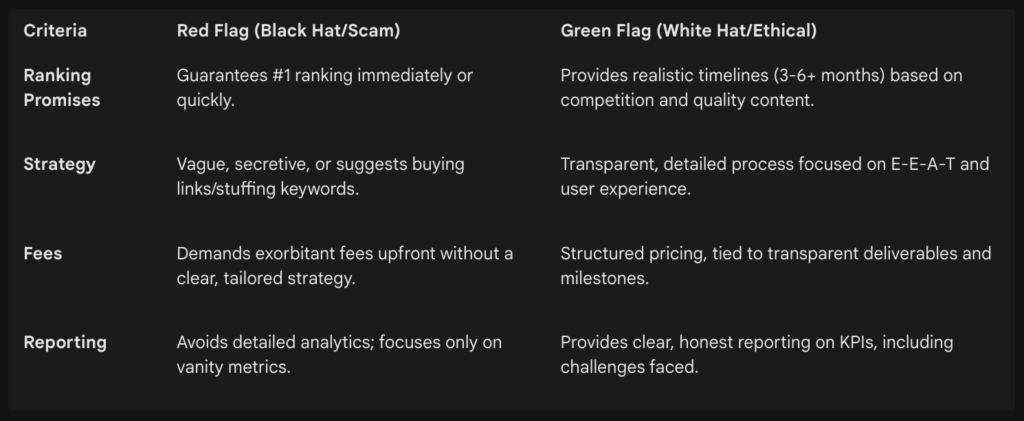
The differences between ethical and unethical practices can be summarized in the following table, which serves as a checklist for the initial vetting process:
Table 1: Black Hat vs. White Hat: Spotting the Warning Signs
The 10 Essential Questions for Your SEO Consultation
These ten questions form the core of a professional SEO Consultation, ensuring the potential partner is technically competent, ethically sound, and aligned with measurable business objectives.
Group A: Strategy and Goals Alignment (Questions 1–4)
Q1: How do you specifically align SEO results with my business’s ROI and KPIs?
This question assesses a consultant’s financial accountability. An expert should define success using measurable business objectives, not just raw traffic numbers. For an SME, success is defined by increased profitability and revenue, not by high rankings alone. The expected answer should transition from basic metrics like “traffic” to actionable goals such as, “We aim to increase qualified organic leads by 30% in six months,” which directly impacts the sales pipeline.
The error occurs when businesses rely on simple, forced translation. Expert SEO Consultant Selangor strategies instead utilize transcreation, which involves adapting content to naturally blend languages, mirroring how Malaysians actually search. This strategic blending—such as “Our kedai runcit in Petaling Jaya offers kaw kaw and same-day pickup”—enhances both local context (kedai runcit) and semantic relevance to the search engine, driving improved ranking and engagement.
Businesses that maintain an English-only focus create a critical conversion gap. By failing to target high-intent Malay terms, they miss capturing users further down the sales funnel. By reflecting the user’s true search language and local phrasing, the website demonstrates superior relevance and Expertise, leading directly to higher conversion rates.
Q2: What is the process and methodology behind your initial technical audit?
Before any visible growth can occur, the website foundation must be structurally sound. A professional consultant must demonstrate a systematic approach to fixing foundational issues, ensuring that the site is ready to be crawled and indexed efficiently. The audit process must include checks on critical elements like Core Web Vitals (page speed), mobile usability, site structure, and canonicalization issues, with a clear justification for why specific fixes are prioritized. Technical competence in these areas dictates the success of all subsequent content and link building efforts.
Q3: How do you develop a content strategy that demonstrates E-E-A-T?
This evaluates a consultant’s commitment to quality and authority in the face of evolving search requirements. The consultant must show an understanding of Google’s increasing emphasis on expertise, particularly in competitive or sensitive sectors. The highest demonstration of expertise lies in the ability to utilize the SME owner’s unique, internal knowledge. The modern consultant acts as a knowledge extractor, structuring the client’s internal expertise into high-quality, authoritative content that satisfies user intent better than competitors. If the consultant does not plan to work closely with internal subject matter experts (SMEs) to gather unique insights and verifiable experience, the resulting content will likely remain shallow and fail to achieve high E-E-A-T standards.
Q4: Given our location, what is your approach to Local SEO in Selangor?
For Malaysian SMEs, particularly those seeking an SEO Consultant Selangor, local search is often paramount. The answer must go beyond generic advice and show specialized knowledge of the regional competitive landscape. Key expectations include proficiency in optimizing the Google Business Profile (GBP) to capture local “near me” searches, robust citation building, reputation management through local reviews, and understanding the multilingual needs (keyword optimization in both English and Bahasa Malaysia) specific to the Klang Valley region.
Group B: Execution and Modern Competence
Q5: What is your ethical (White Hat) strategy for building authoritative backlinks?
Link building is the component of SEO most frequently associated with Black Hat risk. The strategy must be transparent and safe. The expected answer should vehemently reject purchasing links. Instead, strategies must center on earning links through generating valuable, high-quality content, content promotion, manual outreach to niche-relevant sites, and digital public relations (PR)—focusing exclusively on quality links from trusted sources rather than mere quantity.
Q6: How do you adapt strategy for emerging AI indexing and LLM platforms?
This question separates forward-thinking consultants from those adhering to obsolete methodologies. Successful adaptation requires optimizing content not just for traditional search ranking, but for effective consumption by generative AI systems, such as Google’s AI Overviews and other large language models (LLMs). This involves robust implementation of schema markup, the creation of clear topical clusters, and ensuring content delivers a depth of unique, expert value that AI cannot simply regurgitate from competitors. If the content is superficial, AI systems will summarize it, often eliminating the need for the user to click the organic search result. Conversely, if the content is highly structured, expert-driven, and answers complex queries comprehensively, the site is more likely to be featured by the AI as an authority source, ensuring qualified traffic.
Q7: What specific tools and analytics platforms do you use for research and tracking?
Professional SEO experts invest in industry-standard software to ensure accurate data collection and analysis. The consultant should provide a list of professional platforms (e.g., GA4, Search Console, Ahrefs, SEMrush) and, critically, explain how the output from these tools will be used to measure progress against the defined business KPIs (Q1). Any vague references to proprietary or unproven software should be treated as a major warning sign regarding operational transparency and data validity.
Group C: Ethics, Transparency, and Partnership
Q8: Can you provide case studies from similar SME clients, and what were the measurable results?
Verifiable experience is non-negotiable. Requesting case studies from comparable industries or business sizes allows the SME owner to gauge the consultant’s ability to handle similar market challenges. A strong case study must detail the client’s background and goals, the specific White Hat strategy deployed (e.g., technical SEO, content roadmap), and measurable, objective outcomes, such as before-and-after organic traffic metrics or quantifiable conversion rate increases, proving real business impact.
Q9: What is the realistic timeline for seeing significant organic traffic growth?
Setting realistic expectations is a fundamental requirement of ethical practice. Since search engine optimization relies on external factors and algorithm processing, consistent White Hat SEO Marketing efforts typically show noticeable, significant results in the range of 3 to 6 months, though this timeframe is highly dependent on existing domain authority and market competitiveness. A consultant should be prepared to openly discuss potential factors that might accelerate or lengthen this timeline, avoiding any implication of instant success.
Q10: How do you ensure complete transparency in reporting, progress, and methodology?
Transparency is the foundation of long-term trust and the cornerstone of E-E-A-T. True transparency involves more than simply sending a report; it requires educating the client, using clear language to explain technical activities, and encouraging open dialogue. If a consultant consistently relies on complex jargon without translating it into terms of business impact (e.g., explaining “improving crawlability means Google can now find 20 more of your key product pages”), they may be intentionally keeping the client uninformed and reliant. An ethical partner prioritizes client education, ensuring the relationship is based on mutual understanding and accountability.
Green Flags: The Hallmarks of a Trustworthy SEO Consultant Selangor
Beyond simply avoiding red flags, SME owners should look actively for indicators of a strong, ethical partner. These “green flags” confirm commitment to E-E-A-T and long-term partnership.
Ready to Transform Your SEO Marketing Strategy?
Choosing the right SEO Consultant Selangor is the single most pivotal decision you will make in your company’s digital growth journey. By prioritizing the ten critical questions presented here—focused unwaveringly on E-E-A-T, operational transparency, and financial ROI—SME owners can minimize risk and secure a long-term, ethical partnership that delivers lasting results.
Stop relying on empty guarantees and start investing in sustainable, expert SEO Marketing. Schedule a foundational SEO Consultation today to receive a transparent audit and a clear, customized strategy built on decades of ethical experience.