Choosing between an SEO consultant and a digital marketing agency is often a choice between an architect and a builder. In this guide for Malaysian SMEs, we dissect the critical differences between the two roles in the era of AI search. Discover when you need the strategic vision of a consultant versus the scalable execution of an agency—and why the best approach might be a synergy of both.
The Digital Crossroads for Malaysian SMEs in 2026
The Malaysian digital economy has undergone a seismic transformation over the last decade. By 2026, we have moved beyond the simple digitization of business processes into an era of intelligent, algorithmic commerce. For Small and Medium Enterprises (SMEs) in Selangor and across the peninsula, the stakes have never been higher. The government’s MADANI economy framework and the relentless push by agencies like the Malaysia Digital Economy Corporation (MDEC) and the Selangor Information Technology and Digital Economy Corporation (SIDEC) have created a fertile ground for digital adoption. Yet, a paradox remains: while access to technology has democratized, the complexity of achieving visibility has skyrocketed.
As a white hat SEO specialist with twenty years of experience witnessing the evolution from keyword stuffing to the sophisticated, neural-network-driven algorithms of today, I have observed a recurring failure mode among ambitious SMEs. This failure does not stem from a lack of capital or intent; rather, it arises from a fundamental misunderstanding of the roles required to succeed in the modern search landscape. Business owners often view “SEO” (Search Engine Optimization) and “Digital Marketing” as interchangeable commodities, leading them to hire the wrong vehicle for their journey. They may hire a high-volume digital marketing agency when they desperately need strategic correction, or they engage a high-level consultant when they lack the internal resources to execute the basics.
The distinction is not merely semantic; it is functional and financial. In the current ecosystem, where Google is transitioning from a search engine to an “Answer Engine” via AI Overviews and Generative Engine Optimization (GEO), the separation of duties between strategy (the Consultant) and execution (the Agency) is the defining factor of success. This report serves as an exhaustive analysis of this dichotomy. We will dissect the nuances of SEO Marketing, explore the specific operational mechanics of SEO Consultation, and provide a detailed roadmap for Malaysian business owners to leverage both roles effectively. We will delve into the intricacies of the Selangor market, the pitfalls of “black hat” scams that plague the local industry, and the strategic utilization of government grants to fund your ascent to market leadership.
The SEO Consultant – The Strategic Architect
To understand the value of an SEO Consultant, one must first discard the notion that SEO is simply “fixing a website.” In 2026, a website is a living entity within a vast semantic web. The SEO Consultant acts as the strategic architect of this entity. They are not the bricklayers; they are the master planners who understand the physics of the environment (the search algorithms) and design the structure to withstand them.
Providing Direction and Vision: The "Why" Before the "How"
The primary mandate of an SEO Consultant is to provide direction. This role is rooted in diagnosis, prognosis, and prescription. An SME owner in the manufacturing sector of Selangor might approach a consultant with a desire to “rank for ‘packaging’.” A digital marketing agency might immediately begin buying ads or writing blog posts for that term. The consultant, however, pauses to ask the critical questions that define SEO Consultation:
Commercial Viability: Does ranking for “packaging” actually drive revenue, or is it a vanity metric? The consultant analyzes the search intent. If the searcher is looking for “packaging ideas for gifts” (B2C) and the client sells “industrial pallet wrapping machines” (B2B), the keyword is a waste of resources.
Competitive Landscape: The consultant evaluates the “Digital Moat” of competitors. If the top ranking sites are multi-national giants with millions in domain authority, the consultant pivots the strategy toward “Blue Ocean” keywords—specific, high-intent terms where the SME can dominate.
Algorithmic Risk: The consultant assesses the risk profile. Is the current site built on a technical foundation that Google hates? Are there toxic backlinks from a previous “cheap SEO” campaign? The consultant provides the vision for a clean, sustainable architecture.
This directive capacity is what distinguishes the consultant. They are paid for their insight, not their output. Their deliverable is a roadmap that ensures every ringgit spent on execution is driving the business toward a tangible commercial goal.
The Analysis of Keywords: Beyond Search Volume
While digital marketing agencies generate keyword lists, the SEO Consultant is the one that provides the direction and analyzes the keywords. This distinction is subtle but profound. Agency-level keyword research is often quantitative: “Here are 50 keywords with high search volume.” Consultant-level analysis is qualitative and strategic.
Intent Mapping and the Buyer Journey
The consultant maps keywords to the specific stages of the buyer’s journey. For a SaaS company in Kuala Lumpur, a user searching for “accounting software” is in the awareness phase. A user searching for “SST compliant cloud accounting for Malaysia SME” is in the decision phase. The consultant directs the content strategy to target the latter, knowing that while the volume is lower, the conversion rate (and revenue) is significantly higher.
Semantic Relevance and Entity Graphs
In the era of AI Search, keywords are no longer just strings of text; they are “entities” (concepts understood by the AI). The consultant analyzes the “Knowledge Graph” associated with the client’s niche. They identify the related entities—such as “LHDN,” “e-Invoicing,” and “Payroll”—that must be present in the content to signal topical authority to Google. The consultant directs the agency to include these semantic markers, ensuring the content is “machine-readable” for AI Overviews.
Content Analysis: The Pursuit of "Information Gain"
The consultant does not just request “more blog posts.” They analyze the content ecosystem.
Content Audit: The consultant reviews existing content to identify “cannibalization”—where multiple pages compete for the same keyword, confusing the search engine. They issue directives to merge, prune, or update these pages.
Information Gain: Google’s 2026 algorithms prioritize content that adds new information. The consultant analyzes the top-ranking results to find gaps. If every competitor has written a “Guide to SME Loans,” the consultant directs the creation of a “Calculator for SME Loan Eligibility in Selangor 2026.” This strategic pivot creates a unique asset that attracts natural backlinks, a core tenet of white hat SEO Marketing.
Reporting: Interpreting the Data Story
Agencies generate reports; consultants interpret them. The agency’s report might show a table of traffic numbers. The consultant looks at that table and sees a narrative.
Correlation vs. Causation: “Traffic dropped in May. Was it the Core Update, or was it the seasonal holiday?” The consultant uses forensic analysis to isolate variables.
Revenue Attribution: The consultant connects the SEO metrics to business KPIs. They analyze “Assisted Conversions” in Google Analytics 4 to show how an organic blog post read three months ago contributed to a closed sale today.
Strategic Pivots: Based on the report analysis, the consultant alters the course. “We are ranking #1 for ‘cheap services,’ but these leads are low quality. We will now shift the content tone to target ‘premium enterprise solutions’ to attract better clients.”
The Guardian of E-E-A-T
Perhaps the most critical role of the SEO Consultant in 2026 is safeguarding E-E-A-T (Experience, Expertise, Authoritativeness, and Trustworthiness). This is the metric by which Google determines if a site is a credible source of information, especially for “Your Money or Your Life” (YMYL) topics like finance, health, and law. The consultant audits the brand’s digital footprint. They direct the client to improve their “About Us” page, to secure author bios for their blog writers, and to obtain citations from reputable industry associations. They ensure that the digital signals match the real-world reputation of the business.
The Digital Marketing Agency – The Engine of Execution
If the SEO Consultant is the architect drafting the blueprints, the Digital Marketing Agency is the construction firm pouring the concrete. They are the engine of execution. Their value proposition lies in their capacity to carry out the action at scale, leveraging a diverse team of specialists to turn strategy into reality.
The Execution Mandate: Receiving Direction and Performing Action
The ideal workflow is hierarchical: the Digital Marketing agency receives the direction from the SEO Consultant and performs the action. Agencies are built for operational efficiency. They have established workflows, project management tools (like Asana or Monday.com), and specialized departments. When the consultant says, “We need a topic cluster on ‘Digital Grants’,” the agency mobilizes:
The Account Manager creates the timeline.
The SEO Specialist (Agency side) pulls the specific long-tail keywords.
The Content Team writes the articles.
The Web Team uploads and formats them.
The Outreach Team promotes them on social media.
This division of labor allows for speed. An SME owner or a solo consultant cannot physically write, edit, design, and publish 20 high-quality pages a month. An agency can.
Tactical Execution: The "How" in Detail
Keyword Research Implementation
While the consultant defines the strategy of keywords (e.g., “target transactional intent”), the agency performs the keywords research execution. They use tools like Ahrefs, SEMrush, or Ubersuggest to mine the data.
Volume Checking: They verify the exact search volume for “SEO services Selangor” vs “SEO agency Selangor.”
Variation Mining: They find all the permutations—”best SEO,” “affordable SEO,” “top rated SEO”—to ensure the copy captures all semantic variations.
Mapping: They create the spreadsheet that maps specific keywords to specific URLs, ensuring the site structure is logical and crawlable.
Content Copywriting and Production
Content production is the heartbeat of SEO Marketing. The agency’s role is to ensure that the content is produced to a professional standard and on schedule.
Writer Management: Agencies maintain a pool of writers with different specializations. If the client is in the medical field, they assign a writer with healthcare experience.
On-Page Optimization: The agency ensures that the copywriters follow the best practices defined by the consultant—using H2/H3 headers, keeping paragraphs short for mobile readability, and including the target keywords naturally.
Media Enrichment: The agency’s design team creates custom infographics or selects stock images to break up the text, improving “Time on Page” metrics which are crucial for ranking.
Generating Reports: The Data Collection
The agency is responsible for the mechanism of generating reports. They are the custodians of the data pipeline.
Setup: They configure Google Tag Manager (GTM) to track every interaction—form submissions, phone number clicks, PDF downloads.
Compilation: Each month, they compile this data into a digestible format. They track the rankings of hundreds of keywords. They monitor the backlink profile for new acquisitions.
Delivery: They ensure the report is delivered on time, providing the raw material that the business owner and the consultant need to make decisions.
The Multichannel Advantage
Agencies rarely do only SEO. They are “Digital Marketing” agencies for a reason. They offer a holistic execution capability that a solo consultant typically does not.
PPC Integration: While the SEO strategy ramps up (which can take 3-6 months), the agency can run Google Ads to generate immediate leads. They can share data between channels—using the high-converting keywords from the ads to inform the SEO content strategy.
Social Media Amplification: When the agency publishes a new SEO blog post, their social media team immediately shares it on LinkedIn, Facebook, and Instagram. This drives “social signals” and referral traffic, which can help index the content faster.
Email Marketing: The agency can repurpose the SEO content into newsletters, nurturing existing leads and keeping the brand top-of-mind.
Scalability and Reliability
For a growing SME, reliability is key. If a freelancer gets sick, the work stops. If a consultant is booked out, availability drops. An agency, however, has redundancy. If one writer leaves, another steps in. If the account manager goes on leave, a colleague covers the file. This ensures that the Marketing consultation plan is executed without interruption, a critical factor for maintaining momentum in competitive niches.
The Synergy Model – Integrating Architect and Builder
The false dichotomy often presented to business owners is “Consultant OR Agency.” In reality, the most robust digital presences are built on a “Consultant AND Agency” model, or a “Consultant guiding In-House Team” model. The complexity of the 2026 algorithm requires both deep expertise (Consultant) and high output (Agency/Team).
The "Architect-Builder" Workflow: A Case Study
Consider a hypothetical client, “Selangor Precision Engineering,” a B2B manufacturer facing stiff competition from China.
Phase 1: Diagnosis & Strategy (The Consultant)
Action: The SEO Consultant Selangor expert performs a forensic audit.
Finding: The website is technically sound but lacks content authority. The “Service” pages are thin (300 words). The site is invisible for “custom CNC machining,” a high-value term.
Direction: The consultant drafts a “Content Cluster Strategy.” They define the pillar page (“CNC Machining Services”) and 10 supporting cluster pages (“Aerospace Machining,” “Medical Device Components,” etc.). They specify the URL structure, the internal linking schema, and the required schema markup for “Industrial Product.”
Phase 2: The Brief (Consultant -> Agency)
Handoff: The consultant creates a detailed “Content Brief” for the agency. This document is not just a topic title; it includes the target word count, the secondary keywords, the required H2 headers, and the sources to reference for E-E-A-T.
Clarity: This eliminates the guesswork for the agency. They don’t have to wonder what to write; they just have to execute the vision.
Phase 3: Execution (The Agency)
Production: The agency assigns three writers to the project. They interview the client’s engineers to get technical details (facilitated by the agency account manager).
Drafting: They produce the 10 articles over two weeks.
Optimization: The agency’s SEO lead checks the keyword density and adds the meta tags.
Publishing: The web team uploads the content, formatting it with tables and images.
Phase 4: Review & Refine (The Consultant)
Quality Assurance: Before the site is indexed, the consultant reviews the live pages.
Correction: They notice the agency missed the internal links between the “Aerospace” page and the “Main Service” page. They direct a quick fix.
Validation: They test the schema markup using Google’s Rich Results Test tool to ensure the “Product” data is valid for AI indexing.
Phase 5: Reporting & Iteration (Joint)
Data: The agency provides the monthly report showing a spike in impressions.
Insight: The consultant presents this to the SME owner. “We are seeing a 40% increase in visibility for ‘Aerospace’. Next month, we will direct the agency to build backlinks from engineering directories to cement this position.”
Conflict Resolution: Strategy vs. Tactics
Occasionally, friction arises. The agency might say, “This strategy is too hard to execute within the budget.” The consultant’s role is to advocate for the client’s ROI. They might negotiate: “Okay, we will reduce the volume from 10 articles to 5, but we must maintain the depth and quality.” The consultant ensures the agency doesn’t cut corners that would hurt the long-term SEO Marketing goals.
The Financial Logic: Is it Expensive?
Hiring both seems costly. However, consider the cost of failure.
Scenario A (Agency Only): Client pays RM3,000/month for 12 months (RM36,000). The agency produces generic content that doesn’t rank. ROI: Negative.
Scenario B (Consultant Only): Client pays RM5,000 for a strategy. They try to write the content themselves but get busy. Nothing gets published. ROI: Negative.
Scenario C (Hybrid): Client pays Consultant RM5,000 (one-off or quarterly) + Agency RM2,500/month. The strategy is sound, the execution is consistent. Traffic grows, leads generate RM200,000 in revenue. ROI: Positive.
The consultant acts as an insurance policy for the agency spend, ensuring it is not wasted.
The Malaysian SME Context – Challenges, Scams, and Grants
Operating in the Malaysian digital ecosystem presents a unique set of variables that require local knowledge. A generic “global” SEO strategy often fails here due to specific market behaviors and infrastructural realities.
The "Digitalisation Gap" and Government Intervention
The Malaysian government has recognized that SMEs are the backbone of the economy but lag in digital adoption. To bridge this, massive incentives have been rolled out under the MADANI framework.
MDEC SME Digitalisation Grant: This is the flagship initiative. It provides a 50% matching grant up to RM5,000 per company for digital services, including SEO and Digital Marketing.
SIDEC Selangor SME Digitalisation Matching Grant: Specifically for Selangor-based businesses, offering similar matching funds to boost e-commerce and digital presence.
The Role of the Consultant: Navigating these grants is complex. A consultant helps the SME:
Identify Eligibility: Ensuring the business is at least 60% Malaysian-owned and has the required sales turnover (min RM50,000/year).
Scope the Work: Defining the project scope so it qualifies. For example, ensuring the invoice clearly states “Digital Marketing Services” or “E-commerce Development” rather than vague consulting terms.
Select Vendors: Helping the client choose MDEC-approved Digital Service Providers (DSPs) that are competent, rather than just the cheapest option.
The "Cheap SEO" Epidemic and Black Hat Scams
The Malaysian market is rife with predatory agencies offering “Guaranteed Page 1 Rankings for RM500.” Business owners, looking to save costs, often fall into these traps.
The Scam: These agencies use “Black Hat” techniques like Private Blog Networks (PBNs)—networks of fake websites linking to each other to manipulate Google. Or they use “link farms” and spammy comment links.
The Consequence: Google’s AI spam filters (SpamBrain) eventually detect this. The penalty is severe: the site is de-indexed (removed from Google entirely). For a business relying on leads, this is a death sentence.
The Consultant’s Shield: A White Hat consultant audits the proposed strategy of any agency. They check the backlink sources. If they see PBNs, they warn the client. They ensure the strategy is strictly “White Hat”—building authority through genuine content and outreach, which takes longer but protects the brand’s future.
Navigating Local Infrastructure
For SEO Consultant Selangor specialists, local infrastructure matters.
Hosting Latency: Many SMEs host their sites on cheap overseas servers (US or Europe) to save money. This causes high latency (slow loading) for Malaysian users. Google uses “Core Web Vitals” as a ranking factor. A slow site will not rank well in Google.com.my. The consultant directs the client to move to a local Malaysian or Singaporean data center (e.g., Exabytes or AWS Singapore) to ensure sub-2-second load times.
Mobile-First Indexing: Malaysia has extremely high mobile penetration. Most users search on smartphones. The consultant ensures the design is “Mobile First,” prioritizing the mobile experience over the desktop one.
International Expansion
Many Malaysian SMEs aim to export (e.g., Halal food, furniture, electronics). This requires “International SEO.”
Hreflang Tags: The consultant designs the technical architecture to use
hreflangtags. This code tells Google: “Show the English version to users in UK, the Malay version to users in Malaysia, and the Chinese version to users in China.”Conflict Resolution: Without this direction, agencies often duplicate content across regions, causing “duplicate content” penalties. The consultant’s architecture prevents this.
The Future of Search – AI, GEO, and 2026 Trends
The decision of who to hire is also a decision about how to face the future. Search is changing fundamentally. We are entering the age of the Generative Engine.
From SEO to GEO (Generative Engine Optimization)
In 2026, users increasingly get answers directly on the search results page via AI Overviews (formerly SGE). They don’t click blue links; they read the AI summary. To be visible, you must optimize for the AI. This is GEO.
Agency Role: Creating the volume of content needed to cover the topic comprehensively.
Consultant Role: Structuring the content for machine readability. The consultant implements advanced Schema Markup (JSON-LD) that explicitly defines the content. “This text is a recipe,” “This text is a price,” “This text is a review.” This structured data helps the AI parse and “cite” the content in its summary.
The "Entity" Revolution
AI doesn’t read keywords; it understands “entities” (people, places, things, concepts). To rank, your brand must be recognized as an authoritative entity.
The Strategy: The consultant focuses on “Digital PR.” They direct the agency not just to build links, but to get the brand mentioned in “seed sets”—high-authority news sites and industry journals that Google trusts.
Author Authority: The consultant insists on named authors for blog posts. They build the profile of the SME owner (e.g., linking their LinkedIn profile to the blog bio). This signals to the AI that the content is written by a human expert, not an AI bot, which is crucial for E-E-A-T.
Multimodal Search: Video and Voice
Search is becoming visual. Users search with images (Google Lens) and video (TikTok/YouTube).
Video SEO: The agency films the content. The consultant optimizes the metadata. They ensure the video has a transcript (for the AI to read), a timestamped description (Key Moments), and a thumbnail that drives clicks.
Voice Search: Users ask questions to Siri or Alexa. The consultant directs the agency to write content in a “conversational” tone (“How do I apply for the SME grant?”) rather than just keywords (“SME grant application”) to capture these voice queries.
Making the Decision – Which Path is Right for You?
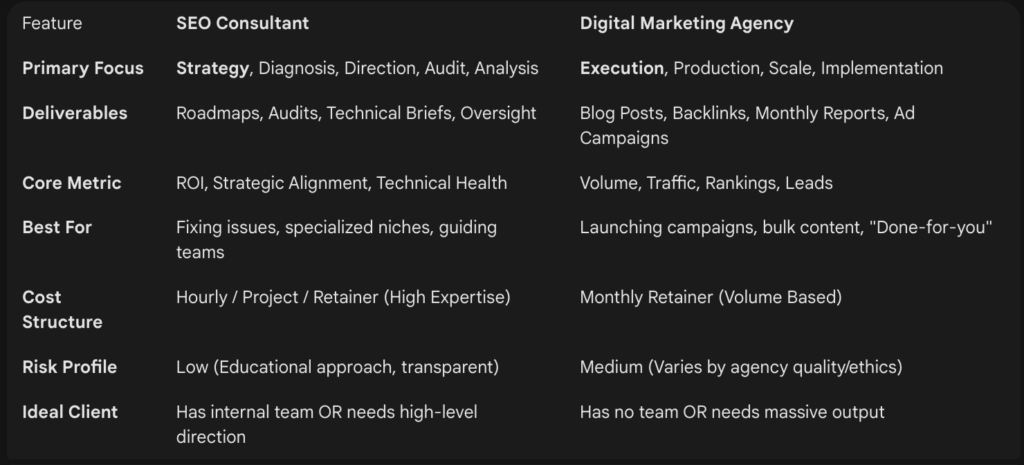
To assist SME business owners in navigating this complex choice, we have developed a decision matrix based on business maturity, budget, and internal capabilities.
The Decision Matrix: Consultant vs. Agency
When to Hire an SEO Consultant
You should engage an SEO Consultation service if:
You have an in-house marketing team: You have writers and developers, but they lack SEO expertise. The consultant acts as the “Fractional Chief Marketing Officer,” guiding your team.
You are in a “YMYL” Industry: If you are in finance, health, or law, the risk of bad SEO is high. You need a specialist to navigate E-E-A-T.
You have hit a plateau: Your current agency has taken you as far as they can, and traffic has stalled. You need fresh eyes to break through the ceiling.
You suspect a penalty: Traffic dropped suddenly. You need a forensic expert to diagnose and fix the technical issues.
You are rebranding or migrating: Moving domains is dangerous. A consultant ensures you don’t lose your rankings during the move.
When to Hire a Digital Marketing Agency
You should engage a Digital Marketing Agency if:
You have zero internal resources: You need someone to do everything—write, design, post, and track.
You need multi-channel execution: You want SEO, Facebook Ads, and email marketing all under one roof.
You need scale: You want to publish 30 articles a month to dominate a niche quickly.
You prefer a single invoice: You want one vendor to handle all marketing tasks.
The digital landscape is unforgiving of indecision. While you deliberate, your competitors in Selangor are optimizing their schema markup, claiming their Google Business Profiles, and publishing authoritative content. The choice is not binary. It is about assembling the right team. You need the Consultant to set the course and the Agency (or team) to row the boat.
If you are an SME owner ready to move beyond “guessing” and start “dominating,” you need a strategy rooted in data, experience, and ethical practice. You need Marketing consultation that respects your budget and protects your brand.
Enquiry us today at https://woonyb.com/. Let us provide the strategic direction your business deserves. Whether you need a comprehensive audit, a roadmap for your agency, or a full-service managed solution, we have the expertise to navigate the 2026 search landscape. Don’t let the AI revolution leave you behind. Contact us now to secure your digital future.