What is the true cost of SEO in Selangor for 2025? We deconstruct the market—from freelancer rates to agency retainers—analyzing the risks of cheap packages and the investment required for sustainable growth.
The Digital Imperative for Selangor SMEs
The commercial landscape of Selangor, the economic powerhouse of Malaysia, has undergone a radical transformation over the last half-decade. As we navigate through 2025, the digital ecosystem has shifted from a supplementary marketing channel to the primary battlefield for business viability and market share capture. For the Small and Medium Enterprises (SMEs) that form the backbone of the state’s economy, the question is no longer whether to invest in Search Engine Optimization (SEO), but rather how much capital is required to compete effectively without falling victim to predatory pricing, ineffective strategies, or disastrous penalties.
The market for SEO services in Malaysia is characterized by extreme volatility and opacity. Business owners in districts ranging from the industrial hubs of Shah Alam and Klang to the commercial centers of Petaling Jaya and Subang Jaya are often bombarded with conflicting information. Quotes for “SEO services” can range from as low as RM500 per month from budget freelancers to over RM50,000 per month for enterprise-grade agency retainers. This staggering disparity creates a state of decision paralysis for business owners who struggle to discern the difference between a high-value strategic partnership and a low-quality commodity service that could ultimately harm their brand.
Key Findings at a Glance:
The Realistic Entry Point: For a legitimate, growth-focused campaign in 2025, Selangor SMEs should anticipate a monthly investment between RM3,000 and RM8,000 for mid-tier professional services.
The Danger Zone: Packages priced below RM1,500/month are statistically likely to rely on automation or “Black Hat” tactics that carry a high risk of Google penalties.
The Strategic Asset: SEO must be viewed as a capital investment in a digital asset, distinct from the operational expense of paid advertising. The ROI is cumulative, compounding over time, unlike the “rented” traffic of Pay-Per-Click (PPC) models.
This document will guide you through every nuance of the pricing landscape, equipping you with the knowledge to make an informed investment that secures your business’s future in the digital age.
The Selangor Digital Economy in 2025: Contextualizing the Cost
To understand the cost of SEO, one must first understand the environment in which it operates. Selangor is not merely a state; it is the most competitive digital market in Malaysia. The density of businesses here means that “standard” SEO practices that might work in less developed regions are insufficient to move the needle in the Klang Valley.
The Hyper-Competitive Landscape
In 2025, the barriers to entry for digital businesses have lowered, resulting in a flood of new competitors across every vertical—from F&B and retail to professional services and B2B manufacturing. A plumbing service in Damansara is not just competing with other local plumbers; they are competing with lead-generation aggregators, directory sites, and established franchises with significant marketing war chests.
This density impacts pricing directly. Ranking for a keyword like “Company Secretary Selangor” requires significantly more resources—more content, higher authority backlinks, and better technical performance—than ranking for the same term in a less populated state like Perlis or Kelantan. The effort required to displace incumbents in the top positions of Google’s Search Engine Results Pages (SERPs) drives the labor hours, and thus the cost, of effective SEO.
The Evolution of Search Behavior in Malaysia
Malaysian search behavior is unique and complex. It is characterized by high mobile penetration and a linguistic phenomenon often referred to as “Manglish”—a blend of English, Malay, and Chinese dialects.
Code-Switching Intent: A user might search for “Best cafe in PJ” (English) but then search for “Tukang paip murah near me” (Malay/English mix).
Local Intent: The specificity of searches has increased. Users search for “near me,” “open now,” and specific neighborhoods (e.g., “SS2,” “Bandar Sunway”).
A cheap, template-based SEO service often targets only the broadest English keywords. A professional consultant, whose fees are higher, invests time in researching and optimizing for this specific linguistic matrix. They understand that capturing the right intent, even if the search volume is lower, leads to higher conversion rates. This level of granular targeting requires human expertise and deep cultural understanding, which commands a premium in the market.
Government Support and Digitalization
The Selangor government, through agencies like the Selangor Information Technology and Digital Economy Corporation (SIDEC), has actively promoted digitalization among SMEs. Grants and matching funds (such as the SME Digitalisation Grant) have injected capital into the market, allowing more businesses to afford professional services. However, this has also led to an inflation in demand and, unfortunately, the proliferation of opportunistic “agencies” looking to capture grant money with subpar deliverables.
Business owners must be vigilant. The availability of a grant should not be the sole reason to hire a vendor. The vendor must demonstrate the capability to deliver long-term value beyond the grant period. The cost of SEO should be evaluated against the potential revenue growth it unlocks, not just the subsidies available to cover it.
The Economics of SEO: Deconstructing the Invoice
One of the most common questions from SME owners is: “Where exactly does the money go?” Unlike purchasing a physical product or a software license, buying SEO is purchasing a service defined by highly skilled labor, sophisticated technology, and the cultivation of authority. Transparency in billing is the hallmark of a professional agency, and understanding the cost drivers helps in validating the quotes you receive.
The Three Pillars of Cost
Every ringgit spent on a professional SEO retainer is generally allocated across three primary vectors: Expertise (Labor), Technology (Tools), and Authority Building (Assets).
Vector 1: Expertise and Labor (The Human Capital)
SEO is not a button that is pressed; it is a continuous process of analysis, creation, and adjustment performed by human specialists.
The Strategist: The architect of the campaign. With 10-20 years of experience, they charge RM300-RM500+ per hour. They analyze the market, define the pivot points, and ensure the strategy aligns with business goals.
The Content Specialist: High-quality content in 2025 cannot be generated solely by AI. It requires human editing, fact-checking, and “humanizing” to meet Google’s E-E-A-T standards. Professional writers in Malaysia who understand SEO nuances charge significant rates per article.
The Technical Lead: A developer or technical SEO who can fix JavaScript rendering issues, optimize Core Web Vitals, and manage schema markup. Their hourly rate often rivals that of senior software engineers.
Insight: If an agency quotes RM1,000/month and claims to provide 20 hours of work, their effective rate is RM50/hour. Considering that a skilled SEO specialist in Malaysia commands a market salary of RM4,000 to RM8,000+ per month, a rate of RM50/hour implies the use of interns, offshore labor, or purely automated software rather than expert human attention.
Vector 2: Technology and Tooling Overheads
Professional SEO is a data-driven discipline. You cannot improve what you cannot measure. Agencies incur significant monthly costs for enterprise-grade software licenses, which are amortized across their client base.
Table 1: The “Hidden” Tech Stack Costs for Professional SEO
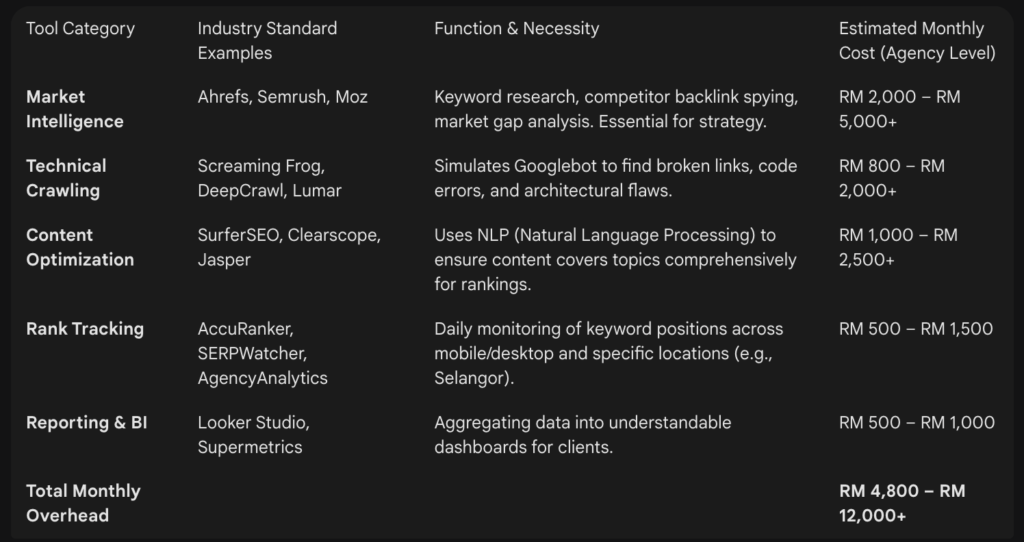
Strategic Insight: When a freelancer charges RM500, they typically cannot afford this stack. They might use free versions or rely on intuition. When an SME pays a retainer of RM4,000 to an agency, they are effectively gaining fractional access to a RM12,000+ tech stack that provides them with competitive intelligence their rivals may lack.
Vector 3: Authority Building (Link Acquisition)
“Off-page SEO” or link building remains a critical ranking factor. However, acquiring high-quality backlinks is expensive.
The Cost of “Real” Links: A high-quality link from a reputable Malaysian news portal, an industry association, or a niche blog requires relationship building, content creation (guest posts), and outreach.
Manual Outreach: It takes time to find prospects, email them, negotiate, write the content, and get it published.
The Alternative (Black Hat): Buying 1,000 links for RM50. These are spam links. They are cheap, but they are toxic. Professional agencies spend budget on earning links, not just buying them.
The Hourly Rate Equation
Even within fixed-price retainers, the underlying calculation is based on hourly effort. Understanding this helps in negotiation and expectation setting.
Freelancer Rates: RM50 – RM250 per hour. Lower overhead allows for cheaper rates, but bandwidth is limited to the individual’s waking hours. If they get sick, your campaign stops.
Agency/Consultant Rates: RM150 – RM500+ per hour. This rate covers the salary of specialists, the office overhead, the tools, and the collective brain trust of the team.
Global Context: In the US or Australia, SEO rates range from $150 USD (RM700) to $300 USD (RM1,400) per hour. Malaysian businesses paying RM300/hour are getting world-class expertise at a significant discount relative to the global market.
The SEO Pricing Landscape in Malaysia (2026)
The market currently segments into three distinct tiers. Each tier represents not just a difference in price, but a fundamental difference in the methodology, risk profile, and expected time-to-result. It is crucial for Selangor SME owners to identify which tier aligns with their business lifecycle and risk tolerance.
Tier 1: The "Budget" Segment (Under RM1,500/Month)
This segment is saturated with junior freelancers, offshore providers, and agencies that rely on heavy automation to maintain margins.
Typical Price Point: RM500 – RM1,500 per month.
Target Market: Micro-businesses (e.g., a home baker), hobby blogs, or local businesses in rural areas with zero digital competition.
Deliverables:
Automated Audits: A generic PDF report generated by a tool, often listing irrelevant errors.
Basic Keywords: A list of 10-20 high-level keywords without intent analysis.
Thin Content: 500-word blog posts that are often spun or AI-generated without human editing.
Directory Links: Submission to low-quality web directories.
Risk Factor: High. At this price point, providers cannot afford manual outreach or technical auditing. The incentive is to cut corners. The risk of engaging “Black Hat” techniques (spammy links, keyword stuffing) increases significantly, which can lead to Google penalties.
Verdict: Generally unsuitable for serious SMEs in competitive sectors like finance, real estate, legal, or e-commerce in Selangor. The “savings” are often negated by the lack of results or the cost of fixing damage later.
Tier 2: The "Growth" Segment (RM3,000 – RM8,000/Month)
This is the “sweet spot” for most established SMEs in Selangor looking for sustainable, defensible growth. This tier allows for sufficient hours to perform White Hat work.
Typical Price Point: RM3,000 – RM8,000 per month.
Target Market: Growing SMEs, manufacturing, professional services (clinics, law firms), and mid-sized e-commerce.
Deliverables:
Strategic Audits: Manual review of the site’s code and structure.
Content Marketing: 4-8 high-quality, research-backed articles per month (1,500+ words).
Link Building: Digital PR outreach and guest posting on relevant industry sites.
Local SEO: Active management of the Google Business Profile, including post updates and review responses.
On-Page: Continuous optimization of meta tags, headers, and internal linking structures.
Service Level: Dedicated account management and regular strategy reviews (monthly or quarterly). The focus shifts from “rankings” to “traffic quality” and “leads.”
Verdict: The recommended entry point for businesses expecting ROI within 6-12 months. It offers the best balance of cost-to-performance for the Selangor market.
Tier 3: The "Enterprise/Dominance" Segment (RM10,000 – RM50,000+/Month)
This tier involves aggressive market domination strategies, often covering multiple regions, languages, or massive e-commerce catalogs.
Typical Price Point: RM12,000 – RM50,000+ per month.
Target Market: Large corporations, multi-national brands, banks, insurance companies, or highly competitive niches (e.g., “Online Casino” or “Credit Cards”).
Deliverables:
Dedicated Squad: A full team (Tech lead, 2 writers, strategist, outreach specialist) assigned solely or largely to the account.
Advanced Data: Use of Big Query, log file analysis, and custom Python scripts for data mining.
International SEO: Implementation of
hreflangtags for multi-country targeting (e.g., Malaysia, Singapore, Indonesia).Digital PR: High-level media relations to secure coverage in Tier 1 news outlets (The Star, Malay Mail, etc.).
Verdict: Necessary for brands competing on a national or regional level across Southeast Asia. At this level, SEO is integrated deeply with the company’s overall marketing and product development.
Comparative Market Rates: The Malaysian Advantage
To contextualize the value available in Selangor, it is beneficial to compare local rates against global standards. Malaysia remains a cost-effective hub for high-quality digital services.
Table 2: Global vs. Local Monthly Retainer Comparison (2026)
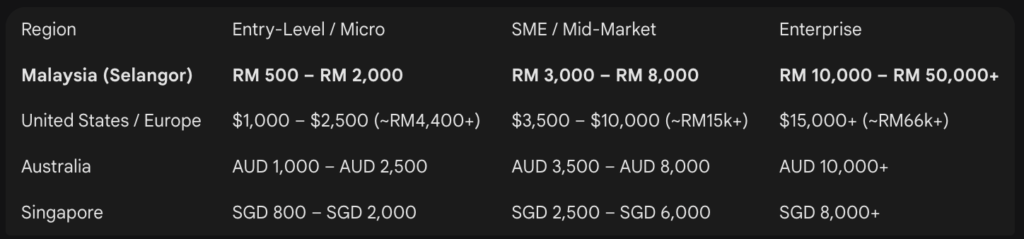
The data suggests that Malaysian SMEs enjoy a significant arbitrage opportunity. A budget of RM5,000 in Selangor secures a service level comparable to a $5,000 (RM22,000) retainer in the US, allowing local businesses to compete effectively for global traffic if they choose the right partner.
Pricing Models: Retainer vs. Project vs. Hourly
In Selangor, three pricing models dominate the industry. Choosing the right one depends on the lifecycle stage of the business, the specific nature of the problem, and cash flow preferences.
The Monthly Retainer (The Industry Standard)
Structure: A fixed monthly fee for a defined scope of continuous work (e.g., “100 hours of SEO activities per month”).
Ideal For: Long-term growth, competitive industries, and businesses viewing SEO as an asset class rather than an expense.
Pros:
Alignment of Incentives: SEO takes time. A retainer allows the agency to plan for 6-12 months, building momentum.
Agility: If Google releases a core update (which happens 3-4 times a year), the agency can pivot resources from “link building” to “content pruning” without renegotiating a contract.
Cumulative Effect: SEO is compound interest. Continuous effort yields exponential results.
Cons: Ongoing financial commitment.
Typical Selangor Range: RM2,000 – RM10,000+.
Project-Based Pricing
Structure: A one-time fee for a specific deliverable with a clear start and end date.
Ideal For:
Technical Audits: Assessing the health of a site before a retainer.
Website Migrations: Ensuring SEO value is preserved when moving from WordPress to Shopify, for instance.
Penalty Recovery: Specific work to remove a manual action.
Foundation Setup: Setting up a site structure before a launch.
Pros: Clear cost cap, defined deliverables, easier to approve internally for some finance departments.
Cons: No ongoing optimization. SEO rankings decay without maintenance. Project-based work often fails to adapt to competitor moves post-delivery.
Typical Costs:
Full SEO Audit: RM1,500 – RM5,000 (depending on site size).
Site Migration: RM5,000 – RM25,000 (High stakes; if done wrong, traffic drops to zero).
Penalty Recovery: RM8,000 – RM30,000.
Hourly Consulting
Structure: Pay-as-you-go for expert advice.
Ideal For: In-house marketing teams needing high-level strategy, second opinions, or troubleshooting specific issues. It is coaching, not execution.
Typical Rates: RM150 – RM450 per hour.
Strategic Recommendation: For 90% of SMEs in Selangor, the Monthly Retainer is the most effective model. SEO requires consistent pressure on the market. Sporadic project work rarely builds sufficient momentum to overtake competitors who are investing monthly.
Deliverables Breakdown: The Anatomy of a Campaign
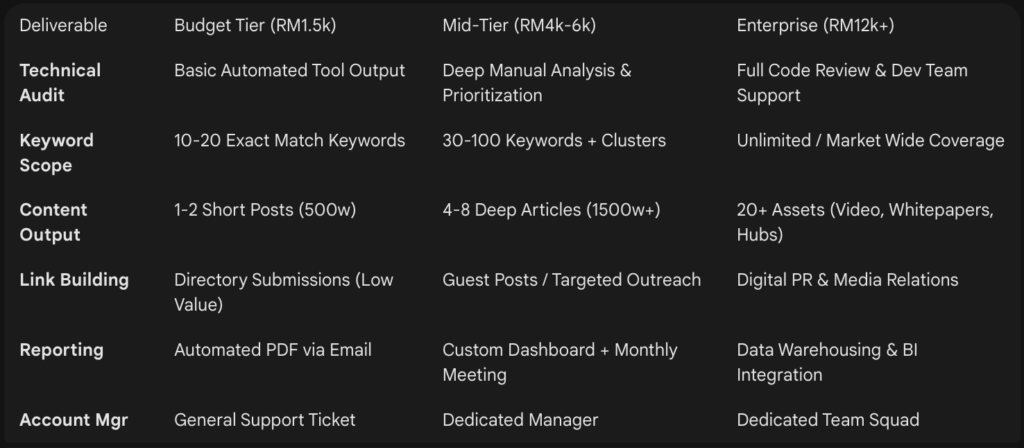
A major source of friction in client-agency relationships is the ambiguity of “SEO work.” To justify the investment, business owners must demand a granular breakdown of deliverables. “Doing SEO” is not a deliverable. The following is a standard operational scope for a professional mid-tier (RM3,000 – RM6,000) campaign in Selangor.
Phase 1: The Audit & Strategy (Month 1-2)
The initial phase is heavy on technical labor and research. This is the diagnostic phase before the surgery.
Technical Audit: Scanning for broken links, 404 errors, slow load times (Core Web Vitals), mobile responsiveness, and duplicate content. In 2025, this also includes checking for “orphan pages” and JavaScript rendering issues.
Keyword Ecosystem: Moving beyond generic terms. Identifying “high intent” long-tail keywords relevant to Selangor/Malaysia.
Example: Instead of just “Catering,” the strategy targets “Halal certified catering for corporate events Shah Alam.”
Competitor Reverse Engineering: Analyzing the top 3 competitors in the SERPs to understand their backlink profile, content velocity, and gaps.
Phase 2: The Build & Optimization (Month 3-6)
On-Page Optimization: Systematically rewriting meta titles, descriptions, and headers (H1-H3) for core service pages.
Content Production: Creation of 4-8 blog posts or service pages per month (1,000-2,000 words each).
Note: In 2025, this includes optimization for AI Overviews (SGE) and “Answer Engine Optimization” (AEO)—structuring content so it is cited by AI chatbots.
Local SEO (Crucial for Selangor): Optimization of the Google Business Profile (GBP). This involves:
Ensuring NAP (Name, Address, Phone) consistency across the web.
Generating and responding to reviews.
Posting weekly updates to the GBP to signal activity to Google.
Phase 3: Authority & Maintenance (Month 7+)
Off-Page SEO: Manual outreach to secure high-quality backlinks. This might involve guest posting on Malaysian business portals or getting featured in local news.
Warning: This does not mean buying links from spam directories. It means earning references.
Conversion Rate Optimization (CRO): Analyzing user behavior (using heatmaps) to improve the percentage of visitors who become leads. Traffic is vanity; revenue is sanity.
Maintenance: Monitoring for algorithm updates and technical regressions.
Table 3: Deliverable Checklist by Budget Tier
The Hidden Dangers of "Cheap" SEO: A Forensic Analysis
In the Selangor market, it is common to see advertisements for “SEO Packages RM500 – Guaranteed Top 1 Ranking.” While attractive to cost-conscious SMEs, these offers are not just ineffective; they are actively dangerous to the long-term health of a business domain.
The Economics of Spam
If a provider charges RM500/month, the math simply does not support ethical work.
The Breakdown: After overheads, the provider has perhaps RM300 left. At a market rate of RM100/hour (low end), that buys 3 hours of work per month.
The Consequence: To deliver “results” in 3 hours, they must automate. They use software to generate thousands of spammy backlinks or use “content spinners” to create unreadable gibberish.
The Penalty Risk
Google’s algorithms (Penguin, Panda, and the rigorous Spam Updates of 2024-2025) are designed to detect and penalize these exact tactics.
Manual Actions: A human reviewer at Google flags the site. It is de-indexed. The business disappears from Google entirely.
Algorithmic Suppression: The site is not banned, but it is suppressed to page 50, effectively becoming invisible.
The Cost of Recovery: Hiring a specialist to remove bad links (disavow files) and fix a penalized site typically costs RM8,000 – RM30,000 and takes 6-12 months.
Insight: “Cheap SEO is expensive.” The cost of cleaning up a failed cheap campaign often exceeds the cost of having done it correctly from the start. Furthermore, the opportunity cost—the revenue lost during the 12 months your site was penalized—can be devastating for an SME.
Vendor Selection: Agency vs. Freelancer vs. In-House
For a Selangor SME owner, the choice between hiring a freelancer, an agency, or building an in-house team is pivotal. Each model has distinct economic and operational implications.
The Freelancer Argument
Cost: Significantly lower (RM1,000 – RM3,000/month).
Communication: Direct access to the person doing the work.
Pros: Great for hyper-specific tasks (e.g., “Write 10 blog posts” or “Fix these 404 errors”). Cost-effective for micro-businesses.
Cons:
Single Point of Failure: If the freelancer gets sick or takes a holiday, your campaign stalls.
Skill Cap: It is rare to find a “Unicorn” who is an expert coder, expert writer, and expert PR strategist. Freelancers usually excel in one area and are weak in others.
The Agency Argument
Cost: Higher overhead (RM3,000+).
Pros:
Multidisciplinary Teams: You get a strategist, a tech specialist, and a writer.
Continuity: Service is guaranteed regardless of staff turnover.
Tool Access: Access to the full RM10k+ tech stack.
Cons: Can feel impersonal if you are a small client. Risk of being passed to junior staff in large agencies if not negotiated carefully.
The In-House Argument
Cost: Salary (RM4,000 – RM8,000 for a mid-level specialist) + EPF + SOCSO + Tools.
Pros: 100% focus on your brand. Deep integration with your product team.
Cons: Expensive for SMEs. Hard to retain talent. You still need to pay for tools (RM2k/month) on top of salary.
Verdict: Usually only viable for companies with monthly revenues exceeding RM500k.
Decision Matrix:
Choose a Freelancer if: You have a budget under RM2,000, know exactly what you need, and can manage the project yourself.
Choose an Agency if: You have a budget over RM3,000, want a “done-for-you” solution, need diverse skills, and are focused on scaling revenue rather than saving costs.
Vetting Your Partner: The E-E-A-T Framework
How does a business owner with no technical background vet a consultant? The key is to look for E-E-A-T (Experience, Expertise, Authoritativeness, Trustworthiness) in the vendor themselves.
Red Flags (Run Away If...)
Guarantees of #1 Rankings: No one controls Google. The algorithm is a trade secret. Any guarantee is a marketing lie and a sign of dishonesty.
Secret Methods: “We have a proprietary black box.” White Hat SEO is transparent. A professional will explain exactly what they are doing.
Ownership Clauses: The contract says the agency owns the website, the content, or the links if you leave. Never sign this. You must own all digital assets paid for.
Suspiciously Low Prices: Anything under RM1,500 for a competitive niche in Selangor is a statistical red flag for low quality.
Questions to Ask Before Signing
Experience: “Can you show me a case study of a Selangor-based company in a similar industry? I want to see the traffic graph, not just rankings.”
Transparency: “Do you provide a monthly breakdown of links built and tasks completed?”
Reporting: “Do you report on vanity metrics (rankings), or do you report on business metrics (traffic, leads, conversions)?”
Strategy: “How do you handle the bilingual nature of the Selangor market? Do we need Malay content?”
Professionalism Indicators
A professional consultant (White Hat, 20+ years exp) will:
Talk about Business Goals (Revenue, Leads) before talking about keywords.
Perform an audit before quoting a final price (or charge for the discovery audit).
Be realistic about timelines (3-6 months for traction, 12 months for maturity).
Educate you, not confuse you with jargon.
Future Trends: AI and the Evolving Cost of SEO
As we move deeper into 2025, the rise of Generative AI (like ChatGPT and Google’s AI Overviews) is fundamentally changing the cost structure of SEO.
The Shift to "Answer Engine Optimization" (AEO)
Users are increasingly getting answers directly from AI without clicking a link. To appear in these AI summaries, content must be highly authoritative and structured specifically for machines.
Impact on Cost: This raises the bar for content quality. “Filler” content is dead. Content must be expert-written, citing data and original research. This increases the cost of content production but increases the value of the traffic that does click through.
Technical Complexity
AI search engines require cleaner code and structured data (Schema markup) to understand the context of a page. This increases the need for technical SEO hours, putting further pressure on the “Cheap SEO” model which ignores technicals.
Strategic Implication: The gap between “Budget SEO” and “Professional SEO” will widen. Budget SEO will become completely ineffective as AI filters out low-quality content, while Professional SEO will become more expensive but more vital for visibility.
Conclusion & Strategic Roadmap
For the Selangor SME owner in 2025, the path to digital visibility is paved with investment, not shortcuts. The “Average Cost” is a metric, but “Value” is the goal.
Summary of Cost Recommendations
Micro Business / Low Competition: Budget RM1,500 – RM2,500/month. Focus on Local SEO (GBP) and basic content.
Standard SME / Growth Phase: Budget RM3,000 – RM6,000/month. This is the functional minimum for a competitive campaign in Selangor involving technical fixes, content, and links.
Market Leader / High Competition: Budget RM8,000 – RM15,000+/month. Required for aggressive expansion and dominance.
Final Thoughts
SEO is not an expense; it is a capital investment in a digital asset. When you stop paying for Google Ads, the traffic stops immediately. When you stop paying for SEO (after a successful campaign), the traffic persists, delivering ROI for years.
In the bustling economy of Selangor, where digital adoption is accelerating and competitors are multiplying, the cost of inaction is far higher than the cost of a retainer. The market will not wait. Select a partner who demonstrates transparency, understands the local linguistic and cultural nuances, and prioritizes sustainable, ethical growth over vanity metrics.