The rise of Google AI Overviews and zero-click searches is redefining the digital landscape. Learn how to master Answered Engine Optimisation (AEO) and Generative Engine Optimisation (GEO), and leverage E-E-A-T to secure your brand’s authority and drive sustainable SME growth.
The Great Search Migration: Why Your Organic Traffic is Changing
The foundation of online visibility is undergoing a fundamental transformation. For SME business owners, understanding this shift is critical, as relying solely on traditional Google SEO practices risks obsolescence. The transition from a search engine that provided lists of links to an environment dominated by “answer engines”—such specifically Google AI Overview—demands a new strategic playbook.
This evolution has rapidly accelerated the trend toward “zero-click” searches, where users receive synthesized answers directly on the Search Engine Results Page (SERP) without navigating to a third-party website. Data suggests this phenomenon has caused organic click-through rates (CTRs) on traditional listings to drop significantly, with some zero-click rates reaching nearly 70% following major AI rollout phases. This shift threatens the primary lead generation channel for many SMEs, necessitating a pivot from optimizing for link ranking to optimizing for information extraction and brand citation.
In this new environment, the strategic Key Performance Indicator (KPI) for informational content must transition from merely tracking CTR to monitoring Citation Velocity and Brand Visibility. When content is cited within a Google AI Overview or other generative output, it acts as a powerful, third-party endorsement of the brand’s authority. Therefore, the strategic objective is to ensure the content is trustworthy and structured enough to become the authoritative source the AI selects, thereby maintaining brand exposure even if the user never clicks the link immediately.
The Strategy Checklist: Our Actionable Approach to AI Visibility
To navigate the generative AI era successfully, SME content strategy must implement the following core adjustments:
Shift your content focus from ranking (Google SEO) to citation (AEO/GEO). Ranking in the traditional “ten blue links” is no longer the sole objective; citation within the AI answer block is the new traffic gateway.
Implement the 5W1H structured writing mindset for maximum machine parsing. This ensures content provides comprehensive, easily extractable facts required by generative models.
Audit and reinforce E-E-A-T signals across your site, especially author and business credentials. E-E-A-T is the confidence score AI uses to select authoritative sources.
Target conversational, high-intent long-tail keywords over high-volume, vague terms. This captures users closer to the transactional stage and aligns with voice/AI conversational queries.
Utilize FAQ and HowTo Schema Markup to create machine-readable answer blocks. Structured data is mandatory for AI systems to accurately parse and index the information.
Place clear, high-intent calls to action immediately following the primary answer block. This is crucial for overcoming the accelerating challenge of zero-click searches.
Decoding the AI Alphabet: AEO vs. GEO
The emergence of AI-driven search has introduced new terminology that clarifies content strategy goals beyond traditional Google SEO. It is crucial for SME owners to differentiate between Answered Engine Optimisation (AEO) and Generative Engine Optimisation (GEO), as they represent distinct tactical objectives within the overarching AI environment.
Defining Google Answered Engine Optimisation (AEO)
Google Answered Engine Optimisation (AEO) is the highly focused process of optimizing content specifically for extraction by answer engines and conversational search features. This includes securing visibility in Featured Snippets, People Also Ask (PAA) boxes, and, most prominently, the Google AI Overview summaries.
AEO is tactical and centers on the immediate delivery of information. The strategy demands that content adopts an “answer-first” structure, where the direct response to a query is presented immediately and concisely. By providing precise, contextually correct answers in a clear, structured format, the content increases its likelihood of being selected and summarized by AI systems to satisfy the user’s intent directly on the SERP
Defining Google Generative Engine Optimisation (GEO)
Google Generative Engine Optimisation (GEO) represents a broader strategic approach tailored for the new generation of AI-driven search platforms, often referred to as generative engines. These include Google’s generative models like Gemini, and external platforms such as Perplexity and ChatGPT. Unlike AEO, which focuses on direct answer extraction, GEO concentrates on optimizing content so that it resonates with AI algorithms that synthesize information to produce original, detailed responses.
The core objective of GEO is not achieving a numbered ranking position, but rather ensuring the content is deemed authoritative and reliable enough to be cited and recommended within the AI’s generated answer. Generative engines prioritize contextual relevance and credibility over traditional factors like click-through behavior, making GEO essential for establishing the brand as a source of truth across the evolving digital landscape. Ignoring GEO risks becoming obsolete, as being ranked #1 in traditional search no longer guarantees inclusion in the AI’s generated response.
The Unbreakable Link: Why Foundational Google SEO Still Matters
It is vital to recognize that AEO and GEO are not replacements for Google SEO, but rather extensions of a sophisticated content strategy. The foundation of all successful AI optimization rests upon robust traditional SEO practices.
Technical health, site structure, mobile optimization, and high-quality backlink profiles remain non-negotiable prerequisites. AI systems, including proprietary crawlers like PerplexityBot, rely on strong Google SEO fundamentals (indexing, sitemaps, page speed) to discover, crawl, and trust the content. For instance, AI systems often reference content that already ranks highly in traditional Google search, which means technical integrity and earned authority are still crucial for gaining AI visibility. GEO builds upon the foundation of great SEO by adding layers of semantic clarity and authority signals, ensuring the content is easy for both humans and machines to access and understand.
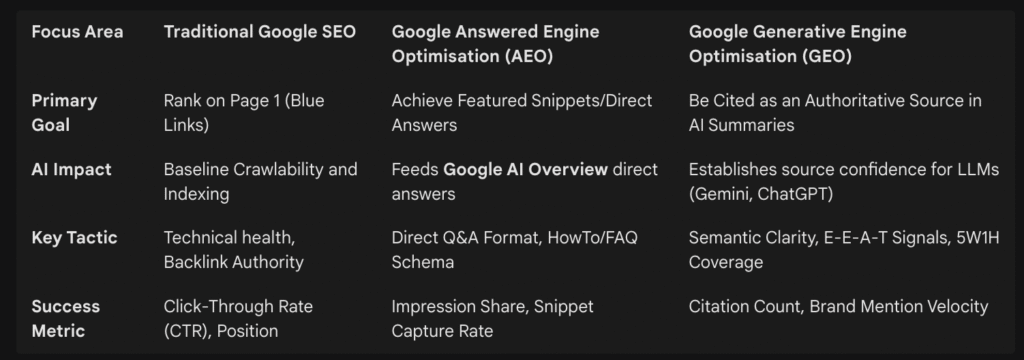
Table 1 provides a clear distinction between the focus and success metrics of these optimization strategies:
Table 1: AI Search Optimization Framework (SEO vs. AEO vs. GEO)
E-E-A-T: The AI Trust Signal
The increasing reliance on generative AI for core search answers mandates that content creators adhere strictly to Google’s E-E-A-T guidelines: Experience, Expertise, Authoritativeness, and Trustworthiness. Because AI systems are trained on vast datasets but can struggle with factual accuracy, verification and source credibility are crucial. Google and other generative models prioritize sources that demonstrate strong E-E-A-T signals, effectively using these signals as a confidence score when selecting sources for their summaries.
The E-E-A-T Mandate: Building AI Trust
For SMEs, building trust for AI means moving beyond general claims of competence. The component of Experience is particularly important, requiring the demonstration of hands-on, real-world knowledge. This involves publishing quantifiable details, such as years in business, professional certifications, specific client counts, or notable project results, often through detailed case studies and testimonials. This shift from simply stating expertise to showing first-hand application validates the brand’s knowledge base for both human users and AI systems.
Furthermore, content must be tied to verifiable entities. Every piece of expert content should feature a visible, credentialed author bio. This practice provides the AI with a reliable entity (the author) to link the expertise and authority to, a fundamental signal used by AI systems to establish trust. The content must also be grounded in reality, meaning referencing authoritative studies, industry guidelines, and data points directly within the answers strengthens the perceived authority and reduces the risk of AI-generated factual errors.
Practical Steps for SME Authority and Trustworthiness
Trustworthiness must be operationalized through both technical implementation and business practice. A secure HTTPS website, clear privacy policies, and comprehensive contact information are basic trust requirements.
One of the most effective strategies for SMEs to build verifiable authority is through comprehensive optimization of the Google Business Profile (GBP). Maintaining consistent Name, Address, and Phone (NAP) details across directories and actively implementing a review acquisition workflow ensures the business entity is clearly defined and positively reinforced online. Local Business schema markup should be implemented to officially define the business entity, services, and location to search engines and AI models, helping local algorithms connect the brand to the areas it serves.
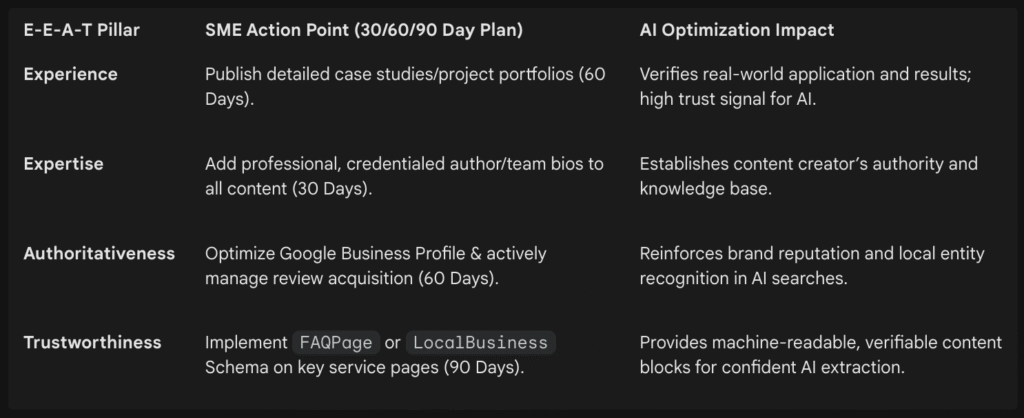
To provide a focused roadmap, the following checklist outlines key implementation phases for SMEs:
Table 2: Actionable E-E-A-T Checklist for SME Websites
The Triple-Threat Content Optimization Plan
Visibility in the age of generative search requires a sophisticated content structure that satisfies both human readers and machine parsing algorithms. This content plan relies on three interconnected strategies designed to maximize citation chances across AEO and GEO platforms.
Strategy 1: Adopting the 5W1H Mindset
Structuring content around the 5W1H (Who, What, When, Where, Why, How) framework is paramount for achieving AI visibility. This structure forces content creators to deliver comprehensive, organized, and factual content blocks that generative engines can easily synthesize.
Structuring Content for Google AI Overview Visibility
The primary tactical mandate is the Answer First approach. The direct, concise answer to the user’s query (the “What” or “How”) must be provided immediately within the opening section, typically the first 50 to 70 words. AI models frequently extract these initial statements for citation, making this direct answer format crucial for securing the Google AI Overview position.
Furthermore, the document structure must facilitate modular parsing. AI assistants do not read a page linearly; they break content into smaller, extractable pieces. Strategic use of clear H2 and H3 headings to segment the 5W1H components allows for clear separation of ideas, improving the AI’s confidence in parsing and ranking the content. Utilizing structured formats like bulleted and numbered lists for key steps or comparisons further enhances machine readability.
Strategy 2: Winning with Conversational Long-Tail Keywords
The second core strategy involves prioritizing long-tail keywords—specific phrases that are often four or more words long—over vague, high-volume terms.
Attracting Quality, High-Intent Users
Long-tail keywords are essential for both Google SEO and the new optimization disciplines because they drive higher-quality traffic and align perfectly with how modern search operates. Users who search using precise, descriptive phrases (e.g., “best accounting software for small manufacturing business”) inherently signal high intent; they know exactly what they need and are close to taking a transactional step.
Furthermore, long-tail keywords are central to AEO and GEO due to the rise of conversational search. Voice search and queries submitted to LLMs naturally mimic human speech patterns, resulting in detailed, question-style long-tail phrases (e.g., “how does x work,” “what is the difference between y and z”). Optimizing content to directly and comprehensively answer these complex, conversational queries significantly increases the chances of being cited by the AI. This strategy is particularly advantageous for SMEs, as long-tail queries generally face lower competition, making it easier to rapidly build topical authority and secure AI citations
Strategy 3: Leveraging FAQs and Schema for Extraction
The third critical component is implementing structured data to create machine-readable answer blocks. The strategy centered on FAQ, Google love it, is now a fundamental requirement for AEO.
Implementing Structured Data for Conversational Search
FAQPage schema explicitly identifies question-and-answer content on the page, making it invaluable for AI systems that seek to match user questions with authoritative answers. This schema provides clear, structured pairs that AI systems can confidently source, aligning perfectly with the conversational nature of AEO.
In addition to FAQPage schema, the implementation of HowTo schema is critical for any instructional content, as it breaks down sequential steps that the AI can easily parse and summarize. Crucially, the structured data must align with the visible content on the page, ensuring accuracy and confidence signals for the AI. While the implementation of structured data previously required developer assistance, modern SME websites built on platforms like WordPress can leverage plugins such as Yoast SEO or Rank Math to simplify the process, rapidly accelerating their AI readiness without significant technical investment.
From Citation to Client: Conversion Strategy
The rise of the zero-click environment introduces a paradox: visibility (citation) is easier to achieve through AEO/GEO, but clicks are harder to earn. Therefore, the conversion strategy must pivot to capitalize instantly on the authority granted by an AI citation.
The Zero-Click Challenge and Your Conversion Funnel
With zero-click search rates accelerating, content can no longer rely on a traditional conversion funnel. The primary goal of informational content must be two-fold: secure the AI citation and immediately shift the user’s intent from purely informational to transactional or investigational.
To maximize influence in this new paradigm, brands must ensure their unique mission, differentiators, and core value propositions are positioned prominently at the beginning of the content. If the Google AI Overview includes this messaging in its summary, the citation effectively becomes an authoritative, third-party endorsement of the brand’s value proposition. Success should be measured by the increase in impressions and citation frequency, recognizing that brand influence and conversions are now distributed across multiple touchpoints, not just the final click.
Designing an AI-Resilient Call to Action Strategy
The highly qualified traffic targeted by long-tail keywords requires an instantaneous conversion opportunity. When a user asks a detailed question, and the Google Generative Engine Optimisation strategy ensures the AI cites the SME’s content as the trusted source, the SME has secured a critical moment of authority and confidence.
To leverage this, the call to action button for user to enquiry must be strategically positioned immediately following the optimized answer block (the concise 5W1H summary). Delaying or burying the CTA risks losing the qualified prospect to a query refinement or competitor. The CTA should be clear, persuasive, and directly address the transactional intent of the long-tail query. For service-based SMEs, this might involve a direct link to a booking page or a specific inquiry form, ensuring the click converts a highly engaged, qualified lead.
Conclusion: Your Future is AI-Optimized
The evolution of search, driven by the Google AI Overview and platforms leveraging generative AI, marks a foundational change for all businesses. For SMEs, success hinges on moving beyond the limitations of traditional Google SEO and embracing the integrated strategies of Google Answered Engine Optimisation (AEO) and Google Generative Engine Optimisation (GEO).
This requires a sustained commitment to demonstrating verifiable E-E-A-T, structuring all content using the 5W1H framework for optimal machine parsing, and strategically targeting long-tail keywords to capture high-intent users. Critically, content strategies must adapt to the zero-click reality by employing structured data (FAQ/HowTo schema) and positioning clear, high-intent calls to action immediately after the authoritative answer is provided. By focusing on citation, authority, and immediate lead capture, SMEs can transform the AI search migration from a threat to a powerful engine for qualified business growth.
Ready to Adapt Your Strategy?
If your organic traffic metrics have been destabilized by the increasing presence of the Google AI Overview and the shift towards conversational search, it signals that the old keyword playbook is no longer viable. Success in the current digital ecosystem requires specialized expertise in E-E-A-T implementation, technical structured content, and AI citation strategies.
Contact our senior strategy team today for a confidential, expert-level audit of your content strategy and a blueprint tailored to achieving maximum Share of AI Voice and sustainable lead generation in your industry.