The requirements for online content visibility have undergone a transformative shift, moving beyond mere keyword matching toward a holistic evaluation of credibility and structural clarity. For Small and Medium Enterprises (SMEs) focused on sustainable growth, white-hat SEO strategies must now directly address Google’s heightened quality standards and the functional demands of Large Language Models (LLMs) used in AI search features.
The Credibility Crisis: Why Google Demands More Experience (E-E-A-T)
Google’s framework for evaluating content quality is known as E-E-A-T: Experience, Expertise, Authoritativeness, and Trustworthiness. This framework is not reserved solely for high-stakes, “Your Money or Your Life” (YMYL) content; it serves as a litmus test for quality across all content categories, including B2B software and industry insights.
Since the late 2022 introduction of the fourth ‘E’—Experience—Google has doubled down on content written by real voices who have “lived it,” contrasting this favorably with content generated superficially by AI without first-hand knowledge. For SMEs, this means content must move beyond generic summaries to demonstrate verifiable, practical applications of knowledge. Trust is the most critical element of E-E-A-T, as the other elements contribute to establishing user trust.
In a B2B context, the demonstration of E-E-A-T involves practical, structural elements:
Expertise and Experience: Publishing detailed, unique how-to guides based on practical experience, and sharing professional credentials or transparent author biographies.
Authoritativeness: Highlighting subject matter experts with bylines, citing reputable data sources, and adding original research or benchmark studies that LLMs can use as go-to references.
Trustworthiness: Meticulous content structure is a direct mechanism for signaling this element. Highly scannable and logically organized content enhances the User Experience (UX), allowing visitors to find answers instantly. This reduction in user frustration feeds directly into the positive trust signals prioritized by Google’s quality evaluators.
From Ranking Pages to Capturing Answers: Defining Generative Engine Optimization (GEO)
The prevalence of AI-generated summaries and quick answer boxes in Search Engine Results Pages (SERPs) has accelerated the shift toward a “zero-click economy,” where users obtain answers instantly without visiting the source website. This has fundamentally altered the goal of SEO.
Traditional SEO focused on maximizing organic search rankings to achieve Position 1. Today, Generative Engine Optimization (GEO) , or Answer Engine Optimization (AEO) , is focused on positioning the content for inclusion as a citation within the AI-generated summaries produced by Google’s AI Overview or other conversational platforms. The primary objective is no longer solely page visibility but citation visibility.
This new optimization environment requires different structural priorities:
Content conciseness and granularity now trump the importance of length.
Contextual relevance has surpassed basic semantic keyword matching.
A fundamental prerequisite for GEO eligibility is ensuring structural integrity. A page is only eligible to be shown in AI Overviews if it is first indexed and eligible to be shown in Google Search with a standard snippet. If the underlying website design makes indexing difficult, or if the content quality is deemed low, the entire page may be disregarded by the indexer. Therefore, the structural disciplines outlined below are sustainable white-hat SEO fundamentals that serve as necessary prerequisites for advanced GEO strategies.
The Structural Blueprint: Optimizing Content for LLM Extraction
To ensure content is efficiently parsed, summarized, and ultimately cited by Large Language Models, SMEs must adopt a systematic approach to on-page formatting that prioritizes machine readability and semantic clarity.
Scannability is Indexability: The User-Machine Harmony
Modern digital consumption habits dictate that both human readers and AI algorithms rely on scannability to quickly assess and extract information. Large, monolithic blocks of text significantly discourage human engagement and complicate the LLM’s task of tokenizing and extracting discrete facts.
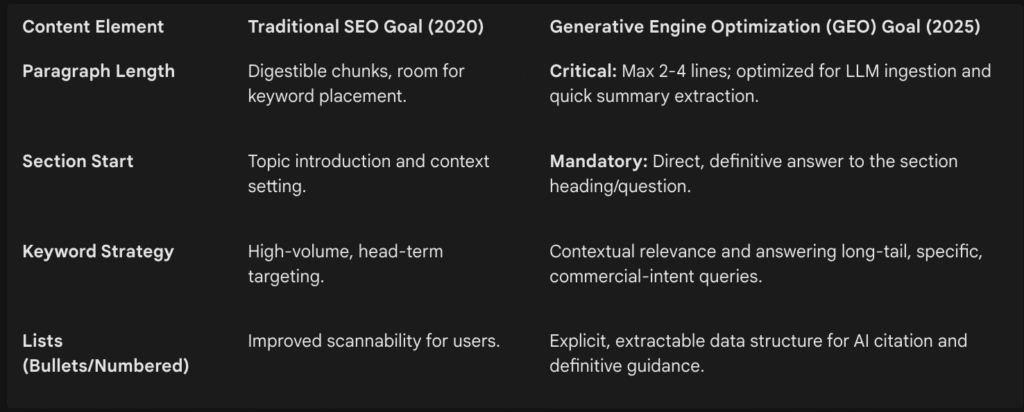
Instruction A: The Direct Answer Principle (Essential for GEO) Every major section of the blog post, typically led by an H2 or H3, must begin by providing a complete and direct answer to the implied question of that heading. This principle requires reversing traditional essay-style writing, which often starts with context before delivering the core message. When an H2 is phrased as a question, followed immediately by a concise, definitive 1-2 sentence answer, it creates a perfect Q&A entity. This clean structure maximizes the probability of the content being extracted and used verbatim in an AI summary or a “People Also Ask” (PAA) box.
Instruction B: Short Paragraphs, High Digestibility To facilitate both human scannability and LLM ingestion, strict conciseness must be enforced. Paragraphs should be limited to 2–4 lines maximum. This fragmentation prevents information overload for the reader while streamlining the LLM’s process by isolating facts into smaller, more manageable data chunks.
Mastering Hierarchical Headings (H1, H2, H3)
Hierarchical headers (H1, H2, H3, etc.) are critical signals that allow search engines and AI models to map the semantic structure of the content. Failure to maintain a logical hierarchy degrades the content’s perceived organization and reduces its chances of being cited as authoritative.
A content structure should always use a single H1 for the main blog title, followed by logical H2s for major sections, and H3s to segment subtopics. For optimal GEO performance, these headers should be phrased as user questions or clear intents. Using question-style headings (e.g., “How does [solution] improve ROI?”) signals to the AI that the content anticipates and answers critical user follow-up questions, which is a strong demonstration of the content producer’s comprehensive expertise and topical depth. This intentional structural discipline improves the confidence with which AI algorithms can process and summarize the SME’s content.
The Semantic Power of Bullet Points and Lists
Bulleted and numbered lists are no longer merely a tool for improving UX; they are now considered a critical GEO technique. They transition complex, flowing prose into explicit, discrete data structures.
AI algorithms prioritize the extraction of facts presented in structured formats, such as lists and tables, because these formats drastically reduce ambiguity and provide verifiable, definitive answers (e.g., specific steps, key benefits, features). To maximize the AI advantage, best practices require that a short lead-in transition paragraph must always precede a list. This paragraph ensures the AI understands the context and purpose of the discrete data chunks that follow.
The following table summarizes the strategic shift from traditional SEO formatting to the demands of Generative Engine Optimization:
Structural Optimization: SEO vs. GEO Alignment
Strategic FAQ Implementation and Structured Data
The dedicated Frequently Asked Questions (FAQ) section represents one of the most valuable structural components for both conventional SEO visibility and modern AI indexing.
FAQs as PAA and Voice Search Magnets
FAQs directly address the conversational nature of modern search, including voice search and the popular “People Also Ask” (PAA) boxes that appear frequently in SERPs. PAA is a crucial tool for understanding user search behavior and identifying related question clusters that, when answered authoritatively, provide a direct path to boosted visibility.
SME content teams should engage in “PAA mining,” actively researching related questions presented by Google and incorporating those high-value queries directly into their on-page FAQ sections. To ensure maximum potential for featured snippets and AI extraction, the answers provided must be concise, accurate, and singular. Overly long, rambling answers dilute the content’s quick-answer potential.
The FAQ Schema Paradox: The AI Imperative
The implementation of FAQPage structured data has historically been a favorite white-hat technique for generating expanded rich results—collapsible snippets that provide a question-answer pair directly on the SERP, boosting visibility and click-through rates (CTR).
The Visibility Restriction: A critical shift occurred in late 2023: Google significantly reduced the visibility of these expanded FAQ rich results for most commercial and general sites, primarily limiting the feature to “well-known, authoritative government and health websites”. For an SME, the traditional benefit of securing a massive SERP display box has largely diminished.
The Pivot to Semantic Understanding: Despite this restriction, implementing FAQPage structured data remains critically important for AI Search Engine Optimization and general entity recognition. The markup serves as a necessary, non-visual signal that helps Large Language Models (LLMs) and search engines understand, organize, and reliably reference the authoritative question-answer content. The objective is no longer maximizing a visual SERP feature, but rather optimizing for flawless semantic comprehension, defining the content as a verifiable entity that an AI can confidently extract and cite.
SMEs must also differentiate between schema types: FAQPage is strictly for pages listing FAQs where the website provides a single, authoritative answer to each question. If the page allows users to submit questions and receive multiple user-generated answers (e.g., a forum), QAPage structured data is required instead.
Technical and Compliance Checklist for FAQ Structure
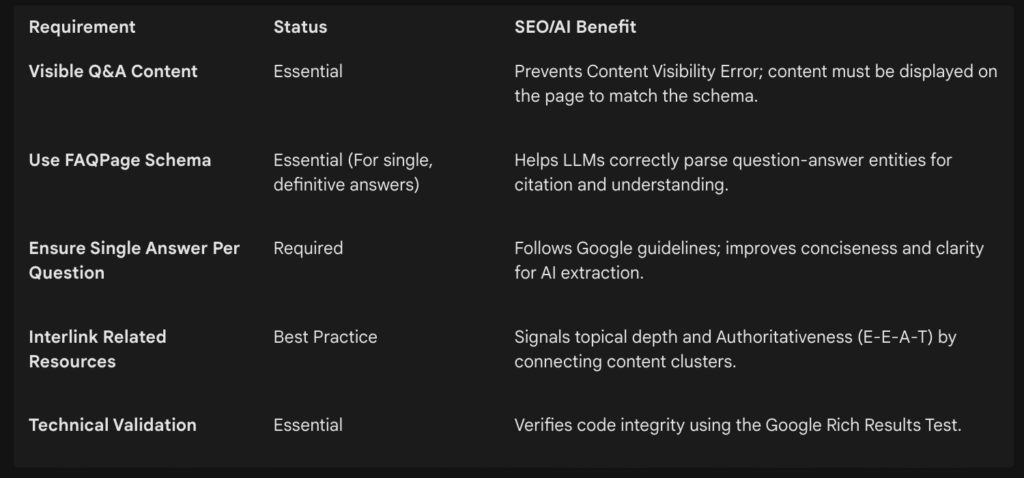
Flawless technical execution is essential; broken code means zero chance of leveraging the semantic benefits. Content teams must follow strict guidelines:
Content Visibility: Google explicitly requires that the questions and corresponding answers marked up in the schema must be visible on the page to the user. Attempting to hide content for the sole purpose of garnering rich results will lead to failure.
Validation: Before publishing, all structured data must be validated using Google’s Rich Results Test. Once deployed, the URL Inspection tool should be utilized to test how Google sees the page, ensuring it is accessible and not blocked by technical barriers (e.g.,
robots.txt).
The following checklist details the structural and technical requirements for successful FAQ implementation in a B2B context:
FAQ Structured Data Checklist for B2B Authority
Tactical Execution: Keywords, Metadata, and Conversion
Structural optimization is a means to an end: attracting qualified traffic and driving conversion. This final stage connects content structure to demonstrable E-E-A-T and business objectives.
Required Keyword Cluster and Contextual Relevance
While structural elements facilitate LLM parsing, they must be populated with content that targets high-intent user needs. Content teams should integrate the following keyword cluster naturally into headings, FAQs, and bulleted lists : AI SEO Strategy, Generative Engine Optimization (GEO), E-E-A-T Content Structure, Optimizing for AI Overviews, FAQ Schema B2B, Bullet Points for LLMs, SME Content Strategy 2025, Search Quality Evaluator Guidelines, White Hat SEO Techniques.
The strategy must prioritize contextual relevance and query matching over simple density. Since the target audience is B2B SME owners, the content should focus on commercial-intent, long-tail queries that signal proximity to a purchase decision, such as those related to pricing, implementation, or specific ROI.
Demonstrating E-E-A-T Through Presentation
The structured content must visually and semantically reinforce the site’s E-E-A-T.
Structured elements (bullet points, clear Q&As) are ideal for housing verifiable signals of expertise. This includes leveraging authoritative data by citing reputable sources, showcasing original research, and providing case studies with demonstrable, verifiable results.
Furthermore, content structure supports the development of topical authority. By strategically using internal linking to connect supporting pages, the SME signals to both human readers and AI algorithms that the website is a comprehensive “hub of expertise” on the topic. This strong interlinking forms topic clusters that significantly boost overall Authoritativeness.
Converting AI Attention to Leads
B2B SEO aims to attract professional decision-makers and convert them into high-value leads. Since generative search (GEO) aims to answer questions quickly, the traffic that ultimately clicks through to the website is often highly qualified and close to making a purchase decision—specifically targeting the Bottom-of-Funnel (BOFU) stage.
The structured content itself is a potent conversion tool. BOFU questions (e.g., “What’s the cost?”, “How can this solution/service benefit me?”, “How do I get started?”) are perfectly answered by concise FAQs and bulleted lists that immediately precede a call-to-action (CTA).
To maximize conversion rates in the GEO era, CTAs must be integrated strategically within or immediately following the sections that resolve commercial doubts. After removing a prospect’s doubt via a definitive, structured answer, the content must instantly funnel that qualified reader toward a conversion-focused action, such as “Request a Demo,” or “Schedule an Expert Consultation”.
Summary and Continuous Improvement
The optimization of blog structure through strategic FAQs and bullet points is not a temporary tactic; it is the establishment of sustainable, white-hat SEO best practices that improve clarity, build trust, and ensure optimal indexing by evolving AI platforms. These methods are foundational to long-term digital success for SMEs.
Ready to Adapt Your Strategy?
If your organic traffic metrics have been destabilized by the increasing presence of the Google AI Overview and the shift towards conversational search, it signals that the old keyword playbook is no longer viable. Success in the current digital ecosystem requires specialized expertise in E-E-A-T implementation, technical structured content, and AI citation strategies.
Contact our senior strategy team today for a confidential, expert-level audit of your content strategy and a blueprint tailored to achieving maximum Share of AI Voice and sustainable lead generation in your industry.