As a business owner, the digital landscape seems to shift constantly. In recent years, a major question has dominated strategy sessions: Will SEO exist in the next 10 years? The introduction of large language models (LLMs) and the Google AI Overview (a core component of the Google SGE) has led many to believe that traditional search engine optimization is obsolete. However, a deeper analysis reveals the opposite. The conclusion, based on two decades in this rapidly shifting industry, is clear: Google SEO is not dying; it is maturing into a more specialized, quality-focused discipline. It remains the essential foundation for success in the age of generative AI.
Understanding the Generative Shift: Google SGE and the AI Overview
The landscape of search has transformed, driven by the rollout of the Google SGE and its signature feature, the Google AI Overview.
What is the Google Search Generative Experience (Google SGE)?
The Google SGE is an AI-driven overhaul of the search interface designed to provide comprehensive, contextually relevant, and detailed answers to user queries by synthesizing information from multiple sources. Unlike traditional search, which primarily listed links, SGE generates content, often leveraging a “query fan-out” technique—issuing multiple related searches across various subtopics and data sources—to develop a complete response.
How the Google AI Overview Reshapes the SERP
The Google AI Overview appears prominently at the top of the Search Engine Results Page (SERP), delivering a synthesized summary and including links to the supporting websites used to generate that summary.
This feature has resulted in a significant shift in traffic patterns. For many informational and “how-to” queries, organic click-through rates (CTR) have declined sharply—studies show an average drop in organic clicks of over 24% for affected keywords, and sometimes over 40%. This occurs because the AI summary often satisfies the user’s need instantly, leading to a “zero-click” event.
The critical realization for SME owners is that the AIO acts as a powerful informational filter. It resolves simple queries instantly, meaning the users who do click through to the source site are often seeking deeper validation, specialized knowledge, or are ready to take a specific action. This filtering process emphasizes quality traffic over sheer quantity, potentially leading to higher engagement and better conversion potential.
Introducing Generative Engine Optimisation (GEO)
To succeed in this new environment, content creators must move beyond traditional SEO strategies designed only for ranking links. This new focus is encapsulated by Generative Engine Optimisation (GEO).
The Strategic Difference: From Ranking Links to Owning the Answer
GEO is the specialized discipline that adapts content specifically to capture visibility within generative AI platforms, such as the Google AI Overview. While SEO focuses on pushing a website link to Position 1, GEO seeks to ensure that the content is prioritized and cited as the best possible answer within the AI-generated response itself.
This strategic evolution shifts the focus toward Visibility Economics. If a brand’s data or expertise is repeatedly mentioned within the AI Overview, it builds immense authority and trust, even if the user does not immediately click the link. The goal is transforming content into a source of knowledge that the generative engine cannot ignore.
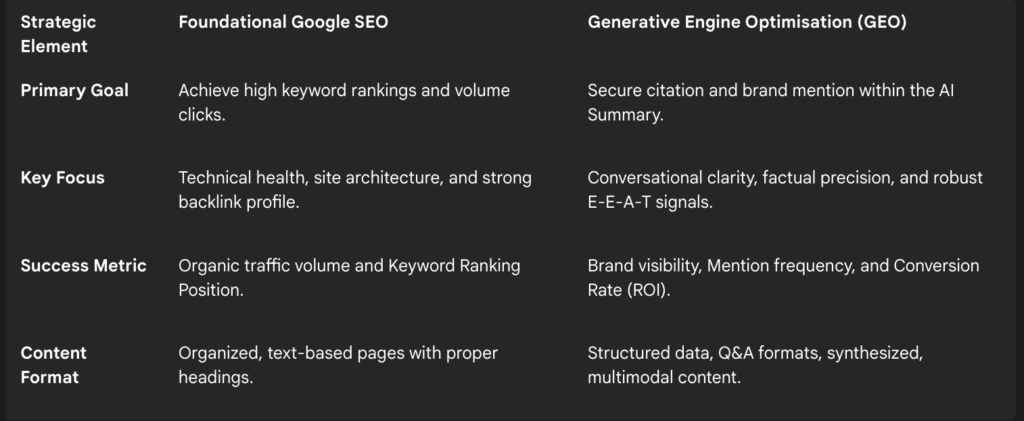
SEO vs. GEO: Optimizing for Traditional Ranking vs. AI Citation
GEO's Focus: Conversational Clarity and Contextual Relevance
Generative engines process language conversationally, relying heavily on NLP. Therefore, GEO demands that content moves away from density and strict keyword targeting toward conversational, precise, and highly structured answers.
This requires optimizing for extraction: content must utilize long-tail, question-based keywords that mirror how people naturally speak, anticipating user intent precisely. By structuring content to provide distinct, self-contained answers to specific sub-questions, content is optimized for the AI’s “query fan-out,” ensuring it can easily extract component facts from the authoritative page. Ultimately, GEO prioritizes context, clarity, and conversational tone over keyword density, demanding factual precision that is easy for the AI to interpret and quote.
Why SEO Remains the Most Important Strategy for Your Business
The strategic advantage created by the generative shift confirms the enduring value of foundational SEO. GEO does not replace the basics; it elevates them.
SEO as the Blueprint: How GEO Sits Under the Core Foundation
The relationship between traditional SEO and GEO is foundational: GEO is an advanced application that requires a perfect SEO baseline. Traditional Google SEO provides the technical infrastructure and the E-E-A-T authority signals necessary for the AI to even consider the content as a valid source. The best content strategies blend both practices. Technical health and verified E-E-A-T determine if the AI can cite the source, while content clarity and structuring (GEO) determine if the AI will cite the source. This comprehensive approach provides stability and resilience during volatile algorithm updates.
The Quality Conversion Advantage in the AI Era
While raw traffic volume decreases, the quality of visitors increases dramatically. Users who click through after reading the AI Overview are pre-qualified; they know the general answer but require deeper validation, specialized knowledge, or are ready to take a specific action.
This shift mandates recalibrating success metrics. The key performance indicator must move away from collapsing traffic volume and focus instead on the total conversions and the cost-per-acquisition (CPA) of those leads. Data suggests that a small percentage of AI visitors can drive a disproportionately high percentage of signups, demonstrating the high conversion value of this high-intent traffic.
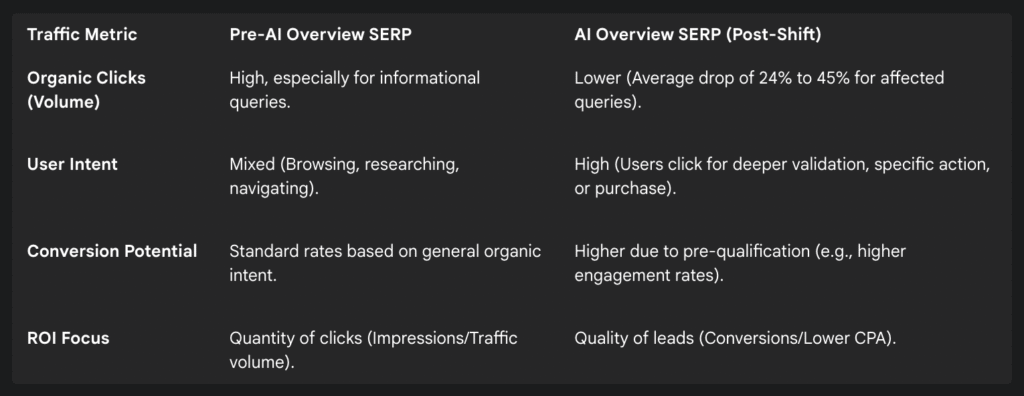
The AI Traffic Shift: Focus on Quality Over Quantity
Case Study: Converting Generative Exposure into Qualified Traffic
An internal case study confirms this strategic shift. By implementing a focused Generative Engine Optimisation (GEO) strategy on a deep-dive resource, the website achieved successful indexing and citation within the generative search environment.
The result of this GEO optimization was approximately 6,000 exposures (brand mentions and citation visibility) in the Google AI Overview within a single month. Crucially, 1% of these exposures converted directly into referral traffic to the website. Although the raw click count was modest (60 clicks), this audience, pre-qualified by the AI summary, exhibited superior engagement metrics and notably higher conversion rates for contact form submissions compared to general organic traffic. This outcome validates the principle that visibility in the Google AI Overview is a powerful upper-funnel branding tool that directly drives qualified, lower-funnel results.
Future-Proofing Your Strategy: Mastering the Next Decade of Search
The Future of Google SEO demands a dual focus on authority and accessibility.
Content Strategy: Creating Authoritative Depth and Multimodality
To secure citation by the Google SGE, content must provide original, specialized, and authoritative depth. AI models synthesize common information; they prioritize sources that offer proprietary data, nuanced explanations, or specialized knowledge that extends beyond what the AI Overview itself can instantly generate.
The mandate for SMEs involves producing original, data-driven content and focused, detailed explanations that serve the user who needs to verify the AIO’s summary or requires action steps. It also means embracing multimodal content (video, structured data, interactive elements), as GEO rewards content adaptable to various generative formats.
Brand Visibility and Digital PR: Strengthening E-E-A-T for AI
The AI system’s assessment of E-E-A-T is heavily influenced by external reputation and brand signals. The breadth of external brand mentions and links from authoritative domains determines how well LLMs understand and trust the source’s expertise.
For SMEs, this means treating SEO as a form of comprehensive Digital PR. Strategies must focus on earning links and citations from relevant, trusted sources, ensuring the brand is mentioned consistently across industry blogs, professional classified sites, and forums. The more comprehensive the brand’s visibility profile across the web, the higher the confidence the AI has in citing that source in the Google AI Overview.
Ready to Thrive in the Future of Google SEO?
The future of search is not characterized by the end of optimization, but by a higher standard of required quality and precision. The relevant question for business owners is no longer, “Will SEO exist in the next 10 years?” but rather, “Is my strategy adapted to capture the highly qualified, conversion-ready traffic that AI now filters?”
Generative Engine Optimisation (GEO) relies entirely on a stellar Google SEO foundation rooted in technical excellence and verified E-E-A-T. By understanding this dual mandate, SMEs can transform the challenge of the Google SGE into a reliable catalyst for higher conversion rates and measurable ROI.
Contact us today for a strategic E-E-A-T and GEO readiness audit to ensure your business captures maximum visibility in the age of the AI Overview.