The Technical Reality of White Hat vs. Black Hat: Genuine white hat SEO builds sustainable business assets through rigorous on-page optimization and technical analysis, whereas cheap black hat services ignore your website entirely, focusing solely on manipulative, external backlink generation.
The Economics of Minimum Costing: Professional search optimization requires immense resources, including advanced technical analysis, expert content copywriting, and expensive tool subscriptions.
The Directory Trap and Uncontrollable Algorithmic Risk: Cheap SEO relies on indexing websites in unregulated directories that are frequently compromised by gambling and money-laundering operations; this not only guarantees that traffic will drop to zero once the service ends but also exposes the business to irreversible Google bans and the destruction of domain authority.
The Digital Imperative for Selangor SMEs in 2026
The commercial landscape in Selangor operates as an advanced, densely populated urban continuum encompassing the greater Klang Valley. Driven by a highly proactive, heavily funded governmental push toward total digital integration, the region has solidified its position as Malaysia’s premier digital economy hub. The implementation of the Selangor Digital Future Action Plan (DxF) 2026-2030 has fundamentally accelerated the digitalization of local enterprises. This comprehensive roadmap is specifically designed to bolster the state’s economic infrastructure through relentless innovation, massive digital expansion, and inclusive economic growth for small and medium-sized enterprises (SMEs). Concurrently, national initiatives guided by the broader digital economy blueprints are actively driving digital adoption across the SME sector, ensuring that micro, small, and medium enterprises successfully integrate advanced digital technologies into their daily operations.
Within this robust economic engine, highly specific industrial and commercial hotspots have solidified, each presenting unique competitive environments. For enterprises operating within these distinct zones, the traditional methodologies of offline corporate networking, legacy print directories, and highly localized physical word-of-mouth have proven entirely insufficient for capturing and defending regional market share. The state currently boasts an internet penetration rate holding steady at over 97%, coupled with a mobile device penetration rate exceeding 99%. This ubiquity of access guarantees that procurement managers negotiating massive supply contracts, retail consumers seeking local services, and enterprise decision-makers evaluating professional consultancies are constantly utilizing digital search platforms to source vendors, rigorously verify credentials, and compare service offerings.
Consequently, authoritative digital visibility represents the primary, unavoidable battlefield for modern commerce. However, this aggressive digital push has created a distinct operational vulnerability: the proliferation of cut-rate, ultra-cheap digital marketing vendors promising top-tier search engine rankings for a fraction of the market cost. In the desperate rush to secure online visibility, many SME business owners are lured by the promise of affordable SEO Marketing, failing to recognize the complex, highly technical nature of modern search algorithms.
In 2026, relying on these deeply discounted services is an operational hazard of the highest order. The digital ecosystem is no longer governed by simple keyword matching, basic metadata manipulation, or rudimentary link counting. Instead, it is dominated by sophisticated artificial intelligence, deep semantic understanding, and rigorous, real-time spam detection frameworks. The fundamental truth of digital economics dictates that quality, safety, and sustainable growth require a commensurate level of investment. When enterprises encounter SEO pricing that seems too good to be true, it is inevitably masking dangerous, destructive shortcuts. This exhaustive research report explores the intricate financial, technical, and algorithmic realities of search optimization, detailing exactly why “cheap” SEO services in Selangor are actively destroying enterprise value and costing businesses substantial sums of money in the long term.
The Evolutionary Shift: Understanding the 2026 Search Ecosystem
Before analyzing the financial and operational mechanics of SEO costing, it is vital to understand the technological environment in which Selangor businesses currently operate. The year 2026 marks a definitive tipping point in how consumers and procurement managers discover information online. The historical paradigm of searching for a term and receiving a list of “ten blue links” has been irrevocably altered.
The integration of artificial intelligence into core search engine functions has revolutionized discovery. Platforms such as Google’s AI Overviews, OpenAI’s ChatGPT, Anthropic’s Claude, and Perplexity now process billions of queries, fundamentally changing how users consume information. These platforms utilize Large Language Models (LLMs) to read, synthesize, and summarize web content directly on the search engine results page (SERP), providing users with direct, conversational answers without requiring them to navigate away from the search interface. This has dramatically accelerated the “zero-click” trend, where roughly 60% of searches end without a single click to a peripheral website, as users become more informed directly through the AI’s generated response.
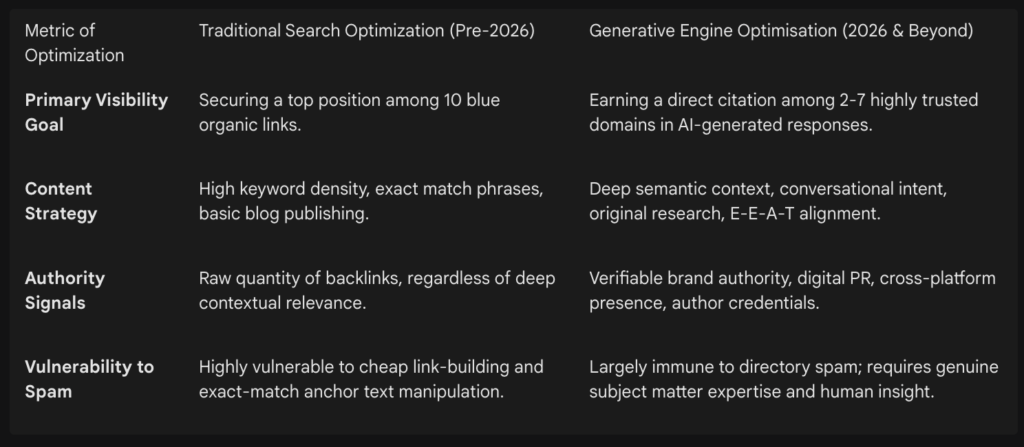
For a business in Selangor to remain visible and competitive in this era, traditional search engine optimization must evolve into Generative Engine Optimisation and Answered Engine Optimisation. These advanced disciplines require structuring a brand’s digital presence, content architecture, and authority signals so that AI-powered search platforms can easily retrieve, confidently cite, and explicitly recommend the brand when answering complex user questions. Getting found online is no longer just about ranking on the first page; it is about earning a coveted place among the two to seven high-authority domains that large language models typically cite in a single comprehensive response.
Earning these AI citations requires a level of sophistication, digital trust, and content depth that cheap, manipulative tactics cannot possibly emulate. When an AI engine names a brand in its answer, it delivers an implicit, algorithmic endorsement that no artificial organic listing ever could. To achieve this, a website must exhibit profound Experience, Expertise, Authoritativeness, and Trustworthiness (E-E-A-T). The algorithms evaluating these metrics are highly advanced, capable of detecting AI-generated content devoid of human oversight, evaluating the historical credibility of authors, and mapping the genuine digital footprint of an enterprise. In this technologically dense landscape, the primitive tactics employed by cheap SEO vendors are not just ineffective; they are actively recognized by search engines as malicious anomalies.
The Fundamental Dichotomy: White Hat vs. Black Hat SEO Specialists
To fully grasp why cheap services cost businesses money, one must clearly delineate the operational differences between legitimate practitioners and manipulative operators. The distinction is not merely ethical; it is fundamentally methodological. It represents two entirely different philosophies regarding digital infrastructure, user experience, and long-term business asset development.
The White Hat Methodology: Genuine Structural and Contextual Optimization
A White Hat SEO specialist is a legitimate, highly skilled professional dedicated to boosting organic traffic through sustainable, algorithm-compliant strategies that prioritize the human user. The core philosophy of white hat optimization centers on structurally improving the client’s website to provide maximum intrinsic value, ensuring that the site is fully understandable to both human visitors and advanced search engine crawlers.
Genuine SEO requires meticulous, comprehensive on-page optimization. This involves a granular review of the website’s architecture, ensuring that HTML tags, meta descriptions, complex header hierarchies, and contextual internal linking structures are perfectly aligned with user search intent. A white hat practitioner analyzes how users interact with the site, optimizing the user interface (UI) and user experience (UX) to reduce bounce rates and increase dwell time—metrics that signal high quality to search engines.
Furthermore, extensive technical analysis forms the bedrock of this approach. Specialists conduct exhaustive, multi-point audits to identify and rectify hidden crawl errors, optimize Core Web Vitals, improve server response times, ensure flawless mobile responsiveness, and eliminate duplicate content issues. They implement sophisticated structured data (Schema markup) to explicitly help search engines contextualize the content, which is a vital prerequisite for Search Generative Experience indexing.
Beyond the technical foundation, white hat specialists focus heavily on authoritative content copywriting. They do not rely on generic, mass-produced text. Instead, they develop comprehensive content strategies that demonstrate real-world experience, requiring verifiable industry subject matter expertise. The traffic generated through these white hat methods is highly targeted and relevant, resulting in superior conversion rates, immense brand credibility, and a compounding return on investment (ROI) that remains stable despite continuous algorithmic updates. In short, white hat SEO treats the website as a permanent, appreciating business asset.
The Black Hat Approach: Superficial Manipulation and Total Neglect
Conversely, Black Hat SEO specialists operate on the sole principle of algorithmic manipulation, prioritizing artificial visibility over actual value. The defining characteristic of a black hat operator is their complete and utter neglect of the client’s actual website. They do not perform technical analysis, they do not improve site speed, they do not optimize the user experience, and they do not generate high-quality, authoritative content.
Instead, black hat practitioners focus almost exclusively on external backlink generation. Their entire business model revolves around creating the false illusion of popularity by artificially pointing thousands of low-quality, spammy links toward the target website from external sources. They exploit temporary technical loopholes in search engine algorithms to engineer artificial overnight spikes in visibility, bypassing the arduous work of actually earning trust.
Techniques employed by these operators include utilizing extensive Private Blog Networks (PBNs)—which are interconnected rings of fake websites designed solely to generate links—as well as mass-producing nonsensical AI content without any human oversight or factual verification. They engage in keyword stuffing, where phrases are hidden in the code or matched to the background color of the page, and cloaking, a highly deceptive practice where the server shows a highly optimized version of a page to the Google crawler while displaying completely different, often irrelevant content to the actual human user.
Because absolutely no foundational improvements are made to the website itself, the results achieved by black hat tactics are inherently unstable and highly volatile. These specialists are engaged in a constant, losing battle against search engine engineers. While their tactics might have offered short-term gains a decade ago, in the highly advanced, AI-powered 2026 digital environment, these shortcuts are detected with devastating speed, leading directly to the destruction of the client’s online presence.
The True Economics of SEO Costing: Why Genuine Services Require Substantial Investment
A primary reason SME business owners fall victim to cheap SEO schemes is a fundamental lack of understanding regarding the operational economics required to execute a successful, compliant campaign. Search engine optimization is not a digitized switch that can simply be flipped on, nor is it a one-time automated software run; it is a highly specialized, resource-intensive professional discipline. The minimum costing threshold of any legitimate agency is dictated by the mandatory material and human inputs required to achieve results that will survive algorithmic scrutiny.
Human Capital and Specialized Labor
Proper optimization requires a diverse team of highly skilled professionals. A standard, effective campaign necessitates the continuous involvement of an overarching SEO strategist, a technical web developer to implement structural changes, a professional content copywriter to draft authoritative text, and a data analyst to interpret behavioral metrics.
Technical analysis alone demands dozens of hours of dedicated, highly specialized labor. Developers must painstakingly audit complex site architectures, rewrite inefficient code to optimize Core Web Vitals, implement dynamic rendering for massive eCommerce platforms, and resolve intricate indexing blockages. This level of technical expertise commands competitive salaries in the Malaysian digital market.
The Financial Burden of Authoritative Content Copywriting
In the era of the Search Generative Experience, content cannot be generic, superficial, or simply outsourced to basic AI tools. Search engines now prioritize original, expert-led insights that strictly adhere to E-E-A-T parameters. Content copywriting requires seasoned professionals who possess the ability to research complex industry topics, interview corporate subject matter experts, and produce authoritative, long-form content that provides genuine value.
For a Selangor-based enterprise, this means moving beyond generic service definitions and instead providing highly localized operational anecdotes, verifiable case studies, and robust author bios linked to professional academic credentials and active LinkedIn profiles. This asset generation is costly, as it demands deep domain expertise, extensive research time, and rigorous editorial oversight to ensure mathematical proof of the author’s qualifications. Genuine content generation is a significant line item in any legitimate SEO budget.
Enterprise-Grade Tool Subscriptions and Advanced Analytics
The modern SEO infrastructure is entirely reliant on expensive, enterprise-grade software ecosystems. Legitimate agencies must maintain active, high-tier subscriptions to advanced technical crawlers that simulate Googlebot behavior, massive backlink analysis databases, complex keyword research platforms, and new AI-supported scoring tools. These platforms often cost tens of thousands of ringgit annually.
Furthermore, tracking keyword ranking optimization across multiple geographic zones, varying devices, and shifting user intents requires specialized API integrations and constant, real-time monitoring. Without these tools, an agency is flying blind, entirely unable to measure the efficacy of their strategies or adapt to sudden algorithmic shifts. The licensing fees for these technologies are unavoidably baked into the cost of genuine service provision.
Establishing the Minimum Costing Baseline in Malaysia
When all these extensive resources—specialized labor hours, high-end content generation, technical development, and premium software subscriptions—are pumped into a campaign, a strict, undeniable minimum costing baseline is established. If the price that is paid by the business owner is lower than this absolute operational cost, then it is mathematically and economically impossible for the vendor to deliver the promised service. At heavily discounted rates, you may expect the service and performance to be highly unsatisfactory, as the vendor must cut critical corners to maintain profitability.
Market data and pricing benchmarks from 2026 clearly illustrate the reality of SEO pricing in Malaysia. For small businesses and local enterprises targeting specific regional markets, a legitimate monthly retainer typically falls between RM 1,500 and RM 3,500. Mid-market and national campaigns, which require broader keyword targeting and more intensive content production, range from RM 3,000 to RM 8,000 per month. Enterprise-level programs—which involve highly complex, multi-market architectures, large-scale digital PR, and international SEO integrations—frequently demand investments between RM 10,000 and RM 50,000 per month. For businesses seeking specialized, one-on-one Marketing consultation, professional hourly rates for genuine experts average between RM 100 and RM 300, while comprehensive one-time technical audits range from RM 4,400 to RM 20,000 depending on the scope of the project.

Data synthesized from comprehensive 2026 Malaysian SEO market pricing parameters and agency service tiers.
When a vendor aggressively offers “comprehensive” SEO Marketing for a flat fee of RM 300, RM 500, or even RM 800 per month, the fundamental economics of the digital industry dictate that they cannot possibly be performing bespoke technical audits, crafting expert-level content, or utilizing premium analytics tools. They are operating drastically below the minimum costing threshold. This confirms that the service is highly automated, entirely outsourced to unskilled labor in unregulated markets, or, most dangerously, entirely reliant on toxic black hat tactics.
The Illusion of Bargains: Why "Cheap" Universally Equates to Black Hat Directory Indexing
In the professional digital marketing sector, the equation is absolute and unforgiving: Cheap = Black hat. Because bargain-rate vendors simply cannot afford the immense labor and resource costs required to execute genuine on-page optimization, site architecture refinement, or authoritative content creation, they are forced to resort to automated, manipulative tactics to artificially inflate traffic metrics and secure continued client payments.
The Mechanics of the Automated Directory Indexing Scheme
The most prevalent, destructive, and economically viable tactic among cheap SEO vendors is automated directory indexing. These low-tier specialists focus solely on forcefully indexing the target website across thousands of obscure, low-quality web directories, defunct forums, and massive link farms to pull artificial traffic to the client’s website.
This process requires absolutely no strategic thought, no market research, no content creation, and zero technical expertise. The vendor simply inputs the client’s URL and target keywords into automated software scripts—often operating on decentralized servers—that relentlessly blast the business’s link across the darkest, most unmonitored corners of the internet. The goal is to overwhelm the search engine’s indexing bots with a sheer, brute-force volume of backlinks, creating a temporary, artificial signal of widespread popularity.
While this aggressive spamming may occasionally result in a fleeting, highly volatile bump in peripheral search metrics, the traffic generated is universally low-intent and entirely useless for actual business growth. The influx of visitors does not consist of real human customers in Selangor seeking logistics services, retail products, or corporate consultations. Instead, these metrics are heavily inflated by automated web bots traversing the link farms, accidental clicks originating from spam networks, and web scrapers. Consequently, the business owner will notice an increase in analytic traffic numbers without any corresponding increase in actual sales inquiries, phone calls, or revenue generation.
The Hostage Architecture: The Zero-Traffic Cliff Upon Contract Termination
The most insidious financial consequence of the cheap black hat model is the total lack of asset ownership and the resulting hostage dynamic. With genuine white hat SEO, the rigorous structural improvements made to the website’s code, the enhanced mobile responsiveness, and the high-quality, authoritative content remain permanently embedded on the website. These elements compound in value, continuing to drive organic visibility, generate leads, and yield high returns on investment long after a specific optimization campaign or consulting contract ends.
For cheap black hat services, however, the relationship is entirely transactional, highly coercive, and utterly devoid of asset creation. Because the vendor has done absolutely nothing to improve the foundational structure or content of the actual website, the only mechanism keeping the site visible in search results is the artificial, highly precarious network of automated directory links.
The vendors retain complete ownership and control over this network. Once the business owner realizes the traffic is not converting to sales and decides to end the service contract—or simply stops paying the recurring monthly fee—the vendor will immediately execute a script to remove the client’s website from these thousands of directories. The moment those links are severed, the artificial signals of popularity completely disappear. Consequently, the website’s traffic will immediately plummet, becoming exactly 0 overnight. The business is left with absolutely nothing to show for months of financial investment, forced into a corner where they must either keep paying the monthly ransom to the black hat vendor or accept total digital obscurity.
The Catastrophic Risks of Algorithmic Exile: How Black Hat SEO Gets You Banned from Google
While the financial loss of a worthless monthly retainer fee and the hostage dynamic of directory links are deeply frustrating, they pale in comparison to the collateral damage inflicted upon the brand’s core digital infrastructure. Employing cheap black hat SEO carries a severe, often irreversible risk of being completely banned from Google and other major search engines. This is not a hypothetical threat; it is an active, daily occurrence in the digital sector.
Forced Association with Illicit Ecosystems: Gambling and Money Laundering
To understand this risk, one must imagine how automated link networks function in reality. Cheap vendors utilize aggressive automated scripts that do not distinguish between legitimate web pages, benign forums, and highly illicit platforms. These tools are designed purely for volume, seeking out any unsecured digital real estate where a link can be forcibly embedded.
Consequently, it is highly common for black hat software to inject client URLs into the comment sections of hacked corporate websites, unregulated offshore gambling platforms, or shadow domains actively associated with illicit money laundering operations. In recent years, cybersecurity researchers have documented widespread campaigns where threat actors exploit underlying vulnerabilities in Content Management Systems (CMS) to create hidden directories on otherwise legitimate sites. They then host vast networks of spam links, frequently associating target websites with illegal rummy games, casino portals, and fraudulent eCommerce scams. When a legitimate Selangor business pays a cheap SEO vendor, they have absolutely no control over which obscure, dangerous sites their brand is being listed in.
The Uncontrollable Nature of Vendor Negligence
This operational model introduces an uncontrollable, systemic risk. Black hat SEO specialists operate at massive scale, managing tens of thousands of client URLs simultaneously through automated software batches. They do not—and mathematically cannot—monitor the directory websites every time a link is placed to ensure they are safe, structurally sound, and free from malicious code.
If a vendor’s link network is suddenly compromised by advanced cybercriminals, the client’s website is immediately associated with that malicious activity. Security researchers have repeatedly observed that platforms utilized for cheap SEO link building are prime targets for threat actors, who use these networks to distribute malware via techniques such as DLL sideloading, intentionally manipulating search results to catapult fraudulent sites to the top of user queries. If your business website is embedded within this toxic network, the search engine algorithms will inevitably identify the connection.
The Destruction of Domain Authority and Trust Signals
Search engine algorithms, particularly those governing the 2026 digital landscape, function fundamentally on network theory. They constantly assess the relationships, proximity, and context between interconnected websites to determine authority. When a legitimate domain is suddenly and heavily linked to illicit gambling rings, malware distributors, or automated money laundering networks, the advanced algorithm categorizes the target site as an active participant in that toxic ecosystem.
This guilt by algorithmic association immediately and thoroughly destroys the website’s Domain Authority and trustworthiness. The site is no longer viewed as a reputable Selangor SME, but rather as a node in a spam network.
Once Domain Authority is compromised by a massive influx of toxic, black hat backlinks, search engines take definitive punitive action. They will issue either a direct Manual Action (applied by a human reviewer at Google) or an automated algorithmic penalty. A penalized website is forcefully de-indexed and banished from the search ecosystem. This means the website will not appear anywhere in the search results, even if loyal customers type the exact brand name directly into the search bar.
Google's Advanced 2026 AI Spam Detection Mechanisms
The risk of algorithmic exile has magnified exponentially in 2026. Google has fundamentally upgraded its AI spam detection frameworks, rendering the black hat SEO techniques that once worked for short periods extremely dangerous. The shortcuts and directory schemes that might have survived for a few months in the past are now the fastest, most reliable way to trigger fast, often irreversible penalties.
According to recent alarming industry statistics for 2026, 70% of penalized websites cannot recover on their own, lacking the technical expertise to untangle the web of toxic links. The recovery process is grueling, with the average recovery time spanning from an agonizing 6 months to 2 years of constant remediation efforts. Furthermore, the financial devastation of losing all organic search visibility is profound; only 40% of businesses survive beyond six months after suffering a severe algorithmic penalty.
The cost of recovering from a black hat penalty is astronomical. A business must hire a specialized, premium technical SEO firm to conduct forensic link audits, meticulously identify thousands of toxic backlinks, compile and file complex Disavow reports, completely rebuild the website’s structural trust signals, and submit lengthy Reconsideration Requests to Google search quality teams. The financial outlay required for this emergency remediation far exceeds the initial savings of hiring a cheap, unregulated vendor. By trying to save a few thousand ringgit on basic SEO, the business owner ultimately destroys a primary revenue channel and incurs massive recovery costs.
Adapting to the Future: The Imperative for E-E-A-T and AI Optimization
The conversation surrounding SEO costing, quality, and the dangers of cheap vendors is further complicated by the monumental, ongoing shifts in how users retrieve digital information. Traditional search volume has begun to drop significantly as users shift their behavior toward AI-powered platforms and conversational agents. To remain viable and visible, an enterprise can no longer simply optimize for traditional “blue links”; they must adapt to the mechanics of the AI era.
The Search Generative Experience and AI Overviews
The introduction of the Search Generative Experience and the widespread rollout of Google AI Overviews have fundamentally changed digital consumption patterns. Search engines now utilize incredibly powerful Large Language Models (LLMs) to read, synthesize, and summarize web content directly on the results page. This technology has drastically reduced organic clicks on top traditional results by an average of 34.5%, as users receive complete, highly contextual answers instantly, without needing to navigate through multiple commercial web pages.
Users now engage in highly specific, conversational research, expecting AI platforms like OpenAI’s ChatGPT, Google’s Gemini, Perplexity, and Anthropic’s Claude to provide in-depth brand comparisons, feature summaries, and direct recommendations. For eCommerce and service-based businesses in Selangor, this means that if your brand is not recognized as an authority by the underlying AI model, you simply do not exist in the modern consideration phase of the buyer’s journey.
Generative Engine Optimisation and Answered Engine Optimisation
To survive and thrive in this paradigm shift, organizations must invest heavily in Generative Engine Optimisation (GEO) and Answered Engine Optimisation (AEO). These advanced disciplines go far beyond the basic keyword insertion and meta-tag tweaking of the past. GEO requires meticulously structuring a brand’s digital presence, publishing highly authoritative thought leadership, and establishing a robust platform presence so that AI-powered search platforms can easily retrieve, confidently cite, and explicitly recommend the brand when answering complex, multi-layered user prompts.
AI engines are programmed to seek out verifiable truth and deep expertise. They do not—and will not—cite cheap directory links, mass-produced AI spam, or cloaked pages. They rely heavily on dense, highly authoritative, logically structured content that adheres strictly to E-E-A-T principles (Experience, Expertise, Authoritativeness, Trustworthiness). Earning a citation from an LLM acts as an implicit, highly trusted endorsement that no traditional organic listing could ever match.
Achieving this prestigious placement requires robust technical infrastructure, flawless structured data implementations, original research, dynamic site optimization, and authentic thought leadership. These requirements demand the strategic, experienced guidance of a premium practitioner. A cheap vendor running an automated script to post links on defunct forums cannot possibly influence an advanced Large Language Model; in fact, their spam tactics actively instruct the AI to view the associated brand as an untrustworthy, manipulative entity.
Identifying the Right SEO Consultant Selangor
Navigating this highly complex, unforgiving digital environment requires expert, personalized guidance. When an SME business owner seeks a Marketing consultation to enhance their digital footprint, they must evaluate potential vendors based on stringent criteria: total transparency, a scientifically sound methodology, and a proven track record of adapting to modern, AI-driven algorithms.
A reputable SEO Consultant Selangor will never offer guaranteed first-place rankings overnight for a few hundred ringgit. They understand that true search engine optimization is a marathon, typically requiring 3 to 6 months to see meaningful movement, and 6 to 12 months to witness strong, compounding financial returns.
Professional consultations begin with an exhaustive, AI-powered audit of the existing digital infrastructure. This discovery phase involves deep competitor analysis, market research, and a clear, collaborative mapping of strategic business goals. Legitimate agencies reject the “one-size-fits-all” approach, instead crafting bespoke strategies tailored to the specific budget, operational capacity, and target market of the enterprise.
Furthermore, the benchmark for quality SEO Marketing involves a clear, unwavering commitment to transparent deliverables. Legitimate agencies provide detailed, regular reporting on technical fixes implemented, content publication schedules, natural, white-hat link acquisition strategies, and rigorous conversion tracking to monitor how traffic translates into actual sales, inquiries, and revenue. They align their long-term tactics with the stringent demands of the 2026 AI search landscape, ensuring that the brand is optimally positioned for both traditional blue-link visibility and modern Generative Engine Optimisation.
Choosing the right partner means selecting a consultancy that acts as an extension of the business, prioritizing sustainable growth, ethical practices, and the long-term protection of the brand’s digital assets over fleeting, highly dangerous shortcuts.
Conclusion
The digital economy in 2026 is mathematically precise, highly advanced, and completely unforgiving of manipulation. As search algorithms become increasingly sophisticated through the deep integration of artificial intelligence and Large Language Models, the margin for error has vanished entirely. “Cheap” SEO services are not cost-effective alternatives for budget-conscious SMEs; they are high-risk financial liabilities masquerading as viable marketing solutions.
By relying on black hat tactics, automated directory spam, and manipulative backlink schemes, these budget vendors expose enterprises to severe, uncontrollable algorithmic penalties. They actively destroy carefully built domain authority and virtually guarantee the catastrophic reality of traffic dropping instantly to zero the moment a contract is terminated. The initial savings gained by hiring a cheap vendor are instantly obliterated by the devastating financial impact of algorithmic exile and the massive costs required for forensic recovery.
Sustainable, measurable growth in search visibility requires a profound understanding of technical web architecture, authoritative content creation, and the emerging paradigms of Answered Engine Optimisation and the Search Generative Experience. These complex disciplines require substantial human capital, premium software resources, and deep technical expertise, establishing a firm financial baseline for legitimate services. The cost of genuine, white-hat optimization is not an operational expense, but rather a foundational, critical investment in digital real estate that compounds in value, driving qualified leads and robust revenue generation over time.
For SME enterprises that recognize the critical importance of a pristine digital footprint, the path forward requires professional, ethical guidance. Navigating the immense complexities of modern search requires precision, data-driven strategy, and an unwavering commitment to quality. If you are looking forward for someone to bring your SEO to another level, we are here to help. Reach out for a comprehensive, personalized marketing consultation, and begin building a digital presence designed to dominate the future of search.