PAA Is a Free Intent Map — Use It Deliberately: Google’s “People Also Ask” (PAA) interfaces function as a dynamic, real-time map of consumer intent in the era of artificial intelligence. By initiating searches with broad seed terms and systematically extracting the resulting PAA questions, organizations can identify low-competition, high-intent sub-topics that reveal exactly what the Malaysian audience is asking during the critical research and purchasing phases.
Long-Tail = Less Competition, More Qualified Traffic: Conversely, long-tail phrases capture immediate buyer intent with a fraction of the competitive friction. In the Malaysian market, this strategy is uniquely effective when adapting to local search behaviors that seamlessly mix English with Bahasa Malaysia and local colloquialisms.
The Transformation of Digital Discovery in 2026
The digital marketing ecosystem has reached a profound and irreversible inflection point. As the global economy transitions deeper into an era defined by artificial intelligence and machine learning algorithms, the fundamental mechanics of online visibility, consumer discovery, and enterprise lead generation have been structurally transformed. For small and medium enterprises (SMEs) operating within the Malaysian market, relying on legacy digital marketing tactics is no longer a viable pathway to sustainable market leadership. The traditional internet, characterized by users typing rudimentary keywords into a search bar and parsing through ten blue links, has been largely superseded by sophisticated, generative answer engines.
In 2026, the search landscape has moved away from algorithms that strictly analyze keyword density and backlink profiles. The introduction and widespread deployment of the Search Generative Experience represents a total paradigm shift. Empirical data across the digital marketing industry demonstrates that approximately 60 percent of online searches now conclude without the user clicking through to any external website. Search engines are utilizing artificial intelligence to synthesize information, providing direct answers, customized summaries, and aggregated recommendations directly at the top of the search engine results page (SERP).
This structural shift necessitates a complete strategic realignment for businesses seeking to maintain digital visibility. The conventional metric of raw website traffic volume is increasingly decoupled from actual brand visibility, topical authority, and qualified lead generation. While overall organic click-through rates may experience a reduction across informational queries, the qualitative value of the remaining traffic is significantly enhanced. When an AI overview algorithmically selects and cites a specific local business as the authoritative solution, any user who subsequently clicks through to the website is effectively “pre-sold” on the enterprise’s credibility.
Despite these advanced technological shifts, the fundamental psychology of the human consumer remains entirely unchanged. Buyers continue to seek immediate, frictionless solutions to their problems. The primary challenge for modern enterprises is identifying exactly how potential clients articulate those problems in natural language. This is where leveraging long-tail search strategies and exploiting dynamic SERP features becomes a critical operational imperative. The methodology detailed in this comprehensive report outlines a highly systematic approach to capturing qualified, high-intent digital traffic in Malaysia. By leveraging public data structures and understanding localized search behaviors, businesses can secure dominant visibility without requiring the massive capital expenditures typically associated with enterprise-level advertising campaigns.
The 2026 Digital Landscape for Malaysian SMEs
To effectively deploy advanced search strategies, it is necessary to contextualize the unique operational and economic environment in which Malaysian SMEs exist in 2026. SMEs in Malaysia play an indispensable role in the national economy, contributing to over 37% of the Gross Domestic Product (GDP) and employing a significant portion of the country’s workforce. They comprise more than 97% of all registered businesses in the country, encompassing diverse sectors from retail and manufacturing to professional services.
However, as 2026 progresses, these businesses face a rapidly evolving, highly volatile landscape influenced by relentless technological advancement, shifting consumer behaviors, and persistent global economic uncertainties. The digital economy within Malaysia is experiencing unprecedented growth, with internet penetration exceeding 95% and e-commerce transactions projected to surpass RM200 billion. For business owners, this growth represents both a massive addressable market and an intensely competitive arena.
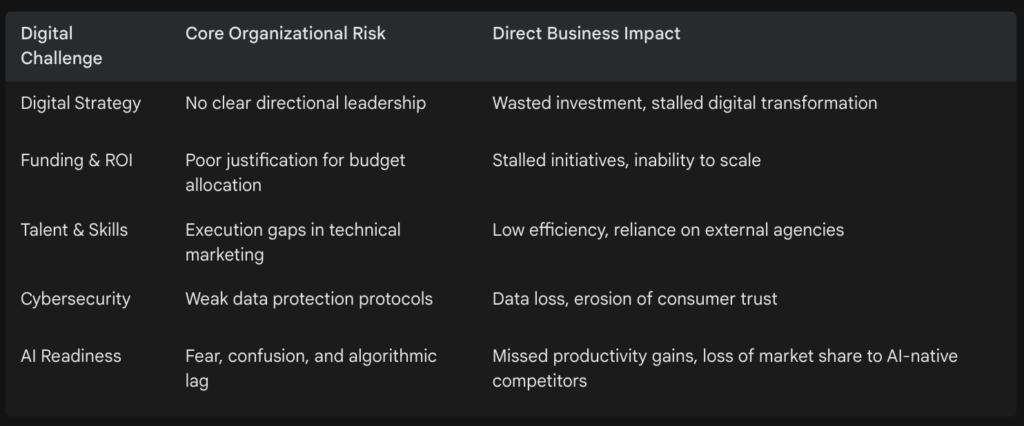
Industry analysis identifies several critical vulnerabilities and digital challenges that Malaysian SMEs must navigate to maintain resilience. A primary concern is the lack of a clear digital strategy and digital leadership, which often leads to poor justification for technological investments and wasted capital. Furthermore, many SMEs face significant digital skills and talent gaps, resulting in execution failures when attempting to implement complex marketing campaigns. AI readiness remains a substantial hurdle, with fear and confusion regarding generative technologies leading to missed productivity gains and operational friction.
In this constrained operational environment, organic search visibility becomes paramount. Unlike paid advertising, which requires continuous capital injection and ceases to generate returns the moment the budget is depleted, a properly engineered organic strategy builds compounding equity over time. Search engine optimization helps businesses attract organic traffic, build unassailable brand authority, and generate predictable leads without relying on volatile ad spend. However, successfully executing SEO Marketing in 2026 requires SMEs to move beyond the rudimentary tactics of previous decades and adapt to the specific requirements of machine learning models.
Navigating SGE, GEO, and AEO
Before executing highly granular content strategies, the architectural differences between traditional search engines and modern answer engines must be understood. The integration of advanced Large Language Models (LLMs) has fundamentally altered how consumers retrieve critical information, evaluate competing brands, and finalize their commercial purchasing decisions.
The Search Generative Experience (SGE)
Google’s Search Generative Experience is arguably the most disruptive technological update since the inception of the search engine. First introduced as an experimental project following the widespread adoption of AI chatbots, SGE is an early step in transforming the standard search experience with generative AI. SGE uses artificial intelligence to summarize vast amounts of information into one easy-to-understand synthesis, pulling quotes, statistics, and citations from multiple websites directly to the top of the search results page.
The system is designed to handle complex, multi-variable queries that previously required users to break down their questions into smaller components. For example, a user evaluating vacation destinations can query, “what’s better for a family with kids under 3 and a dog, bryce canyon or arches,” and the AI will evaluate the parameters, cross-reference data, and output a highly specific recommendation.
Furthermore, SGE deeply integrates commercial intent through Google’s Shopping Graph, a comprehensive dataset containing more than 35 billion constantly refreshing product listings. When searching for commercial solutions, users receive snapshots of noteworthy factors to consider, updated reviews, real-time pricing, and direct product images. For enterprises that rely on organic traffic, this creates a complex dynamic. A website might be utilized by the AI to generate the summary, yet receive no direct visit from the user, leading to a phenomenon known as the “zero-click” search.
Differentiating the Optimization Disciplines
Because the presentation of information has fractured into multiple formats—blue links, AI summaries, featured snippets, and conversational chat interfaces—traditional SEO techniques have bifurcated into more specialized disciplines. To remain visible, an enterprise must optimize for the distinct data ingestion requirements of these different systems.
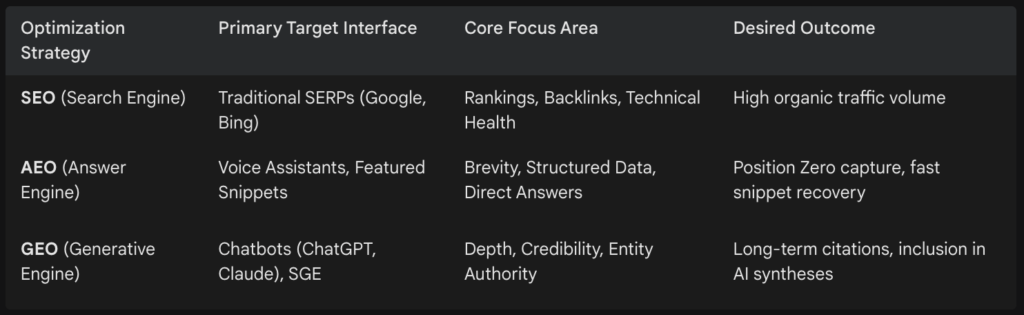
Search Engine Optimization (SEO): This remains the foundational practice of optimizing web architecture, securing authoritative backlinks, and ensuring content is technically sound, mobile-friendly, and indexable. Traditional SEO ensures that search engine crawlers can navigate the site efficiently, and it continues to govern visibility in standard SERPs.
Answered Engine Optimisation (AEO): A highly specialized tactical approach focused on brevity, direct answers, and rigorous structured data. AEO primarily targets voice assistants (like Siri or Alexa) and featured snippet real estate on Google. This discipline is heavily focused on optimizing for the “Position Zero” result, aiming to recover clicks in an ecosystem dominated by immediate answers. AEO relies heavily on implementing structured markup, such as
FAQPageandHowToschema, to facilitate rapid machine comprehension and direct data extraction.Generative Engine Optimisation (GEO): A methodology specifically tailored for generative chat interfaces (such as ChatGPT, Gemini, and Claude) and large-scale AI summaries. While AEO is about winning a quick snippet on a Google SERP, GEO is about becoming a trusted, heavily cited source within a conversational AI. GEO requires the creation of comprehensive, highly credible content that enterprise-level AI agents deem trustworthy enough to ingest and synthesize. It demands deep topical authority, logical flow, and rigorous adherence to establishing credibility.
For a business operating in highly competitive regions, executing a comprehensive digital strategy requires harmonizing these three disciplines. The most efficient, lowest-cost mechanism for achieving this harmony is the strategic extraction and clustering of specific user questions.
PAA Is a Free Intent Map — Use It Deliberately
Traditional keyword research tools, while useful for establishing baseline metrics, frequently guide marketers toward high-volume, short-tail terms that are statistically attractive but commercially inefficient. Relying solely on metrics like monthly search volume routinely leads to targeting broad concepts where the user’s ultimate goal remains highly ambiguous. Targeting keywords that are too broad is a common operational mistake that results in campaigns bringing in heavy traffic, but failing to attract the right audience, ultimately leading to weak measurement and poor return on investment.
Google’s People Also Ask boxes reveal the exact questions your Malaysian audience types at the research and buying stage [User Query]. This feature acts as an infinitely expanding semantic web; interacting with one question algorithmically generates additional, highly specific follow-up questions related to the initial query. By searching seed terms like “SEO services Malaysia” and scraping PAA results, you uncover low-competition, high-intent sub-topics that most competitors completely ignore [User Query].
The Strategic Value of PAA in the AI Era
The PAA feature is one of the primary drivers of Answered Engine Optimisation. Because these interactive drop-down boxes are populated by queries that real human users are actively and frequently searching, they completely bypass the guesswork and assumption inherent in traditional marketing strategy. Furthermore, content structurally optimized to answer PAA questions is inherently conversational, making it highly compatible with Generative Engine Optimisation and natural language processing models.
When a user engages with the Search Generative Experience, Google frequently embeds a conversational chat feature directly beneath the ‘People also ask’ module. This integration seamlessly transitions the user from a traditional search interface into an AI-driven, multi-turn dialogue. Both the PAA box and the generative chat enable users to ask questions in a highly conversational manner, mimicking natural human communication. By proactively structuring a website’s content to answer PAA questions directly, the enterprise positions its digital assets as the foundational source material for both the static SERP feature and the subsequent generative chat.
Methodologies for Extracting PAA Data
Harvesting this invaluable data requires deliberate execution. While manual inspection is possible for small-scale campaigns, robust SEO Marketing demands automated extraction methods to comprehensively map the entire taxonomy of user intent within a specific market sector.
Manual Extraction and Expansion
For immediate insights and ad-hoc content planning, an analyst can perform a localized Google search for a core business offering. Upon locating the PAA box—which frequently appears after the first few organic results, depending on the commercial intent of the query—the analyst can systematically click to expand the questions. Each expansion triggers the algorithm to generate further related questions, quickly transforming a single seed query into a sprawling map of dozens of highly specific customer pain points and objections.
Automated and Programmatic Extraction
For large-scale, enterprise-level strategy execution, manual clicking is highly inefficient. Programmatic scraping utilizing Python is the industry standard for aggregating thousands of PAA data points. Advanced data extraction frameworks utilize HTTP libraries such as httpx or requests, combined with parsing libraries like parsel or BeautifulSoup, to navigate search engine result pages programmatically.
Because search engines deploy highly sophisticated anti-bot measures to prevent mass scraping, programmatic extraction must be engineered carefully. Scripts must utilize reverse-engineered search URL parameters, employ dynamic XPath selectors to isolate the specific HTML elements containing the PAA questions, and utilize optimized request formatting. Furthermore, scripts must pass highly specific User-Agent headers to simulate legitimate browser traffic, and implement exponential backoff retry logic to detect 403 Forbidden status codes and manage rate limiting.
An operational Python script typically structures the query by encoding spaces with mathematical plus signs (e.g., converting “search query” to search+query), dispatches an authenticated GET request, verifies the 200 HTTP success status code, and parses the resulting DOM structure. The extracted data is then securely appended to a local JSON file, logging the date, the initial query parameter, and the array of generated questions for later analysis.
Alternatively, for SMEs lacking dedicated data engineering teams, accessing specialized API services—such as Scrapingdog, Traject Data (SerpWow), or Oxylabs—is highly recommended. These enterprise platforms manage proxy rotation, IP bans, and CAPTCHA circumvention autonomously. By simply passing an API key and a target query to the service’s endpoint, marketers receive clean, structured JSON payloads containing precise peopleAlsoAskedFor data arrays, ready for immediate integration into content planning matrices.
Long-Tail = Less Competition, More Qualified Traffic
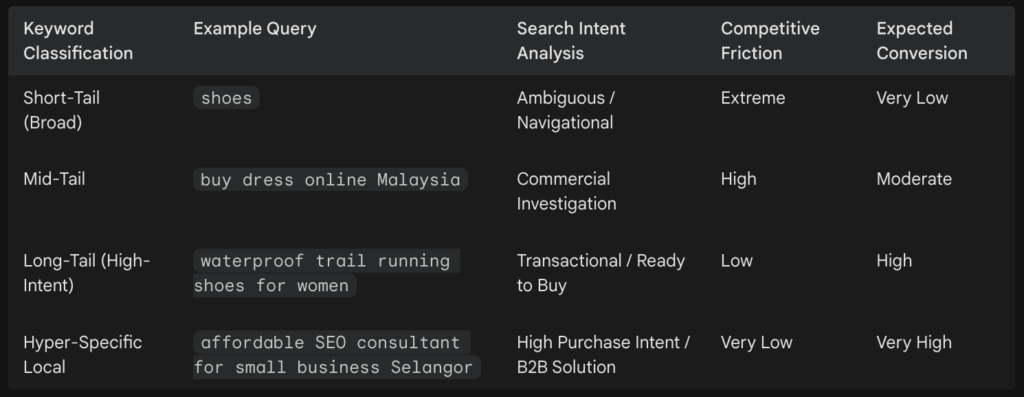
Once the PAA data is extracted, it becomes immediately apparent that the most valuable queries are exceptionally specific. In the Malaysian market, broad terms like “digital marketing” are dominated by agencies with massive budgets [User Query]. Attempting to rank an SME website for such high-competition, low-intent terms results in wasted capital, stalled initiatives, and immense frustration for the business owner.
But “affordable SEO consultant for small business Selangor” has real buyer intent with a fraction of the competition [User Query]. While broad keywords might look impressive on monthly analytics reports due to their raw search volume, they rarely indicate whether a user is actually prepared to execute a transaction. Long-tail keywords are the difference between attracting a passive window shopper and connecting with a highly qualified prospect who has their credit card in hand.
The Economic Rationale for Long-Tail Targets
Let us establish a precise definition: a common misconception is that “long-tail” refers strictly to the physical length or word count of the phrase. In reality, the defining metrics are specificity and intent. Because of this extreme specificity, these terms naturally have lower individual search volumes than broad “head” terms. However, in aggregate, long-tail multi-word search phrases account for over 91% of all web searches and convert at exponentially higher rates.
Long-tail keywords communicate a clear, unambiguous customer need that an enterprise can directly solve. When an enterprise understands this search intent deeply, they can create content that specifically addresses those precise queries and drives conversions.
For example, a broad query for “dentist” signifies ambiguous intent; the searcher could be looking for dental school requirements, stock images of teeth, or a local clinic. It is highly competitive and yields a low conversion rate. Conversely, the long-tail phrase “affordable pediatric dentist near me” communicates local intent, an urgent need, and readiness to transact.
For SMEs looking to aggressively optimize their marketing budgets, targeting zero-volume or extremely low-volume long-tail keywords represents an overlooked arbitrage opportunity. Because traditional, mass-market keyword planning tools frequently dismiss highly specific phrases due to low search volume thresholds, these terms remain entirely uncontested by larger, slower-moving competitors. A single, meticulously written guide addressing a hyper-specific long-tail query can quietly drive qualified leads for years, creating a sustainable competitive advantage and delivering superior long-term ROI compared to paid search campaigns.
The Linguistic Reality of Malaysian Search: Navigating "Bahasa Rojak"
Executing an effective long-tail and PAA strategy in Malaysia requires a highly nuanced understanding of local linguistic patterns and cultural communication styles. The demographic landscape, consisting of approximately 69.8% Bumiputera (Malaysian Malays), deeply influences search mechanics and algorithmic processing. Search algorithms in 2026 process queries based heavily on natural language processing—meaning they analyze how users naturally speak, write, and think.
Blending Languages for Semantic Relevance
In Malaysia, natural communication frequently involves “Bahasa Rojak”—the fluid, informal blending of English and Bahasa Malaysia, often incorporating elements of Chinese dialects and Tamil, within a single sentence or search query. Long-tail topics align naturally with how Malaysians search — often mixing English with Malay phrases [User Query].
When analyzing market data, stark differences emerge based on linguistic choices. The search engine results for the formal English term “tshirt printing” yield entirely different commercial entities and intent profiles than the Malay equivalent “print baju” or the mixed-language query “print tshirt cepat”. Despite meaning essentially the same thing, the algorithms recognize the cultural context and intent behind the language selection, delivering different localized results.
For local businesses, optimizing strictly in formal, academic English leaves substantial market share uncontested. High-intent long-tail topics must reflect the linguistic reality of the target consumer. Successful Answered Engine Optimisation requires blending keywords contextually without forcing unnatural translations or engaging in archaic keyword stuffing.
Bilingual Long-Tail Application Examples:
Instead of strictly targeting: “cheap printing shop Kuala Lumpur”
Optimize for the local reality: “kedai printing murah KL”
Instead of strictly targeting: “women’s hair salon Johor Bahru”
Optimize for the local reality: “salon rambut wanita JB”
Search engine algorithms in 2026 accurately recognize bilingual phrasing, rewarding content that matches the semantic reality of the local user. A local retail business can seamlessly combine terms naturally within a sentence, such as promoting a “kedai runcit” in Petaling Jaya that offers “kaw kaw deals and same-day pickup,” thereby satisfying both local demographic search patterns and broader semantic relevance requirements.
Furthermore, incorporating Malaysian colloquialisms, sentence-final Manglish particles (such as “ah”, “leh”, “meh”, “loh”, “gua”), and culturally specific phrasing into the deeper layers of conversational content can significantly boost alignment with natural language processing models used by AI search engines. While the core headers should remain professional, capturing the specific bartering phrases users might type into a chat interface (e.g., “Berapa harga?”, “Boleh kurang?”, “mahal sangat”) within FAQ schemas ensures the brand surfaces when users engage generative AI for localized shopping advice.
English Dominance in B2B and Enterprise Sectors
While Bahasa Rojak dominates localized B2C searches and informal queries, English remains the absolute primary operational language for B2B services, SaaS platforms, and enterprise-level solutions in Malaysia. For a firm offering professional Marketing consultation, software development, or advanced SEO services, queries such as “SEO agency Malaysia”, “digital marketing company KL”, or “accounting software Malaysia” will predominantly utilize English. If the target audience includes corporate professionals, tech startups, or international buyers operating within the Klang Valley, English dominates the high-intent search results.
The optimal architectural approach for a Malaysian SME involves a strategic bilingual digital infrastructure: maintaining formal English for top-level site structure, B2B service pages, primary navigation, and global SaaS offerings, while deploying Bahasa Malaysia and highly localized, mixed-language long-tail phrases in supporting blog content, FAQ sections, and localized schema metadata. This bilingual SEO mix appeals simultaneously to machine algorithms and human cultural preferences.
Cluster PAA Topics Into a Content Funnel, Not Just Blog Posts
Extracting a list of high-intent, long-tail PAA questions is merely the diagnostic phase of the strategy. The true commercial power comes from organizing PAA findings into a tightly integrated topic cluster, establishing a comprehensive content funnel rather than publishing disjointed, isolated blog posts [User Query].
Modern search engines and sophisticated AI generative models do not evaluate web pages in a vacuum; they assess the holistic, systemic topical authority of the entire domain. If a website publishes a single, isolated article about “SEO trends,” it signals minimal authority to the algorithm. However, if that website hosts a meticulously structured network of heavily interlinked articles covering the entire taxonomy of a specific subject, the AI models categorize the domain as an authoritative “Entity”. Topic authority is rapidly replacing single-keyword dominance as the primary ranking factor.
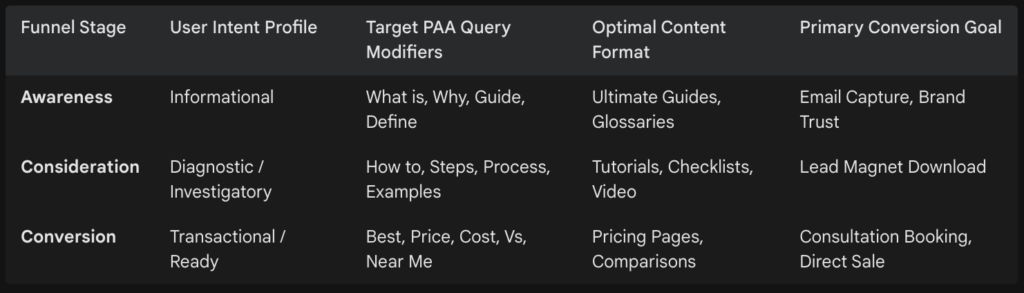
An effective topic cluster requires mapping the extracted PAA data against the traditional psychological buyer’s journey, constructing distinct, interlinked content assets for each phase of the commercial funnel [User Query].
1. Top of Funnel (Awareness): Resolving "What Is" Inquiries
At the awareness stage, the prospective client recognizes a symptom, a pain point, or a problem but lacks the technical vocabulary to diagnose it accurately. They utilize broad, informational search queries.
PAA questions at this stage frequently begin with “What is,” “Why does,” “History of,” or “How does.” Content engineered for the awareness phase should completely avoid aggressive sales language or immediate calls to action. Instead, it must serve as an authoritative educational asset, establishing baseline trust and fulfilling the “Expertise” and “Trustworthiness” parameters of the E-E-A-T framework.
Example PAA Queries: “What is Generative Engine Optimisation?”, “Why is my website not showing on Google Malaysia?”, “What is the difference between SEO and SEM?”
Content Strategy: Create definitive, comprehensive “Ultimate Guides” and glossaries. Utilize clear definitions, historical context, industry data, and broad overviews to provide the best possible baseline answer on the internet. The conversion goal here is not a direct sale, but rather establishing brand recall and potentially capturing an email address for future nurturing.
2. Middle of Funnel (Consideration): Addressing "How To" Queries
Once the prospect understands the nature of their problem, they move into the consideration phase, investigating specific methodologies to solve it. This stage is heavily populated by “How to,” “Can I,” “Steps to,” and “Best ways to” queries [User Query].
This stage is absolutely critical for Answered Engine Optimisation (AEO). Content at this level should be formatted specifically to allow AI algorithms to effortlessly extract step-by-step instructions and display them as featured snippets.
Example PAA Queries: “How to do local SEO in Selangor?”, “How to integrate long-tail keywords in WordPress?”, “Steps to secure SME digital grant Malaysia.”
Content Strategy: Deploy the “5W1H” (Who, What, Where, When, Why, How) content architecture. Structure the article with chronological, actionable steps, utilizing highly readable bullet points and numbered lists. This structural clarity allows LLMs to ingest the data seamlessly and present it within AI overviews, creating highly citable “Atomic Answers”.
3. Bottom of Funnel (Conversion): Capturing "Best," "Price," and "Compare" Intent
The bottom of the funnel is where actual revenue is generated. The user has selected a solution methodology and is now actively evaluating vendors. These queries are highly transactional and exhibit extreme commercial intent.
PAA data at this stage relies heavily on “Best,” “Price,” “Cost,” “Review,” and “Vs” terminology [User Query]. Small businesses often shy away from addressing pricing or directly comparing themselves to competitors out of fear. This hesitation creates a massive content vacuum that savvier operators can easily exploit to dominate high-intent searches.
Example PAA Queries: “Affordable SEO Consultant Selangor pricing”, “SEO agency vs freelance consultant Malaysia”, “Best marketing consultation firms in KL.”
Content Strategy: Publish transparent pricing guides, objective comparison matrices, and deep-dive, data-backed case studies. When developing this content, implement structured data heavily, ensuring that search algorithms can parse exact pricing parameters, service areas, and operational guarantees directly into the SERPs.
Operationalizing the Strategy: Technical Formatting for AI Extraction
Executing this funnel strategy requires transitioning from theoretical architecture to precise technical deployment. A high-intent content cluster must be engineered to satisfy both human readers and the ruthless efficiency of machine intelligence.
Structuring Content for Direct AI Extraction
In 2026, content must be formatted meticulously for clarity and algorithmic extraction. Best practices dictate using question-based H2 and H3 headers that perfectly match the exact natural language wording of the targeted PAA query.
Immediately following the header, the content must provide a concise, 40 to 60-word summary paragraph that directly answers the question without preamble, narrative buildup, or marketing fluff. This direct, succinct paragraph serves as the primary data node for AEO. By providing a brief but complete answer immediately, the content significantly increases its probability of being featured in zero-click results, drop-down PAA boxes, and voice assistant responses. Following this initial summary, the subsequent paragraphs can expand into deep, exhaustive detail, satisfying the human reader who clicks through for deeper context and building the topical depth required for GEO.
Implementing Structured Data (Schema Markup)
A technologically perfect, high-converting landing page remains dormant without a continuous influx of targeted traffic. While organic search is the foundation, in 2026, social media platforms have transcended their original functions as mere networking sites to become powerful, active search engines in their own right. For Malaysian SMEs, a sophisticated social media content strategy across platforms like LinkedIn and Facebook is vital for driving qualified, intent-rich prospects into the highly optimized landing page funnel.
Leveraging Local Entity Authority and E-E-A-T
Because LLMs process vast amounts of unstructured data, they are prone to “hallucinations”—generating highly plausible but factually incorrect responses. To combat this, search engines apply aggressive algorithmic filtering mechanisms, relying heavily on E-E-A-T signals (Experience, Expertise, Authoritativeness, and Trustworthiness) to verify the truth of a claim.
To build Trustworthiness, content clusters must be supported by original research, explicit author credentials, verifiable statistics, and real-world case studies. For a localized Malaysian business, this requires asserting the business as a defined “Entity” rather than merely a collection of web pages. In 2026, Google views a business as a distinct digital object with verified mathematical relationships to physical locations, individual experts, and specific product categories.
By tightly linking the website to a verified and highly active Google Business Profile, accumulating authentic local reviews, maintaining consistent NAP (Name, Address, Phone Number) data across the web, and utilizing localized Bahasa Malaysia terms naturally in the schema, the enterprise solidifies its entity status. This compels AI models to recognize, trust, and preferentially extract their proprietary information over that of their less structured competitors. Old SEO attempted to rank for the keyword “Best Cafe”; the new local SEO focuses on establishing the brand as the undisputed, authoritative entity for the concept of “Coffee” within a specific geographic boundary.
Evaluating Partnerships: Consultant vs. Agency
As SMEs recognize the absolute necessity of transitioning to these advanced frameworks, the operational decision becomes whether to execute internally, hire an independent consultant, or retain a large-scale digital agency. Running a business in Malaysia’s competitive digital landscape means every marketing capital allocation matters.
An SEO consultant is typically a solo professional or a small team offering highly personalized service and deep, specialized expertise—often focusing intensely on specific technical SEO techniques or niche industries. They are highly agile, capable of executing rapid strategy pivots, and generally charge 30-50% less than larger agencies, making them ideal for SMEs with a clear vision and budgets between RM2,000 – RM8,000 monthly.
Conversely, an SEO agency is a larger organization with multiple departments handling everything from complex technical SEO overhauls to massive content creation campaigns under one roof. They are suited for established enterprises requiring full-range, multi-channel digital marketing services.
When selecting a partner for SEO services in Malaysia, decision-makers must demand strategic transparency. Not all specialists are created equal. A competent partner must provide a clear strategy tailored to specific business goals, avoiding generic packages or dangerous promises of “guaranteed #1 rankings in 24 hours”. They must understand industry-specific regulations, buyer behaviors, and most importantly, the rapidly shifting dynamics of AI search visibility. Business owners must retain ownership of their Google Analytics and Search Console data to independently verify performance.
In 2026, tracking success requires a focus on revenue-focused metrics rather than traditional SEO vanity metrics. Success is measured by tracking conversion rates by keyword, customer acquisition cost through organic search, and revenue per visitor from high-intent terms.
Conclusion
The intersection of generative artificial intelligence, Answer Engine Optimization, and shifting consumer search behaviors demands a profound evolution in digital methodology. For enterprises operating within Malaysia’s highly dynamic digital economy, the days of ranking through keyword stuffing, purchasing low-quality backlinks, and arbitrary content generation are permanently over. Future market leadership belongs exclusively to organizations that meticulously map their digital assets directly to the specific, high-intent, long-tail inquiries of their target audience.
By treating the “People Also Ask” ecosystem as a freely accessible, real-time map of human intent, and organizing the extracted data into logical, interconnected content funnels, an enterprise establishes unassailable digital authority. This architecture not only satisfies the immediate informational requirements of the human consumer—in whatever language or colloquialism they choose to search—but also aligns perfectly with the strict data ingestion requirements of 2026’s advanced AI search algorithms.
The implementation of targeted Generative Engine Optimisation through a localized, structured framework ensures sustainable visibility independent of escalating paid advertising costs. If you are looking forward for someone to bring your SEO to another level, we are here to help.