Pillar 1: Technical Infrastructure & Security: A successful SEO strategy requires a flawless technical foundation.
Pillars 2 & 3: Generative On-Page & Off-Page Optimisation: Content creation has shifted towards Generative Engine Optimisation (GEO), utilizing an “inverted pyramid” style to provide direct answers for AI models. Simultaneously, off-page strategies now prioritize building real-world entity trust through unlinked brand mentions, rigorous citation engineering, and multi-channel authority.
Pillar 4: Mastering Conversational AI Intent: Users no longer type fragmented keyword strings; they engage in complex dialogues with large language models.
The Transformation of Search and Discovery
The landscape of search and digital discovery has undergone a fundamental, irreversible restructuring. As the digital economy progresses through 2026, the environment has moved entirely beyond the rudimentary mechanics of exact-match keyword repetition and standard bulk backlink acquisition. Artificial intelligence is no longer merely an underlying influence on how search engines calculate rankings; it has fundamentally altered how users search, the formats they expect to consume, and how quickly they make purchasing decisions. The profound integration of advanced large language models (LLMs) into consumer search behaviors has catalyzed a definitive shift from traditional algorithmic list-making to contextual, intent-driven answer synthesis.
For small and medium-sized enterprises (SMEs), particularly those operating within highly competitive markets, this evolution represents both a profound challenge and an unprecedented opportunity. The catalyst for this digital transformation has been the widespread deployment of the Search Generative Experience, which has recently evolved into highly sophisticated modalities such as Google AI Mode, alongside the meteoric proliferation of autonomous generative engines including ChatGPT, Perplexity, and Claude. These advanced systems actively read, synthesize, and serve comprehensive answers directly on the search engine results page (SERP), frequently eliminating the necessity for a user to click through to a traditional website. Quantitative research indicates that the presence of AI Overviews reduces organic clicks on the top traditional search result by an average of 34.5%, while interactions with standard blue links have nearly halved in numerous commercial sectors.
To successfully navigate this highly complex reality, commercial entities must adopt a holistic, modernized approach to digital visibility. Traditional search engine optimization has splintered into highly specialized disciplines, giving rise to Generative Engine Optimisation and Answered Engine Optimisation. However, the foundational mechanics of digital success remain firmly rooted in a structured, sequential framework. By mastering the four modernized pillars of SEO—Site Audit, On-Page Optimisation, Off-Page Optimisation, and AI Intent—organizations can build a resilient, future-proof digital presence capable of thriving in the artificial intelligence era. This comprehensive analysis details the intricate mechanisms of each pillar, providing the strategic insights necessary for sustainable enterprise growth.
Pillar 1: The Comprehensive Site Audit
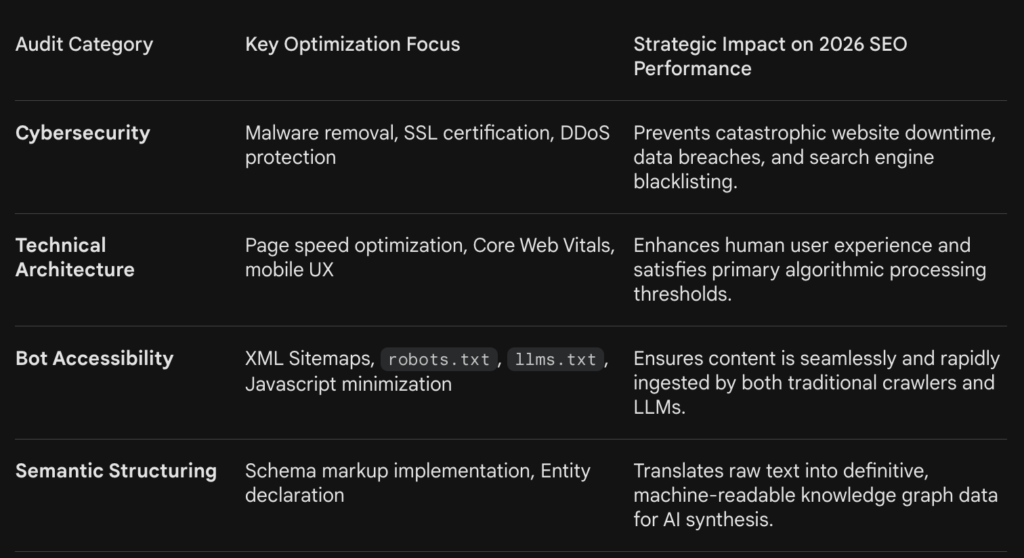
The first and most critical pillar of an effective SEO Marketing strategy is the establishment of a flawless technical foundation. A comprehensive site audit is to ensure that a current website is free from error and to ensure there is no malware or virus that might cause the website to go down or be hacked. Without a secure, technically sound, and continuously available infrastructure, all subsequent marketing and optimization efforts are rendered entirely ineffective.
Cybersecurity, Malware Prevention, and Operational Stability
In 2026, search engines, generative AI models, and data aggregators prioritize user safety and data integrity above all other potential ranking factors. A website that has been compromised by malware, malicious scripts, or unauthorized data breaches not only endangers the end-user but also triggers immediate, severe punitive actions by major search engine algorithms. When a search engine detects malicious code, the site is frequently subjected to immediate de-indexing, accompanied by prominent browser warnings that deter all incoming traffic.
The site audit process must begin with a rigorous vulnerability assessment, comprehensively scanning the server architecture, the content management system (CMS), third-party plugins, and underlying database structures for security flaws. Ensuring that the digital asset is entirely free from viruses guarantees operational uptime, preventing the catastrophic revenue losses and brand damage associated with sudden website blacklisting. For SMEs, particularly those transitioning to complex e-commerce platforms, routine cybersecurity audits act as the primary defense mechanism against automated botnet attacks and targeted exploitation.
Technical Architecture and AI Crawler Accessibility
Beyond the immediate imperative of cybersecurity, a thorough site audit addresses the underlying technical architecture that dictates how efficiently search engine bots—and modern AI training crawlers—navigate, interpret, and extract data from a digital asset. The technical audit encompasses several critical evaluations that directly impact Search Generative Experience visibility:
Core Web Vitals and Page Speed: Website development and maintenance protocols now prioritize conversion-centered architecture and lightning-fast load times. The speed at which a page renders is a direct ranking factor. Slow-loading pages are heavily penalized in the mobile-first indexing era, directly impacting user bounce rates, overall search visibility, and the probability of being selected as a source by time-sensitive AI retrieval protocols.
Mobile Responsiveness and User Experience (UX): A paramount priority is placed on responsive design, ensuring that websites function seamlessly and intuitively across all devices, including smartphones, tablets, and desktop interfaces.
Crawlability, Indexation, and LLM Directives: Generative AI systems require unimpeded, highly structured access to site data to facilitate the Retrieval-Augmented Generation (RAG) framework. Audits must rigorously verify the correct configuration of traditional
robots.txtfiles and XML sitemaps. Furthermore, 2026 mandates the emerging implementation of specific AI-crawler directives, such asllms.txtfiles, which specifically guide large language models on how to parse, interpret, and extract the most vital site data while bypassing extraneous code.Clean Code and JavaScript Reduction: Excessive reliance on complex, client-side JavaScript can severely hinder the ability of AI crawlers to render and understand page content efficiently. Comprehensive technical audits identify bloated code and render-blocking resources, streamlining the backend to present a lightweight, easily digestible structural framework that AI engines can process without expending excessive computational resources.
Structured Data and Knowledge Graph Integration
To be accurately interpreted by an Answered Engine Optimisation protocol, a website must utilize advanced structured data. Schema markup acts as a direct, machine-readable translator between the website’s raw textual content and the search engine’s semantic database, clearly defining entities, relationships, organizational hierarchies, and contextual meaning.
A highly detailed audit identifies all strategic opportunities to implement comprehensive schema structures—such as FAQ schema, Local Business schema, Product specifications, and Article authorship schema. These microdata formats are absolutely essential for triggering rich snippets, feeding local intent queries, and ensuring inclusion in the highly synthesized, AI-generated summary tables that currently dominate the top of the SERP.
Pillar 2: Advanced On-Page Optimisation
Once the technical and security foundation of the website is firmly secured, the strategic focus shifts inward to the textual and multimedia content housed within that architecture. Content copywriting, keywords, and current content optimisation will fall under this category. However, in the highly evolved era of generative AI, on-page strategies have drastically transitioned from simple keyword placement into sophisticated semantic engineering designed to satisfy complex machine learning models.
Generative Engine Optimisation (GEO) and Modern Copywriting
Generative Engine Optimisation is the specialized practice of formatting and structuring content so that it seamlessly becomes part of the direct answers delivered by AI-powered systems like ChatGPT, Google Gemini, and Perplexity. These advanced engines do not operate on traditional ranking paradigms where ten blue links compete for visual priority; instead, they aggressively synthesize and amalgamate information from multiple sources to provide an immediate, definitive, and conversational response. Consequently, content copywriting methodologies must be radically adapted to appease the ingestion mechanisms of these generative systems.
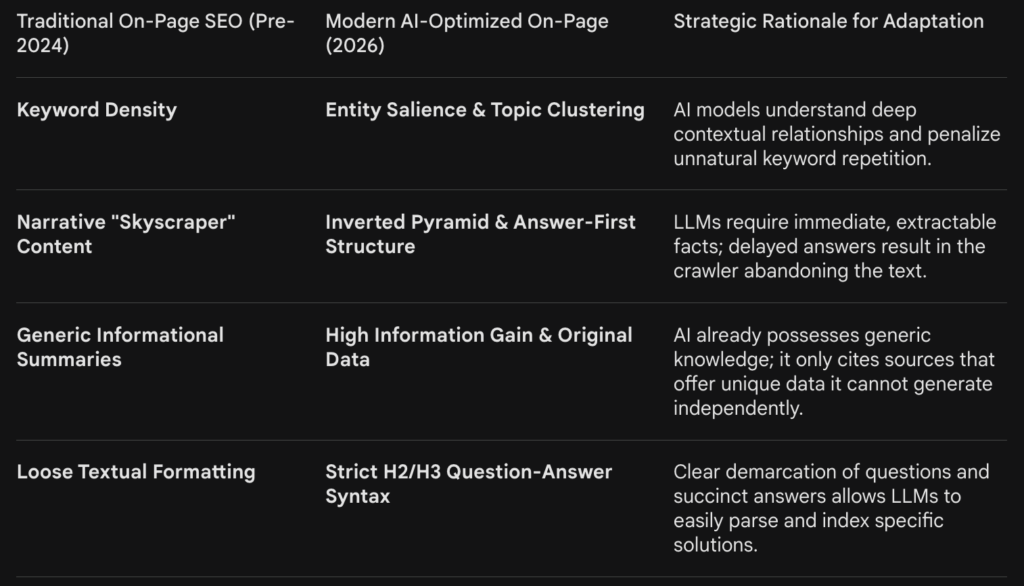
The standard, legacy “skyscraper” approach—characterized by long-winded, narrative-heavy articles that deliberately delay delivering the core answer to increase on-page dwell time—is now entirely obsolete. Modern AI models heavily favor specific, definitive, and clear statements over hedged, conversational phrasing. To successfully optimize for these systems, professional copywriters must employ the “inverted pyramid” style of informational delivery. This rigorous methodology demands that content provides an immediate, succinct, and highly accurate answer directly after addressing a specific question, which is only then followed by supporting details, empirical data, and broader context.
Furthermore, every individual page must be written as a standalone, highly extractable asset. Best practices in 2026 suggest placing a clear, logically structured summary at the very top of long-form pages, utilizing two to three dense, factual sentences that a large language model can extract, process, and reuse essentially verbatim. Paragraphs should be kept intentionally concise—ideally between 25 and 40 words—to facilitate easy algorithmic segmentation.
Strategic Keyword Evolution and Entity-Based SEO
While traditional, high-density keyword metrics have lost their primary relevance, foundational keyword research remains a highly critical starting point for any digital campaign. However, the strategic execution has shifted profoundly from targeting isolated, high-volume search phrases toward developing comprehensive, interconnected topic clusters and mastering entity-based SEO. Entities—defined as distinct concepts, recognizable brands, industry standards, and specific geographic locations—are the fundamental building blocks of AI knowledge graphs.
Current content optimization requires meticulously auditing and updating existing page libraries to ensure they cover semantic subtopics naturally and comprehensively. For instance, an article discussing the concept of “website speed optimization” must not merely repeat that exact phrase; it must provide direct, step-by-step technical information that naturally incorporates related entities such as “caching mechanisms,” “lossless image compression,” and “server response times”. AI systems continuously evaluate deep, complex signals such as semantic keyword coverage, formatting hierarchies, and the logical, factual relationship between interconnected ideas.
E-E-A-T and The Mandate of Information Gain
Generative engines are highly susceptible to hallucinations and the regurgitation of misinformation, making them heavily reliant on quantifiable trust signals when selecting source material. The concepts of Experience, Expertise, Authoritativeness, and Trustworthiness (E-E-A-T) have transitioned from being general guidelines to acting as primary, non-negotiable quality factors. Effective on-page optimization must clearly and transparently highlight author credentials, provide highly credible primary data, and utilize structured outbound citations to respected industry resources.
Equally critical to the concept of E-E-A-T is the algorithmic mandate of “Information Gain.” AI models actively prioritize and reward information that provides unique insights, original statistical research, or fresh, contrarian perspectives that are not already ubiquitous within their vast, pre-existing training data. Providing unique strategic frameworks, proprietary industry statistics, deep case studies, or highly localized knowledge ensures that the content remains effectively irreplaceable. This uniqueness forces the AI model’s Retrieval-Augmented Generation mechanism to actively retrieve and explicitly cite the specific web page, rather than simply generating a generic answer derived from its internal static memory.
Pillar 3: Strategic Off-Page Optimisation
Once everything is ready and the on-page assets are perfected, it is time to promote the business. For off-page optimisation, the strategy will be more focused on backlinks. A backlink is similar to a referral, operating on the principle of how many people are willing to refer the enterprise on their own website. In a highly fragmented, noisy, and competitive digital ecosystem, raw technical perfection and high-quality internal content are often insufficient without the external algorithmic validation provided by third-party endorsements.
The Qualitative Evolution of the Backlink
In the foundational years of traditional SEO, the sheer volume and velocity of backlink acquisition often unilaterally dictated search ranking success. By 2026, the paradigm has shifted entirely; the qualitative nature, topical relevance, and semantic context of these digital referrals are paramount. Advanced search algorithms and generative AI models meticulously assess the topical authority and historical trustworthiness of the referring domain before assigning value. A single, highly contextual referral from a rigorously vetted, authoritative industry publication carries exponentially more computational weight than hundreds of generic, low-quality directory links or automated forum signatures.
Modern off-page optimization involves systematic, strictly white-hat link-building campaigns designed to naturally attract these high-value referrals. This sophisticated process includes targeted guest blogging on highly reputable third-party platforms, executing digital public relations (PR) campaigns that generate organic media coverage, and the continuous creation of original, data-driven thought leadership that naturally earns enthusiastic endorsements from industry peers. The objective is to build a backlink profile that appears entirely organic and heavily concentrated within the enterprise’s specific operational niche.
Multi-Channel Authority and Unlinked Brand Mentions
Generative Engine Optimisation extends off-page strategies far beyond the acquisition of traditional, clickable hyperlinks. Because generative engines actively synthesize answers by scanning vast swaths of the entire web simultaneously, getting a brand mentioned—even without a direct, followable hyperlink—constitutes a massive strategic advantage. These unlinked brand mentions serve as powerful entity associations within an AI’s highly complex training parameters, establishing the brand as a recognized node of authority within a specific subject matter graph.
To maximize the frequency and quality of these mentions, businesses must proactively build a broader, multi-channel digital footprint. This vital off-page strategy involves active, highly authentic engagement within moderated community platforms such as Reddit, Quora, and highly specialized, industry-specific forums. Large Language Models increasingly source real-world, localized knowledge and unfiltered consumer sentiment from these human-centric platforms; empirical research indicates that user-generated platforms like Reddit now account for a substantial, sometimes dominant, percentage of the top-tier sources utilized by advanced answer engines like Perplexity. By establishing a highly credible, helpful presence on these specific feeding platforms, a brand ensures it remains a highly prominent entity within AI retrieval processes.
Citation Engineering and Knowledge Panel Optimization
For commercial entities, particularly SMEs operating within specific geographic regions or localized service niches, aggregator websites, industry-specific portals, and business directories act as critical algorithmic trust vectors. Off-page optimization in 2026 necessitates rigorous citation engineering—maintaining flawlessly consistent, highly accurate organizational profiles across platforms like Google Business Profile, Crunchbase, Trustpilot, and localized commercial directories.
This consistency provides the exact structured data necessary for comprehensive knowledge panel optimization. When a generative engine’s verification sub-routines cross-reference a business’s credentials, location data, and operational hours across dozens of independent, high-trust platforms, its internal confidence score regarding that business increases dramatically. This high confidence score directly and forcefully influences the likelihood of the enterprise being cited or recommended in an AI-generated, location-specific conversational response.
Pillar 4: Mastering AI Search Intent
The final, and arguably most transformative, pillar of modern digital strategy revolves entirely around human psychology and advanced machine interpretation. AI has become an important asset for digital online presence, so with the right search intent, a business is able to attract those users who are looking for solutions online, as these are potential customers. A one-off search intent consultation is offered for free today; interested parties can engage for more details. Understanding exactly how target demographics articulate their pain points, anxieties, and desires to AI assistants is the ultimate competitive advantage in the modern, intent-driven digital economy.
The Paradigm Shift: From Fragmented Keywords to Conversational Dialogue
Search intent optimization in 2026 demands the acknowledgment that users no longer interact with search engines using stilted, fragmented keyword strings (e.g., “buy cheap shoes selangor”). The widespread introduction and adoption of conversational AI assistants has effectively trained consumer behavior to input highly complex, multi-layered, and natural language questions. Queries processed through platforms like Google AI Mode are, on average, two to three times longer than traditional search strings, and they frequently incorporate specific conditional logic, immediate personal context, and multi-step requirements.
An enterprise seeking to optimize for this advanced AI intent must meticulously map its digital content across the entire, non-linear buyer journey—from initial problem awareness to final, transactional decision-making. This strategic mapping requires building highly integrated content ecosystems that proactively anticipate natural, conversational follow-up questions. For example, if a user queries an AI regarding the installation of commercial solar panels, the optimized content must not only answer the immediate technical question regarding voltage; it must also seamlessly anticipate and address associated regional tax incentives, long-term maintenance costs, weather resilience, and typical implementation timelines.
The Mechanics of Query Fan-Out
To fully comprehend AI intent, one must understand the backend technology driving the Search Generative Experience, specifically a mechanism known as “Query Fan-out”. When a consumer submits a complex, multi-layered question to an AI-mode search engine, the system does not simply execute a 1:1 text match against an index. Instead, the underlying language model (such as Gemini 2.5) interprets the deep, semantic intent behind the input and independently generates hundreds of parallel, supplementary secondary queries.
The AI retrieves thousands of documents for all these secondary queries simultaneously, deploying highly specialized sub-models to extract, classify, and summarize the vast data pool into a single, cohesive, and comprehensive response. Because a single user prompt triggers this vast array of automated micro-searches, a website’s content must be exhaustively detailed and semantically rich. A brand will only be successfully cited in the final algorithmic synthesis if its content successfully and authoritatively intersects with these automated secondary queries. This technological reality reinforces the absolute necessity of semantic topic clusters, where heavily interlinked pages provide total, authoritative coverage of a subject.
Platform-Specific Intent Optimization Strategies
Understanding modern AI intent also requires the strategic recognition that different generative platforms excel at entirely different intent types, and they rely on vastly distinct data sourcing preferences. A monolithic approach to intent optimization is no longer viable; strategies must be platform-specific:
ChatGPT (Exploratory and Synthesis Intent): This platform is highly effective for deep exploratory queries, coding assistance, and complex data synthesis. Content specifically optimized for ChatGPT should utilize clear decision frameworks, step-by-step diagnostic approaches, “if/then” conditional logic formatting, and maintain a highly objective, conversational tone that naturally invites follow-up questions. It heavily favors established, globally recognized knowledge bases and objective empirical data over highly persuasive, sales-heavy rhetoric.
Perplexity (Research and Citation Intent): Operating primarily as an advanced, real-time research and citation engine, Perplexity exhibits a remarkably strong preference for community-vetted content, up-to-the-minute data, and highly structured, factual lists. Optimization requires maintaining maximum content freshness, frequently updating core pages, and ensuring prominent visibility on human-centric forums.
Google AI Overviews / SGE (Commercial and Navigational Intent): Designed specifically to augment traditional commercial search behavior, Google’s AI interface displays a significant, measurable overlap (frequently cited at 76%) with traditional organic ranking signals. Optimizing for Google requires a highly sophisticated dual approach: maintaining absolute classic SEO technical superiority while simultaneously providing succinct, highly extractable summaries at the absolute top of the page to feed the generative overview.
Hyper-Localized and Personalized AI Intent
One of the most defining, yet frequently underestimated, trends in generative engine optimization is the rapid algorithmic shift toward highly localized and deeply personalized AI responses. When a user requests recommendations for professional services or commercial contractors, modern AI models absolutely no longer provide generic, national-level lists. Instead, they apply immediate, highly accurate geographic context drawn directly from local entity data and spatial coordinates.
Furthermore, advanced AI engines are increasingly tailoring their output based on deep, individual session context, prior purchasing behavior, and, with explicit user permission, even personal calendar and email data to facilitate 1:1 personalization. To align with these hyper-localized intents, digital content must be structured to explicitly declare geographic relevance, specific service perimeters, and localized expertise.
Localised Dominance: The Strategic Imperative of an SEO Consultant Selangor
For commercial entities operating within highly specific, rapidly expanding geographic markets—such as the vibrant, economically dense, and highly competitive business landscape of Selangor, Malaysia—the successful theoretical application of these four pillars requires profound, nuanced local adaptation. Attempting to implement generic, globalized best practices without deeply ingrained localized context almost universally results in misaligned search intent, highly inefficient budget allocation, and stagnant digital growth. Engaging a dedicated SEO Consultant Selangor provides SMEs with a formidable strategic advantage, firmly rooted in market-specific empirical data and a deep understanding of regional consumer behavior.
Addressing Intrinsic SME Challenges Through Data-Driven Strategy
SMEs within the region frequently confront a debilitating trifecta of digital challenges: an overwhelming lack of general online exposure, unsustainably high digital advertising (PPC) customer acquisition costs, and a systemic, chronic lack of high-quality, conversion-ready leads. A generalized, template-based marketing approach cannot adequately resolve these intrinsic, structural issues. A specialized Marketing consultation must begin with deep, intensive discovery and market analysis, meticulously mapping out the optimal digital channels, specific content tactics, and AI SEO strategies that are highly specific to the individual client’s budgetary constraints and harsh industry realities.
Top-tier professionals specializing in SEO Marketing firmly prioritize sustainable, evidence-based growth methodologies over the unrealistic, short-term guarantees frequently peddled by low-quality agencies. By flawlessly executing comprehensive technical site audits, executing highly precise on-page semantic engineering, and methodically building localized off-page authority networks, these specialists ensure that local businesses stand out prominently to both human consumers and highly advanced local search algorithms. This approach is entirely data-driven, relying on predictive modeling and continuous analytics rather than outdated intuition.
Demonstrable Commercial Impact and Quantifiable ROI
The profound commercial effectiveness of integrating the four pillars through highly specialized, localized consultation is unequivocally evidenced by measurable, real-world performance metrics. By aggressively pivoting away from outdated, vanity-metric traffic-chasing tactics and focusing intensely on deep conversion rate optimization and AI intent alignment, commercial businesses in the region have recorded substantial, often transformative, digital success. Documented case studies within the Malaysian market powerfully illustrate these outcomes :
E-Commerce Expansion and CPA Reduction: E-commerce apparel brands leveraging highly localized, intent-driven SEO strategies have successfully achieved top-tier keyword rankings for highly competitive commercial terms. This strategic execution successfully lowered Cost Per Acquisition (CPA) drastically—in some recorded instances dropping from RM300 to RM0 for organic channels—while simultaneously generating tens of thousands of units of highly qualified, free organic traffic.
B2B Revenue Scaling: B2B manufacturers and specialized professional service providers have meticulously documented revenue increases of up to 85%, alongside massive 40% improvements in overall lead conversion rates. This was achieved by building rigorous foundational tracking architectures and optimizing content for highly specific, complex, intent-driven commercial searches.
Logistics and Service Dominance: Service providers and logistics networks utilizing fully integrated SGE marketing protocols have successfully transitioned from relative local obscurity to completely dominating top market positions, frequently securing inclusion in top-three algorithm recommendations.
These highly tangible, audited outcomes underscore the absolute necessity of moving far beyond generic, low-level marketing advice. An MBA-qualified consultant brings critical, enterprise-level analytical rigor to local SMEs, expertly crafting bespoke, holistic strategies that integrate seamlessly across advanced web development, AI-assisted content production, and highly targeted digital advertising.
The Future Trajectory: Agentic AI and Autonomous Commerce
Looking slightly beyond the immediate operational horizon of 2026, the ongoing integration of “Agentic AI” is rapidly and permanently reshaping the architecture of digital commerce. While current iterations of AI primarily focus on synthesizing information and providing complex answers, Agentic AI represents the next evolutionary leap. As these AI systems evolve from merely answering user questions to actively executing autonomous, multi-step tasks on behalf of the user—such as independently researching and booking contractors, purchasing specific B2B software inventory, or automatically reserving specialized commercial services—the operational stakes are raised exponentially.
The brands that have successfully optimized for generative citations today, building unshakeable E-E-A-T and flawless technical accessibility, will be the exact entities that secure these automated, frictionless revenue streams tomorrow. If an AI agent cannot easily crawl a site, verify its schema data, or validate its external off-page authority, it will simply bypass that business and autonomously award the transaction to a fully optimized competitor. Failing to comprehensively implement deep AEO and GEO strategies today guarantees permanent exclusion from the highly lucrative, autonomous commercial pipelines of the very near future.
Conclusion
The complex digital marketing landscape of 2026 unequivocally demands a highly sophisticated, data-driven departure from the rudimentary methodologies of the past decade. The pervasive proliferation of the Search Generative Experience, the integration of Google AI Mode, and the absolute dominance of advanced large language models have mandated a permanent shift from simple keyword manipulation to contextual, highly authoritative, intent-driven knowledge sharing.
By systematically and rigorously applying the modernized four pillars of SEO, commercial enterprises can successfully construct an impenetrable, future-proof digital foundation. A meticulous site audit guarantees ironclad cybersecurity and flawless technical crawler accessibility. Highly advanced on-page optimization structures complex information for both seamless human comprehension and rapid AI data extraction. Strategic, qualitative off-page optimization builds the critical referral authority required to establish undeniable industry E-E-A-T. Finally, deeply mastering complex AI search intent ensures that a brand intercepts high-value potential customers precisely at their exact moment of commercial inquiry.
Navigating this profound technological transition requires intense analytical precision, dedicated technical resources, and deep localized market expertise. If decision-makers are looking forward for someone to bring their SEO to another level, dedicated professionals are here to help. By fully embracing the technical realities of Generative Engine Optimisation and Answered Engine Optimisation today, SMEs can effectively turn the massive disruption of artificial intelligence into an unparalleled engine for long-term, highly sustainable commercial growth.