In the modern digital landscape, the primary objective for businesses has evolved far beyond simply attracting visitors to a website. While impressions and clicks are foundational metrics, they do not inherently translate to business success. This is where Conversion Rate Optimization (CRO) emerges as a critical discipline. Conversion rate optimization is the systematic process of increasing the percentage of website visitors who complete a desired action, which is referred to as a “conversion”. This is not a vague concept but a quantifiable method for enhancing a website’s efficiency and profitability
Defining Conversion Rate Optimization (CRO): Beyond Impressions and Clicks
For small and medium-sized enterprise (SME) owners, this translates into a powerful, practical benefit: CRO is an effective method for generating more leads and revenue from the website traffic you already possess, eliminating the need to increase marketing spend to acquire new visitors. A conversion can be defined differently depending on a company’s business model and goals. It could be a macro-conversion, such as a completed product purchase, or a micro-conversion, such as submitting a contact form, downloading a lead magnet, signing up for a newsletter, or even clicking a tracked phone number. By focusing on these tangible actions, CRO shifts the emphasis from superficial traffic volume to meaningful business outcomes.
An effective CRO strategy is not a single action but a comprehensive process that relies on several key elements. It starts with a deep understanding of the target audience through user research and a meticulous analysis of website analytics. This is followed by strategic improvements to user experience (UX) design, persuasive copywriting, and landing page optimization to guide visitors toward the desired action. All of these elements work in concert to create a more intuitive, user-friendly, and effective digital experience.
The Synergy of SEO & CRO: Attracting the Right Visitors and Guiding Their Journey
The relationship between Search Engine Optimization (SEO) and Conversion Rate Optimization is not one of competition but of collaboration. The two disciplines are inextricably linked, each serving a vital purpose in a complete digital marketing strategy. To illustrate this dynamic, consider a powerful analogy: if a website is a retail store, then SEO is the big, bright sign on the storefront that draws people in from the street. It is the force that increases a site’s visibility in search engine results and drives targeted, organic traffic. Once a potential customer steps inside the store, CRO takes over as the friendly, knowledgeable salesperson. It is the strategy that enhances the user experience, helps visitors find what they need, and gently encourages them to complete a purchase.
This synergy allows for a powerful dual-purpose approach to digital growth. SEO’s primary function is to attract highly relevant, high-quality traffic by targeting specific user intent, whether it is an informational, navigational, or transactional query. When a user lands on a page that directly addresses their search query, they are already more likely to be engaged and receptive to the content. This is a critical prerequisite for successful CRO. When a website’s CRO strategy is aligned with the user’s initial search intent, it creates a seamless journey from the moment they click a search result to the moment they convert. This powerful partnership ensures that a business is not only attracting the right audience but is also effectively guiding them toward meaningful actions, ultimately amplifying the return on all digital marketing efforts.
A Data-Driven Showdown: SEO Conversion Rates vs. Google Ads
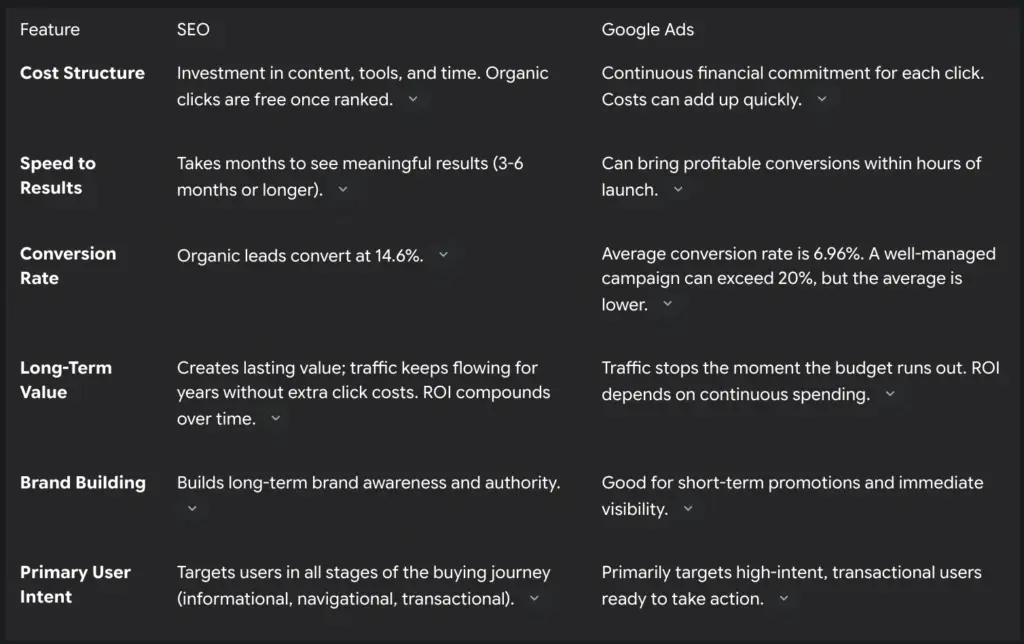
A common question for SME business owners is where to invest their marketing budget. While Google Ads can deliver fast, immediate results, a closer look at the data reveals a compelling long-term advantage for a robust SEO strategy. The evidence indicates that organic SEO leads convert at a significantly higher rate than traditional outbound marketing methods, reaching an average of 14.6% compared to just 1.7%. When compared to the average Google Ads conversion rate of 6.96%, the superior conversion power of organic traffic becomes even more apparent.
This is not to say that Google Ads cannot achieve high conversion rates. In fact, some well-managed, tightly targeted paid campaigns can achieve conversion rates of 20% or higher. However, this is a notable exception that requires a great deal of skill, continuous investment, and a financial commitment that stops the moment the advertising budget is exhausted. A key distinction lies in the nature of the traffic and the underlying trust that drives conversions. Organic traffic arrives from a search listing that Google has deemed authoritative and relevant. This inherent trust, built over time, is an invaluable asset that is not easily replicated by a paid advertisement. The high conversion rate of organic traffic is a direct, measurable return on the trust investment a business makes through a long-term SEO strategy. It means that SEO is not just a traffic channel; it is a pre-qualified, trust-based sales channel that builds compounding value over time without an ongoing cost per click.
The following table provides a strategic comparison of SEO and Google Ads to help clarify their respective roles and benefits for a business focused on sustainable growth.
The Power of Credibility: Building Trust as Your Ultimate Conversion Asset
In the digital realm, trust is a form of currency. For an SME business owner, the importance of trust and credibility cannot be overstated, as they directly impact the likelihood of a visitor taking a desired action. Without a strong sense of trust, a user is far more likely to “bounce”—to leave the website after viewing a single page. They may be hesitant to share personal information, make a purchase, or even engage with the content, regardless of how compelling the offer might be.
This is where the symbiotic relationship between SEO and CRO comes to fruition. The very factors that Google uses to determine a site’s authority and ranking—its Expertise, Experience, Authoritativeness, and Trustworthiness (E-E-A-T)—are the same factors that a human visitor looks for to build confidence in a brand. A site that has earned a high organic ranking has already been validated by a sophisticated algorithm. This pre-established trust, which is a key component of a successful SEO strategy, translates directly into a higher likelihood of conversion once the user lands on the site. This forms a virtuous cycle: by dedicating resources to build credibility for SEO, a business is simultaneously building the foundation for a more effective CRO strategy.
Actionable Trust Signals for Your Website and Content
To effectively build this trust and credibility, an SME owner can implement a range of actionable signals across their website and content.
Social Proof: People are psychologically inclined to follow the actions of others, a phenomenon known as social proof. Leveraging this can significantly boost conversion rates. Practical examples include displaying customer testimonials, case studies, and positive reviews. Showcasing user-generated content (UGC), such as customer photos or videos, and mentioning media features or affiliations with well-known brands can also provide powerful third-party validation.
Transparency and Authority: A business must be upfront and honest with its audience to establish trust. This includes crafting a detailed and factual “About Us” page that tells the company’s story, shares team backgrounds, and establishes their expertise in the industry. Clear and easy-to-find contact information also provides an instant sense of accessibility and credibility. Furthermore, transparent policies—such as a clear privacy policy, terms of service, and refund or return policies—are essential for reassuring customers and reducing perceived risk.
Security and Professionalism: A website’s design and technical security play a crucial role in building confidence. Displaying security badges and SSL certificates reassures visitors, particularly on pages that handle sensitive information like payments. A professional, clean, and consistent website design also reflects a reliable and trustworthy brand, as a user’s perception of a site’s usability is directly linked to its trustworthiness.
Your Strategic Blueprint for SEO CRO
Phase 1: The Foundation – Research and Data Analysis
The journey to higher conversion rates begins with a methodical approach to data collection and analysis.
Step 1: Define Your Conversion Goals. Before analyzing any data, a business must clearly define what a conversion means to them. This involves identifying both primary goals (macro-conversions) and smaller, contributing actions (micro-conversions). For example, a macro-conversion for a SaaS company might be a subscription, while micro-conversions could include a free trial signup or a resource download. Having these goals in place provides a clear benchmark for measuring the success of any optimization efforts.
Step 2: Gather the Right Data. This is the most critical step in the process and requires a dual approach. First, collect quantitative data to understand what users are doing on the site. This data, available through tools like Google Analytics, includes metrics like bounce rates, pages per session, time on page, and user flow through the site. Second, gather qualitative data to understand why users are behaving in that way. Tools like Microsoft Clarity and Hotjar provide valuable insights through heatmaps and session recordings, which visualize user clicks, scrolls, and navigation patterns. This is supplemented by user feedback from surveys and direct customer interviews.
Step 3: Identify Conversion Barriers. With a comprehensive view of both the “what” and the “why,” it becomes possible to pinpoint the friction points where visitors are abandoning their journey. For example, a high exit rate on a payment page might indicate that the checkout form is too complicated or that the required payment options are not available. This data-driven diagnosis is essential for making informed decisions about where to focus optimization efforts.
Phase 2: The Scientific Method – Formulating Hypotheses and Testing
Once the barriers are identified, the CRO process moves into a phase of scientific experimentation.
Step 4: Formulate a Hypothesis. A hypothesis is a formal statement that turns an identified problem into a testable solution. It should clearly state the issue, the proposed change, and the expected outcome. For instance, a hypothesis could be: “If we simplify the checkout form by removing unnecessary fields, we expect to see a 15% increase in completed purchases”. This specific, measurable statement is crucial for evaluating results.
Step 5: Test Your Hypothesis. This is where the hypothesis is put to the test. A/B testing is a foundational CRO method that allows a business to compare two versions of a page one with the proposed change and one without to see which performs better. It is important to only test one variable at a time to ensure that the results are clear and directly tied to the change. By splitting website traffic between the two variations, a company can determine with statistical confidence which version is more effective at converting visitors.
Phase 3: The Continuous Loop – Implementation, Monitoring, and Iteration
CRO is not a one-time fix but a long-term investment in a website’s effectiveness.
Step 6: Implement and Monitor. Once a winning variation has been identified through testing, the changes should be implemented permanently across the site. The process does not end there. It is crucial to continuously monitor the performance of these changes over time to ensure that the positive results are sustained. This continuous cycle of research, testing, and implementation is what drives ongoing growth and improvement, creating a cycle of learning that refines a business’s understanding of its customers with every iteration
Monitoring Your Success: A KPI Guide for Business Owners
For an SME owner, tracking the right metrics is essential for understanding the true impact of their CRO efforts. While the conversion rate is the central metric, a comprehensive view requires monitoring a range of Key Performance Indicators (KPIs).
The Essential KPIs: Measuring What Truly Matters
Metrics can be categorized into two groups: those that measure direct business outcomes and those that provide diagnostic information about user behavior.
Primary Metrics (The Business Outcomes):
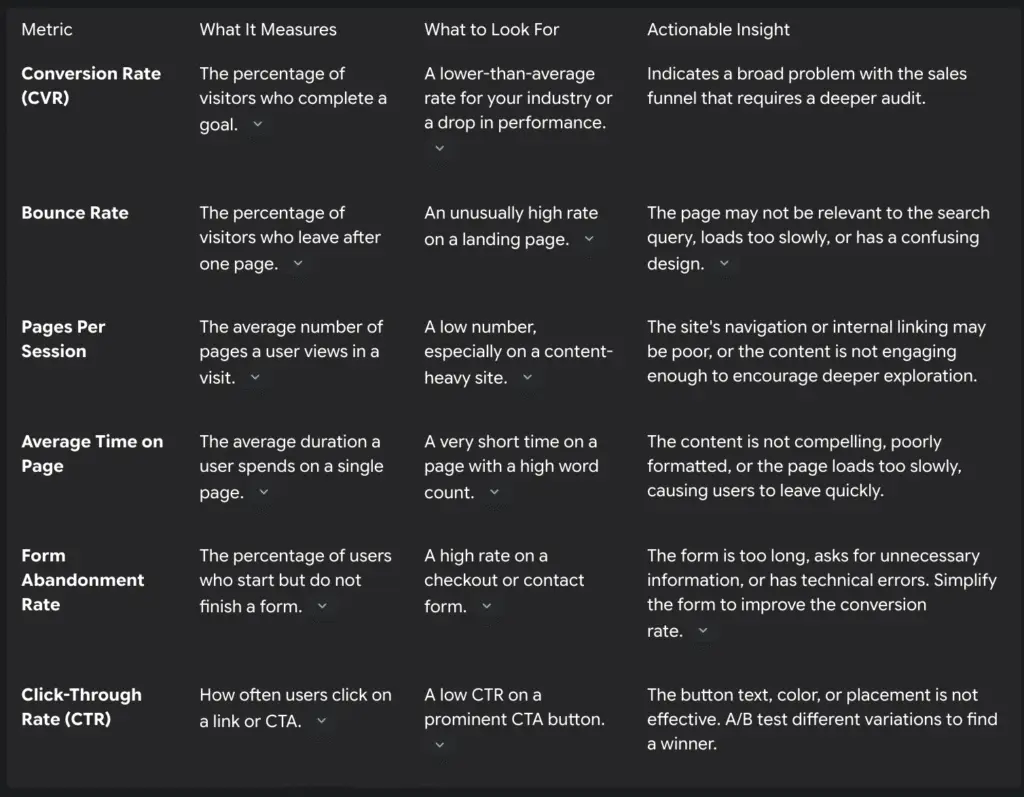
Conversion Rate (CVR): The most fundamental metric, it shows the percentage of visitors who complete a desired goal. The formula is straightforward: Conversion Rate =
(Number of Conversions / Total Visitors) × 100%Click-Through Rate (CTR): Measures how often users click on a call-to-action (CTA), link, or ad after seeing it. A high CTR indicates that a CTA is compelling and well-placed.
Cost per Acquisition (CPA) & Customer Acquisition Cost (CAC): These metrics quantify the cost to acquire a new lead or customer. CRO directly lowers these costs by increasing the conversion rate from existing traffic.
Customer Lifetime Value (CLV/LTV): Measures the total revenue a business can expect from a single customer over their relationship with the company. A strong CRO strategy can enhance CLV by creating a more satisfying user experience that encourages repeat business and loyalty.
Secondary Metrics (The Diagnostic KPIs): These metrics offer insight into the “why” behind the conversion numbers.
Bounce Rate: The percentage of visitors who leave a site after viewing only one page. A high bounce rate on a key landing page is often a red flag for poor content or a difficult user experience.
Average Time on Page / Pages Per Session: These metrics indicate user engagement. If users are spending a significant amount of time on a page and navigating to others, it suggests the content is compelling and well-structured.
Form Abandonment Rate: The percentage of users who start filling out a form but do not complete it. This is a clear indicator of friction in a lead capture process.
Monitoring Your KPIs: How to Get the Data
For an SME owner, monitoring these KPIs does not require expensive or complex software. Google Analytics is the industry standard and a free, powerful tool for tracking a wide range of quantitative data. It allows a business to set up conversion goals and analyze reports to see how different segments of users behave. For the qualitative “why,” free tools like Microsoft Clarity provide heatmaps and session recordings that show precisely how users are interacting with a page, identifying points of confusion or frustration.
The following table translates key CRO metrics into a practical diagnostic dashboard.
Benchmarks and Reality: What Good Looks Like for a Malaysian SME
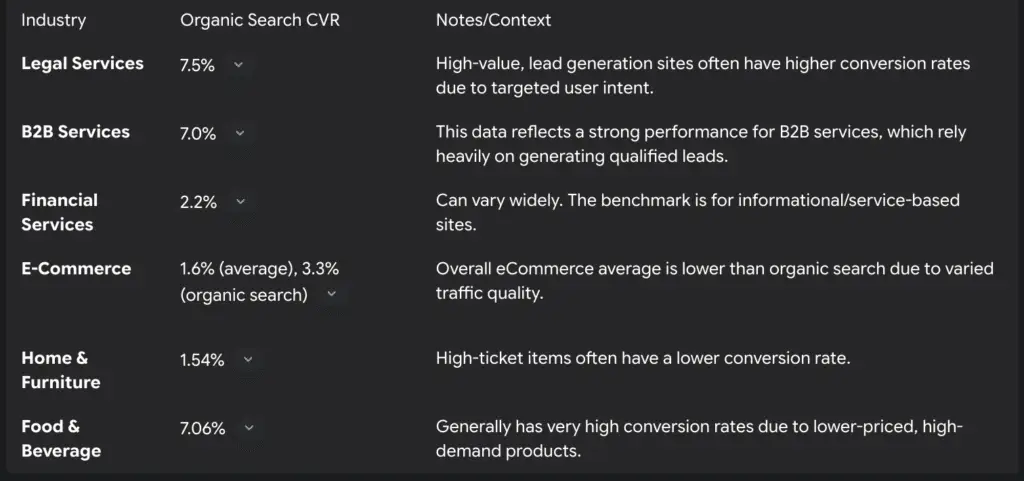
For SME owners, it is natural to want to know what a “good” conversion rate is. While global benchmarks can provide a general idea, it is important to understand their limitations. The average global eCommerce conversion rate is approximately 1.99%, while the average across 14 industries is around 2.9%. A “good” eCommerce rate is generally considered to be above 2%. However, these numbers can be highly misleading, as conversion rates vary significantly by industry, product value, and traffic channel.
A critical element of this analysis is recognizing that while there are many sources discussing “Malaysia” and “conversion rates,” a closer look reveals they are almost entirely discussing economic or currency exchange rates, not digital marketing performance. There is no publicly available, definitive benchmark for digital marketing conversion rates in Malaysia. A true expert approach acknowledges this absence of data and provides actionable, localized strategies in its place. The report must provide real-world value by addressing the specific, identifiable challenges faced by Malaysian SMEs in converting online traffic into sales.
A Local Perspective: Strategic CRO Insights for Malaysian SMEs
The available research provides valuable localized insights into the expectations of a typical Malaysian online shopper. These consumer behaviors and preferences can be leveraged to craft a highly effective CRO strategy. Malaysian mobile shoppers, for example, expect fast-loading pages, seamless checkout processes, and multiple payment options, including e-wallets.
Based on these local expectations, a Malaysian SME can implement a range of strategic “quick wins” to improve their conversion rates.
Payment Optimization: Immediately add Malaysian-specific payment methods and popular e-wallets to the checkout process.
Localized Pricing and Promotions: Implement psychological pricing (ending prices in.99 or.97) and leverage popular local shopping seasons and holidays like Hari Raya, Merdeka Day, or the year-end sales.
Language and UX Testing: Conduct A/B tests on key elements like CTA buttons, testing different options such as English vs. Malay text and varied colors or placements.
Mobile-First Design: Prioritize mobile-friendly design improvements and ensure that product images load quickly on mobile data.
The following table provides a realistic view of conversion rates by industry and channel, using the most reliable data available to provide a useful proxy for what a Malaysian SME can aim for.
Conclusions & Recommendations
The analysis presented in this report leads to several clear and actionable conclusions for SME business owners in Malaysia. The era of simply chasing traffic is over. True, sustainable business growth in the digital space is a direct result of a holistic strategy that combines SEO with Conversion Rate Optimization.
The evidence overwhelmingly supports the superior, long-term value of a strong organic presence. Organic traffic not only converts at a significantly higher rate than paid advertising on average, but its conversion power is built on a foundation of trust and credibility that compounds over time. By investing in SEO to become an authority in your field, you are simultaneously building the essential trust signals that will persuade visitors to convert once they arrive on your site.
For a Malaysian SME, a CRO strategy is not a “nice to have,” but an essential tool for turning a struggling digital presence into a profitable one. With a wealth of free and low-cost tools and a clear, scientific process, it is possible for any business to systematically identify and remove the barriers to conversion on their website. The key is to shift the focus from a single, elusive benchmark number to a continuous process of data-driven improvement. By prioritizing localized strategies that meet the unique expectations of the Malaysian market—from payment options to cultural promotions—a business can ensure that every visitor who arrives is not just a statistic, but a tangible opportunity for growth.