The digital landscape is undergoing a fundamental transformation, with Google’s Search Generative Experience (SGE), now widely known as AI Overviews, signaling a new era of search. This is not a mere update; it is a paradigm shift from a traditional search engine to a dynamic, AI-powered assistant. While initial data reveals a potential decline in traditional click-through rates (CTR) for both organic and paid results, this shift presents a strategic opportunity for forward-thinking SME business owners. The core of this advantage lies in a simple but powerful realization: Search is no longer just about driving traffic volume; it is about attracting higher-quality, more qualified traffic.
The Foundation — Understanding Website Traffic Monitoring for SMEs
1.1. Introduction: Why Traffic Monitoring is a Necessity, Not a Luxury
In the increasingly competitive digital landscape of Malaysia, a business’s online presence is not merely a marketing accessory; it is a fundamental determinant of its survival and growth. As consumers in Malaysia spend more time online—searching for products, comparing services, and reading reviews—a brand that does not appear on the first page of search results is essentially invisible to its target audience. This lack of visibility can directly translate into a significant loss of potential customers, particularly those who are already in the consideration or transactional phase of their buying journey.
To address this challenge, it is imperative for SMEs to embrace a data-driven approach to their online presence. Unlike paid advertising, which ceases to deliver results the moment the budget runs out, a well-executed search engine optimization (SEO) strategy provides a long-term return on investment (ROI), with organic traffic continuing to bring in visitors for months or even years after the initial work is completed. This longevity is a powerful advantage for SMEs, as it levels the playing field, enabling them to compete effectively with larger corporations by capturing intent-driven traffic and building brand credibility. Therefore, the core problem for many SMEs is not just low traffic, but a fundamental lack of digital presence and authority, which the right set of tools is specifically designed to solve. The blog post will frame traffic monitoring tools not as isolated metrics dashboards, but as essential components of a cohesive, long-term strategy for building brand authority and generating qualified leads.
1.2. The Free Essentials: Your Core Data Engines
1.2.1. Google Analytics (GA4): Your Business Intelligence Hub
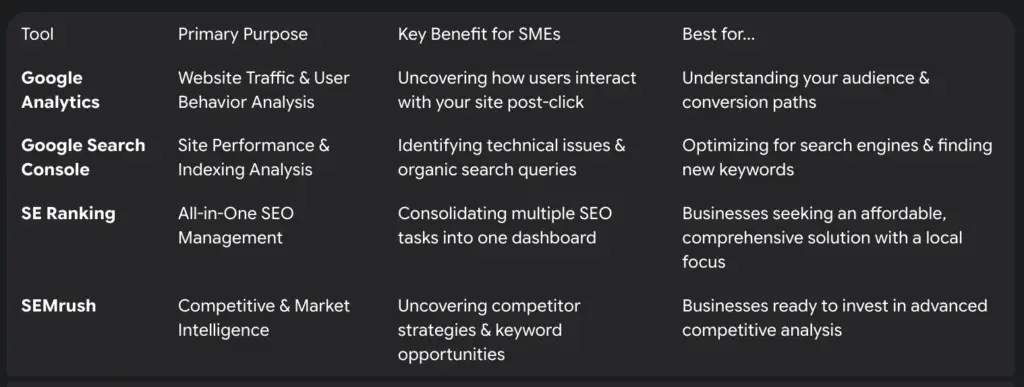
Google Analytics 4 (GA4) represents a significant evolution in web analytics, moving from a traditional session-based model to a more flexible and granular event-based approach. This shift allows businesses to gain a deeper understanding of customer interactions across their websites and apps, tracking specific user actions such as clicks, video views, and downloads rather than just page views and sessions.
GA4 offers a suite of features that are invaluable for small and medium-sized enterprises. Its enhanced machine learning capabilities provide automatic insights into website trends and user behavior, helping businesses to anticipate future customer actions and optimize their marketing efforts. For SMEs, this means the ability to analyze user behavior by visualizing user flows to understand how visitors navigate the site, identifying high-traffic pages, and tracking micro-conversions like form completions or newsletter sign-ups. The tool also provides predictive metrics, such as purchase probability, to help inform data-driven decisions. GA4’s cross-device and cross-platform tracking capabilities enable businesses to develop a more effective multichannel marketing strategy by following the customer journey across various devices and platforms.
1.2.2. Google Search Console (GSC): The Direct Line to Google
Google Search Console (GSC) serves as the essential bridge connecting a website directly to Google’s Search Engine Results Page (SERP). While Google Analytics provides information on what users do
after they arrive on a site, GSC offers critical insights into how they found it in the first place. The tools and reports within GSC help businesses measure their site’s Search traffic and performance, fix technical issues, and ensure their content is optimized for Google Search results.
For SMEs, GSC is a critical tool for understanding their search visibility. It allows them to see which queries are bringing users to their site and to analyze impressions, clicks, and their average position in the SERP. Businesses can also use GSC to submit sitemaps and individual URLs for crawling, ensuring that Google has the freshest view of their site’s content. Furthermore, GSC provides email alerts for significant technical issues and allows businesses to monitor key metrics like Core Web Vitals to assess page speed and overall user experience.
There exists a crucial, complementary relationship between GA4 and GSC. GSC provides the vital data on site health and visibility, telling a business if Google likes their site and how it performs in search. This information, such as ranking position and organic queries, directly informs the analysis within GA4. GA4 then takes over to analyze user behavior after the click, providing details on what users do on the site, their navigation paths, and whether they convert. This symbiotic duo provides a holistic view of the entire organic customer journey, from initial search to final conversion, and is a pairing that every business owner must understand and leverage.
Investing in Visibility — Paid Tools for a Competitive Edge
While free tools like GA4 and GSC are essential for a data-driven foundation, a competitive market like Malaysia requires an investment in advanced tools that provide a deeper level of market and competitor intelligence. The cost of these professional keyword research tools is a significant but necessary expense, often exceeding RM500 per month. However, this is an investment that saves a business money in the long run by preventing wasted time and effort and reducing the temptation to resort to ineffective or risky black-hat SEO practices.
2.1. SE Ranking: Your All-in-One SEO Command Center
SE Ranking is a versatile and user-centric platform that serves as an all-in-one SEO solution, making it an ideal entry point for SMEs beginning their investment in paid tools. Its comprehensive features are consolidated into a single dashboard, simplifying complex SEO tasks into an easily manageable workflow.
The platform’s core strengths include its rank tracking capabilities, which provide accurate daily monitoring of keyword positions across global and local search engines, a feature particularly valuable for Malaysian businesses focused on attracting local customers. SE Ranking also offers insightful competitor analysis, allowing businesses to benchmark their efforts against rivals to uncover strategic gaps and opportunities. Its built-in website audits can detect technical problems and on-page errors, while its backlink monitoring helps maintain a strong backlink profile. For the business owner, SE Ranking provides actionable on-page SEO recommendations, customizable marketing plans, and flexible reporting options that can be tailored to the specific needs of the business.
The flexible pricing structure, with plans starting from $39 per month or $65 per month , makes it an accessible and strategic choice for SMEs looking to gain a competitive advantage without a prohibitive financial commitment. The platform’s strong focus on local SEO enhancements further aligns its value with the needs of the Malaysian market.
2.2. SEMrush: The Powerhouse for Market and Competitor Intelligence
SEMrush is a top-tier SEO platform, widely recognized for its extensive keyword database containing over 20 billion keywords and its robust competitive analysis features. For businesses looking to go beyond the basics and perform in-depth market research, SEMrush is a powerful asset.
Its strategic value for SMEs lies in its ability to provide deep market intelligence. The Keyword Gap tool allows for a direct comparison of a business’s keyword rankings with those of up to four competitors, revealing keywords they rank for that are currently “missing” from the business’s own profile. The Topic Research tool provides insights into what a target audience is searching for, enabling the development of content that resonates and ranks higher on Google. Furthermore, SEMrush’s Organic Traffic Insights tool can reveal keywords masked by Google Analytics’ “not provided” label, offering a clearer picture of the actual terms driving traffic to a website and providing an additional advantage over competitors.
While its starting price of around $140 per month is at a higher tier , its powerful data and AI-powered features for content creation and personalized keyword suggestions make it an indispensable tool for a business ready to scale its SEO efforts and outmaneuver its competition.
The choice between SE Ranking and SEMrush for an SME is a strategic one, based on their current stage of growth. SE Ranking, with its lower entry price and user-friendly, all-in-one dashboard, is an ideal tool for day-to-day management and local focus. SEMrush, with its extensive database and advanced features, is positioned as a more advanced competitive intelligence tool for businesses ready to invest in deeper market research and gain a significant edge. This tiered approach provides actionable, growth-oriented advice for an SME.
The Blog Post — Crafting Content That Converts
3.1. Optimizing the Title and Description: Your First Impression
The title and meta description of a blog post are not just labels; they are critical on-page SEO elements that serve as the first impression to potential visitors in search results.
Meta Title: For optimal display and user experience, a meta title should be concise, ideally under 60 characters. The primary keyword, such as “Tools for traffic,” should be placed as far to the left as possible to signal its relevance to both search engines and users. Modifiers and secondary keywords can be included to capture long-tail variations, and a pipe (|) is a useful symbol to separate the main title from a brand name or secondary phrase. The title should be written to appeal to humans, not just algorithms, with an emotional hook or a clear promise of value to encourage a higher click-through rate.
Meta Description: While not a direct ranking factor, a well-written meta description can significantly boost click-through rates. The description should use the full available space, typically 155 to 160 characters, to act as a mini-advertisement for the page. It should address the user’s search intent, include the primary and, if possible, a secondary keyword, and contain a compelling call to action. When a user’s query matches a keyword in the meta description, Google often bolds the term, making the result stand out and appear more relevant. This convergence of technical optimization and user-centric copywriting is key to success, as search engines increasingly reward content that provides a positive user experience.
3.2. The Full Blog Post: A Detailed Content Outline
The full blog post will be structured to provide a logical flow of information, guiding the SME business owner from a foundational understanding to a strategic, actionable plan.
Introduction: Begin by addressing the pain point of not knowing how to effectively monitor website performance. Hook the reader by emphasizing that in Malaysia’s competitive market, a data-driven approach is the only way to ensure long-term growth.
Section 1: The Free, Foundational Tools: Dedicate this section to explaining the distinct but complementary roles of Google Analytics 4 and Google Search Console. Frame them as the essential “engine” and “bridge” for an SME’s digital presence. Include actionable, simplified steps for setup and initial use.
Section 2: Stepping Up with Paid Tools: Introduce SE Ranking and SEMrush as the “competitive advantage” tools. Compare their features and pricing to help SMEs make an informed choice based on their budget and goals. This section positions the user as an expert who provides a strategic roadmap for growth.
Section 3: Beyond the Tools: A Malaysian SEO Strategy: This section will provide the core, localized value of the post. Discuss the critical importance of a local SEO strategy for Malaysian businesses, including optimizing Google Business Profile, managing local reviews, and building local citations. Weave in keywords such as “SEO malaysia” and “SEO marketing Malaysia” naturally. Highlight how content marketing and link-building have led to measurable success for local companies.
Conclusion: Summarize the key takeaways, reinforcing that the right tools, when used as part of a cohesive strategy, can transform a business’s online presence. End with a strong call to action, driving the reader to download the accompanying lead magnet.
3.3. Image Alt Text: The Hidden SEO Opportunity
Image alt text is a vital SEO element that improves both search engine crawlability and accessibility. The text should be useful, information-rich, and contextual to the page’s content, while avoiding the practice of keyword stuffing, which can harm user experience and lead to a site being flagged as spam. For accessibility, a screen reader reads the alt text aloud, so it should be a brief, natural-language summary of the image’s purpose.
Local Market Insights — Strategic Recommendations
5.1. Navigating the Malaysian SEO Landscape
The digital ecosystem in Malaysia is distinguished by its cultural diversity, multilingual audiences, and a growing appetite for e-commerce, making a nuanced SEO strategy essential. The local SEO landscape is particularly important, as many Malaysians rely on phrases like “best café in KL” or “digital marketing agency in Penang” to find businesses near them. A successful strategy must, therefore, rely on factors such as proximity and relevance, emphasizing the optimization of a business’s Google Business Profile and local directory listings.
The pricing of SEO services in Malaysia varies widely, with monthly retainers typically ranging from RM900 to RM10,000 or more, and hourly rates for freelancers between RM150 and RM450. This context provides a compelling argument for the value proposition of the blog post and lead magnet. By offering a detailed guide on using essential tools, the content empowers SMEs to take a cost-effective first step in their digital journey. It also primes the audience to understand the value of professional help down the line, positioning a full-service retainer as a logical and justifiable investment.
5.2. Case Studies: Lessons from Successful Malaysian Businesses
Real-world examples demonstrate the tangible impact of a well-executed SEO strategy in the Malaysian market. Case studies show that strategic implementation, which includes a focus on content marketing, link-building, and local optimization, has led to significant increases in organic traffic, conversions, and sales for Malaysian companies. One example highlights a 561% increase in organic traffic and a 260% increase in conversions, while another showcases a 40% rise in sales for a local business. These results are not merely vanity metrics; they represent a fundamental change in a business’s ability to compete and grow. The lessons from these success stories reinforce the idea that long-term, data-driven strategies are the key to building a strong online presence and staying ahead of competitors.
5.3. Actionable Next Steps for Content Promotion
Following the publication of the blog post, a targeted promotional strategy is recommended to maximize its reach and lead-generation potential.
Social Media Amplification: Share the new blog post and its key takeaways on relevant social media platforms to drive initial traffic and brand awareness.
Targeted Ads: Consider running targeted ad campaigns on platforms where the SME audience is active, with a clear call to action to download the eBook lead magnet.
Future Content Roadmap: Develop a series of follow-up blog posts that deep-dive into each of the tools mentioned, such as “A Beginner’s Guide to GA4 for Malaysian SMEs” or “7 SE Ranking Features to Outsmart Your Competitors.” This creates a content cluster that builds topical authority and provides a comprehensive resource for the audience.
Final Synthesis and Strategic Outlook
Success in the digital landscape requires a strategic and data-driven approach. The tools discussed from the foundational Google Analytics and Search Console to the professional-grade SE Ranking and SEMrush are not merely metrics dashboards but essential components of a cohesive digital growth strategy. By framing these tools as part of a long-term investment, the content can empower Malaysian SME business owners to take control of their online presence. The blog post will serve as an educational pillar, while the eBook will act as a practical lead magnet, providing immediate value that builds trust and sets the stage for a lasting client relationship. The final strategy is designed to deliver not just information, but a clear, actionable roadmap for digital success.