The rise of “Zero-Click” searches and the Google AI Overview is fundamentally reshaping the digital landscape, causing significant organic traffic drops for SMEs. Discover a three-phased SEO strategy focused on E-E-A-T content, strategic keyword validation, and conversion optimization to secure your visibility in the age of generative AI.
The New Reality of Organic Traffic
The Core Challenge: Why Your Clicks Are Vanishing
For SME business owners, organic traffic is historically viewed as the bedrock for predictable lead generation and sustained growth. Consequently, a sudden, persistent decline in website traffic often signals a critical shift in search engine dynamics that cannot be addressed by simple optimization tactics. This decline is not merely a ranking fluctuation; it is a fundamental alteration in how users interact with the Search Engine Results Page (SERP).
The primary reason why traffic is dropping for many businesses is the core concept of the “Zero-Click” search. A Zero-Click search occurs when a user successfully obtains the answer to their query directly on the SERP without ever needing to click through to any external website. This phenomenon is directly responsible for declining website clicks, forcing SMEs to reconsider the utility of achieving traditional organic positions.
This trend has been aggressively accelerated by the widespread introduction of generative features, notably the Google AI Overview. These AI-generated summaries appear at the top of the search results, situated above traditional links. The AI Overview synthesizes complex answers by drawing information from multiple authoritative sources using large language models. The presence of these AI answers significantly diminishes the value of even a top rank; data confirms that when an AI Overview is present, the Click-Through Rate (CTR) of the first organic result plummets dramatically, dropping from an average of 7.3% to a mere 2.6%. This means that top-ranking content is increasingly overlooked, as the search engine itself provides the final answer on its own domain.
Understanding the SEO Funnel: From Ranking to Leads
Effective Google SEO must be understood as a clear pipeline: Keyword Ranking $\rightarrow$ Targeted Traffic $\rightarrow$ Lead Conversion. When traffic declines, this vital chain is fractured. Historically, the focus was securing position #1 to drive the largest volume of traffic. However, the Zero-Click environment has redefined the relationship between ranking and traffic.
The strategic implication of Zero-Click searches is that they act as an intense filter. While overall traffic volume may decrease, the visitors who still click through to the website, despite the instant answer provided by the AI Overview, are often further along in their buyer journey and possess higher commercial intent.5 These visitors are not simply browsing; they are seeking deeper validation, comparison, or specific transactional details. Therefore, if the traffic drop is confirmed to be Zero-Click-driven, the strategic goal must pivot. The focus is no longer pure volume, but rather optimizing the landing page conversion rate (CRO) to maximize the return from this smaller, but highly qualified, pool of engaged visitors.6 This conversion-focused approach requires exceptional, authoritative SEO Content that immediately validates the company’s expertise and experience upon arrival.
Decoding Zero-Click Search and the AI Threat
How Zero-Click Searches Redefined Visibility
Zero-click results are delivered through various on-SERP features, including standard Featured Snippets, direct answers provided by Knowledge Graphs, and, particularly critical for service-based SMEs, the Local Pack. For local businesses, the Local Pack often appears before traditional organic results, providing essential data like location, phone numbers, and hours pulled from an optimized Google Business Profile. This high prominence allows users to obtain necessary information immediately, making robust Local SEO a mandatory component of modern Google SEO.
This shift in how information is delivered has a quantifiable impact on user behavior. When quick answers are displayed, up to 26% of users cease their search entirely because their needs are satisfied, compared to 16% when no summary is shown. This demonstrates that the search engine is actively terminating the user’s journey before the SME website even has a chance to compete for the click. The competition is no longer just other websites; it is the search engine platform itself.
The Generative Threat: Impact of the Google AI Overview
The introduction and global rollout of the Google AI Overview have amplified the Zero-Click trend, causing significant shifts in web traffic flow. These generative summaries, placed at the SERP apex, are now capturing a significant portion of user attention, drastically reducing visibility for traditional organic listings.
The severity of the loss is considerable. Data confirms that organic traffic losses are not confined to a single sector; major publishers have reported losses as high as 79% of their organic traffic. For an SME, this level of decline is an existential threat. To counteract this, brands must shift their focus from merely achieving high rank to optimizing their content for inclusion within the AI Overview summary—a practice often termed Generative Engine Optimization. This requires a specialized form of content creation focused on clarity, authority, and alignment with how large language models process information, often utilizing entity-based optimization. Websites that successfully receive links within these AI Overviews tend to receive higher click-through rates from engaged users, whereas overall traffic to non-featured sites is dwindling.
The Hidden Cause: Dropping Keyword Demand
Before an SME invests significant resources into fixing content or technical structure, a critical diagnostic step involves determining if the decline is rooted in market relevance. It is essential to diagnose whether the keywords demand might be already dropping and the search volume is no longer at there, hence it caused the Zero Click happen.
There is a considerable cost associated with targeting the wrong keywords. If a business spends time and capital optimizing for a subject they believe is relevant, only to discover that few users are actively searching for that specific phrase, the entire investment is wasted. This phenomenon is compounded in a Zero-Click environment: the existing low demand for a keyword makes it effortless for quick-answer features to satisfy the remaining minimal search volume, pushing the click rate to zero. The traffic drop is then understood not as an SEO failure, but as a symptom of market decay or irrelevance. Therefore, the strategy must prioritize validating the long-term viability of the target keywords before any content quality fixes are implemented.
Phase 1: Strategic Keyword Recalibration and Market Validation
Moving Beyond Basic Search Volume
Relying solely on the monthly search volume average for a keyword provides an incomplete and often misleading picture of market viability. This static metric fails to account for seasonality, temporary market shifts, or long-term structural industry changes.
Effective Google SEO for SMEs requires strategic targeting: focusing on keywords that align with transactional or high-intent user phases, such as specific product comparisons or service pricing inquiries. These complex, bottom-of-funnel queries are less likely to be fully resolved by a generic Google AI Overview summary. Furthermore, embracing the long-tail and conversational keywords strategy offers a dual benefit: these terms generally have less intense competition, making ranking achievable, and they inherently reflect higher user intent, leading to a higher conversion probability among those who do click through.
Deep Dive Metrics: Analyzing Momentum and Longevity
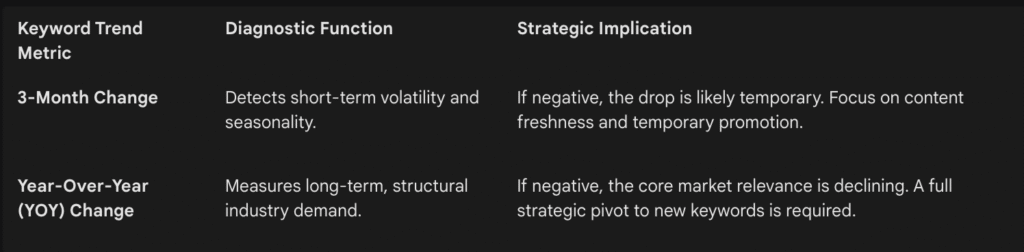
Strategic keyword viability analysis demands the use of advanced trend metrics beyond the monthly average. As stipulated, the solution requires re-doing keyword research and looking into additional metrics such as the 3 months and YOY changes.
The 3-Month Change metric compares the latest month’s search volume against the volume from two months prior. This is an immediate indicator of short-term shifts. If this trend is strongly negative, it signifies that on these 3 months people are less likely to search for the keywords anymore. This fluctuation often points toward seasonality or temporary changes in consumer focus.
Crucially, the Year-Over-Year (YOY) Change compares the latest month’s volume against the exact same month in the previous year. This metric provides the decisive diagnosis regarding long-term market structural health. If the YOY trend is significantly negative, it confirms that in long term basis, this industry demand might be dropping. If both these metrics are negative, particularly the YOY change, it strongly suggests that resources must be immediately shifted away from optimizing obsolete keywords toward finding entirely new, rising market segments, preventing the sinking of funds into dead-end markets.
The relationship between these metrics guides the resource allocation:
Keyword Trend Validation Matrix: Structural vs. Seasonal Drop
Phase 2: Building Authority with E-E-A-T Content Structure
The Mandate for Trust: E-E-A-T as the Competitive Edge
If initial analysis confirms that market demand is stable (YOY change is neutral or positive), but ranking or CTR remains low, the issue shifts entirely to content quality and digital authority. If both trend analysis and keyword ranking show stability but traffic is not increasing, then attention must be paid to the content structure. Implementing an authoritative content strategy using the EEAT Content structure (Experience, Expertise, Authoritativeness, Trustworthiness) is the mandatory solution to increase ranking and capture featured position.
High E-E-A-T is not merely a ranking factor; it is the prerequisite for being selected as a reputable source by the generative AI models that power the Google AI Overview. Search engines place a high value on trust signals, particularly for topics that fall under the “Your Money or Your Life” (YMYL) category, which often includes financial and health services relevant to many SMEs. Authoritative content also improves click-through rates because users feel confident engaging with trustworthy content.
Actionable Steps to Boost Expertise and Experience
To genuinely demonstrate E-E-A-T, SMEs must go beyond surface-level content:
Demonstrating Expertise (E) and Experience (E): Content creators and contributors must highlight their practical knowledge and credentials. Every piece of SEO Content should include a clear author byline that links to a detailed author profile highlighting relevant credentials, experience, and specific subject matter expertise. For specialized topics, clearly displayed qualifications are essential. Furthermore, the content itself must integrate evidence of first-hand experience, such as proprietary data, detailed case studies, or process walkthroughs, rather than simple regurgitation of common knowledge.
Establishing Authoritativeness (A) and Trustworthiness (T): Trustworthiness is built through accuracy and external validation. To build authority, SMEs should prioritize publishing high-quality content that naturally encourages external links from authoritative, related sites. All claims and data must be supported by proper citations and links to authoritative external websites. Maintaining trustworthiness also requires a commitment to regularly update articles, guides, and blogs to ensure factual accuracy and technical relevance, maintaining long-term E-E-A-T compliance
Optimizing SEO Content for AI Retrieval
The immediate competitive environment demands that content not only achieves authority but is also structured specifically for quick retrieval by both standard SERP features and the Google AI Overview. This requires adopting a “snippet mindset.”
To increase the chances of content appearing in zero-click features, the SEO Content must be organized with clear, concise answers to common industry queries. This involves structuring sections using definitions, bulleted lists, and numbered steps that can be easily parsed for Featured Snippets. Additionally, implementing structured data (Schema Markup) is critical, as it helps search engines understand the context and core data points of the content, boosting the page’s eligibility for rich results and improving AI processing. Finally, even when content satisfies a user’s initial informational query via a zero-click feature, the written material must insert deeper value and detail to encourage the highly qualified user to visit the site for more in-depth information.
Phase 3: Technical Validation via Google Search Console
Diagnosing Ranking Discrepancies
After strategic market validation (Phase 1) and comprehensive content restructuring (Phase 2), the final, mandatory step is technical diagnosis using the Google Search Console (GSC). This platform provides objective evidence that differentiates between a strategic content failure and a fundamental technical fault.
The first step in using GSC is ruling out technical faults that prevent indexing. The Page Indexing report should be checked immediately. A sudden drop in the number of ‘Valid’ indexed pages indicates a site-wide technical issue, such as issues with the robots.txt file or incorrect canonicalization, which will suppress all traffic regardless of content quality. Resolving indexing errors must precede any further content investment.
Advanced Search Console Debugging
The era of relying on absolute ranking position for high traffic volume is concluded, largely due to the permanence of the Zero-Click economy and the rise of the Google AI Overview. Sustainable Google SEO success for SMEs hinges on a strategic shift away from high-volume, low-intent traffic toward authoritative content that maximizes conversion from qualified visitors.
The prescribed approach requires a systematic, three-phased methodology: first, strategically validate that market demand is viable using YOY trend data; second, rigorously build brand authority and trust through the EEAT Content structure to be selected as a source by generative AI; and third, use Google Search Console as the technical validation layer to ensure the SEO funnel is not broken by technical errors or severe CTR erosion. By focusing resources on high-intent, authoritative SEO Content, SMEs can move beyond the fear of vanishing clicks and capture high-value leads ready for conversion.
Conclusion: Recapturing the Engaged Audience
Once indexing is confirmed as healthy, the Performance Report provides the necessary detail to diagnose the specific type of traffic drop.
Defining the Drop Pattern: The Performance Report must be configured using the date filter to pinpoint the exact period of the traffic drop. Crucially, the comparison feature should be utilized, comparing the drop period against an equivalent prior period (e.g., the identical timespan immediately preceding the drop).
Isolating CTR Failure: Analyzing the comparison metrics is essential:
If both Impressions (visibility) and Clicks have dropped significantly, the issue is typically a large-scale loss of position, often caused by an algorithmic update or persistent technical issue.
If Impressions are stable or have increased, but Clicks are significantly down, this directly confirms a Zero-Click CTR failure. This validation confirms that the existing content is visible but is failing to convert visibility into engagement, solidifying the need for the EEAT Content structure optimization strategy.
Pinpointing Resource Allocation: Using the ‘Pages’ report in GSC, SMEs can order the results by ‘Clicks Difference’ to identify the few pages that have lost the most traffic. This ensures that resources for content and technical remediation are focused on the highest-value pages, ensuring maximum return on effort. Additionally, reviewing the ‘Queries’ report allows the business to compare top queries in their region to those currently driving traffic, identifying content gaps related to rising industry trends. This insight provides a direct roadmap for creating new SEO Content to address emerging market needs.
Grow your business today!
Do not allow the passive decline of organic traffic to jeopardize your lead generation pipeline. The permanent transformation of the search landscape demands immediate, expert intervention and a data-driven strategy.
Contact the woonyb.com SEO Strategy Team today to schedule an in-depth audit. We will provide a tailored diagnostic report leveraging advanced YOY data analysis and a full E-E-A-T compliance review to secure your visibility and lead generation in the AI search future.