The digital publishing landscape has fundamentally shifted. Generative AI tools have saturated the internet with surface-level information. For the forward-thinking SME business owner, securing digital visibility means mastering the EEAT Content structure. We detail why prioritising ‘Experience’ is your most reliable strategy for rising above generic SEO Content and securing a prominent position in the new era of search features like the Google AI Overview. By proving first-hand involvement and verifiable credentials, you build the trust required for long-term Google SEO success.
E-E-A-T Explained: Why "Experience" is Your Best Weapon Against AI Content
The digital publishing landscape has fundamentally shifted. The rapid proliferation of Generative AI tools has saturated the internet with easily produced, surface-level information. For the forward-thinking SME business owner, this presents a significant challenge: how does one ensure that their valuabxle SEO Content rises above the noise, differentiating itself from millions of identical, synthesized articles? The answer lies in mastering the EEAT Content structure, a critical quality framework developed by Google. This strategic commitment to verifiable quality is no longer an optional SEO tactic but an essential business strategy for securing digital visibility and credibility in the age of generative search features like the Google AI Overview.
This analysis details why embracing E-E-A-T—and specifically leveraging the ‘Experience’ element—is the most reliable path to achieving sustained ranking and consumer confidence.
What is the E-E-A-T Content Structure and Why It Matters
E-E-A-T is the sophisticated quality framework derived from Google’s Search Quality Rater Guidelines (QRG) used by human evaluators to assess the quality of web content and its creators. While the human ratings do not directly set rankings, the data gathered informs and guides Google’s complex automated systems, helping them determine which content is truly helpful and worthy of indexing. For any business aiming for longevity in search, understanding this framework is paramount.
Defining the Four Pillars of Digital Credibility
The E-E-A-T framework breaks down the concept of quality into four distinct, measurable attributes:
Experience (The differentiator): This element, formally added in December 2022, is defined by the content creator’s first-hand, real-world involvement with the subject matter. This requires demonstrating practical interaction, such as actually using a product, visiting a location, or living through a specific situation. Experience is demonstrated through authentic stories, unique data, and the use of original media (photos, videos) that prove direct engagement.
Expertise (The knowledge base): This reflects the author’s verifiable level of skill, deep knowledge, or formal/informal education in the topic area. Expertise is demonstrated by the sheer depth and comprehensive quality of the content, often supported by detailed author bios, credentials, and relevant qualifications.
Authoritativeness (The external recognition): This measures how widely recognized and respected the content creator or the entire website is within their industry niche. Authority is validated externally—it is not self-proclaimed—but rather earned through high-quality backlinks, citations, mentions in the press, and peer recognition.
Trustworthiness (The core foundation): Google explicitly defines Trust as the most important component of the entire family, noting that untrustworthy pages possess low E-E-A-T regardless of their apparent Experience, Expertise, or Authoritativeness. Trust encompasses transparency, accuracy, honesty, security (HTTPS), and reliability.
The strategic significance of the ‘Experience’ component must be underscored, particularly for SMEs. Highly capable AI tools are exceptionally effective at synthesizing existing knowledge and data, thereby replicating general Expertise and Authoritativeness (E-A-T) from indexed web pages. This synthesis results in an abundance of generic, recycled content. By prioritizing and documenting first-hand Experience, the SME gains a crucial advantage: they create content that is inherently non-replicable by AI because it relies on sensory, proprietary, or specific personal involvement that the algorithm cannot generate. This focus allows SMEs to compete not on volume or keyword saturation, but on the authenticity and unique insight that secures a competitive advantage against automated content generation.
E-E-A-T Content Structure Effectiveness for Google and AI Platforms
Mastering the EEAT Content structure is central to succeeding with Google SEO because it directly dictates the quality signals that Google’s highly complex automated systems prioritize. Sites with strong E-E-A-T signals rank better because the algorithms are calibrated to reward trustworthy information.
Securing Visibility in the Google AI Overview
The proliferation of generative search results, such as the Google AI Overview, means that only the most credible, high-E-E-A-T sources are selected for citation and prominent display. This evolution in search technology introduces a critical filter:
The Trust Filter: AI models rely heavily on strong E-E-A-T signals to prevent the spread of misinformation, inaccurate facts, or “hallucinations”. Content lacking robust signals of expertise and trustworthiness will simply not be deemed reliable enough to be featured or cited by Google’s new AI-driven search features.
The People-First Mandate: Google overtly rewards content created “primarily to help people,” prioritizing resources that offer original insights, reports, and unique perspectives—qualities inherent to high-E-E-A-T content. Conversely, Google views the use of automation, including AI generation, for the primary purpose of manipulating search rankings as a violation of its spam policies, making it clear that scalable, low-quality content is actively discouraged.
The Necessity of Human Oversight: If an SME chooses to utilize AI to assist in content generation, it is imperative that a real, qualified person review the output, rigorously fact-check its claims, and integrate genuine experience and personal insights that the AI cannot replicate. This human review process ensures the content reflects the necessary Expertise and prevents the risk of providing inaccurate or misleading information.
Content Indexation and the YBML Standard
Google applies increased scrutiny and weighting to E-E-A-T for YMYL (Your Money or Your Life) topics—those that could significantly impact a person’s financial stability, health, safety, or the welfare of society.
Extending Trust to B2B Operations: While the term YMYL traditionally covers personal finance or medical advice, B2B services often deal with “Your Business Money or Life” decisions. For instance, advising on significant capital investments, implementing critical IT infrastructure, or providing compliance guidance requires a level of rigor that mirrors YMYL standards. Therefore, SMEs operating in competitive B2B spaces must adopt YMYL-level standards by demonstrating verifiable credentials and high trust to satisfy the algorithm’s increasingly stringent quality demands across all competitive verticals.
E-E-A-T as Risk Mitigation: Google’s emphasis on E-E-A-T, particularly for high-stakes topics, functions as a public safety and quality assurance initiative. By implementing E-E-A-T principles, the SME is essentially self-certifying their content’s accuracy and integrity. This self-certification acts as a crucial form of risk mitigation, helping to ensure business continuity in search visibility by protecting the site from being de-indexed or severely penalized during broad core algorithm updates designed to filter out low-quality or potentially harmful information.
Ultimately, adherence to E-E-A-T boosts content visibility. Strong E-E-A-T signals content quality to Google, which reduces bounce rates and increases user trust, directly influencing rankings and visibility, especially for competitive SEO Content queries.
Building Unshakeable Trust and Credibility with E-E-A-T
Building credibility through the EEAT Content structure extends far beyond securing favorable search ranking metrics. It directly impacts commercial success by influencing user engagement, lead generation quality, and ultimately, conversion rates through the assurance that the business is a reliable, knowledgeable partner.
Gaining Authoritativeness Through Off-Site Validation
Authoritativeness is established when reputable sources recognize the SME as an expert; it is based on external validation, not internal claims. SMEs must strategically invest in external signaling activities:
Attracting Linkable Assets: Content deeply rooted in unique, verifiable experience naturally serves as a high-value, linkable asset. This type of content attracts high-quality backlinks from other authoritative websites, which are exceptionally powerful signals of Authoritativeness to Google. This creates a symbiotic feedback loop: unique Experience (on-page) drives Authoritativeness (off-page).
Brand Mentions and Entity Optimization: High-E-E-A-T businesses should systematically pursue mentions in industry press, feature their team members in podcasts or speaking engagements, and encourage positive branded searches. Google interprets these off-page signals—even those without direct links—as confirmation that the brand entity is well-established, respected, and often sought out in the field.
Schema Markup for Identity: To solidify this identity, businesses should utilize Schema markup (specifically the
SameAsproperty) to explicitly link their website to verified social media profiles and organizational identifiers. This technological step helps search engines consolidate the brand’s digital footprint, unifying its identity and assigning greater authority to the overall entity.
Trustworthiness: The Essential On-Site Signals
Because Trust is the most critical element, it requires consistent, meticulous demonstration across the entire website. Trust signals are visual and textual cues that build confidence and reassurance for visitors.
Transparency and Contact Information: A fundamental requirement for B2B trust is clear transparency. This necessitates providing clear “About Us” pages that detail staff biographies, certifications, and company history. Visible contact details, including a physical address, phone number, and email, are mandatory for establishing foundational credibility.
Technical Integrity and Security: Operating a secure, encrypted website (HTTPS) is a non-negotiable trust factor. Beyond security, a clean, professional, and fast-loading website design reinforces professionalism and reduces trust erosion caused by poor user experience.
Social Proof Integration: SMEs must actively display social validation. This includes embedding review widgets (from Google or industry-specific platforms), prominently showcasing client testimonials, and highlighting any industry awards or accreditations. These signals provide necessary social proof, assuring potential clients that others have benefited from the business’s expertise.
The meticulous documentation required for high E-E-A-T—detailed case studies, expert bios, verifiable results, and transparent methodology—aligns perfectly with the information required by a B2B buyer during their due diligence phase. Consequently, investing in E-E-A-T SEO Content minimizes the perceived risk of engaging with the SME, validates their claims before a sales call, and acts as a powerful sales enablement tool, resulting in higher quality leads and a potentially shorter sales cycle.
Integrating the EEAT Content Structure into Your Website (Actionable Guide)
For the SME business owner, E-E-A-T implementation must be efficient and targeted. The strategy should focus on optimizing the visibility of human assets and verifiable original work. Logical content structure utilizing proper heading tags is also essential for both readers and search engines.
The Three-Step Implementation Plan for SMEs
Successful implementation starts with auditing your existing digital assets against the four pillars:
1. Step 1: Auditing Your “Who” (Expertise & Authoritativeness)
Action: Create or overhaul comprehensive author biography pages and require all contributing writers to quantify their professional experience. List specific, verifiable credentials (e.g., “John Smith, CPA,” “Jane Doe, PMP”) directly within article bylines and link them to the detailed biography.
Guideline: The “About Us” page should be dedicated to detailing the team, their qualifications, company history, certifications, and any relevant industry awards or publications. This consistent repetition establishes your site and writers as credible authorities.
2. Step 2: Proving Your “How” (Experience)
Action: Pivot your content creation strategy away from summarizing general knowledge toward sharing first-hand accounts. Use original, proprietary media—unique photography, internal data sheets, or non-stock visual evidence—to accompany every key claim.
Guideline: Structure content, especially service descriptions or product reviews, to include sections detailing the methodology. For instance, include a clear “How We Tested” or “Our Client Success Story” section. If reporting on results, share details about the testing process and the evidence of the work involved.
3. Step 3: Securing Your “Why” (Trustworthiness and Structure)
Action: Ensure that your website adheres to a logical H-tag structure, using H2 tags for main thematic sections and H3 tags for subsections, which both aids readability and satisfies Google SEO requirements. Verify clear navigation to all legal, policy, and contact pages.
Guideline: Reinforce trust visually by displaying trust bars (e.g., secure checkout icons) and ensuring positive customer reviews and testimonials are embedded where users make crucial decisions.
Example: An E-E-A-T Content Blueprint for SME
This table demonstrates the practical, E-E-A-T-driven approach that an SME offering business guidance or specialized products can adopt immediately. This approach, exemplified by resource blogs created for small business merchants, ensures content addresses common hurdles with unique, expert-reviewed guidance.
EEAT Implementation Checklist for SME Owners
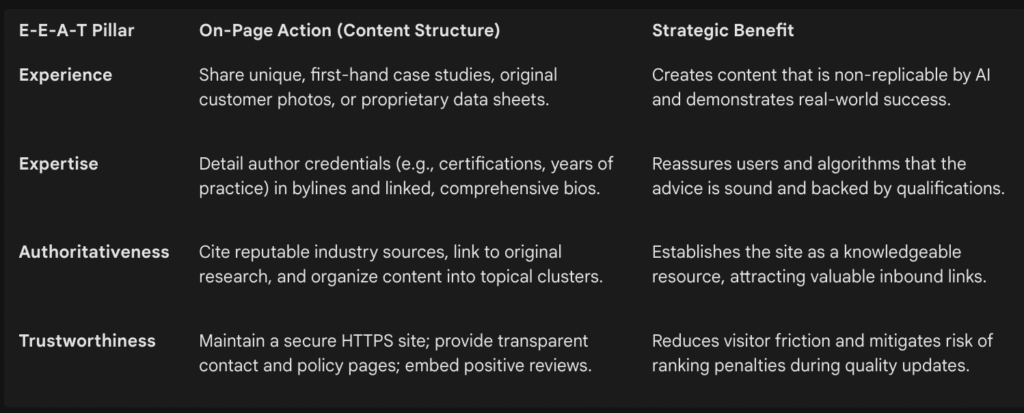
This blueprint emphasizes creating “people first content” by tailoring resources to the target audience, using relevant real-world examples, and ensuring every claim is supported by current, relevant industry data or expert sources
Secure Your Digital Future with Proven Credibility
For SME business owners, the digital content environment demands a fundamental strategic pivot. The choice is clear: compete on the generic volume that AI provides, or compete on the invaluable quality that only human experience and verifiable credentials can deliver. By diligently adopting and consistently implementing the EEAT Content structure, a business is not merely conforming to Google SEO requirements; it is fundamentally enhancing its brand’s standing as a trustworthy, knowledgeable, and reliable industry player. This strategic commitment to authenticity is the most powerful tool for ensuring sustained visibility and influence, even as search technology continues to be shaped by the Google AI Overview.
Grow your business today!
Your unique, first-hand experience is your most valuable competitive moat. Now is the opportune time to audit your existing digital presence and establish the explicit credibility signals necessary for long-term growth and defense against the rising tide of generic content. Stop guessing how to make your SEO Content resonate.
If your organization is ready to pivot its strategy from keyword chasing to verifiable experience—and build an E-E-A-T framework that clearly outperforms AI-generated resources—allow us to provide the strategic blueprint. Our content strategy experts specialize in translating raw business experience into high-performing, authoritative SEO Content.
Schedule Your Free E-E-A-T Content Audit Today and Transform Your Credibility into Traffic.