The Shift to AI Overviews: The era of traditional organic blue links has passed, replaced by AI systems that synthesize answers directly; businesses must now optimize to become the cited entity within these automated responses.
Hyper-Localized Digital Architecture: Deploying single, highly focused landing pages for specific locations and implementing structured locational schema markup are non-negotiable technical requirements for algorithmic visibility in 2026.
Machine-Consumable Content Formats: Restructuring website content into modular blocks with concise, targeted summaries enables large language models to easily extract, verify, and cite local business data.
The Paradigm Shift in Malaysian Search Dynamics
The digital landscape within Malaysia has reached unprecedented levels of maturity and saturation as of 2026. Recent macroeconomic data indicates that out of a population utilizing 44.0 million active cellular mobile connections, there are 35.4 million distinct internet users, representing a staggering 98.0 percent online penetration rate. Concurrently, Malaysia accommodates 30.7 million social media user identities, encompassing 85.0 percent of the demographic. In this highly connected, mobile-first ecosystem, consumer search behavior has evolved with rapid intensity. Users no longer simply submit fragmented keywords to search engines expecting to scroll through a list of hyperlinks; instead, they demand immediate, conversational, and highly accurate resolutions to their queries.
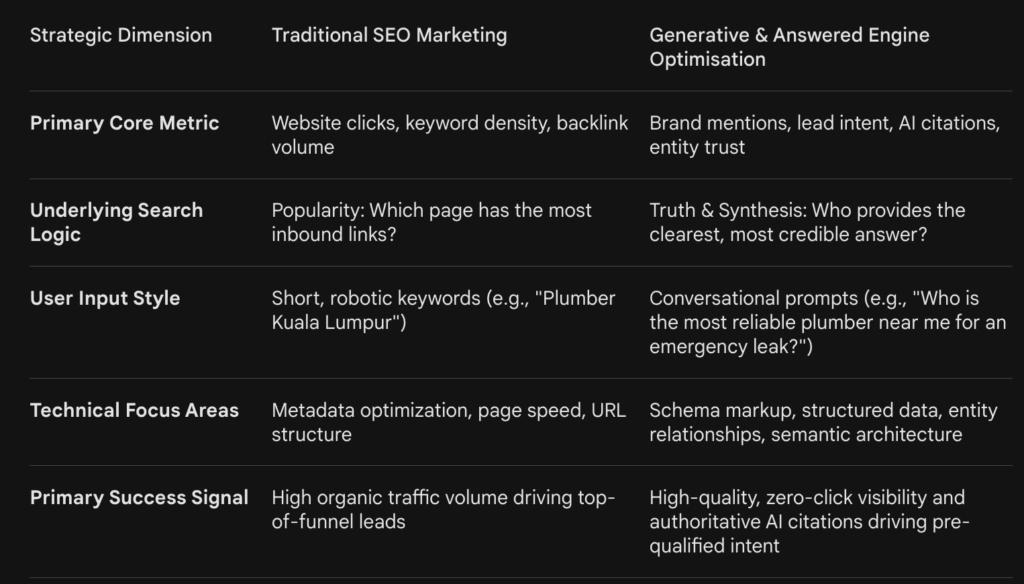
This behavioral shift has catalyzed the development, refinement, and global deployment of the Search Generative Experience. In the current 2026 landscape, search engine architectures operate primarily as intelligent synthesizers rather than mere indexers of web pages. When a consumer in Cyberjaya or Penang searches for a local enterprise—whether it is an agile startup, a specialized legal firm, or a heritage retailer—artificial intelligence systems intercept the query, evaluate billions of disparate data points, and generate an immediate, comprehensive overview. Consequently, traditional SEO Marketing, which focused heavily on keyword density and manipulating algorithmic popularity through mass link building, is no longer sufficient to secure digital prominence. The overarching goal has transitioned entirely from ranking first on a traditional search engine results page to becoming the primary, trusted cited source within the AI-generated answer.
The Zero-Click Reality and Entity Trust
The most profound and disruptive impact of the Search Generative Experience is the exponential rise of the zero-click search phenomenon. Current empirical data across the digital marketing industry demonstrates that over 60 percent of searches now conclude without the user clicking through to any external website. Because the AI provides the requested information directly on the results interface, the conventional metric of raw website traffic volume is increasingly decoupled from actual brand visibility, authority, and lead generation.
This dynamic necessitates a profound realignment in digital strategy for small and medium-sized enterprises. While overall organic click-through rates may experience a reduction across informational queries, the qualitative value of the remaining traffic is significantly enhanced. When an AI overview algorithmically selects and cites a specific local business as the authoritative solution, any user who subsequently clicks through to the website is effectively “pre-sold” on the enterprise’s credibility. The challenge for Malaysian SMEs is therefore architectural: how to structure digital assets so that AI algorithms recognize, trust, and preferentially extract their proprietary information over that of their competitors. This introduces the concept of the business as an “Entity” rather than a website. In 2026, Google views a business as a distinct object with defined relationships to locations, products, and individuals. Old SEO attempted to rank for the keyword “Best Cafe.” The new local SEO focuses on establishing “Brand X” as the undisputed, authoritative entity for the concept of “Coffee” within the specific geographic boundary of “Bangsar”.
The Strategic Triad: SEO, GEO, and AEO
To successfully navigate the complex 2026 environment, organizations must thoroughly understand the distinct yet deeply interconnected disciplines that have superseded traditional organic optimization. The modern visibility triad consists of foundational SEO Marketing, Generative Engine Optimisation, and Answered Engine Optimisation. Operating effectively requires a synchronized approach across all three vectors.
Defining Generative Engine Optimisation (GEO)
Generative Engine Optimisation involves intentionally structuring a digital presence and its associated content so that Large Language Models—such as Google’s Gemini, OpenAI’s ChatGPT, and Anthropic’s Claude—can effortlessly extract, verify, and securely credit the information. This discipline moves far away from prioritizing isolated keywords and focuses almost entirely on establishing unshakeable entity authority. Through rigorous Generative Engine Optimisation, a business systematically builds its authority so that when a user prompts an AI for the optimal service in a specific Malaysian region, the system compiles a single narrative recommending that exact business as the most credible solution.
Establishing this entity authority requires a multi-channel approach. It demands consistent brand mentions across the web, cross-channel alignment of business facts, robust public relations signals, and deep, contextually relevant content that proves lived experience. The immediate impact of dominating these mentions is a massive increase in brand awareness, as AI recommendations are inherently perceived as more objective and trustworthy by modern users than traditional sponsored advertisements.
Defining Answered Engine Optimisation (AEO)
While Generative Engine Optimisation focuses on broad brand credibility and overall entity strength across disparate AI systems, Answered Engine Optimisation specifically targets the granular mechanics of becoming the direct, immediate answer for highly specific, conversational queries. AI search prioritizes absolute truth, content clarity, and informational structure over the historical popularity metrics that dominated older algorithms.
Answered Engine Optimisation ensures that a website’s content serves as the most clear, concise, and definitive resolution to a user’s problem. Businesses that effectively merge traditional technical discovery mechanisms with advanced Answered Engine Optimisation observe stronger visibility, superior user engagement, and higher conversion rates. They achieve this by satisfying the AI’s strict requirement for clear, unambiguous data while maintaining the foundational technical infrastructure required for baseline indexing.
The Architecture of Geographic Relevance
A persistent, highly complex challenge for SMEs operating across multiple regions or offering varied services across different states is how to signal exact geographical relevance to increasingly sensitive AI engines. AI overviews and generative models are hyper-focused on location data, continuously attempting to merge spatial proximity with topical authority to deliver the best local recommendations. When a consumer searches for a service, the AI evaluates the physical distance between the user and the entity, alongside the entity’s proven expertise in that specific locale.
The Imperative of the Dedicated Landing Page
To achieve prominence within the Search Generative Experience, absolute structural focus is required at the page level. The most effective architectural approach is the deployment of a single landing page that are focusing on single location and industry. Relevancy is very important to be ranked in the SGE. With a dedicated landing page, the team is able to insert the relevant keywords and content for the dedicated location only, where this will increase the chances to being indexed in the SGE.
Historically, some practitioners attempted to bypass this requirement by utilizing “doorway pages”—thin, virtually identical pages populated with swapped city names designed solely to capture localized search volume across dozens of municipalities. In 2026, such tactics are not merely ineffective; they are explicitly penalized by sophisticated AI evaluation systems. These legacy tactics violate the core principles of helpful, original content and frequently trigger manual ranking suppression or complete de-indexing. Instead, the modern dedicated landing page must be an exhaustive, genuinely useful resource tailored specifically to the unique realities, challenges, and characteristics of that distinct micro-market.
When an AI model evaluates a conversational query such as “comprehensive corporate legal services in Petaling Jaya,” it scans its vast index for the highest concentration of localized semantic relevance. A generalized corporate “Services” page that lists Petaling Jaya casually alongside twenty other Malaysian cities severely dilutes the spatial signal. The algorithm cannot ascertain if the business has a true presence there or merely services the area peripherally. Conversely, a dedicated Petaling Jaya corporate law page—featuring local client case studies, specific neighborhood references, driving directions from known landmarks, and targeted semantic variations—provides an immensely concentrated relevancy signal. This highly focused, localized approach allows the algorithmic engine to confidently pair the user’s spatial coordinates with the business’s entity footprint, resulting in a prime citation within the AI overview.
Advanced Schema Markup: The Algorithmic Translation Layer
Even with highly relevant, perfectly localized landing pages, AI algorithms require an unambiguous translation layer to parse unstructured human language into structured, machine-readable databases. This critical translation is achieved through the rigorous application of advanced Schema Markup. Google love structural data, once the team have done the content, use the Schema Markup to ensure you structured your data based on Google preference. In the schema markup, you may insert the locational keyword, where this is 1 of the ways for Google index you in the right locations.
Essential Schema Types for 2026 Dominance
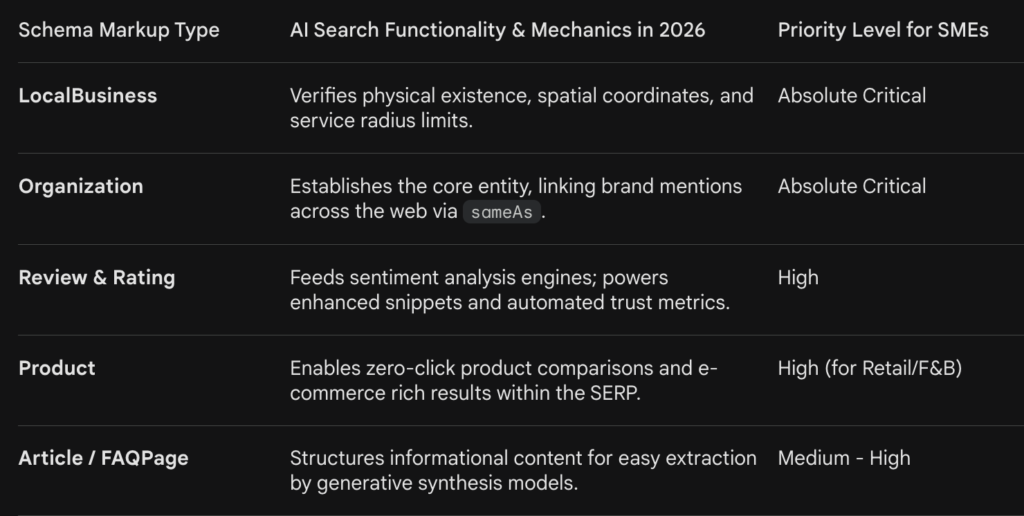
Schema markup acts as a direct line of communication to the search engine, explicitly defining the exact nature of the entity, the parameters of its offerings, and its precise spatial boundaries. AI systems achieve significantly higher accuracy and citation rates when their responses are grounded in structured knowledge graphs populated by pristine schema implementation. It essentially serves as a cheat sheet for the algorithm, eliminating any need for the system to “guess” what the page represents.
LocalBusiness Schema: This is the absolute, non-negotiable foundation for local search visibility in 2026. For businesses with physical locations, this specific markup details the operating hours, exact longitudinal and latitudinal coordinates, customer service contact numbers, and defined service area radiuses. In the current environment, incomplete or contradictory business hours across different directories trigger immediate trust penalties from AI systems, highlighting the need for pristine LocalBusiness schema implementation.
Organization Schema: This syntax defines the broader corporate entity and serves as the structural foundation for Knowledge Graph inclusion. By utilizing the powerful
sameAsproperty within Organization schema, businesses can digitally link their primary website to their official social media profiles, Wikipedia entries, and industry databases. This allows AI models to cross-reference and unify the brand’s identity across the entire internet, cementing its status as a verified entity.Review and AggregateRating Schema: AI overviews extract structured sentiment signals to determine recommendations and assess brand reputation. Review schema translates disparate customer feedback into a quantifiable, algorithmic trust signal, acting as verified social proof that validates the business to the generative engine. Implementing schema that triggers review snippets is critical, as rich results can increase click-through rates by up to 40 percent compared to standard, unenhanced listings.
Person Schema: To satisfy modern algorithmic requirements for experience and expertise (part of the E-E-A-T framework), assigning Person schema to author bios and corporate leadership profiles links their specific professional credentials to the content they produce. This explicitly declares topic expertise, helping AI systems identify subject matter experts for specific queries and enhancing the overall authoritativeness of the root domain.
Implementing Geographic Nuance in Code
Optimizing schema for local audiences requires the strategic embedding of geographic terminologies directly into the code. By explicitly declaring the service areas using the areaServed property and incorporating location-specific terms directly into the structured data syntax, businesses align their underlying digital footprint with local search intent. If a Malaysian enterprise provides specialized digital solutions, the schema must clearly define localized offerings. This ensures that when the generative AI engine seeks solutions near a specific user in Subang Jaya or Johor Bahru, the business’s structured data provides an exact, undeniable match.
Content Modularity and Machine Consumption
The traditional paradigm of digital content creation heavily favored long, flowing, linear narratives. Blog posts were designed to be read sequentially from top to bottom. However, Large Language Models and Generative AI systems process information fundamentally differently than human readers. They do not read for pleasure; they scan for extraction. They seek immediate, verifiable data fragments that can be effortlessly lifted, synthesized, and presented to the user. Therefore, the architectural design of the content itself must aggressively evolve into a “Machine-Consumable” format.
The Algorithmic Power of the Structured Summary
One of the most effective methods to facilitate this rapid algorithmic extraction is the strategic use of structured lists and summarization blocks. Short and precise bullet point. Sometimes you look into the blog post, the author will summarise the content into short bullet point to explain what is the blog post is about. This is one of the ways that Google where should they index you in the SERP and which locations that you are targeting right now.
When an AI model parses the underlying HTML document of a webpage, structural tags such as <ul> (unordered list) and <li> (list item) serve as powerful cognitive anchors for the machine. They signal to the parsing algorithm that the enclosed information is highly concentrated, definitive, and intentionally sequential. Consequently, when optimizing for the Search Generative Experience, critical business facts, service locations, pricing models, and core value propositions must be formatted as short, precise bullet points. This modularity directly supports the modern “Answer-First” framework, where the most accurate answer is provided concisely—ideally in an “atomic” block of 40 to 60 words—acting as a highly attractive hook for the AI to cite the brand in its primary snapshot.
Executing Modular Content Design
Beyond the implementation of simple lists, entire web pages must fully embrace Modular Content Design. In this advanced structural framework, a long-form article is divided into self-contained blocks that function entirely independently. This allows the AI to extract specific relevance without having to parse, process, and understand irrelevant surrounding text.
A fully optimized, machine-consumable modular block in 2026 consists of several strict components:
The Query Header: An H2 or H3 tag phrased explicitly as the exact question the consumer is asking (e.g., “What are the premier commercial logistics services in Penang?”). This signals the topic intent to the crawler instantly.
The Key Takeaway Box: A dense, two-to-three sentence summary located immediately beneath the header that directly answers the query without any introductory filler.
The Structured Proof: The aforementioned short, precise bullet points, semantic tables, or coded charts that provide the empirical data, localized service specifics, or step-by-step processes.
The Contextual Deep-Dive: A subsequent paragraph of 200–300 words that elaborates on the topic in continuous narrative prose. This satisfies the algorithm’s requirement for topical depth and demonstrates the human expertise necessary for E-E-A-T validation.
This highly structured, modular approach ensures that regardless of the specific fragment of the user’s conversational prompt, the AI engine can locate a perfectly structured, easily extractable module of information that directly resolves the query.
Elevating E-E-A-T Signals in the Malaysian Context
As generative AI models flood the internet with an unprecedented volume of synthetic, automated content, search engines are engaged in an arms race to differentiate between genuine, human-led expertise and mass-produced automated noise. Google’s primary mechanism for executing this differentiation is the rigorous evaluation of Experience, Expertise, Authoritativeness, and Trustworthiness (E-E-A-T). In the context of the 2026 Search Generative Experience, E-E-A-T is no longer merely a theoretical content guideline; it is a measurable, definitive algorithmic threshold that strictly dictates whether an entity is permitted entry into the coveted AI overview snapshot.
Local Nuance and Authentic Cultural Resonance
A highly critical, yet often overlooked, component of localized E-E-A-T in Malaysia is the demonstration of authentic local experience. AI models in 2026 are highly sophisticated in their natural language processing capabilities, easily identifying when content has been mass-produced for generic global audiences and simply localized via automated translation.
To effectively build “Local Trust” scores, digital content must incorporate genuine regional nuances that cannot be easily hallucinated by an AI. This includes utilizing localized English variations (such as Manglish) where contextually appropriate, correctly referencing Bahasa Malaysia terminologies naturally within the prose, and integrating highly specific local landmarks to ground the entity in reality (e.g., noting that a clinic is “located directly adjacent to Pavilion Bukit Jalil” or “serving the bustling Sunway commercial district”). These linguistic and geographic micro-signals prove to the evaluating algorithm that the entity possesses actual, lived experience within the physical geographical coordinates it claims to serve.
Credentialing, Proof, and the Human Element
Furthermore, proving undisputed expertise requires highly verifiable human credentials. Author bios must be robust, complete with the previously discussed Person schema markup, digitally linking the creator’s identity to their professional LinkedIn profiles, published academic or industry papers, and their historical track record within the industry. Original photography of Malaysian corporate offices, real staff interactions, and specific, localized client case studies heavily outweigh generic stock imagery. AI algorithms prioritize this verifiable “lived experience,” recognizing it as proprietary data that cannot be purely synthesized from existing global datasets.
When businesses publish original market data, proprietary surveys detailing specific Malaysian consumer behavior, or unique professional insights regarding the local industry landscape, they generate what search engineers term “Information Gain”. Information Gain occurs when a webpage provides substantial, net-new value that the AI cannot scrape or synthesize from other existing sources. By becoming the exclusive origin point for new data, the SME effectively forces the AI model to cite its domain as the primary source, securing top-tier visibility regardless of traditional backlink profiles.
The Competitive Arena of Selangor: A Micro-Market Analysis
To properly contextualize these advanced optimization techniques, it is essential to deeply examine one of Malaysia’s most critical and competitive economic engines: the state of Selangor. Understanding the macroeconomic conditions, sectoral growth, and competitive density of specific regions dictates the urgency, scale, and specific parameters of required digital interventions.
Economic Maturation and Sectoral Growth
Selangor has consistently maintained its definitive position as Malaysia’s top-performing state, possessing a highly diverse, remarkably resilient, and deeply integrated economy. Official projections for the 2026 fiscal year anticipate the state’s gross domestic product (GDP) to expand steadily between 5.0 and 5.8 percent, reaching an estimated monumental value of RM479 billion. The regional economy has officially transitioned into a mature phase. Consequently, future expansion necessitates growth driven by advanced productivity, superior talent acquisition, and sophisticated digital skill development, rather than basic, legacy industrialization.
Key sectors propelling this intense economic growth include advanced construction (projected to expand aggressively between 5.8 and 6.8 percent), comprehensive professional services, high-tech logistics, digital innovation industries, and specialized healthcare. Furthermore, the state of Selangor is pioneering massive structural initiatives in the ASEAN “blue economy,” advanced green technology implementation, and artificial intelligence infrastructure integration. This is creating vast new supply chains, highly lucrative vendor ecosystems, and massive B2B opportunities.
The Strategic Mandate for Specialized Digital Consultation
In such a hyper-competitive, high-growth environment, basic digital visibility achieved through rudimentary tactics is entirely inadequate. With world-class infrastructure, high consumer purchasing power, and a massive, highly educated talent pool, Selangor offers extraordinarily fertile ground for SMEs operating in retail, food and beverage, specialized wellness, and high-end professional services. However, this lucrative market also attracts intense, well-funded foreign and domestic competition. Between January and September of the preceding year alone, the state recorded the creation of 43,998 new job opportunities, reflecting massive, ongoing corporate investment and relentless business expansion.
For an SME to successfully capture market share within this immense density, highly targeted, technically flawless digital strategies are absolutely mandatory. Securing the services of a dedicated SEO Consultant Selangor or engaging in comprehensive, localized Marketing consultation is no longer a strategic luxury but a critical operational necessity [User Query]. A regional expert fundamentally understands the complex micro-geographies of the state—intimately differentiating the unique user search intent between commercial hubs like Shah Alam, residential density in Subang Jaya, and the tech-centric corridors of Cyberjaya. This expertise is required to architect the specific single-location landing pages and hyper-local schema deployments required to digitally dominate those distinct geographic radiuses.
Furthermore, as Selangor strategically positions itself as a premier regional hub for specialized sectors—such as the booming medical tourism industry and advanced, precision manufacturing—the associated supply chains require profound B2B visibility. Local suppliers, logistics firms, and service providers must ensure their entity data is perfectly structured and their E-E-A-T signals are flawless. This ensures that when multinational corporations utilize AI systems to source local vendors, their enterprises are algorithmically recommended as the primary, undisputed authorities in the region.
Synergizing Social Media with AI Search Visibility
A truly comprehensive 2026 optimization strategy recognizes that search engine algorithms do not operate in an isolated vacuum. The ranking algorithms constantly crawl external social platforms to dynamically assess entity credibility, evaluate sentiment consistency, and measure real-time cultural relevance. Consequently, social media has transitioned from a purely engagement-driven marketing channel into a critical, foundational layer for Generative Engine Optimisation.
The Scale of Social Influence and Algorithmic Integration
With social media users now constituting a “supermajority” of the global online population (numbering 5.66 billion users worldwide), platforms have evolved into primary search engines and discovery ecosystems in their own right. In Malaysia specifically, users average approximately three hours per day engaged on social networks, utilizing these platforms to continuously evaluate business credibility, seek peer recommendations, and execute direct commercial transactions.
Different platforms serve distinctly different algorithmic and psychological functions within the complex Malaysian digital market:
Facebook: Remains the absolute dominant force for multi-generational reach and massive community scale. It is highly effective for localized community engagement, establishing broad regional brand awareness, and driving mid-funnel consideration.
LinkedIn: Operates as the premier platform for B2B authority and professional credentialing. Content published here—particularly deep thought leadership, industry analysis, and professional insights—is heavily crawled by LLMs to determine an entity’s industry expertise and validate E-E-A-T signals.
WhatsApp: Functions effectively as the core conversational and conversion interface within Malaysia, moving consumer interactions from public discovery channels into private, high-trust commercial resolution.
Xiaohongshu (RED) & TikTok: Serve as massive, algorithmically driven discovery engines for younger demographics, prioritizing raw emotional influence, visual verification, and peer trust.
Social Signals as Definitive Entity Verification
From a strict SEO Marketing and Generative Engine Optimisation perspective, activity on these diverse platforms generates critical external validation signals. When recognized industry thought leaders or verified local consumers actively discuss a brand on Facebook or share its insights on LinkedIn, these mentions are rapidly ingested by AI models as definitive proof of the entity’s real-world prominence and operational legitimacy.
To maximize this algorithmic synergy, SMEs must ensure absolutely flawless consistency across their entire digital footprint. The business name, operating hours, exact service locations, and core value propositions must be completely identical across the central website domain, the Google Business Profile, Facebook pages, and LinkedIn corporate profiles. This strict consistency—termed “Consensus Alignment”—allows the AI to confidently verify the brand’s facts. If a business claims one specific service radius on its primary website but a slightly conflicting one on its Facebook page, the algorithm experiences entity confusion. This confusion results in a severely lowered confidence score and guarantees exclusion from AI overview citations.
Furthermore, as AI content generation tools become ubiquitous across the internet, plain, generic educational posts are no longer sufficient to capture audience attention or trigger algorithmic sharing on social feeds. The most effective social media strategies for 2026 employ AI tools strictly to structure data and scale publishing velocity, while fiercely preserving human judgment, showcasing real staff faces, and presenting proprietary, controversial, or highly unique opinions. This authentic, human-centric content drives the high-quality user engagement and external linking that eventually feeds back into the core domain’s search authority, creating a self-sustaining cycle of visibility.
Measuring Success in a Synthesized, Zero-Click Ecosystem
Adapting to the profound realities of the 2026 search landscape requires completely abandoning outdated key performance indicators (KPIs) that rely on legacy metrics. When the vast majority of informational and localized queries result in zero-click resolutions directly on the Google search interface, tracking raw organic traffic volume provides a deeply skewed, fundamentally inaccurate metric of business success.
Tracking Entity Confidence and Citation Frequency
Instead of merely tracking standard SERP rankings for isolated, robotic keywords, advanced practitioners and SEO consultants now monitor their “Entity Confidence” and overall brand inclusion rates within generative snapshots. While native platforms do not always provide explicit, dedicated filters for AI overview presence in standard analytics dashboards, success can be effectively deduced through specific data patterns. For instance, identifying search queries in Google Search Console that register exceptionally high impressions but significantly lower-than-historical click-through rates almost always indicates that the brand’s content is being successfully synthesized and displayed prominently within an AI snapshot. The user saw the answer, recognized the brand, and was satisfied without needing to click the link.
Additionally, measuring the frequency, context, and authority of brand mentions across third-party sources—such as industry forums, localized digital directories, and verified review platforms—provides a highly accurate proxy for how heavily an AI model might weigh the entity’s credibility. A comprehensive Answered Engine Optimisation strategic layer actively monitors whether LLMs are quoting the brand’s specific modular answers, tracking how seamlessly that structured data can be extracted and presented to the end user.
The Unification of Technical and Conversational Systems
Ultimately, the most successful enterprises in Malaysia do not treat traditional technical indexing and modern AI visibility as separate, siloed initiatives. They operate in parallel. The technical layer—ensuring lightning-fast page speeds, pristine site architecture, the elimination of doorway pages, and rigorous, geographically accurate schema implementation—guarantees that the digital asset exists in the index and can be effortlessly parsed by crawlers. Concurrently, the generative layer—focused relentlessly on concise bullet points, modular answer structures, and establishing deep, verifiable entity trust—ensures that once the data is parsed, the information is definitively selected, cited, and delivered to the consumer as the ultimate algorithmic truth.
Strategic Integration and Next Steps
The relentless acceleration of the digital landscape in 2026 has fundamentally, permanently altered how Malaysian businesses must approach their online visibility and customer acquisition strategies. Relying on keyword stuffing, generic content, location-swapped doorway pages, and outdated link-building schemes is entirely ineffective against modern AI algorithms. These advanced systems prioritize deep entity authority, flawless structural clarity, and verifiable, hyper-local relevance above all else.
For SMEs seeking to dominate their respective markets—whether capturing the diverse, culturally rich consumer base in Penang, scaling e-commerce operations in Johor, or providing highly specialized B2B logistics services in the rapidly expanding, ultra-competitive economy of Selangor—the path forward is clear and mathematically defined. It requires the meticulous construction of single, location-specific landing pages that provide concentrated, undeniable relevancy. It necessitates the deployment of advanced Schema Markup infused with precise locational data to serve as a machine-readable translation layer. Furthermore, it demands that all digital content be architecturally designed for immediate algorithmic extraction, utilizing short, precise bullet points that guide generative engines directly to the core resolution of consumer queries.
Transitioning a legacy digital footprint into a highly optimized, AI-ready architecture requires profound technical insight, strategic patience, and continuous algorithmic monitoring. It is not a project that can be executed passively. For enterprises seeking to implement these advanced methodologies and secure their market share in the era of the Search Generative Experience, expert guidance is paramount. If you are looking forward for someone to bring your SEO to another level, we are here to help. Embracing Generative Engine Optimisation and Answered Engine Optimisation today ensures that when the AI algorithms of tomorrow synthesize the digital landscape, your enterprise is not merely present, but definitively cited as the foremost authority.