The term “passive marketing” is often associated with search engine optimization (SEO), but this label is a common misconception that can mislead business owners. While the outcome of a successful SEO strategy is indeed a sustained, low-maintenance flow of organic traffic and leads, the process required to achieve this is intensely active and foundational. It demands continuous strategic effort to build a durable online presence.
Why SEO is Not a Passive Channel
The perception that SEO is a passive marketing channel arises from the conflation of its process with its outcome. Some sources define passive marketing as a strategy that attracts customers “over time without active outreach” , relying on content that, once created, “continues to attract customers with little to no further effort required”. While a successful SEO strategy can indeed generate a “stable flow of leads” and operate “24/7, 365 days a year” with minimal maintenance, this long-term stability is not achieved passively.
The true nature of SEO is that of a foundational channel, requiring significant, active effort and investment. It is akin to building the solid foundation of a house, which provides a stable base for all future construction and remains strong over time. This contrasts with the “quick jolt” of paid advertising. The long-term impact of SEO is built upon a continuous, proactive commitment to three core pillars: content creation, technical optimization, and authority building.
Content Creation: This is a perpetual effort to build a library of unique, high-quality content that provides value to the audience. The process requires ongoing research to identify “high-value keywords with low competition” and to stay “up to date on the latest industry news and trends”. Content must be regularly updated with fresh information and perspectives to remain relevant and trustworthy. This is far from a one-time effort.
Technical Optimization: Maintaining a healthy website is an active responsibility. Technical SEO involves improving critical elements such as page load speed, mobile responsiveness, and site security. These are not “set-it-and-forget-it” tasks but require continuous monitoring and refinement to ensure a positive user experience and to make it easier for Google’s crawlers to index the site.
Authority Building: A website’s authority is a critical component of its search performance and is earned through sustained, proactive effort. This includes acquiring quality backlinks from reputable sites within the industry, which signals trustworthiness to Google. Authority can also be built by publishing original case studies and showcasing transparency about the company and its team members.
Integrating SEO with Paid Advertising (PPC/SEM)
The most effective digital marketing strategies do not view SEO and paid advertising (PPC) as competing channels but as complementary forces that amplify each other’s impact. Paid ads provide immediate visibility and traffic, which can be invaluable for a new business seeking rapid growth. Meanwhile, SEO is a long-term investment that builds a lasting organic presence and credibility.
The true power of integrating these two strategies lies in the creation of a cost-reduction flywheel. The process begins with paid advertising, which provides immediate, high-converting keyword performance data. This data can then be used to inform and refine the long-term SEO strategy, allowing a business to invest resources in creating content for the most profitable keywords.
As the website’s organic rankings for these validated keywords improve, its brand credibility and authority are established. Google’s algorithms reward sites that provide “relevant, valuable experiences” with improved Quality Scores, which directly impacts paid ad performance. A strong organic presence signals relevance and authority, which can “help lower long-term advertising costs” and reduce dependency on paid channels to generate traffic and leads. This allows for the strategic reallocation of budget to other areas of the business as SEO matures and provides compounding returns.
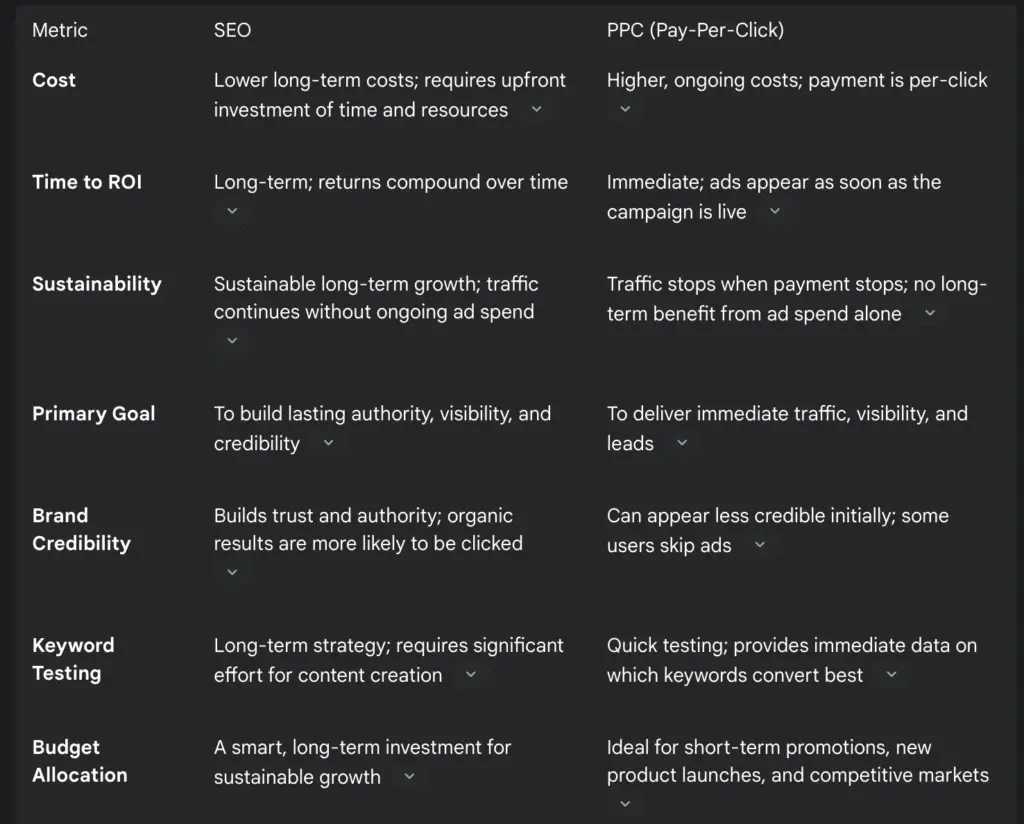
The following table provides a strategic comparison of SEO and PPC, highlighting their complementary roles for SME business owners.
Navigating the AI Frontier: SEO in the Age of Google SGE
Google’s latest evolution, the Search Generative Experience (SGE), represents a significant shift from a search engine to an “answer engine”. SGE uses generative AI to provide “conversational summaries” directly at the top of the search results page (SERP). This can lead to a potential decrease in organic visibility and click-through rates, as users may get their answers without visiting a website.
The implications of SGE are profound, as the new SEO battleground is not just the organic listings but also the “AI Overview” itself. The new goal is to become an authoritative source that the AI uses to generate its summary. This forces a move from simply “ranking for a keyword” to “being a trusted source for an answer,” which is a far more fundamental and challenging objective. This dynamic elevates the importance of a concept Google has been developing for years: E-E-A-T (Experience, Expertise, Authority, and Trust).
The E-E-A-T Imperative: For SMEs, E-E-A-T is no longer a peripheral concept; it is a critical differentiator. It is built through specific, demonstrable actions that a small business is uniquely positioned to perform. Genuine Experience and Expertise can be showcased through original, hands-on content and unique perspectives that a large, generic corporation cannot replicate.
Authority is established by acquiring third-party mentions, such as being featured on other reputable sites or building quality backlinks. Finally,
Trust is the foundation of E-E-A-T. It is built through transparency—displaying clear information about the company, its mission, and the credentials of its team members.
New Content Paradigms for SGE: To be featured in SGE’s AI Overviews, content must be optimized for AI readability and user-friendliness. This involves structuring content with question-based headings, using bulleted and numbered lists, and implementing structured data that helps AI algorithms easily parse and summarize the information. The focus should be on creating comprehensive, in-depth content that covers a topic thoroughly and answers related questions. This approach ensures that a website is providing a high level of value that the AI can recognize and use
Conclusion
In conclusion, the notion of Google SEO as a passive marketing channel is a simplified and misleading perspective. While a successful SEO strategy can deliver passive, compounding returns, this outcome is the direct result of a continuous, strategic, and proactive process. SEO is the foundational digital asset that builds lasting brand authority, enhances the performance of all other marketing channels, and is more critical than ever in a world shaped by AI-powered search.
The establishment of a digital foundation that delivers compounding returns for a business requires a multi-faceted approach. It involves moving beyond basic keyword optimization and adopting a holistic strategy that focuses on consistent content creation, technical excellence, and the relentless pursuit of demonstrable expertise and trust.
Ready to build a digital foundation that delivers compounding returns for a business? Our team is here to help a business move beyond the basics and develop a strategic SEO plan tailored to long-term growth goals. Contact our team today to start the conversation.