The 3-Second Rule & Core Web Vitals: Search algorithms now heavily penalize slow websites. Meeting strict Core Web Vitals (LCP, INP, CLS) and achieving sub-3-second load times are mandatory to prevent high bounce rates and maintain algorithmic trust.
The Mobile-First Imperative: With over 62% of global traffic coming from mobile devices, a “desktop-first” design retrofitted for mobile is no longer viable. Success requires mobile-centric architectures designed around human biomechanics and “radical reachability.”
Data-Driven Conversion Architecture: Gone are the days of guessing where to place Call-To-Action (CTA) buttons. Modern conversion optimization relies on heatmap tracking and scroll-depth analysis to position CTAs precisely where user intent and attention peak.
How User Experience Intersects with SEO and Conversion Rates
The architectural framework of digital marketing has undergone a profound metamorphosis throughout the first quarter of 2026. The historical division between Search Engine Optimization (SEO) and User Experience (UX) design has completely dissolved. In the contemporary digital economy, these two disciplines are inextricably linked, functioning as a singular, cohesive mechanism that drives organic visibility, user engagement, and ultimately, commercial conversion. For Small and Medium Enterprises (SMEs) aiming to establish a robust digital footprint, understanding this convergence is no longer a strategic luxury; it is a fundamental requirement for commercial survival.
The algorithmic parameters governing search visibility have pivoted aggressively toward behavioral metrics. Search engines and emerging artificial intelligence platforms do not merely index keywords; they measure how human beings interact with digital interfaces. Metrics such as dwell time, interaction latency, bounce rates, and scroll depth are processed as direct indicators of value. Consequently, a website that excels in traditional keyword integration but fails to deliver a frictionless, highly responsive user experience will find itself marginalized in search engine results pages (SERPs) and entirely ignored by emerging conversational AI interfaces.
This exhaustive research report dissects the critical components of the 2026 digital landscape, providing actionable, data-driven intelligence on how loading speed, mobile-first architectural frameworks, behavioral conversion placements, seamless narrative web design, and AI-centric search optimization will dictate the future of digital commerce.
The Macro-Economic Digital Environment for SMEs in 2026
To contextualize the urgency of UX and SEO integration, it is necessary to examine the broader economic landscape. The year 2026 has been designated by economic analysts as the era of the “Great SME Pivot”. The digital economy is projected to contribute over 25.5% to the national gross domestic product (GDP) in emerging tech hubs, transforming traditional business models. The market dynamics demand that businesses migrate from standard brick-and-mortar reliability to highly scalable “click-and-mortar” digital ecosystems.
In regions experiencing rapid technological acceleration, professional SEO Consultation has evolved from a supplementary marketing tactic into a core business infrastructure requirement. Engaging an expert SEO Consultant Selangor, for instance, provides local SMEs with the geographic targeting and technical sophistication necessary to compete against multinational conglomerates. The role of an SEO Marketing agency is no longer confined to generating isolated traffic spikes; it involves constructing a continuous, multi-channel presence that follows the customer seamlessly across the digital ecosystem.
As foreign direct investment increasingly targets regions with high-value technological infrastructure, the digital presentation of an SME becomes its primary asset. The narrative crafted by an enterprise’s digital footprint serves as the frontline for lead generation, brand credibility, and international market penetration. A sophisticated digital presence communicates authority and operational maturity, directly impacting business valuation and long-term sustainability.
The Three-Second Threshold: Loading Speed and Algorithmic Viability
In an era characterized by instant gratification and extreme algorithmic efficiency, consumer digital patience is virtually non-existent. The velocity at which a website delivers its primary visual and interactive components establishes the absolute baseline of user experience. If a website loading speed is more than 3 seconds, the users will tend to choose competitors, as in the online world, there are more than 1,000 companies that they can choose to engage with.
This three-second threshold represents a critical cognitive breakpoint. Psychological studies integrated into UX research indicate that human attention spans in digital environments demand immediate visual feedback. When a server request takes longer than three seconds to resolve, the user’s perception of the brand’s competence, reliability, and security degrades exponentially. In the context of e-commerce and B2B lead generation, milliseconds of latency translate directly into thousands of dollars in lost revenue.
When a visitor encounters a slow-loading page, the immediate reaction is to abandon the session and return to the search engine results—a behavioral phenomenon known as a “bounce” or “pogo-sticking.” Search algorithms register this immediate exit as a negative qualitative signal, interpreting the site as irrelevant or technically flawed. As bounce rates increase, algorithmic trust decreases, resulting in a systemic degradation of SEO rankings. Therefore, site speed is not merely a technical convenience; it is a primary ranking factor that dictates organic visibility.
Advanced Technical Optimization for Server Velocity
Achieving a sub-three-second load time requires a holistic approach to technical server management, database querying, and front-end asset delivery. The modern web is resource-heavy, often laden with high-resolution media, complex JavaScript frameworks, and third-party tracking scripts. Mitigating the weight of these elements is paramount.
To maintain competitiveness in 2026, web developers and SEO Marketing teams must collaborate to implement aggressive performance budgets. A primary target is reducing the Total Page Weight to below 1.5 megabytes. Lighter pages load significantly faster, particularly on mobile networks, and ensure that search engine bots can crawl and index the site efficiently without exhausting their allocated crawl budget.
Furthermore, the implementation of advanced server-side caching and Content Delivery Networks (CDNs) is mandatory. A high Cache Hit Ratio—targeting 80% or greater—reduces the processing load on the origin server. This allows returning visitors and users located far from the primary server to access stored versions of the site almost instantaneously. Additionally, accelerating DNS Lookup Time to under 100 milliseconds shortens the initial connection setup time, shaving critical fractions of a second off the total loading duration.
Decoding Core Web Vitals for the 2026 Search Algorithm
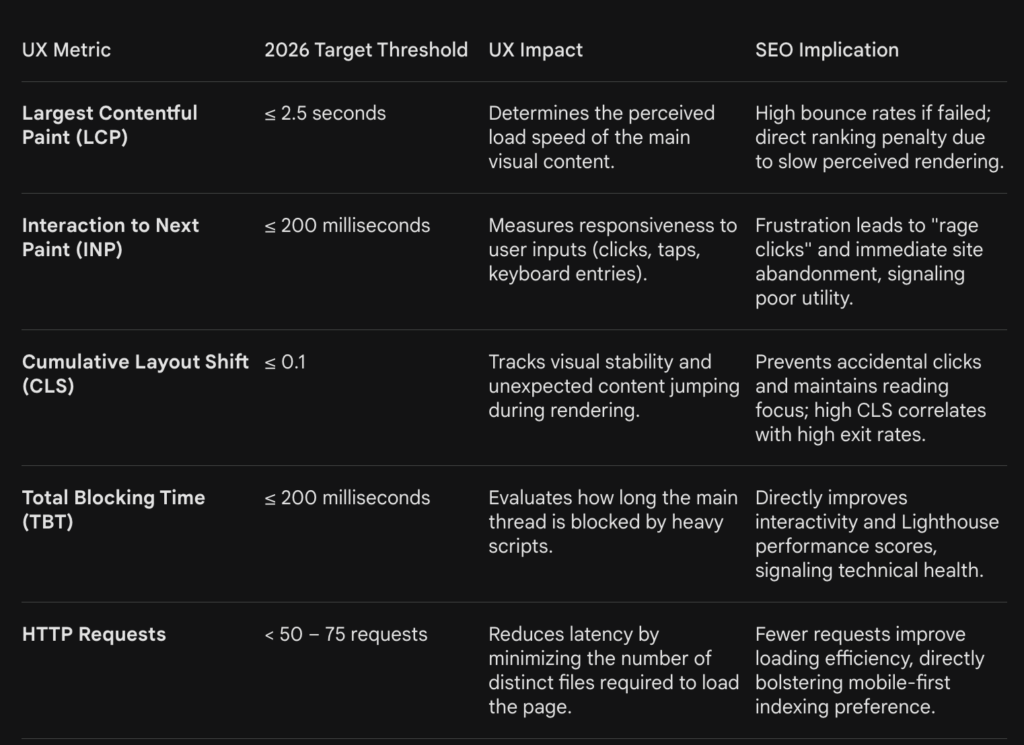
The quantification of user experience is heavily reliant on Google’s Core Web Vitals, a standardized set of performance metrics that measure the real-world user experience regarding loading performance, interactivity, and visual stability. By 2026, these metrics account for a substantial portion of search visibility, acting as the definitive tie-breaker in competitive commercial niches where content quality among top-ranking sites is relatively homogenous.
The shift from the initial “page experience update” in previous years to ongoing, stringent performance expectations means these metrics are now the absolute baseline for competitive rankings. Google utilizes Chrome User Experience Report (CrUX) data—gathered from real users interacting with the site—rather than simulated lab data, meaning organizations cannot manipulate these scores without genuinely improving the interface.
The Mechanics of LCP, INP, and CLS
To optimize these vitals, organizations must understand their underlying mechanics. Largest Contentful Paint (LCP) focuses on the time it takes to render the largest text block or image visible within the user’s viewport. To achieve an LCP of under 2.5 seconds, developers must prioritize the critical rendering path. This involves deferring non-essential JavaScript, utilizing next-generation image formats (such as WebP or AVIF), and implementing CSS extraction so that only the styles required for above-the-fold content are loaded initially.
Interaction to Next Paint (INP), which replaced the older First Input Delay (FID) metric, is a highly sensitive measurement of a website’s overall responsiveness. It evaluates the latency between a user initiating an action (such as tapping an accordion menu or adding an item to a cart) and the browser painting the resulting visual change. An INP exceeding 200 milliseconds creates a sluggish, unresponsive feeling. Optimizing INP requires breaking up long JavaScript tasks, minimizing the reliance on complex third-party scripts, and ensuring the main thread is kept clear.
Cumulative Layout Shift (CLS) measures visual stability. A high CLS occurs when images load without defined dimensions, or when dynamic advertisements inject themselves into the page late in the rendering process, causing the text to jump unexpectedly. This creates severe user frustration, often resulting in accidental clicks on the wrong buttons. Specifying width and height attributes for all media, pre-allocating space for ad slots, and ensuring web fonts do not cause a Flash of Unstyled Text (FOUT) are essential steps to maintaining a CLS below 0.1.
The March 2026 Google Core and Spam Updates
The absolute necessity of high-quality UX and robust technical infrastructure was underscored by the rapid deployment of Google’s algorithm updates in the first quarter of 2026. Following the February 2026 Discover update, Google released a global spam update on March 24, 2026. Notably, this algorithmic shift was completed in under 24 hours, a stark contrast to historical rollouts that required weeks to propagate.
This aggressive quality enforcement specifically targeted sites demonstrating single-channel dependence, high friction user interfaces, and automated content generation that lacked substantive expertise or experiential value. The update severely penalized digital properties that relied on template-driven publishing and slow, ad-heavy architectures.
The industry reaction to these updates highlighted a vital lesson: SEO is no longer a contest of keyword density or artificial link manipulation. It is about building a publishing system and digital architecture that rewards relevance, authority, and seamless human interaction. Websites that treated UX as a secondary concern saw massive traffic deprecations, proving that search engines are actively punishing interfaces that fail to respect the user’s time and cognitive load.
The Mobile-First Imperative: Designing for Dominant Traffic
The desktop computer is no longer the primary gateway to the internet. The migration toward mobile-centric consumption has reached absolute saturation. Global aggregate telecommunications data for 2026 reveals that 62.73% of all internet traffic originates from mobile devices, a figure that continues to stabilize well above the 60% threshold. Concurrently, the proliferation of high-speed 5G networks is projected to account for 43% of all mobile data traffic, facilitating heavier, more complex mobile browsing behaviors.
Given these statistical realities, the structural design of a website must prioritize the smartphone interface. Because 62.73% of traffic comes from mobile, if a website is not mobile-friendly, the user will tend to exit the website immediately. Unless the website is the absolute only option available—such as an exclusive government portal for tax filing or visa processing—consumer tolerance for poor mobile design is zero. A desktop-first design retrofitted for mobile screens via basic CSS media queries is a fundamentally flawed architecture that guarantees high attrition rates.
Radical Reachability and the Thumb Zone
Mobile responsiveness in 2026 extends far beyond simple fluid grids and text scaling. It requires a profound understanding of human biomechanics, specifically how users physically hold and interact with their handheld devices. The concept of “radical reachability” has become a central tenet of advanced UI/UX design.
Modern smartphones feature increasingly elongated screens, creating significant usability challenges when primary navigation menus are located at the top of the interface. Behavioral data from the Baymard Institute indicates that 46% of users experience noticeable friction when attempting to interact with complex, top-heavy mobile menus. This friction leads to physical stretching, cognitive annoyance, and eventual application or site abandonment.
To combat this, elite UX designers map their interfaces around the “thumb zone”—the bottom third of the mobile screen where the user’s thumb naturally rests when holding the device single-handedly. Key interaction points, primary navigation bars, and critical action triggers must be securely anchored within this ergonomic safe zone. Anything placed outside this zone requires deliberate effort and repositioning of the hand, thereby introducing unnecessary friction into the user journey.
Furthermore, the physical dimensions of digital elements must accommodate human anatomy. Mobile interactions rely on broad finger taps rather than precise mouse clicks. Interface elements must maintain a minimum 44×44 pixel tap target size, as recommended by major OS developers, with adequate padding to prevent accidental interactions. A mobile-first philosophy ensures that the interface feels like a natural, effortless extension of the user’s hand, entirely eliminating navigational frustration.
Strategic Conversion Architecture: Precision Button Placement
Generating organic traffic through rigorous SEO marketing is only half of the commercial equation. The ultimate objective is capturing that traffic and converting it into measurable business value, whether that entails a product sale, a consultation booking, or a lead capture. The geographic placement of the Call-To-Action (CTA) button is the fulcrum upon which these conversion rates balance.
Historically, web designers relied on aesthetic intuition, standardized templates, or arbitrary best practices to place CTAs—typically forcing them “above the fold” or relegating them strictly to the bottom footer. In 2026, conversion architecture is dictated entirely by empirical behavioral data, specifically through the implementation of advanced heatmap testing and scroll-depth analysis.
Mapping the User Journey Through Analytics Heatmaps
Heatmap analytics provide a visual, quantitative representation of qualitative user behavior. While traditional analytics platforms provide the “what” (total page views, bounce rates, and exit metrics), heatmaps reveal the “why” by tracking exact mouse movements, tap locations, scroll depths, click clusters, and areas of navigational frustration.
People will scroll a website, and if analysts are able to identify where the users will naturally stop or press the mobile screen to scroll, they can place the call to action nearby. In this way, developers are able to prompt users to click on the call to action button at the precise moment their attention is maximized. This methodology aligns the digital interface with the natural cognitive rhythm and reading cadence of the consumer.
Advanced research tools such as Contentsquare or customized UX integration suites track massive amounts of session data to generate these visual representations. Click maps reveal which non-clickable elements users are attempting to interact with, highlighting opportunities to transform static graphics or text into functional conversion pathways. Conversely, “rage clicks”—areas where users repeatedly and rapidly tap in frustration—indicate a broken UI element or a misleading design cue that is causing friction.
Scroll Maps and Contextual Intent Synchronization
Scroll maps are particularly vital for determining optimal CTA placement. By analyzing these maps, UX teams can identify the exact percentage of users who reach specific depths of a page. When a scroll map transitions visually from “hot” (heavily viewed) to “cold” (rarely viewed), it indicates a sudden drop-off in attention. Placing a CTA just above this natural attrition point ensures maximum visibility before the user loses interest and exits the page.
Furthermore, the psychological readiness of a user fluctuates as they consume content. A user reading the introductory paragraph of a technical guide is in a state of information gathering; presenting an aggressive, hard-sell CTA at this stage is premature and often counterproductive. Conversely, a user who has scrolled through detailed case studies, feature comparisons, and testimonial sections has demonstrated high commercial intent.
By aligning the geographic placement of the conversion button with the contextual narrative of the content, businesses create a frictionless path to purchase. For example, testing distinct variations of layout structures through rigorous A/B testing allows organizations to confirm which placements perform best. Industry case studies note that combining heatmap insights with iterative A/B testing can increase sign-up conversions by upwards of 25% by simply moving the CTA into the user’s natural line of sight.
The Psychology of Seamless Transitions and Narrative Flow
A high-converting website is not merely a repository of disparate information panels; it is a carefully curated, sequential narrative. Users look at a website like reading a book, so when a website is scrolling from the most interesting chapter direct to awkward pages, it will affect the user mood and eventually stop them from engaging with the website’s content.
This concept of “seamless transition” encompasses both the technical rendering of the website and the logical progression of its content. In 2026, the digital environment is hyper-competitive, and brand loyalty is exceedingly fragile. Research indicates that 32% of customers are willing to walk away from a brand they previously loved after just one poorly designed digital experience. A jarring transition—whether it is a visually chaotic page load, a broken layout due to poor responsive coding, or a sudden shift in brand tone—breaks the psychological immersion of the user.
Micro-Interactions and Visual Continuity
To maintain user engagement and facilitate a seamless flow, digital interfaces must communicate state changes fluidly. Micro-interactions are subtle, purposeful animations that provide immediate visual feedback. For example, a subtle animation when hovering over a button, or a skeleton loading screen that outlines the content structure before the data fully populates, reassures the user that the system is actively functioning.
These animations must serve a functional purpose rather than acting as purely decorative flair. They bridge the cognitive gap between actions, making the digital experience feel cohesive, responsive, and alive. Implementing an opacity slider or transparency options allows glass effects to be personalized, while sustainable design practices ensure that these visual enhancements do not bloat the code and negatively impact the aforementioned Core Web Vitals.
Furthermore, traditional responsive design that relies on rigid, fixed breakpoints is becoming obsolete. By 2026, fluid and adaptive layouts dominate best practices. This fluid approach ensures that websites scale gracefully across an infinite combination of devices, resolutions, and screen orientations, providing an absolutely seamless experience on every possible interface.
When the narrative flow of a website is seamless, the cognitive load placed on the consumer is minimized. The user does not have to consciously think about how to navigate the site or decipher confusing layouts; they are intuitively guided from initial awareness, through educational content, directly into the conversion funnel. This seamless experience cultivates deep consumer trust, and establishing trust is the absolute prerequisite for digital commerce.
From Traditional SEO to Generative Engine Optimisation (GEO)
While technical UX ensures that a website can successfully convert acquired traffic, the mechanisms for acquiring that traffic in 2026 are undergoing a seismic paradigm shift. The rapid proliferation and integration of Large Language Models (LLMs) into the global search ecosystem have birthed an entirely new optimization discipline that operates parallel to, and often supersedes, traditional SEO.
For an enterprise to thrive, it must master Generative Engine Optimisation (GEO). Traditional search engines operate on an indexing and retrieval model, providing users with a list of blue links on a SERP and requiring the user to navigate through various websites to synthesize an answer manually. The Search Generative Experience (SGE), powered by dominant platforms such as ChatGPT, Google AI Overviews, Perplexity, and Claude, bypasses this manual process entirely.
With ChatGPT alone serving hundreds of millions of active weekly users, and Google’s AI Overviews reaching over 2 billion monthly users, the way humans discover information has permanently changed. In this new environment, the goal of digital marketing is no longer restricted to ranking on page one of Google; it is about becoming the definitive, authoritative source that the AI engine trusts, retrieves, cites, and recommends directly in its generated response.
Deconstructing the Mechanics of GEO
Generative Engine Optimisation is the systematic structuring of a brand’s digital presence to ensure AI chatbots select its content over competitors. Unlike traditional SEO, which heavily weights the volume of backlinks and exact-match keyword density, GEO focuses intensely on semantic entity relationships, fact density, formatting clarity, and machine-readable data structures.
Extensive academic and industry research, including a pivotal study analyzing 11,128 commercial queries across the four major generative AI chatbots, reveals a distinct algorithmic preference for highly specific content architectures. AI engines do not read content the way human beings do; they break pages down into individual passages and evaluate each one for relevance, semantic clarity, and factual density.
To excel in GEO, content must be meticulously engineered for algorithmic extraction without sacrificing human readability. Marketing consultation experts advocate for the implementation of a rigid three-layer content architecture:
The Direct Answer (First 50 Words): AI tools inherently seek to extract the first one or two sentences from a page when forming concise answers. The opening paragraph must provide a fact-dense, direct answer to a specific user query, stripped of all marketing fluff and preamble.
Context and Importance (Next 100-150 Words): Following the direct answer, the content must elaborate on “why it matters,” utilizing clean heading hierarchies (H2s and H3s), bullet points, and numbered lists to break up the text. This structured formatting signals to the AI exactly how the information is organized.
Comprehensive Depth (1,000+ Words): The final layer involves a deep, exhaustive analysis of the topic. This depth provides the AI with the necessary authority signals and topical coverage required to trust the document as a primary source.
Implementing Entity Clarity and Schema Markup
Beyond content structure, GEO demands technical precision in how a brand identifies itself to machine learning models. Schema markup is a form of structured metadata added directly to a website’s HTML that explicitly communicates the exact purpose of the content.
Implementing schema markup allows answer engines to verify facts quickly, map relationships between various entities, and extract accurate answers with absolute confidence. It solidifies a brand’s position inside the AI knowledge graph, ensuring consistency in messaging across the web. When a brand’s entities (its products, executives, geographic locations, and services) are clearly defined via schema, the AI is far more likely to cite that brand accurately in a comparative summary against competitors.
Answered Engine Optimisation (AEO) and the Zero-Click Reality
Answered Engine Optimisation (AEO) operates as a highly specialized subset of GEO, specifically targeting inclusion in direct answer boxes, AI Overviews, and conversational voice assistant responses. As consumers and B2B procurement officers increasingly utilize voice search via smartwatches and home assistants, queries are shifting from disjointed keywords to complete, grammatically complex conversational sentences.
The overarching objective of AEO is to secure visibility in “zero-click” environments. In traditional SEO, Return on Investment (ROI) is primarily last-click; visibility depends entirely on users clicking through a blue link to visit the website. Conversely, AEO focuses on getting the content cited directly within the AI interface, delivering an implicit endorsement without requiring the user to ever leave the search engine page.
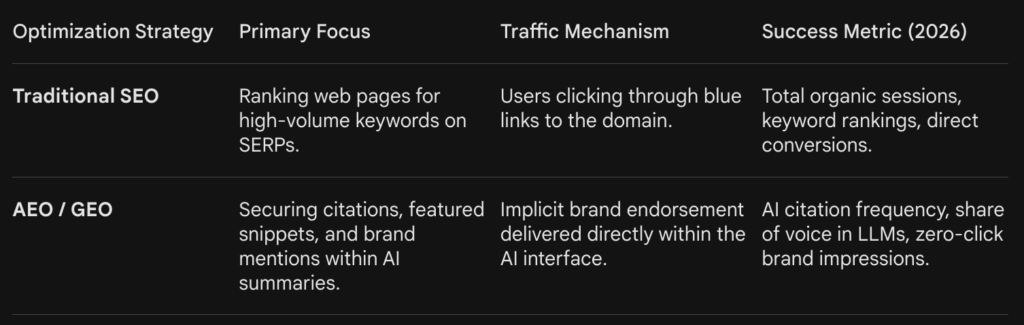
Organizations must adapt to the reality that highly valuable brand building occurs even when a user remains on the search engine results page. If a localized search for a B2B service yields an AI overview prominently featuring an organization’s name, its primary value proposition, and positive attributes, a highly valuable “zero-click brand impression” has successfully occurred.
The Importance of Third-Party Sentiment in AEO
Because AI engines synthesize information from across the entire web, an AEO strategy cannot be confined to the brand’s own website. LLMs scan industry publications, local business directories, review platforms, and community forums like Reddit to gauge public consensus and brand authority.
If an AI detects negative sentiment from outdated Reddit threads or poor aggregate reviews on third-party sites, it will actively exclude that brand from its recommendations, regardless of how well the brand’s own website is optimized. Therefore, modern AEO requires aggressive digital public relations. Brands must build strong narratives across external comparison sites, publish expert commentary in credible publications, and actively manage their knowledge panels to ensure the data fed into the AI ecosystem is overwhelmingly positive and authoritative.
Advanced analytics tracking platforms, such as Meridian, are now essential for monitoring where a brand is actually being mentioned in AI answers, tracking citation sentiment, and understanding which specific prompts trigger that visibility.
Aligning the 2026 Strategy: Integration and Execution
The convergence of site performance, mobile optimization, conversion architecture, and generative AI optimization represents the most complex digital landscape in the history of the internet. Success in 2026 requires dismantling the silos that traditionally separated web developers, UX designers, and SEO specialists.
For an enterprise to secure its market share, it must conduct routine, comprehensive audits of its technical health. This includes utilizing heatmap technologies to continuously refine CTA placements, upgrading server infrastructures to obliterate loading latency, and restructuring massive content libraries to align with the rigid GEO three-layer architecture. Furthermore, regular content refreshes are critical, as AI engines heavily weight recency when selecting sources; a guide published in 2024 will inherently lose algorithmic ground to a 2026 article on the same topic.
The integration of these complex methodologies requires deep technical expertise, continuous behavioral analysis, and a relentless commitment to digital excellence. For organizations seeking to dominate their respective markets, adapting to this multifaceted ecosystem is the only viable strategy. If a business is looking forward for someone to bring its SEO to another level, expert consulting teams are here to help. Building a future-proof digital presence ensures that an organization isn’t just a result on a page, but a trusted authority cited by AI, a seamless experience for the user, and the definitive answer to every complex market query.