Structure Sells Before Google Does: A high-converting Malaysian landing page relies on a proven anatomy—an intent-matched H1, a localized trust-building introduction, scannable benefits, and a singular Call to Action. Without this strategic architecture, top-tier rankings generate traffic but fail to produce tangible leads.
Local Trust Signals Are Non-Negotiable: Malaysian consumers exhibit high skepticism and require immediate proof before converting.
SEO and Conversion Are the Same Job: Technical optimization and copywriting are deeply intertwined. Structuring H2s to answer buyer questions directly feeds featured snippets and AI engines, while fast mobile UX and natural long-tail keyword integration simultaneously satisfy search algorithms and human user intent.
The 2026 Digital Paradigm Shift in the Malaysian Enterprise Landscape
The commercial ecosystem across Malaysia, particularly within dense economic hubs such as Kuala Lumpur and the broader continuum of Selangor, operates as an advanced, highly integrated digital economy. Driven by aggressive governmental digital integration initiatives and rapidly evolving consumer behaviors, enterprises are forced to adapt to shifting search engine algorithms and heightened user expectations. As of 2026, traditional, keyword-stuffed ranking tactics are entirely obsolete. Artificial intelligence has fundamentally reshaped digital discovery, moving the paradigm away from traditional search engine results pages (SERPs) and towards immediate, AI-generated answers.
In this highly competitive environment, merely securing a position on the first page of search results is insufficient. The integration of the Search Generative Experience represents a critical juncture for small and medium-sized enterprises (SMEs). Users now rely heavily on conversational assistants and generative platforms to conduct pre-purchase research, with industry data indicating that up to 60% of traditional searches now conclude without a single organic click. This “zero-click” phenomenon does not imply a lack of consumer interest; rather, it indicates that consumers are receiving their answers directly from the search engine’s interface.
Consequently, the architecture of a website’s landing pages must evolve to serve a dual purpose. First, it must present an immediate, frictionless conversion path for human visitors. Second, it must offer flawlessly structured, highly citable data for algorithmic interpretation. This comprehensive guide dissects the anatomy of a high-converting landing page specifically tailored for the Malaysian market in 2026, detailing the structural, psychological, and technical imperatives required to turn passive organic traffic into active, qualified leads.
Structure Sells Before Google Does
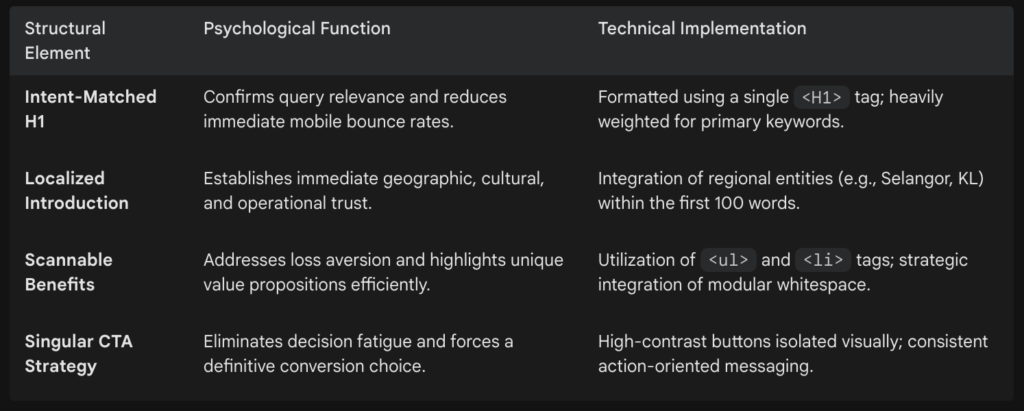
A fundamental error observed in numerous digital marketing campaigns is the prioritization of algorithmic appeal over human psychological engagement. A high-converting Malaysian landing page follows a proven anatomical framework that dictates user flow and minimizes cognitive friction. The assertion that structure sells before Google does is a critical operational reality. Without a meticulously designed layout, even the most robust SEO Marketing campaigns that achieve top-tier rankings will produce zero tangible leads.
When a Malaysian consumer clicks on a search result, they are unconsciously evaluating the page within milliseconds. If the visual hierarchy is chaotic, if the value proposition is buried beneath dense paragraphs of corporate jargon, or if the path to contact the business is ambiguous, the user will immediately exit the page. This structural failure not only costs the enterprise a potential lead but also damages the page’s organic ranking by signaling a poor user experience to search algorithms.
The Intent-Matched H1: The Immediate Hook
The structural foundation of a high-converting landing page begins with a search-intent-matched H1 tag. This primary heading must immediately confirm to the visitor that their specific query has been accurately and comprehensively resolved. It should not be a generic welcome message or a vague branding statement.
For example, if a user searches for a specific corporate service in the Klang Valley, an H1 that reads “Welcome to Our Corporate Solutions Page” is structurally deficient. Conversely, an intent-matched H1 such as “Expert Corporate Tax Consultation for Selangor SMEs” immediately validates the user’s search intent, anchors the geographic relevance, and states the core value proposition. This immediate validation drastically reduces the initial bounce rate, keeping the user engaged long enough to process the subsequent trust signals.
The Trust-Building Introduction: Local Context Matters
Following the initial visual hook of the H1, the architecture demands a highly specific, trust-building introductory segment. In the Malaysian context, generic, globally applicable introductions fail to resonate. Local context matters profoundly.
Content must explicitly mention geographic operational zones—such as specific districts in Selangor, the Kuala Lumpur city center, or Penang’s tech hubs—or address highly specific industry pain points relevant to the local economy. This geographical and contextual anchoring signals immediate relevance to the user. When an SME owner in Petaling Jaya reads an introduction that explicitly understands the unique logistical challenges of operating within the Klang Valley, a subconscious psychological bond is formed. This local anchoring demonstrates that the enterprise is not a faceless international entity, but a local partner capable of providing nuanced, contextually aware solutions.
Scannable Benefit Sections: Combating Attention Scarcity
The modern digital consumer suffers from acute attention scarcity. Dense, uninterrupted paragraphs of text fail to maintain engagement; therefore, the implementation of scannable benefit sections is essential for maintaining momentum down the page hierarchy.
Users do not read landing pages; they scan them for specific markers of value. To facilitate this behavior, structural elements such as bulleted lists, strategic white space, and modular content blocks must be rigorously employed. Each benefit should be clearly isolated, focusing on how the service resolves a specific pain point rather than merely listing technical features.
For instance, rather than a dense paragraph explaining the technical mechanics of a software product, the page should utilize a staggered layout featuring high-contrast subheadings (H3s) paired with concise, two-sentence explanations and supporting iconography. This modular approach not only pleases the human eye but also creates distinct semantic chunks of information that AI parsing algorithms can easily extract and index.
The Singular Call to Action: Eliminating Decision Fatigue
Crucially, the entire structural design must culminate in a single, unambiguous Call to Action (CTA). Implementing multiple, divergent CTAs on a single landing page—such as simultaneously asking the user to subscribe to a newsletter, follow social media accounts, read the company blog, and request a quotation—introduces severe cognitive overload.
This decision fatigue results in user confusion and fundamentally depresses conversion rates. A singular objective must be isolated and prioritized above the fold, and repeated strategically throughout the scrolling experience. Every element on the landing page, from the H1 to the localized introduction to the scannable benefits, must act as a directional funnel pointing the user toward this single, binary choice.
Local Trust Signals Are Non-Negotiable
In the contemporary digital marketplace, Malaysian buyers exhibit high levels of hesitation and justifiable skepticism. The proliferation of digital misrepresentation, automated spam, and generic overseas service providers demands that local enterprises provide immediate, undeniable proof of credibility before a consumer will initiate a commercial interaction. Local trust signals are not merely aesthetic enhancements to a landing page; they are non-negotiable conversion triggers.
Recognizable Brand Affiliation and Social Proof
A primary method for bridging the consumer trust gap involves the strategic display of client logos and social proof. However, generic or unrecognizable corporate iconography provides minimal psychological reassurance. For SMEs operating in Malaysia, displaying logos from recognizable local brands, governmental bodies, or prominent regional corporations serves as a potent, immediate endorsement.
When a landing page features the logos of familiar local shopping centers, established Malaysian hospitality chains, or recognizable local manufacturing entities, it leverages associative authority. This strategy rapidly elevates the perceived legitimacy of the service provider. Furthermore, social proof should not be limited to static logos. Integrating verifiable, localized case studies—such as detailing how an SEO Consultant Selangor improved lead generation for a manufacturing plant in Shah Alam—provides concrete evidence of operational competency. Testimonials should ideally include the full name, title, and local company name of the reviewer to maximize authenticity.
Bahasa Malaysia and English Bilingual Microcopy
Malaysia’s incredibly diverse, multicultural demographic necessitates a highly nuanced approach to user interface linguistics. Relying solely on standardized, formal English can inadvertently alienate significant portions of the local market, while exclusively using Bahasa Malaysia may fail to capture corporate decision-makers or the expatriate demographic.
The implementation of bilingual microcopy—utilizing both Bahasa Malaysia and English in secondary text, instructional labels, form fields, and navigational cues—creates an environment of inclusivity and deep cultural resonance. Code-switching, or the natural blending of languages often observed in Malaysian colloquial communication, can be carefully applied to micro-interactions to mirror natural speech patterns.
For example, a primary CTA button might read “Get Your Free Quote,” but the subtext immediately below it could feature supportive Bahasa Malaysia phrasing, reassuring the user about the lack of hidden obligations. This linguistic duality drastically reduces cognitive friction. It signals to the consumer that the enterprise intimately understands the local consumer base and is deeply embedded in the cultural fabric of the market, thereby elevating brand trust.
The WhatsApp-First Conversion Funnel: The Death of the Web Form
Perhaps the most critical evolution in Malaysian digital consumer behavior in 2026 is the complete obsolescence of traditional contact forms. In the Malaysian market, the conventional “Submit” button on a standard web form is widely considered a dead-end.
Consumers browsing via mobile devices—which constitute the vast majority of web traffic in Malaysia—experience acute “form fatigue” when faced with mandatory data entry fields asking for names, emails, and phone numbers. Furthermore, local consumers refuse to endure standard 24-hour corporate email response times; immediate, conversational interaction is not just preferred, it is actively demanded. Research indicates a strict “10-Minute Response Rule,” where the vast majority of Malaysian consumers lose commercial interest if they do not receive an acknowledgment within ten minutes of initiating contact.
Consequently, the most successful SMEs are abandoning standard lead generation structures in favor of WhatsApp-First funnels. Integrating click-to-chat WhatsApp CTA buttons directly adjacent to value propositions allows users to transition instantly from a static informational landing page to a dynamic, personalized messaging environment.
This recognizable “green button” serves as a powerful psychological trust signal. It implicitly promises that a verified human operator is available for immediate consultation, bridging the trust gap that exists with anonymous web forms. Optimizing the search-to-message journey involves pre-filling WhatsApp prompts with context-specific text. For example, if a user clicks a WhatsApp button on a specific service page, the pre-filled message might read: “Hi, I am interested in your SEO Consultation services for my business in Selangor. Can you share more details?” This eliminates all remaining friction from the user’s path to action, often resulting in click-to-chat engagement rates that are three times higher than standard web forms.
GST/SST-Compliant Pricing Transparency
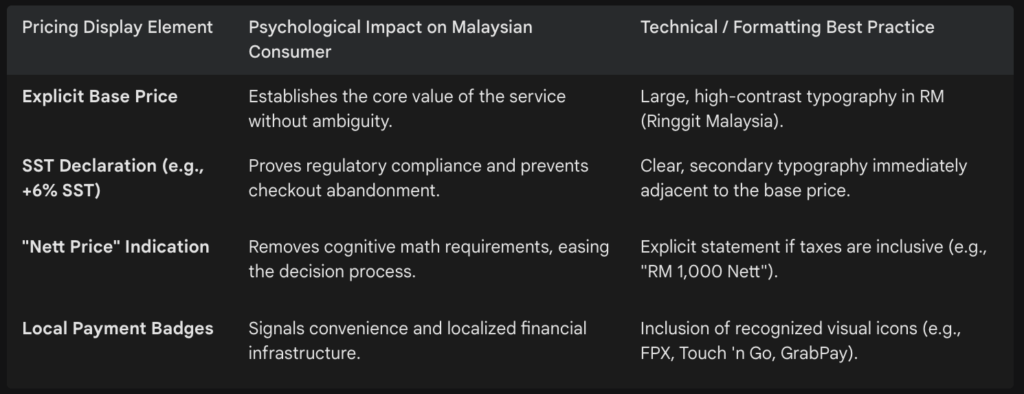
Financial transparency is a definitive trust signal. In Malaysia, navigating the complexities of the Sales and Service Tax (SST) is a mandatory aspect of commercial operations, and consumers are highly sensitive to hidden fees, unexpected surcharges, or ambiguous final costs.
Landing pages that feature pricing models, subscription tiers, or service packages must display GST/SST-compliant pricing structures with absolute, unequivocal clarity. Demonstrating whether a service is subjected to the standard 10% rate, the reduced 6% or 5% rates, or explicitly stating that the tax has been embedded into the final cost, completely eliminates pre-purchase anxiety.
This level of operational transparency not only complies with regional regulatory frameworks but serves as a profound psychological anchor. It proves to the Malaysian consumer that the enterprise operates with high integrity, financial professionalism, and respects the consumer’s right to clear, upfront information.
SEO and Conversion Are the Same Job
A prevalent and highly damaging misconception among SME owners and legacy marketers is the treatment of technical SEO and persuasive copywriting as distinctly separate, often isolated, operational disciplines. In reality, particularly in the 2026 digital ecosystem, SEO and conversion are the exact same job.
The mechanics that satisfy advanced search engine crawlers are identical to the mechanics that provide a superior human user experience. You cannot optimize for a machine without optimizing for the human, and vice versa.
Question-Based H2s and the Featured Snippet Pipeline
The structural hierarchy of a landing page, specifically the strategic utilization of H2 and H3 tags, serves as the primary navigation system for both human readers and algorithmic bots. To maximize both visibility and conversion, H2s must not be generic labels (e.g., “Our Process”); rather, they must be constructed to explicitly answer the precise questions that potential buyers are asking.
When heading structures are formulated as direct buyer questions (e.g., “How Much Does SEO Consultation Cost in Malaysia?”), they immediately capture the reader’s attention by addressing their core concerns. Furthermore, when the immediately subsequent paragraph provides a concise, 40-to-60 word factual answer, the page fulfills the exact criteria required to capture Google’s featured snippets. This formatting strategy simultaneously satiates the human user’s desire for immediate, no-nonsense information and feeds the data pipelines of advanced answer engines, positioning the page at the absolute top of the search results.
Natural Integration of Long-Tail Phraseology
Effective copywriting does not rely on the jarring, unnatural keyword stuffing tactics of the past. Today’s natural language processing algorithms can easily detect and penalize forced keyword density. Instead, the body copy must naturally carry high-intent, long-tail variations.
Integrating highly specific phrases such as “SEO landing page Malaysia” or seeking the expertise of an “SEO Consultant Selangor” should flow seamlessly within the context of a broader narrative concerning localized business growth. When content provides genuine depth and explicitly addresses the user’s search intent, semantic relevance naturally increases. This elevates the page’s topical authority in the eyes of search algorithms without compromising the persuasive power, tone, or readability of the sales copy. The goal is to write in a manner where the keywords are a natural byproduct of discussing the topic thoroughly.
The Technical Imperatives: Page Speed and Mobile UX
The underlying technical infrastructure of a landing page exerts massive, unavoidable influence over both its rankability and its capacity to convert. In a heavily mobile-dominated digital economy like Malaysia, page speed is a primary metric of success. The integration of high-resolution, uncompressed imagery, complex render-blocking scripts, or poorly optimized server configurations creates latency.
If a Malaysian consumer, browsing on a mobile network while commuting in the Klang Valley, experiences a load delay exceeding three seconds, bounce rates escalate exponentially. Search engines interpret this high bounce rate and low dwell time as a definitive behavioral signal of poor user experience, subsequently downgrading the page’s organic ranking.
Conversely, a highly optimized, lightning-fast mobile architecture ensures that the user reaches the conversion point—such as the vital WhatsApp CTA—without experiencing technical frustration. Thus, server response times, image compression protocols, Core Web Vitals compliance, and a frictionless mobile UX directly impact the commercial viability of the page, proving unequivocally that technical optimization and lead conversion are inseparable concepts.
Mastering Generative Engine Optimisation and Answered Engine Optimisation
The transition towards artificial intelligence has fractured traditional search methodologies, necessitating the adoption of highly specialized frameworks: Generative Engine Optimisation and Answered Engine Optimisation. For SMEs seeking comprehensive marketing consultation, understanding the nuanced distinction and the technical application of these advanced paradigms is paramount for survival in 2026.
Understanding the Mechanistic Differences
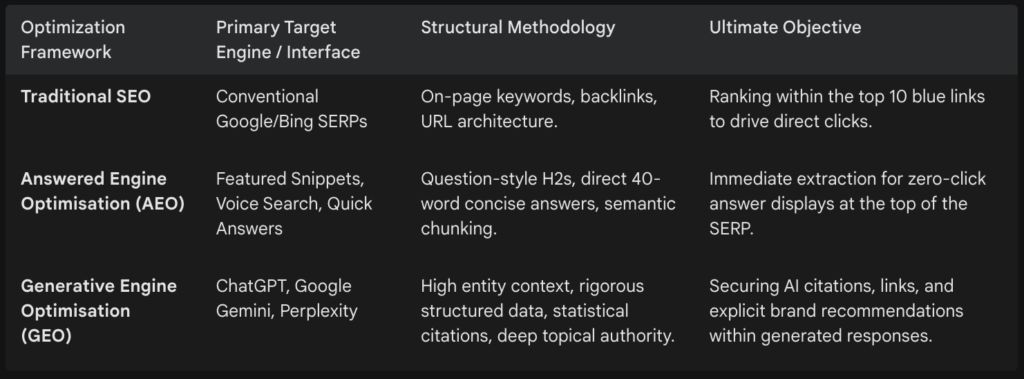
While traditional search engine optimization historically focused on securing blue links on SERPs via external backlinks and keyword density, AEO and GEO function entirely differently.
Answered Engine Optimisation (AEO) is primarily concerned with structuring data so that voice assistants (like Siri or Alexa) and search platforms can extract direct, definitive answers for instant, zero-click display. It relies heavily on formats such as comprehensive Frequently Asked Questions (FAQs) and structuring content to match “People Also Ask” conversational queries.
Conversely, Generative Engine Optimisation (GEO) targets the massive Large Language Models (LLMs) that power platforms like ChatGPT, Google Gemini, and Anthropic’s Claude. The objective of GEO is not merely to rank on a page, but to position an enterprise’s digital assets as the authoritative source material that these AI engines retrieve, synthesize, and explicitly cite when formulating a conversational response for a user. In 2026, earning an explicit citation from an AI model provides an implicit endorsement that far exceeds the trust generated by a standard organic search listing.
Implementing AI-Centric Content Architecture
To successfully adapt a Malaysian landing page for the Search Generative Experience, specific formatting rules must be rigorously applied, as AI parsing algorithms read structural hierarchy before they interpret textual substance.
1. The Inverted Pyramid Structure: This journalistic concept is now mandatory for GEO. The most critical information—the direct answer to the user’s implicit query or the primary value proposition—must be presented immediately beneath the heading. This must be followed sequentially by supporting evidence, localized context, and secondary technical details. AI models prioritize content located at the top of informational blocks.
2. Machine-Readable Definitions: Definitions and core concepts must be formatted in a manner that AI can easily extract without requiring complex natural language processing interpretation. Employing the structural template of is [clear definition] allows machine learning models to instantly recognize, categorize, and store the data point for future retrieval.
3. Advanced Schema Markup Integration: The implementation of schema markup represents the removal of interpretation guesswork for AI engines. By utilizing specific JSON-LD structures to explicitly define local business parameters, service areas, author credentials, and contact points, an enterprise unequivocally signals its exact nature to the parsing algorithms. For instance, explicitly tagging a local WhatsApp number under the contactPoint schema property ensures that AI models understand exactly how the business can be reached, vastly increasing the likelihood that the AI will recommend the enterprise to a user seeking immediate local assistance.
The E-E-A-T Framework Application in the Malaysian Context
The proliferation of artificially generated content has prompted search engines to heavily prioritize Experience, Expertise, Authoritativeness, and Trustworthiness (E-E-A-T). For a landing page to achieve sustained visibility in 2026, it must emanate irrefutable human expertise.
In the context of Malaysian service providers, demonstrating experience involves moving beyond generic, boilerplate claims. Landing pages must explicitly detail the operational history of the practitioners. Referencing specific localized case studies—such as detailing the exact percentage of lead generation improvement for an SME in the Klang Valley—provides verifiable evidence of real-world application. Incorporating granular details regarding complex local challenges, and the specific methodologies used to overcome them, proves that the content is derived from genuine operational experience rather than generalized theory generated by an AI.
Furthermore, authoritative signals must be explicitly stated. Including author credentials, professional certifications, and detailed organizational information within the page copy and the backend schema markup solidifies the domain’s standing as a premier industry resource.
The Economics of Professional Implementation vs. Minimum Costing
The architectural, psychological, and technical complexity required to execute these frameworks successfully in 2026 highlights a critical operational reality for SMEs: the severe danger of pursuing minimum-cost digital services.
The digital economy is saturated with entities offering baseline, low-cost visibility tactics. These services frequently rely on outdated, highly manipulative strategies—often categorized as black-hat techniques—that completely ignore the structural, psychological, and technical necessities detailed in this report. Instead of building a sophisticated, AI-ready landing page infrastructure that converts traffic into revenue, minimum-cost services often focus solely on generating bulk external backlinks from unregulated, irrelevant, or compromised directories.
The Uncontrollable Algorithmic Risk
The reliance on cheap, manipulative tactics exposes the SME to irreversible algorithmic risk. Search engines, powered by incredibly advanced machine learning algorithms, can rapidly identify unnatural linking patterns and structurally deficient websites. When a domain is penalized or outright banned from the index due to association with compromised networks (such as unregulated directories), the digital asset is effectively destroyed, bringing organic lead generation to an immediate halt.
Conversely, genuine white-hat, high-level implementation requires immense resource allocation. True architectural optimization involves deep technical auditing, psychological copywriting, rigorous A/B testing of conversion elements, and the continuous monitoring of AI indexation. While the initial investment for professional SEO Marketing is higher, it builds a sustainable, long-term business asset. A properly architected landing page is resilient to algorithmic shifts and is fully capable of capturing and converting high-intent traffic within the highly competitive Malaysian economic hotspots.
Social Media Distribution Mechanics for 2026
A technologically perfect, high-converting landing page remains dormant without a continuous influx of targeted traffic. While organic search is the foundation, in 2026, social media platforms have transcended their original functions as mere networking sites to become powerful, active search engines in their own right. For Malaysian SMEs, a sophisticated social media content strategy across platforms like LinkedIn and Facebook is vital for driving qualified, intent-rich prospects into the highly optimized landing page funnel.
LinkedIn: B2B Authority and Algorithmic Nuance
For enterprises offering professional services, corporate consulting, or B2B solutions, LinkedIn represents the highest-yield platform for targeted traffic. However, the distribution strategy has evolved significantly. Success requires the adoption of a creator mindset and the leveraging of humanizing brand narratives.
Content driving traffic to a landing page should not resemble a traditional, sterile corporate advertisement. Instead, posts should extract specific, high-value insights directly from the landing page—such as a proprietary data point regarding local market trends or a contrarian perspective on conventional industry practices. Utilizing long-form text posts, native document sharing, and engaging visual assets positions the enterprise as an authoritative thought leader. When this thought-leadership content naturally links back to the landing page, the traffic that arrives is highly pre-qualified and primed for conversion. Furthermore, actively utilizing employee advocacy—where team members share institutional insights organically—drastically extends the reach of the content beyond the algorithmic constraints of the corporate page.
Facebook: Hyper-Targeted Consumer Acquisition
Despite the rise of emerging platforms, Facebook remains an inescapable and vital force within the Malaysian digital ecosystem due to its unparalleled user volume and incredibly sophisticated targeting capabilities. For direct-to-consumer businesses and service-oriented SMEs, Facebook excels at intercepting users and guiding them toward conversion-focused landing pages.
The 2026 strategy for Facebook relies heavily on the integration of short-form video and User-Generated Content (UGC). Consumer attention spans are critically compressed; therefore, creative assets must package authenticity into rapid, highly engaging formats. An effective campaign might feature a quick, 15-second visual demonstration of a service resolving a common local pain point, immediately followed by a directive to visit the optimized landing page for a comprehensive solution. By utilizing hyper-targeted advertising based on precise demographic behaviors, localized interests, and previous platform interactions, enterprises can ensure that the traffic arriving at their meticulously structured WhatsApp funnel possesses a high degree of intent.
Furthermore, as social platforms increasingly index their content for their own internal search functions, applying SEO principles to social media profiles and post descriptions—ensuring that relevant keywords and clear entity contexts are present—guarantees cross-platform visibility and maximizes the overall return on marketing investment.
Conclusion
The 2026 digital landscape in Malaysia demands a radical departure from historical digital marketing methodologies. The reliance on generic web design, isolated traffic generation tactics, and black-hat manipulation is no longer commercially viable. As established through this comprehensive analysis, the architecture of a high-converting landing page is a complex, deliberate synthesis of human psychology, localized trust signals, and advanced algorithmic compliance.
By prioritizing structural intent, an enterprise guarantees that its value proposition is immediately comprehensible to the consumer, drastically reducing bounce rates. The non-negotiable inclusion of local trust signals—specifically the strategic use of bilingual microcopy, transparent SST integration, and immediate WhatsApp accessibility—serves to completely dismantle the inherent skepticism of the Malaysian market. Furthermore, the explicit alignment of conversion rate optimization with the technical prerequisites of both traditional search algorithms and emerging Generative Engine Optimisation ensures that the digital asset remains highly visible and deeply authoritative across all discovery platforms.
The execution of these advanced frameworks requires specialized knowledge, rigorous technical capability, and a deep understanding of local socio-economic nuances. If you are looking forward for someone to bring your SEO to another level, we are here to help.