For many small and medium-sized enterprise (SME) owners in Malaysia, the question of how much to spend on online advertising is a significant and often daunting one. A common pitfall is to base this crucial decision on an arbitrary percentage of revenue or on a competitor’s presumed spending, without a deeper understanding of the business’s own financial health and strategic goals. This approach often leads to inefficient spending, disappointing returns, and a perception that online advertising is a costly gamble rather than a strategic investment.
The Evolving Malaysian Market: From Ad Spend to Consumer Habit
A successful online advertising strategy must be built on a clear understanding of the market’s macroeconomic currents and the digital habits of its consumers. The Malaysian digital landscape is undergoing a profound transformation, with spending and consumer attention shifting decisively from traditional to digital channels.
The Digital Advertising Landscape: A Data-Driven Overview
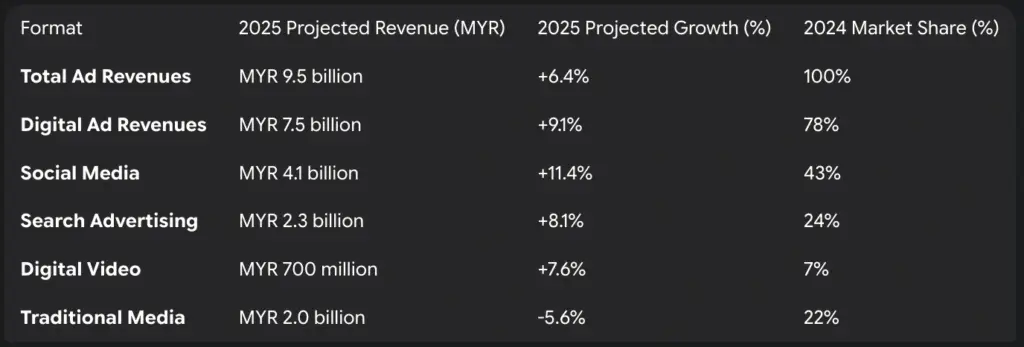
The Malaysian advertising economy is now unequivocally dominated by digital formats. Research projects that digital ad revenues will grow by 9.1% to reach MYR 7.5 billion in 2025, accounting for a commanding 78% of the total market. This trend is not an anomaly but a sustained push, with digital’s share of total advertiser budgets projected to climb to 82% by 2027. The growth is largely fueled by key digital segments. Social media is leading the charge with a projected growth of 11.4% in 2025, followed by search advertising at 8.1% and digital video at 7.6%. Traditional media, in stark contrast, continues to see declining revenues, with TV advertising revenues, in particular, falling by 11.9% in 2024 alone.
This macroeconomic shift carries significant implications for the SME owner. The sustained shift from traditional to digital advertising is a fundamental economic change. For an SME with a constrained budget, this data suggests a clear prioritization: traditional media should be de-emphasized, if not completely deprioritized. Conversely, the high-growth digital channels, while offering immense opportunities for audience reach, are also becoming increasingly competitive. This implies that while the potential for reaching a wide audience is greater, the cost of doing so is also likely to increase. A successful budget, therefore, must be designed not just to capitalize on growth but also to strategically outmaneuver competitors in a crowded space, making efficiency a paramount concern.
The Foundation of Strategy: Knowing Your Customer and Your Competition
Before allocating a single ringgit to advertising, a business must have a deep understanding of its market and its target customers. This foundational work provides the intelligence needed to make every ad dollar count.
Understanding Your Customer: The Blueprint for Targeting
The first step in any effective marketing plan is to identify the ideal customer. This goes beyond basic demographics such as age, gender, or location. A truly effective customer blueprint incorporates psychographics—details about a person’s lifestyle, values, interests, and pain points—as well as their online behavior, including which platforms they frequent and what kind of content they consume. This nuanced understanding dictates the strategic decisions that follow. For example, a B2B service targeting business professionals would find a higher return on investment (ROI) by advertising on LinkedIn, while a B2C fashion brand would be more effective on visual-first platforms like Instagram or TikTok. The data-driven insights from this process empower a business to craft highly relevant and persuasive ad copy, leading to more efficient spending and better results
Analyzing Your Competition: Your Strategic Compass
Competitive analysis is not an exercise in imitation; it is a search for differentiation and opportunity. By analyzing what competitors are doing, a business can identify gaps in the market and refine its own unique value proposition. Tools like the Meta Ad Library, SEMrush, or Ahrefs provide valuable insights into a competitor’s ad platforms, messaging, and search engine strategies.
The interconnectedness of audience research, competitive analysis, and budget allocation is a direct causal chain. The findings from this research directly inform strategic decisions. For instance, if analysis reveals that a major competitor has saturated Google Search with high-cost ads, a small business with a limited budget would be wise to avoid a direct confrontation. Instead, it could strategically allocate its budget to less competitive channels, such as social media content or a long-term search engine optimization (SEO) strategy, to build a presence in a different way. The budget is not a standalone decision; it is the financial output of a well-defined marketing plan, guided by a clear understanding of the market, the customer, and the competitive landscape.
The Profitability Compass: From Margins to Lifetime Value
An ad budget must be grounded in the business’s internal financial health. Blindly spending money without understanding a business’s profit margins and customer value can lead to significant financial distress, regardless of how many new customers are acquired.
The Truth About Profit Margins
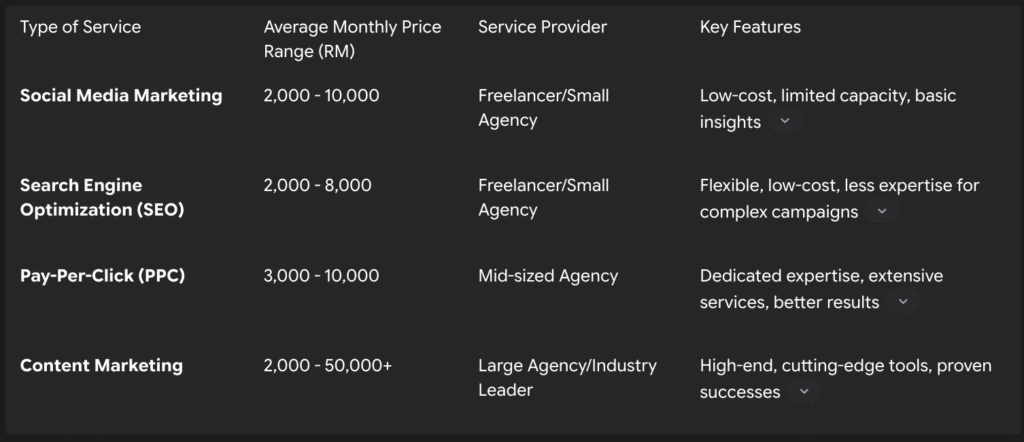
Digital marketing costs in Malaysia can range from RM 1,000 to RM 50,000 or more per month, depending on the service provider and campaign complexity. For many SMEs, this presents a significant challenge, as profit margins can be very tight. For example, the average profit margin for restaurants in Malaysia ranges from 5-8%, while for retail and hospitality, it can be as low as 2-3%. This reality highlights a fundamental flaw in the common practice of allocating a simple percentage of revenue to advertising. A low-margin business that allocates a high percentage of its revenue to advertising could inadvertently spend more on customer acquisition than the total profit generated from those customers, leading to a business model that is unprofitable at its core.
The low-margin environment prevalent in many Malaysian industries means that a business’s ad spend must be hyper-focused on efficiency and fast ROI. For a business with a 3% profit margin, the time it takes to recover the Customer Acquisition Cost (CAC) is significantly longer than for a business with a 50% margin. This emphasizes that for low-margin SMEs, a focus on lowering CAC, perhaps through more cost-effective strategies like strategic SEO or organic content, is more critical than simply increasing raw ad spend
The Power of Customer Lifetime Value (CLV)
Customer Lifetime Value (CLV), often used interchangeably with Lifetime Value (LTV), is a metric that estimates the total profit a customer will generate for a business over the entire duration of their relationship. It is a far more powerful metric for budgeting than a single-transaction profit margin. The importance of CLV lies in the fact that acquiring a new customer is often 5 to 25 times more expensive than retaining an existing one. A high CLV justifies a higher upfront investment in customer acquisition.
A basic CLV calculation is:
CLV = Average Purchase Value × Average Purchase Frequency × Average Customer Lifespan
For example, a small Malaysian business might calculate its CLV as follows:
An average customer spends RM 100 per purchase.
They buy from the business 4 times a year.
They remain a customer for 3 years.
The business has a 40% gross profit margin.
Using the formula, the CLV is RM100 × 4 purchases × 3 years = RM 1,200 in revenue. With a 40% margin, the lifetime profit is RM 1,200 × 0.40 = RM 480. This figure represents the total value a business can expect to gain from a single customer, providing a crucial benchmark for how much it can afford to spend to acquire them.
The most critical metric for evaluating the health of an ad budget is the LTV/CAC ratio. A ratio of 3:1 or higher is considered a signal of a sustainable and healthy business model, indicating that the value of a customer is at least three times the cost of acquiring them. This ratio fundamentally reframes the conversation from “How much should I spend?” to “How much am I willing to spend to acquire a customer, knowing their long-term value?” The ad budget is no longer an arbitrary number but a direct function of the business’s desired growth rate and its fundamental unit economics.
The Strategic Budgeting Framework: A Formula for Sustainable Growth
The Formula for Smart Ad Spend
To move away from arbitrary budget numbers, a business can follow a simple, four-step process:
Determine Your Goal: Define a specific, measurable, achievable, relevant, and time-bound (SMART) objective. Is the primary goal brand awareness, lead generation, or direct sales conversions?
Calculate Your LTV: Use the formula from Chapter 3 to determine the average profit or revenue a customer brings to the business over their lifetime.
Identify Your Target CAC: Based on the desired LTV/CAC ratio (ideally 3:1 or higher), set a maximum, profitable amount that the business can spend to acquire a single customer.
Forecast Your Needs: Once the target CAC is set, the total ad budget is a simple calculation. For example, if the goal is to acquire 50 new customers this quarter and the target CAC is RM 100, the total ad spend for the quarter would be
50 customers × RM 100/customer = RM 5,000.
This strategic approach ensures that the budget is a function of the business’s profitability and growth goals, not an arbitrary number.
Typical Monthly Costs and Benchmarks
While the framework provides a strategic method for calculating a budget, it is also helpful for SMEs to have a realistic understanding of typical costs in the Malaysian market. The following table provides a general benchmark for monthly digital marketing costs based on the type of service and provider.
Conclusion: Investing, Not Spending
The question of how much to allocate for online advertising in Malaysia is not about finding a magic number. It is about adopting a strategic mindset. Online advertising is a powerful tool, but it must be approached as a strategic investment, not a blind expense.
The primary takeaway for any Malaysian SME owner is this: begin with a solid foundation of data. Start with market research and audience analysis, not a budget number. Understand that while your profit margin is a constraint, your Customer Lifetime Value is your true growth enabler. Efficiency and a smart, data-driven strategy, as demonstrated in the real-world case studies, will always matter more than raw spending power. By moving from a “spend and hope” approach to a “measure and invest” model, a business can build a powerful, predictable, and profitable growth engine. The strategic framework presented in this guide, along with the accompanying e-book, provides the roadmap to begin that journey today.