The Resource Trade-Off Reality: Achieving high-impact market penetration demands either a substantial financial budget for immediate advertising visibility or a significant time investment in sustainable SEO and social media management.
AI Search and E-E-A-T Dominance: The 2026 paradigm requires businesses to align content with highly specific search intents and strict E-E-A-T guidelines to secure citations within emerging AI overviews and generative answer engines.
Omnichannel Ecosystem Synergy: Maximizing limited budgets requires leveraging personal branding, shooting informational videos, and repurposing deep organic content across free social media platforms to generate social traffic and natural backlink acquisition.
The 2026 Digital Ecosystem in Selangor
The marketing landscape for Small and Medium Enterprises (SMEs) in Selangor, Malaysia, has undergone a radical and irreversible transformation by the year 2026. Driven by robust economic dynamics, evolving consumer preferences, and proactive government initiatives aimed at fostering digital transformation, the regional ecosystem is highly fertile for innovation. However, this rapid digitization has inevitably saturated the market, rendering visibility increasingly difficult to attain for organizations operating on restricted financial budgets. Malaysian consumers have become extraordinarily digitally adept, with mobile connection penetration exceeding 120%, effectively establishing the mobile interface as the primary, and often exclusive, storefront for modern commerce. In this mobile-only paradigm, if an enterprise’s digital experience is not seamless on a six-inch screen, that enterprise is effectively closed for business.
Simultaneously, the foundational architecture of digital discovery is undergoing a seismic shift. Traditional organic search, characterized by lists of blue links, is rapidly ceding ground to artificial intelligence. The Search Generative Experience (SGE) and localized Answer Engine Optimization (AEO) frameworks are fundamentally altering how users formulate queries and discover products and services. For an SME operating in Selangor, relying on outdated paradigms—such as untargeted social media broadcasting or archaic keyword-stuffing techniques—yields rapidly diminishing returns. The contemporary challenge necessitates a highly nuanced understanding of resource allocation, the integration of advanced generative optimization, the proactive leverage of personal branding, and the surgical execution of localized advertising campaigns. This comprehensive analysis exhaustively details how low-budget SMEs in the region can architect high-impact digital strategies by aligning directly with 2026 algorithmic demands and prevailing consumer behaviors.
The Immutable Law of Resource Allocation: Capital Versus Temporal Investment
A persistent and dangerous misconception within the SME sector is the existence of digital marketing strategies that require minimal time, minimal financial investment, and yet somehow deliver disproportionately high commercial impact. The empirical reality of the 2026 digital ecosystem dictates that such a tripartite advantage is a mathematical and algorithmic impossibility. The foundation of any viable digital strategy rests on a strict, unavoidable trade-off between temporal investment and capital expenditure. An enterprise must definitively choose its primary lever of growth.
The Capital-Intensive Route: Accelerated Impact via Paid Advertising
When an enterprise possesses a substantial budget but lacks the time required for organic maturation, paid advertising represents the optimal deployment of resources. Platforms such as Google Ads, Meta Ads (Facebook and Instagram), and programmatic display networks allow for immediate market penetration, rapid traffic generation, and accelerated lead acquisition. This approach operates on a deterministic model: capital is directly converted into visibility. However, this visibility is inherently transient. The precise moment the capital expenditure ceases, the visibility evaporates, leaving no residual digital equity.
Furthermore, in the highly competitive sectors concentrated within Selangor, cost-per-click (CPC) rates and auction dynamics demand rigorous financial guardrails. Without sophisticated management, a substantial budget can be exhausted rapidly with minimal return on investment. For low-budget SMEs, attempting to outspend enterprise competitors in broad auction environments is an unviable strategy. Therefore, the reliance purely on ads is reserved for those who can sustain the financial burn rate.
The Time-Intensive Route: Compound Impact via Organic Channels
Conversely, when an enterprise operates with a constrained financial budget, it must substitute capital with a substantial and sustained temporal investment. This manifests as intensive SEO Marketing, rigorous long-form content creation, and proactive social media management. Organic growth relies on the compounding effects of entity authority, factual density, and relationship building. It requires the meticulous construction of a digital footprint that search algorithms and AI engines deem authoritative and trustworthy.
The corporate sector frequently attempts to circumvent this fundamental law by seeking rapid, low-cost organic solutions. A prevalent manifestation of this is the desire to hire an SEO Consultant Selangor for a single month to permanently “fix” a declining website and restore organic traffic. While technically feasible to execute a short-term contract, the reality of the 2026 digital ecosystem renders this approach highly ineffective. A one-month engagement is solely sufficient for baseline technical auditing; it fundamentally fails to address the ongoing, foundational on-page optimizations and dynamic entity-based strategies required to drive modern search visibility.
Website development teams often prioritize aesthetics and functionality, frequently leaving profound structural gaps that fail to meet modern search engine requirements. Standard website fixes do not ensure indexing within AI-driven search environments. Securing a presence in these new models requires the continuous deployment of schema markup, the regular updating of content for freshness signals, and the persistent cultivation of external authority—all of which necessitate a long-term commitment of time. Therefore, an SME with a low budget must fundamentally accept that achieving high impact will require huge time and consistent, systemic effort.
Dominating the Search Generative Experience: Redefining SEO in 2026
The year 2026 represents a critical inflection point in the digital discovery process. Traditional search volume—characterized by users scanning a page of ten blue links—has demonstrably declined by an estimated 25% as users aggressively migrate toward AI-powered answer engines. Platforms such as Google’s AI Overviews, OpenAI’s ChatGPT, and Perplexity synthesize vast amounts of information from multiple web sources to provide direct, definitive, and highly contextualized answers.
Consequently, the primary objective of any modern marketing consultation or SEO campaign is no longer simply to rank a domain on the first page of search results. The new imperative is to ensure the enterprise is explicitly cited, recommended, and sourced within the generated narrative of an artificial intelligence model. If traditional SEO was about earning a spot on the first page, the future of SEO is about being the definitive source that the AI engine relies upon to formulate its answer. With the latest AI Overviews, SEO will become exponentially more valuable, as Google and other engines focus intensely on indexing and surfacing content that is perfectly relevant to the user’s highly specific query.
Generative Engine Optimisation (GEO) and Answered Engine Optimisation (AEO)
To adapt to this paradigm, SMEs must master Generative Engine Optimisation and its localized counterpart, Answered Engine Optimisation. While traditional algorithms measured content quality through proxy behavioral signals such as dwell time, bounce rate, and click-through rate, generative engines evaluate content based on internal architectural metrics. These systems utilize natural language processing to assess “factual density,” structural clarity, and the authoritative weight of the underlying entity.
When an AI engine explicitly names a brand in its response—for example, citing a Selangor-based logistics firm as the optimal solution for regional supply chain management—it delivers an implicit algorithmic endorsement that no standard organic listing could ever achieve. This dynamic creates a rapidly widening divide between proactive market leaders and laggards. Brands that consistently appear in AI-generated recommendations shape how buyers understand the market, effectively defining the category and creating a compounding advantage.
Aligning with Search Intent and Preparing the Keyword Matrix
The foundational step in executing a low-budget, high-impact SEO strategy is the meticulous preparation of a target keyword list. However, in 2026, compiling a list of high-volume, generic terms is counterproductive. SMEs must prepare a highly focused list of long-tail keywords based entirely on user Search Intent. Generative engines are profoundly intent-driven; users ask highly specific, high-commercial-intent questions.
For instance, rather than targeting “accounting software,” a Selangor SME should target “best cloud accounting software for retail SMEs in Selangor.” The content creation process must be reverse-engineered from these specific intents. Once the intent is mapped, the SME must create comprehensive content that directly answers the user’s underlying problem. This involves listing 10 to 15 core questions the target demographic frequently asks and structuring the content to systematically address each one.
The Imperative of the E-E-A-T Framework
Once the keywords and search intents are established, the content must be crafted using the E-E-A-T (Experience, Expertise, Authoritativeness, Trustworthiness) format. AI algorithms rely heavily on E-E-A-T signals to determine which sources are reliable enough to cite in a generated overview. For a low-budget SME, demonstrating E-E-A-T requires a structural methodology:
Experience: Content must demonstrate firsthand experience with the topic. For a B2B service provider, this means integrating highly detailed, localized case studies detailing specific problems solved for clients within Selangor. It involves moving beyond theoretical advice to practical, proven application.
Expertise: AI models evaluate the depth of knowledge presented. Content should feature clear, definitive language rather than hedged phrasing. SMEs must publish deep, comprehensive pillar pages that cover a topic exhaustively, ensuring that when an AI parses the page, it finds a high density of factual, verified information.
Authoritativeness: Authority is established through external validation. This requires the cultivation of high-quality backlinks from reputable industry publications, local news outlets, and recognized digital PR channels. Furthermore, maintaining consistent brand mentions (entities) across the web and actively managing knowledge panels are critical.
Trustworthiness: Trust is the foundational pillar. This is signaled through technical security (HTTPS), transparent business practices, verifiable contact information, clear authorship with detailed bio pages, and the implementation of robust schema markup to help AI engines easily parse and verify the data.
By rigorously applying the E-E-A-T framework to intent-driven keywords, an SME ensures its content is perfectly positioned to be indexed, retrieved, and cited by generative AI platforms.
Localized Answer Engine Optimization for Selangor
One of the most critical trends for local businesses in 2026 is how strongly AI search has moved toward localized and personalized outputs. When a user in Petaling Jaya queries an AI engine for a nearby commercial contractor, the system does not return a generic national answer; it applies strict geographic context and draws upon local entity data.
To dominate localized search without a massive budget, SMEs must execute a flawless local AEO strategy. This involves creating dedicated, hyper-structured pages for specific geographic locations within Selangor. These pages must feature accurate Name, Address, and Phone (NAP) details, service descriptions, and location-specific FAQs. The critical differentiator is the deployment of advanced schema markup. Adding LocalBusiness, PostalAddress, and Service schema translates human-readable text into the structured data that AI systems require to confidently parse, verify, and recommend a local entity.
Synergizing Organic SEO with Personal Branding and Social Media
In an era characterized by algorithmic curation and “AI fatigue,” consumers increasingly crave genuine human connection and authentic community engagement. While businesses favor AI for operational efficiency, the end consumer views highly polished, faceless corporate communication with mounting skepticism. For low-budget SMEs, relying solely on the corporate entity to build trust is inefficient. Instead, the strategic focus must pivot toward the personal branding of the enterprise’s founders, executives, and key personnel.
To achieve maximum impact with minimal financial expenditure, SMEs must fully utilize free social media platforms. The core strategy involves ensuring the capacity to shoot informational videos and deploy them systematically to tap into the market. Furthermore, for social media to drive tangible SEO value, the enterprise must proactively post all the deep content prepared for organic search onto these platforms. This dual-pronged approach brings additional, highly qualified social traffic to the website while naturally building external backlinks and social citations that fortify the overarching SEO strategy.
B2B Dominance: LinkedIn as a Personal Branding Engine
For B2B SMEs operating in Selangor, LinkedIn is the premier platform for personal brand building and lead generation. Establishing authority in 2026 is not achieved through erratic posting; it requires a repeatable, data-driven system. The methodology begins with defining clear content pillars that represent the intersection of the founder’s specific skills, market interests, and the pressing pain points of their Ideal Customer Profile (ICP).
Instead of posting generic corporate updates, founders must utilize storytelling. By documenting the founder’s journey—sharing hard-won industry insights, analyzing real-world productivity challenges, and dissecting both failures and successes—the enterprise humanizes its brand. This transparency builds profound trust, positioning the individual as a credible thought leader. A strong, consistent LinkedIn presence serves as a hedge against algorithmic volatility on other platforms by fostering direct, personal network effects, ensuring the brand remains authoritative in the eyes of potential partners and clients. Crucially, when founders share links to their deep E-E-A-T aligned blog content within these narratives, they generate high-quality referral traffic that search engines interpret as strong validation signals.
B2C and Omnichannel Reach: The Visual Discovery Engines
For both B2B and B2C enterprises, short-form video has established absolute dominance, generating engagement rates substantially higher than static imagery. In 2026, platforms such as TikTok, Instagram Reels, and YouTube Shorts are no longer merely social networks; they function as full-funnel search and discovery engines. Younger demographics, in particular, increasingly bypass traditional text-based search engines, utilizing a social scroll to evaluate credibility, seek recommendations, and research brands.
To capitalize on this behavior, SMEs must shoot informational videos that directly address consumer pain points. This requires the implementation of “Social SEO”—the practice of naturally embedding target keywords into the spoken audio, post captions, and on-screen text of the video to ensure algorithmic categorization and retrieval. Videos must be optimized for mobile consumption: strictly vertical formatting, compelling narrative hooks delivered within the initial three seconds to prevent scrolling, and the mandatory inclusion of captions, as the vast majority of mobile video is consumed without audio. Cultural localization is also critical; Selangor startups utilizing familiar local settings, culturally relevant humor, and regional language nuances consistently outperform generic, globally targeted content.
The Omnichannel Content Repurposing Ecosystem
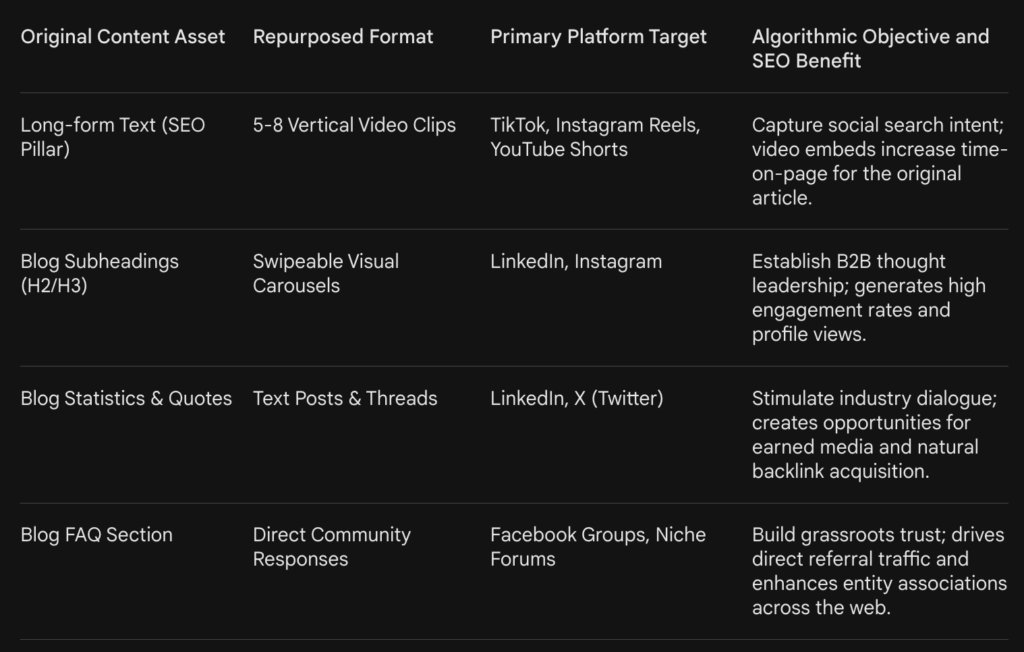
The inherent limitation of a low budget necessitates extracting the maximum possible utility from every created digital asset. A foundational, expertly crafted SEO blog post must not languish as static text on a website; it must serve as the central intellectual pillar for an expansive, omnichannel distribution strategy. Repurposing organic content is the mechanism by which huge time investments yield exponential reach, driving supplementary social traffic to the domain and building the robust digital footprint that AI answer engines monitor for cross-platform validation.
An exhaustive, high-impact content repurposing workflow in 2026 operates through the following systemic phases:
The Foundational Asset: A comprehensive, 2000-word E-E-A-T aligned blog post is researched and published on the enterprise website, targeting specific Generative Engine Optimisation and localized AEO queries.
Short-Form Video Extraction: The core concepts, actionable steps, and contrarian opinions within the article are transformed into a concise video script. The founder shoots a 10-to-15-minute informational video discussing these concepts. This master recording is then processed through AI clipping tools (e.g., OpusClip, Descript) to extract 5 to 8 standalone, vertical video clips. Each clip delivers a single, potent insight tailored for TikTok and YouTube Shorts.
Visual Carousel Generation: The structured headings (H2s), checklists, and data points from the blog post are converted into highly visual carousel posts. These formats perform exceptionally well on LinkedIn and Instagram, encouraging users to swipe through the data and generating high dwell times.
Micro-Blogging and Thread Creation: Individual statistics, powerful quotes, or specific definitions from the pillar asset are deployed as text-only posts on LinkedIn or X (formerly Twitter). A complex concept from the blog can be broken down into a step-by-step thread, driving engagement and debate.
Community Cultivation: The FAQs addressed within the blog are utilized to systematically answer user queries in relevant Facebook groups, Quora, or Reddit threads. Providing high-value answers that link back to the comprehensive blog post establishes topical authority and drives highly qualified traffic.
By executing this repurposing matrix, an SME transforms a single investment of time (the blog post) into weeks of multi-platform social media dominance, driving traffic back to the site and signaling immense brand authority to search algorithms.
Strategic Paid Advertising on a Constrained Budget
While the architectural foundation of a low-budget strategy relies heavily on the intensive application of time via SEO marketing and omnichannel social media repurposing, relying exclusively on organic channels can result in a prolonged period of low lead velocity. Therefore, a surgical, highly disciplined allocation of capital toward paid advertising is often necessary to bridge the temporal gap before organic channels fully mature.
However, when spending a little into ads, the deployment of that budget must be ruthlessly efficient. Generic, “set-and-forget” campaigns, or those utilizing broad targeting without rigorous guardrails, will rapidly consume limited resources without generating a measurable return on investment. The advertising strategy must fundamentally diverge based on whether the SME is operating in a Business-to-Consumer (B2C) or Business-to-Business (B2B) paradigm.
B2C Strategies: Engineering Awareness via Visual Ecosystems
For B2C enterprises operating in Selangor, the purchasing cycle is often shorter and more heavily influenced by visual stimuli and emotional resonance. The primary objective of limited ad spend in this context is rapid brand awareness, the stimulation of impulse discovery, and staying top-of-mind. The optimal platforms for this execution are Meta Ads (Facebook and Instagram) and the Google Display Network.
Malaysian consumers heavily integrate visual social platforms into their daily routines. By leveraging highly targeted display and social ads, B2C brands can consistently present their value proposition to specific demographic segments. To maximize a low budget, the methodology involves utilizing the short-form videos generated during the content repurposing phase as the primary ad creative. This approach ensures that the ad budget is not wasted on expensive, bespoke commercial production, allowing maximum capital to flow directly toward media buying and audience reach.
Furthermore, campaigns must be strictly geofenced. A local retailer in Subang Jaya gains no benefit from displaying awareness ads to users in Penang. By aggressively narrowing the geographic targeting to the SME’s exact serviceable areas within Selangor, the budget is concentrated on the most probable converters, maximizing the impact of every Ringgit spent.
B2B Strategies: Precision Bidding and Intent Capture via Google Search Ads
The B2B purchasing cycle is inherently longer, highly analytical, involves multiple stakeholders, and is significantly less susceptible to visual impulse. Consequently, B2B ad budgets must be directed away from broad awareness and focused intensely on capturing high commercial intent via Google Search Ads. For a Selangor B2B SME operating with a limited monthly budget (defined in 2026 as generating only 10 to 30 clicks per day), standard automated playbooks designed for massive enterprise budgets will fail catastrophically.
To ensure viability and control the ads budget based on the bidding, the following structural guardrails must be rigorously implemented:
Strict Match Type Restriction: Unoptimized B2B accounts running broad match keywords without vast troves of offline conversion data will waste significant portions of their spend on irrelevant, consumer-level queries. Low-budget campaigns must prioritize exact-match and tightly controlled phrase-match keywords tied directly to high-margin revenue generation.
Negative Keyword Vigilance: B2B buyers utilize highly specific, technical nomenclature. Guarding the budget against adjacent, irrelevant consumer searches requires rigorous, weekly negative keyword audits. In a low-budget scenario, one poorly aligned search term clicking through at a high CPC can consume an entire daily budget instantly.
Value-Based Bidding (VBB) Integration: Rather than instructing Google’s algorithm to merely “maximize conversions”—a setting that treats a low-value newsletter sign-up equally to a high-value enterprise consultation request—B2B advertisers must integrate offline conversion data from their CRM. By assigning specific monetary values to different stages of the sales funnel (e.g., a Sales Qualified Lead is worth exponentially more than a basic form fill), utilizing Target ROAS (Return on Ad Spend) or Target CPA (Cost Per Acquisition) bidding strategies forces the algorithm to optimize for actual business value rather than superficial lead volume.
Campaign Consolidation for Algorithmic Learning: A critical architectural error for accounts with minimal spend is extreme fragmentation. Creating too many separate campaigns limits the conversion data flowing into any single entity. Smart Bidding algorithms require a minimum threshold of conversions (typically 30 to 50 per month) to identify successful patterns and optimize delivery. Budgets must be consolidated into a minimal number of high-intent campaigns to aggregate sufficient data for the algorithm to function effectively.
Intent-Matched Landing Page Architecture: Directing paid, high-CPC B2B traffic to a generic corporate homepage results in massive prospect leakage. Traffic must be funneled to dedicated, intent-matched landing pages devoid of distracting navigation, tailored specifically to the exact problem queried in the search term. Empirical data indicates that intent-matched destinations produce conversion rates up to four times higher than generic homepages. Every campaign deserves its own dedicated digital destination.
By adhering to these stringent parameters, a low-budget B2B SME can effectively compete in the Google Ads ecosystem, capturing high-value leads without engaging in unwinnable bidding wars with enterprise competitors.
Strategic Synthesis and The Path Forward
For Small and Medium Enterprises in Selangor, achieving high-impact digital growth on a highly constrained budget is entirely feasible, provided there is an uncompromising commitment to strategic resource allocation. The pervasive myth that massive results can be achieved with minimal time paired with minimal capital must be definitively discarded. Instead, enterprises must ruthlessly prioritize their efforts, channeling their available time into E-E-A-T aligned, factually dense content designed specifically to dominate the new Search Generative Experience.
By localizing entity data, leveraging the authentic, connective power of personal branding, and maximizing the lifespan of deep content through intelligent omnichannel video repurposing, small businesses can cultivate a formidable organic presence. This approach generates the critical social traffic and authoritative backlinks necessary to satisfy modern generative algorithms. When this compounding organic authority is surgically augmented by precisely targeted ad spend—safeguarded by stringent negative keyword lists, geofencing, and advanced value-based bidding algorithms—the enterprise creates a robust, highly resilient digital acquisition machine capable of competing with substantially larger organizations.
Navigating this intricate intersection of generative algorithms, technical site architecture, and automated bidding platforms is complex. The technical debt accrued by poorly structured campaigns compounds rapidly, rendering businesses invisible to modern answer engines.
If you are looking forward for someone to bring your SEO to another level, we are here to help. With decades of combined experience, Woonyb.com specializes in empowering SMEs with data-driven AI SEO Marketing, comprehensive marketing consultation, and performance-guaranteed digital strategies designed specifically for the 2026 landscape. Connect with our expert team to transform your digital presence into measurable, sustainable growth.