Real-Time Agility for AI Crawlers: Maintaining a real-time communication method, such as WhatsApp, ensures that immediate technical anomalies are resolved before a brand is delisted from an AI Overview.
Monthly Reporting and Consultation: On a monthly basis, enterprise teams must ensure they are getting reports and strategies consultation from the SEO specialist. This regular cadence allows organizations to adapt to rapid algorithmic shifts, evaluate AI citation performance, and align localized content strategies.
Quarterly Direction Update: A quarterly direction update allows the team to assess the total pages that have been indexed in the Google SERP and strategically determine what kind of content will be prioritized next.
The Restructuring of the Digital Search Ecosystem in 2026
The digital visibility landscape in 2026 operates on a paradigm entirely distinct from the methodologies that governed the early 2020s. For over two decades, the primary objective of search marketing was singularly focused: secure a top position among ten blue links on a Search Engine Results Page (SERP). However, the exponential proliferation of large language models (LLMs) and conversational search interfaces has fundamentally fractured this traditional model.
The industry is currently experiencing the realization of Gartner’s stark prediction: traditional search engine volume is undergoing a precipitous 25% drop, with search marketing rapidly losing market share to AI chatbots and other virtual agents. This is not a theoretical projection; it is playing out in real-time. Google, while still processing an estimated 14 billion search queries daily, is facing unprecedented pressure from AI-powered search systems. ChatGPT alone has surged to over 700 million weekly active users, securing its position as the fourth most visited website globally with over 5 billion monthly visits. Furthermore, Google’s aggressive integration of its AI Mode and Search Generative Experience (SGE) means that AI Overviews now appear on nearly half of all Google searches , and trigger up to 57% of the time for the highly specific, long-tail queries that traditionally drove e-commerce conversions.
The consequence of this technological shift is the normalization of the “zero-click” search. Approximately 60% of all online queries now end without a single click to an external website. AI-generated summaries efficiently answer user questions before they ever reach a brand’s landing page, burying product pages and category content beneath synthesized conversational text. In this environment, the metric of enterprise success has migrated from driving raw organic traffic to securing brand citations directly within AI-generated responses.
For Small and Medium Enterprises (SMEs), particularly those navigating dynamic and hyper-competitive regional markets, this evolution necessitates a radical restructuring of digital strategy management. A passive approach is no longer viable. The frequency, depth, and medium of communication between a business and its SEO Consultant Selangor have become critical operational determinants. An outdated communication cadence will inevitably lead to systemic visibility failure in the era of automated answer engines.
Defining the Modern Search Triad: SEO, AEO, and GEO
To comprehend the absolute necessity of highly specific communication intervals—ranging from real-time messaging to quarterly reviews—one must first understand the complex, overlapping disciplines that now constitute a holistic digital visibility strategy. In 2026, succeeding in search requires the integration of three distinct optimization methodologies: SEO Marketing, Answered Engine Optimisation (AEO), and Generative Engine Optimisation (GEO).
The Enduring Foundation of Traditional SEO Marketing
Traditional Search Engine Optimization (SEO) remains the foundational layer of digital architecture. It involves the rigorous optimization of website structure, content depth, and external authority signals to rank higher in traditional, link-based SERPs. SEO functions through a triad of technical excellence, on-page relevance, and off-page credibility.
Despite the rise of AI, traditional SEO is indispensable because it serves users in the deep-research phase of the buyer’s journey. Furthermore, the technical foundations required for SEO—such as fast loading speeds, mobile-first indexing, and clean crawlability—are the exact prerequisites needed for AI bots to access a site. Content length also continues to play a vital role in traditional rankings; statistics from 2026 reveal that long-form content exceeding 3,000 words still dramatically outperforms average-length pieces, acquiring three times more traffic and 3.5 times more backlinks.
Answered Engine Optimisation (AEO)
While SEO targets the deep researcher, Answered Engine Optimisation (AEO) targets the immediate inquiry. AEO is the highly strategic process of creating and structuring digital content to become the primary, direct source for AI-driven platforms and voice assistants. It deliberately shifts focus away from driving clicks to a website, prioritizing instead the inclusion of the brand’s data directly on the results page—often referred to as “Position Zero”.
AEO requires extreme precision. Instead of exploratory, narrative-heavy blog posts, AEO demands extraction-friendly content formats such as comprehensive FAQ sections, precise glossaries, and structured data markup. The goal is to organize content with a clear information hierarchy, utilizing logical heading structures and explicit semantic relationships, so that machines can effortlessly identify, extract, and present the relevant information to the user.
Generative Engine Optimisation (GEO) and the Search Generative Experience
GEO represents the absolute apex of current search strategy. If AEO is about providing a direct answer to a simple question, Generative Engine Optimisation is the practice of structuring content so that advanced LLMs (like ChatGPT, Claude, Perplexity, and Google’s Gemini) retrieve, cite, and recommend a brand when synthesizing complex, multi-faceted responses.
Earning a place among the two to seven domains typically cited by an LLM in a single response provides an implicit, high-trust endorsement that no traditional organic listing can match. GEO requires businesses to produce deeply authoritative, comprehensive content that AI models recognize as the definitive consensus on a subject. Because GEO dictates whether a brand is recommended during complex problem-solving queries, it has transitioned from an experimental tactic to a core brand survival strategy.
The operational distinctions between these three pillars dictate varying technical requirements and review cycles, as illustrated in the following comparative analysis:
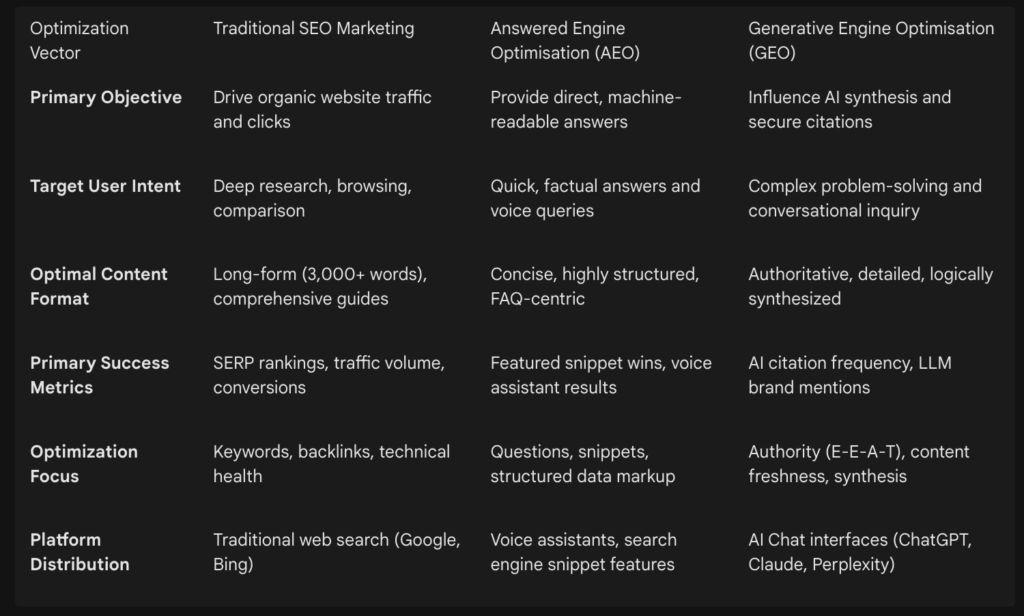
A successful digital strategy in 2026 does not treat these as competing ideologies, but as integrated layers. To effectively manage these distinct layers, an organization’s communication rhythm with its SEO Consultant Selangor must be multifaceted, accommodating both rapid technological shifts and long-term algorithmic processing.
Crawler Dynamics: The Bifurcation of Indexing Timelines
The absolute necessity for highly specific communication intervals—real-time, monthly, and quarterly—is dictated by the drastically different speeds at which traditional search algorithms and modern AI engines process information. Understanding these dual indexing speeds is paramount for any business leadership team.
The Three-Month Horizon of Traditional Google Indexing
For traditional SEO, the timeline from publishing a piece of digital content to achieving stable, revenue-generating visibility is notoriously protracted. Google’s indexing pipeline relies on a sequence of resource-intensive phases: initial URL discovery, bot crawling, content parsing, indexation, and finally, ranking. For a new website, or a newly structured section of an existing domain, achieving full, comprehensive indexing is a slow process that frequently spans two to three months.
When a new piece of content is published, it is often swiftly discovered by Google’s systems but subsequently relegated to a “Discovered – currently not indexed” status within Google Search Console. This status explicitly indicates that while Google is aware of the URL, it has deliberately rescheduled the crawl. This delay occurs because the search engine is evaluating the overall quality, trust signals, and priority of the domain before expending valuable computational crawl budget.
Even for established, technically sound websites, significant architectural additions can experience inexplicable, prolonged delays. Industry case studies continually document instances where specific location-based service pages remain in a discovered but unindexed state for over a year, despite flawless technical implementations, accurate XML sitemaps, and robust internal linking architectures. While initial search impressions for a brand-new website might register within four to eight weeks, achieving consistent, stabilized traffic and meaningful SERP rankings typically requires three to six months of sustained optimization and domain maturation.
The 48-Hour AI Crawler Paradigm
In stark, aggressive contrast to Google’s lengthy traditional indexing timelines, AI platforms and LLMs operate on hyper-accelerated data ingestion cycles. To maintain the factual accuracy and conversational relevance of their outputs, generative engines must possess the most current information available. With the widespread implementation of SGE and AEO protocols, specialized AI bots monitor the web continuously.
Advanced enterprise AI monitoring tools and platforms explicitly track this activity, revealing that competitive benchmarking and bot refreshes occur on incredibly compressed cycles. Depending on the tracking parameters, AI crawler activity refreshes data hourly, daily, or at an absolute minimum, every two days. AI engines like Perplexity weight recency heavily in their citation algorithms, while platforms like ChatGPT Search utilize real-time web retrieval combined with their underlying model knowledge to generate responses.
This means that the data fed into these generative engines must be perpetually current. With the implementation of SGE and AEO, these AI platforms will be crawling the website in every 2 days to ensure they are getting the latest update, so to ensure the brand is being indexed and cited, a business must establish real-time operational agility.
This bifurcation—a three-month horizon for traditional SEO and a 48-hour horizon for AEO/GEO—creates a highly complex management environment. It demands that digital marketing cannot be treated as a passive, detached endeavor.
The Imperative for Real-Time Communication
Given the relentless 48-hour crawl frequencies of modern AI platforms, the communication methods between an enterprise and its marketing consultancy must be instantaneous. Communication methods need to be real time, such as the WhatsApp platform, to effectively manage the volatility of Generative Engine Optimisation. Traditional email threads, which routinely introduce delays of 24 to 48 hours, are fundamentally incompatible with the demands of the 2026 digital landscape.
Adapting to the Two-Day AI Indexing and Delisting Cycle
If an AI bot encounters a technical error, a broken link, or outdated schema markup during its rapid two-day cycle, it does not wait for a webmaster to troubleshoot the issue; it simply drops the domain from its citation matrix immediately. Advanced AI monitoring platforms actively provide alerts when AI crawlers encounter technical problems accessing content. When such an alert is triggered, the window to resolve the issue is measured in hours, not weeks.
In conclusion, with the latest updates on the AI overview, Google will take a much shorter time to index your website, but it will also take a shorter time to delist your website if technical parameters fail. So if a business is actively being listed on the Google AI ecosystem, leadership must ensure real-time communication with their SEO Consultant to guarantee the receipt and implementation of the latest updates and hotfixes.
For example, AI models rely heavily on flawless Core Web Vitals to extract information rapidly. If a server fluctuation pushes a site’s Largest Contentful Paint (LCP) beyond 2.5 seconds, or an Interaction to Next Paint (INP) exceeds 200 milliseconds, Google’s automated systems immediately categorize the site as providing a poor user experience. Because generative AI relies on extracting the most authoritative, frictionless data available, it penalizes such technical degradation instantly. Immediate, real-time communication allows the SEO specialist to alert the business owner, secure necessary approvals, and deploy technical patches before the next AI crawl cycle commences.
WhatsApp as the Primary Enterprise Communication Infrastructure
To facilitate this necessary real-time agility, sophisticated professional infrastructures have universally adopted instant messaging platforms. In 2026, WhatsApp is not merely a peer-to-peer social messaging application; it has evolved into a mandatory enterprise communication and marketing automation tool.
With over 3.2 billion active users globally, WhatsApp serves as the premier digital touchpoint for immediate operational action. The statistics surrounding its efficacy are staggering and underscore why it has become the standard for immediate business-to-consultant coordination:
WhatsApp marketing and communication campaigns routinely achieve exceptional open rates of 98%, compared to the meager 20% average of traditional email.
Real-time communication improves brand perception for nearly 70% of users, while 66% of consumers actively finalize purchases following a chat interaction with a business.
Conversely, operational delays in these communication channels are disastrous, resulting in a 56% purchase abandonment rate.
When an AI monitoring tool detects a sudden drop in a brand’s citation frequency, or a competitor launches a disruptive new localized campaign, an alert is pushed immediately to the consultant. Utilizing WhatsApp allows the consultant to instantly bypass the clutter of an email inbox, initiating a rapid, constructive dialogue with the business owner. Waiting for a scheduled weekly or monthly meeting to address a sudden drop in AI visibility ensures that the brand will forfeit its crucial “Share of AI Voice” to more agile competitors.
The Monthly Cadence: Strategic Reporting and Marketing Consultation
While real-time communication protocols handle technical emergencies and necessary micro-adjustments, the monthly reporting and consultation cycle serves as the tactical engine of the entire digital campaign. On a monthly basis, the executive team must ensure they are getting the reports and strategies consultation from the SEO specialist. This structured review is to ensure the team is getting the latest updates on algorithmic shifts and market behaviors, allowing for the proactive adjustment of the underlying strategy.
Analyzing the Zero-Click Visibility Matrix
A professional monthly SEO Consultation in 2026 transcends the archaic practice of merely reporting on keyword positions and backlink acquisition. The modern consultant must dissect a highly complex matrix of both traditional and generative metrics.
During the monthly marketing consultation, the primary focus must be analyzing the impact of zero-click searches. With 60% of all searches resulting in zero clicks , traditional organic traffic metrics will inevitably display volatility that can be misleading if viewed in isolation. The consultant must separate traditional organic traffic from the emerging AI referral patterns.
The consultation must address critical questions based on the previous 30 days of data:
AI Citation Intelligence: Utilizing advanced tracking tools, the consultant identifies exactly which pages and domains AI models are citing when mentioning the brand. If the brand’s visibility in AI Overviews is declining, the monthly review dissects the root cause. Are competitors providing superior, extraction-friendly AEO content? Is the site’s schema markup failing to map semantic relationships correctly?
Competitor Benchmarking: Tools tracking up to 150 specific prompts across unlimited domains provide a clear picture of how the brand stacks up against key competitors in the generative space. The monthly meeting is where counter-strategies are developed.
Automated Audit Translation: Artificial Intelligence has reshaped technical SEO by automating the identification of broken links, crawling errors, and duplicate content. While these AI tools run continuously, the monthly consultation is where the SEO expert translates these technical findings into actionable business insights, such as analyzing user behavior patterns to identify pages that contribute to high bounce rates and disrupt answer engine extraction.
Evaluating E-E-A-T Signals and Algorithmic Adjustments
Search algorithms, both traditional and generative, are in a state of perpetual refinement. Recent Google core updates have placed a massive premium on Experience, Expertise, Authoritativeness, and Trustworthiness (E-E-A-T). Sites that feature robust author biographies, verifiable expert input, and real-world experience receive significant algorithmic prioritization, effectively penalizing auto-generated, template-like content. According to a study by Search Engine Journal, 72% of SEO professionals acknowledge that author credibility and content quality matter significantly more following recent algorithmic shifts.
During the monthly reporting cycle, the specialist advises the business owner on how to inject authentic, human-centric insights into their digital assets to satisfy these E-E-A-T requirements. This collaborative dialogue is essential. If a new trend emerges in the target demographic—for example, a decisive shift in consumer preference toward short-form video content over traditional text formats —the monthly strategy session is the specific venue where resources are rapidly reallocated to capture this new intent. Agencies that utilize update-based fixes and agile monthly realignments report organic visibility growth of up to 36% for their clients.
The Quarterly Cadence: Macro-Directional Updates
The broadest and most consequential sweep of the communication architecture occurs during the quarterly direction update. Because Google algorithms will take a longest time of 3 months to index a website content deeply and accurately , evaluating macro-strategy on a shorter timeline often leads to reactive, counterproductive decision-making.
On a quarterly direction update, the enterprise team can definitively ensure they get the latest update on the total pages that have been indexed in the Google SERP and comprehensively determine what kind of content that we are going to do on next.
Assessing the Three-Month Deep Indexing Yield
During this quarterly review, the SEO specialist presents a holistic, panoramic view of the domain’s digital footprint. This involves examining Google Search Console data over a 90-day trajectory to track the successful migration of URLs from the purgatory of “Discovered – currently not indexed” to fully active, ranking SERP listings.
By default, the primary Search Results report in Google Search Console displays data from the last three months, making it the optimal interval for accurate performance comparison. This 90-day timeframe is absolutely critical because it provides sufficient runway to separate normal algorithmic volatility—often colloquially termed the “Google Dance”—from genuine, sustained performance trends. A comprehensive, 3,000-word piece of GEO-targeted content that experienced significant ranking fluctuations in month one might settle into a dominant, traffic-driving top-three position by the end of month three. Attempting to judge the success of such pillar content on a weekly basis is fundamentally flawed.
Roadmapping Content and Resource Allocation
Once the total indexed pages are verified, and their performance across both traditional SERPs and AI Overviews is analyzed, the consultant and the business owner collaborate on the overarching direction for the upcoming quarter. This strategic roadmap involves:
Comprehensive Gap Analysis: Identifying topical clusters where the brand failed to capture AI citations or traditional rankings, and formulating hyper-specific content strategies to bridge these identified gaps.
Format Diversification Strategy: Deciding whether the forthcoming quarter should prioritize the development of AEO-friendly FAQ schemas to capture voice search, in-depth GEO-targeted whitepapers to establish industry consensus, or localized service pages to capture high-intent geographic traffic.
Budgetary and Resource Realignment: Reviewing the financial return on investment of the previous quarter’s digital efforts and adjusting operational budgets accordingly. Industry benchmark data reveals that enterprise CMOs are aggressively adapting; 32% now rank AEO and GEO as their primary marketing priority, with many organizations actively allocating upwards of 12% of their total marketing budgets specifically to AEO infrastructure. The quarterly meeting is the appropriate corporate venue for business owners to authorize these high-level financial pivots.
The Crucial Role of Technical SEO in Answer Engine Viability
Underpinning all of these communication cadences and strategic planning sessions is the inflexible bedrock of technical SEO. A pervasive and highly dangerous misconception among enterprise leadership is that the shift toward generative AI and conversational search renders traditional technical web development obsolete. The operational reality is the exact opposite. AI crawlers and LLM extraction bots are remarkably intolerant of poor technical infrastructure.
Core Web Vitals and Machine Extraction Tolerance
As previously noted, Google’s indexing systems, as well as the real-time extraction capabilities of platforms like ChatGPT Search and Perplexity, depend heavily on foundational page speed and user experience metrics. If a website loads slowly, it fundamentally disrupts the bot’s ability to ingest data efficiently.
The technical parameters that an SEO consultant must continuously monitor, and report on during monthly and quarterly reviews, include :
Largest Contentful Paint (LCP): The time it takes for the largest visual element to render. It must be optimized to execute in under 2.5 seconds.
Interaction to Next Paint (INP): A measure of responsiveness. The site must respond to interactions in under 200 milliseconds.
Cumulative Layout Shift (CLS): A measure of visual stability. It must remain under 0.1 to prevent jarring shifts that confuse both human users and extraction algorithms.
When an AI bot, operating on its strict 48-hour cycle, attempts to parse a page to formulate an answer, it must be able to render the Document Object Model (DOM) flawlessly. If excessive JavaScript bloat, unoptimized high-resolution images, or inefficient server routing delays this rendering process, the AI bot will simply abandon the crawl, resulting in a total loss of potential citations.
Structuring Data for Real-Time AI Synthesis
Technical SEO in 2026 also mandates the implementation of rigorous, flawless schema markup. While traditional search engines historically utilized schema to generate “rich snippets” (like star ratings or recipe times), AI answer engines utilize structured data as a direct, explicit extraction map.
Content that is organized with crystal-clear information hierarchies—utilizing logical heading structures, linear topic progression, and explicit semantic relationships—gets cited exponentially more frequently because generative machines can parse and synthesize it without algorithmic friction. It is the SEO consultant’s responsibility to continually run AI-powered diagnostic tools to ensure this technical architecture remains pristine. When an anomaly is detected, the real-time WhatsApp communication protocols discussed in Section 4 are invoked to deploy an immediate resolution.
Localized Dynamics: The Selangor SME Landscape
While the theoretical frameworks of AEO, GEO, and hyper-accelerated bot crawl cycles are universally applicable across the global internet, their practical implementation must be highly localized to be effective. For SMEs operating within the dynamic, multifaceted economy of Selangor, Malaysia, the digital landscape presents a highly specific set of challenges and lucrative opportunities.
Hyper-Localized Intent in the Malaysian Market
Selangor encompasses a vast and diverse economic spectrum. The region features everything from sprawling retail franchises and advanced industrial manufacturing hubs to highly specialized, localized professional service providers. In this dense, competitive ecosystem, businesses increasingly rely on hyper-localized digital visibility to intercept high-intent consumer traffic at the exact moment of need.
Search intent in Malaysia has grown exceptionally nuanced. Effectively capturing this intent requires a sophisticated understanding of multilingual search behaviors, routinely requiring the strategic blending of Bahasa Malaysia, English, and highly specific localized colloquialisms. An international, generic AI model might easily misinterpret these regional linguistic nuances if the local context is not explicitly and technically structured within the website’s AEO architecture. Furthermore, the market demands rigorous technical architecture to capture a predominantly mobile-first consumer base; by 2026, failing to provide a fast-loading, scannable, mobile-first experience guarantees audience abandonment.
The Four-Step SEO Consultant Selangor Methodology
This extreme local complexity underscores the absolute necessity of partnering with an expert SEO Consultant Selangor rather than a generic, offshore provider. A non-localized agency applying generalized, template-based SEO tactics will categorically fail to capture the semantic depth and cultural nuance required by generative engines operating in the Malaysian context.
A highly specialized, local consultant understands the specific economic drivers, nuanced consumer behaviors, and linguistic intricacies of the Selangor market. Elite consultancies in this space apply a meticulous, tailored four-step methodology to ensure digital dominance for their SME clients :
Discovery & AI-Powered Audit: The engagement begins with an in-depth, AI-driven analysis of the enterprise’s current digital footprint and the localized industry landscape. This step identifies critical vulnerabilities and untapped semantic opportunities.
Strategic Planning with A.I.: Based on the audit, a bespoke, localized strategy is crafted. This plan aligns specifically with the SME’s unique business goals and budgetary parameters, leveraging advanced predictive AI insights.
Implementation & Expert Guidance: The consultancy provides hands-on, collaborative support to execute sweeping technical optimizations, structural AEO formatting, and localized content creation, ensuring the enterprise team is empowered throughout the transition.
Ongoing Optimization & Support: Utilizing the established real-time (WhatsApp), monthly (tactical reporting), and quarterly (macro-directional) communication cadences outlined in this report, the consultant continuously tracks revenue, adjusts to sudden algorithmic shifts, and maintains ironclad search authority.
Securing Digital Dominance in the AI Era
The year 2026 undeniably represents a major inflection point in the history of digital commerce. The aggressive integration of the Search Generative Experience, the absolute necessity of Answered Engine Optimisation, and the rising supremacy of Generative Engine Optimisation have entirely rewritten the operational rules of digital visibility.
The mechanical realities of artificial intelligence—specifically the relentless 48-hour crawl frequencies of LLM bots, sharply contrasted with the traditional three-month deep indexing cycles of Google’s SERP—demand a sophisticated, multi-tiered approach to campaign management. SMEs can no longer afford to view search engine optimization as an isolated, passive marketing channel checked once a quarter.
Digital survival and market dominance now require extreme operational agility. This agility must be underpinned by real-time communication infrastructures, such as WhatsApp, to ensure immediate technical compliance and prevent rapid AI delisting. Simultaneously, this rapid-response capability must be balanced with rigorous, data-driven monthly tactical consultations, and comprehensive quarterly strategic reviews to navigate the broader, slower currents of long-term indexing and algorithmic evolution.
Navigating this highly complex, rapidly shifting matrix requires specialized expertise, particularly in nuanced, highly competitive local markets like Selangor. The operational directive for businesses seeking to thrive in this environment is clear: If you are looking forward for someone to bring your SEO to another level, we are here to help. Engaging with a dedicated expert ensures that an enterprise’s digital footprint remains optimized, authoritative, and perpetually visible in the age of the Answer Engine.