The Three-Month Milestone: Reaching the critical three-month mark requires a robust technical foundation and deep experience in the SEO industry. Search engines inherently require this operational time to crawl, index, contextualize, and initially rank a website’s content.
The Rocket Ship Methodology: Search optimization functions much like a rocket. In the beginning stage, an organization must pump in high-quality content as the fuel to ignite the rocket. Once the rocket achieves a stable orbit, the long-term, compounding results materialize.
Post-Stability Analysis and Recommendations: Once stable rankings are achieved, search engines will frequently recommend the website in traditional SERPs and AI Search interfaces, increasing exposure, clicks, and conversions. To capitalize on this, continuous analysis of backend data via Google Analytics and Google Search Console is required for further strategic optimization.
The 2026 Digital Ecosystem for Malaysian Enterprises
The digital economy in Malaysia is undergoing a profound and rapid transformation. As regional integration accelerates, the business landscape is shifting dynamically. Following the conclusion of the Digital Economy Framework Agreement and the upgraded Asean Trade in Goods Agreement, Malaysian commercial entities are presented with unprecedented access to a regional market encompassing 680 million people. In this highly competitive, borderless environment, relying on legacy digital marketing tactics is no longer sufficient. Consumer behavior has shifted dramatically, creating a highly demanding digital-first populace.
Recent data mapping the 2026 Malaysian consumer landscape reveals critical behavioral shifts that dictate how digital assets must be structured. Currently, 70 percent of consumers prefer brands that offer highly personalized experiences, while 65 percent regularly execute purchases directly through social media platforms. Furthermore, 55 percent of consumers utilize voice search for local business discovery, 80 percent factor sustainability into their purchasing decisions, and an overwhelming 90 percent expect instant customer service responses. These metrics underscore a reality where digital visibility is synonymous with commercial viability.
Simultaneously, the foundational mechanics of search engines have evolved beyond recognition. The era dominated solely by the traditional “ten blue links” is fading rapidly, replaced by highly sophisticated artificial intelligence models that curate, summarize, and deliver answers directly to the user. Industry projections, including a watershed 2024 report by Gartner, predicted that by 2026, traditional search engine volume would drop by 25 percent, with search marketing continuously losing market share to AI chatbots and other virtual agents.
For a small or medium-sized enterprise (SME) operating in Malaysia, establishing digital dominance requires a nuanced understanding of how long these modern optimization processes take, how success is measured, and what specific frameworks must be deployed to capture both human attention and machine-driven recommendations. The responsibility to break the cycle of competing purely on price is paramount; businesses must pivot from being mere middlemen and OEM manufacturers to becoming brand owners and intellectual property holders competing on value, innovation, and trust.
Defining Good SEO: The Progression of Digital Growth
A ubiquitous pitfall in digital commerce involves a fundamental misunderstanding of how search engine algorithms operate and deliver return on investment (ROI). Before analyzing operational timelines, one must define what constitutes a successful optimization campaign.
How does one define a good SEO strategy? Fundamentally, it is an architectural and content-driven process that follows a strict, unyielding sequence: Keywords Ranking -> Traffic -> Conversion.
Search engines are discovery tools and answer engines; they are not direct, immediate sales mechanisms like paid media channels. When a newly launched campaign begins, the immediate goal is to establish topical relevance and algorithmic authority for specific search terms. Only when those keyword rankings reach the first page of search results does the website begin to capture organic traffic. Finally, once that high-intent traffic arrives on a well-optimized, user-friendly landing page designed with Conversion Centered Development principles, conversions occur.
Therefore, if an enterprise looks into conversion in the beginning, the SEO strategies will not be suitable for that specific organization. Platforms offering paid digital advertisements, such as Google Ads or Meta Ads, provide instant visibility and can drive immediate transactional data. In contrast, organic search optimization is a strategic marathon, an investment in digital equity that builds a permanent, compounding asset designed to lower customer acquisition costs systematically over time. This long-term yield is only achievable provided the enterprise respects the necessary progression of the digital pipeline.
The Paradigm Shift: From Search Engines to Answer Engines
To fully grasp the definition of superior search optimization in 2026, one must acknowledge the transition from information retrieval to information synthesis. Search engines have evolved from mere directories into “answer engines” designed to resolve complex queries and drive immediate action. This evolution is driven by Large Language Models (LLMs) such as Google’s Gemini, OpenAI’s ChatGPT, and Anthropic’s Claude.
When a user in Malaysia enters a query, the immediate response is typically an AI-generated summary that aggregates data from multiple sources. This Search Generative Experience introduces a new variable to the traditional SEO definition. Success is no longer solely defined by ranking first on a list of links; it is defined by becoming the trusted, cited source that AI models reference within their generated responses. This necessitates a comprehensive SEO Marketing approach that integrates traditional ranking strategies with advanced machine-readability protocols.
Furthermore, an internal team can manage the critical task of local directory synchronization. In the Malaysian context, where localized search intent is exceptionally high, ensuring absolute consistency of the business’s Name, Address, and Phone number (NAP) across platforms like Google Business Profile, local industry registries, and regional social commerce platforms is paramount. Discrepancies in this foundational data actively degrade the trust signals required by both traditional algorithms and emerging generative models.
The DIY approach also encompasses the creation of fundamental, informational content. A business owner possesses the deepest intrinsic knowledge of their own products and services. Translating this expertise into basic blog posts, detailed service descriptions, and transparent frequently asked questions (FAQs) provides the search engine with the raw textual material required to understand the commercial entity’s core competencies.
The Rocket Ship Analogy: Fuel, Ignition, and Orbital Stability
To accurately conceptualize the timeline, effort, and resource allocation required for organic search dominance, one must view the process through a highly specific mechanical paradigm. Search optimization functions exactly like a rocket launching into orbit.
In the beginning stage, the system requires massive amounts of energy, precision engineering, and resources simply to overcome the gravitational pull of established, incumbent competitors. During this critical launch phase, the enterprise needs to pump in content as the fuel to ignite the rocket. This content cannot be thin, purely promotional, or generated en masse without editorial oversight. In the 2026 algorithmic climate, mass AI content without human edits, expired domain tricks, and parasite SEO are completely ineffective.
Instead, the fuel must be comprehensive, semantically linked, and deeply informative. The production of high-quality articles, technical service pages, and locally relevant data acts as the combustible material that search engine crawlers consume. Without this continuous injection of high-value, highly structured content, the campaign lacks the necessary propulsion to rise above the algorithmic noise and the lower pages of search results.
However, this heavy, resource-intensive investment is transitional. Once the rocket is stable and reaches its target trajectory, the enterprise can begin to harvest the long-term, compounding results. In a stable state, the website requires less raw output to maintain its position, benefiting immensely from the momentum, topical authority, and backlink equity established during the initial ascent.
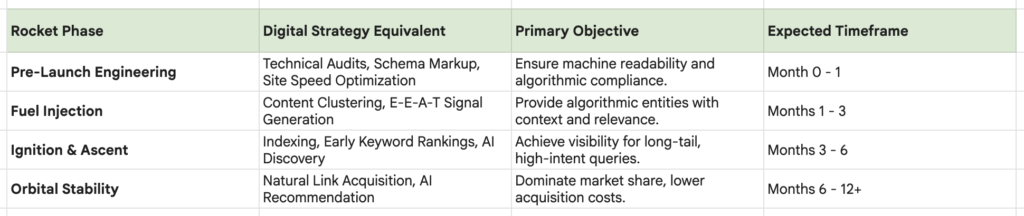
The Comprehensive 2026 Timeline: Engineering the Ascent
The most frequently asked question in the digital marketing sector regarding organic growth is how long the process will take to yield measurable financial results. While individual trajectories vary based on industry competition, historical domain authority, and the velocity of content production, extensive data analysis from 2026 provides a highly reliable benchmark.
Generally, it takes a minimum of 3 months to observe tangible improvements in visibility. This three-month milestone is heavily contingent upon two critical factors: the digital asset must possess a very good technical foundation, and the campaign must be executed with deep experience in the SEO industry. Even with flawless technical execution and high-quality content, Google and other search engine algorithms inherently need time to crawl the new pages, understand the semantic relationships within the content, establish baseline trust metrics, and rank the website against established competitors.
The complete lifecycle of a modern, enterprise-grade optimization campaign is broken down into four distinct, sequential phases.
Phase 1: Months 1 to 2 – The Foundation and Trust Building Phase
During the initial sixty days, the focus is entirely on technical remediation, structural architecture, and establishing algorithmic trust. This is the phase where dedicated SEO Consultation proves its value. Search engines evaluate websites based on their crawlability, load speeds, and structural integrity. A digital asset that cannot be efficiently parsed by a machine cannot be ranked.
Technical Optimization and Core Web Vitals: In Malaysia’s highly saturated, mobile-first ecosystem, ensuring fast load speeds and smooth user experiences is non-negotiable. The engineering team must focus on Core Web Vitals, utilizing diagnostics like Google PageSpeed Insights to resolve loading speed or interactivity bottlenecks. This involves reducing large image payloads, enabling advanced browser caching, rectifying 404 errors, enforcing strict HTTPS protocols, and configuring optimal XML sitemaps and robots.txt files.
Semantic HTML and Machine Readability: To prepare for AI parsing, the website’s code must leverage Semantic HTML5. This helps AI instantly identify core topics, supporting arguments, and related resources. Utilizing specific tags such as <article>, <section>, and <aside> creates a logical, hierarchical document flow that generative engines prioritize.
Foundational Content and Entity Verification: Simultaneously, the enterprise must publish core foundational pages—Home, Services, About, and Contact—alongside 5 to 8 deeply researched, highly authoritative blog articles structured around main keywords and natural semantic flow. Furthermore, claiming and verifying the digital entity via Google Search Console and Google Business Profile is critical. AI Overviews rely heavily on the Google Knowledge Graph to verify that a business actually exists and operates legitimately within the Malaysian market.
During Phase 1, traffic remains minimal, and rankings will fluctuate wildly as algorithms test the new data. The primary metric of success is steady, unhindered indexing.
Phase 2: Month 3 – The Critical Ignition Point
If the foundational engineering and fuel injection were executed flawlessly, the third month serves as the ignition point. At this juncture, the initial wave of content begins to rank for specific, targeted long-tail keywords.
The search algorithms have gathered enough preliminary data regarding the website’s relevance, load speed, and user experience to begin testing its pages against real, live user queries in the Malaysian market. This is the precise three-month milestone where the digital rocket begins its upward ascent. The website transitions from being merely “discovered” to being “recommended”.
Phase 3: Months 4 to 6 – Traction and Traffic Generation
Between the fourth and sixth months, the momentum shifts decisively from technical indexing to active, measurable traffic generation. This is typically the phase where stakeholders stop questioning the efficacy of the campaign, as organic traffic increases and search rankings stabilize on the first two pages of results.
The continuous pumping of content fuel begins to establish “topical authority”. Search engines no longer view the website as a collection of isolated, random articles, but rather as a cohesive, deeply interconnected knowledge hub for a specific industry. By building content clusters around one tight theme—providing real examples, use cases, updated statistics, and FAQs pulled from real user queries—the rankings become highly resilient. As these keyword rankings climb, the organic traffic metrics will demonstrate a noticeable, sustained upward trajectory.
Phase 4: Months 6 to 12+ – Orbital Stability and Market Dominance
Beyond the six-month mark, the optimization efforts transition into a state of stability, category authority, and profound momentum. The website begins to earn natural backlinks from other publishers, user engagement metrics validate the content’s superior quality, and the domain establishes a highly defensible digital moat against local and regional competitors.
In this stable state, the brand transitions from fighting for visibility to maintaining market dominance, ensuring that the continuous influx of organic traffic drives high-quality, low-cost conversions to sustain long-term business growth.
The Stability Phase: Multiplying Exposure Through AI
Reaching a stable orbit in search rankings triggers a compounding series of algorithmic benefits. Once it is stable, Google will frequently recommend and suggest the domain in the traditional SERP (Search Engine Results Page) and within the new, highly visible AI Search environments [user prompt].
This consistent recommendation engine dramatically increases brand exposure, allowing the enterprise to capture a disproportionate share of clicks and, ultimately, driving high-quality conversions. In the 2026 digital ecosystem, this exposure is no longer limited to standard organic links. Stability now dictates visibility across a vast spectrum of advanced search formats, requiring an evolution from basic SEO to comprehensive AI SEO methodologies.
The Imperative of Generative Engine Optimisation (GEO)
The search landscape, the buyer’s journey, and the roadmap to digital success have been structurally reimagined by artificial intelligence. As traditional search engines rapidly evolve into conversational, source-backed virtual assistants, the methodology for capturing traffic has expanded strictly into Generative Engine Optimisation (GEO).
GEO focuses on ensuring that a brand’s digital footprint is accurately ingested, validated, and cited by Large Language Models (LLMs). When a user queries a generative AI model, the system synthesizes data from multiple sources to provide a direct, conversational answer. Websites that have achieved orbital stability and topical authority are heavily favored as primary citations within these generative responses.
Distribution is moving fundamentally from links and clicks to answers and sources; the brands that win will not be the loudest, but the most citable. Citability is achieved through clarity, consistency, and irrefutable proof, ensuring that the AI algorithms view the brand as the safest, most accurate source to present to the user.
Dominating with Answered Engine Optimisation (AEO)
Closely related to GEO is the practice of Answered Engine Optimisation (AEO). While traditional SEO focuses on driving clicks through enticing meta descriptions, AEO directly anticipates and capitalizes on the “zero-click” search phenomenon.
Currently, roughly 60 percent of searches end without a single click to a website. Modern consumers are researching thoroughly, iterating on queries, and seeking immediate answers without navigating away from the search interface. AEO involves structuring website data in a highly concise, factual manner so that AI algorithms can seamlessly extract the brand’s information to serve as the definitive answer.
When an organization successfully integrates AEO through precise question-based keyword research, logical heading structures, semantic HTML, and FAQ schema, its content is featured in rich snippets, voice search readouts, and AI overviews. Although this may bypass a direct click to the website initially, it establishes immense brand authority and share of voice. Furthermore, when users require deeper exploration and do click the cited source link, they act as highly pre-qualified leads. They have already expressed a specific interest and consumed the brand’s expertise via the AI, demonstrating a much higher propensity for conversion upon arriving at the landing page.
Navigating the Search Generative Experience (SGE) in Malaysia
Google’s Search Generative Experience, a dominant force in the 2026 ecosystem, aggregates information to provide highly contextual summaries at the absolute top of the search results. For a Malaysian SME, ranking organically at position number one is significantly devalued if an AI-generated summary pushes that organic link “below the fold,” making it invisible without scrolling.
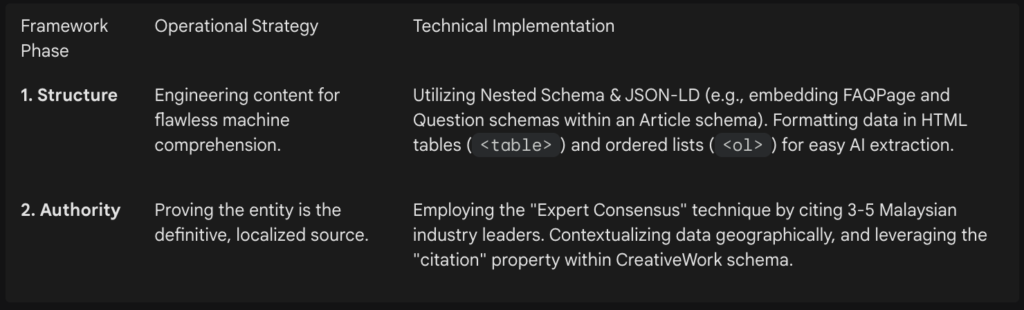
Adapting to SGE requires the implementation of the “Structure then Authority” framework, a vital component of advanced Marketing consultation.
If the AI cannot algorithmically “read” the site’s structure, it cannot “cite” the site in its generative overview. The integration of advanced schema markup acts as a machine-readable cheat sheet, allowing Google’s AI to understand complex business services without having to guess intent or context.
Post-Stability Execution: The Necessity of Backend Data Analysis
Achieving a stable ranking position and commanding high AI visibility is not the conclusion of the digital optimization journey; rather, it marks the beginning of the crucial refinement phase. Once the SEO is stable, the technical team will need to comprehensively analyze the data from the backend to further optimize the campaign [user prompt].
Digital markets are highly dynamic ecosystems. Competitors continuously adjust their strategies, consumer behavior shifts, and search algorithms undergo frequent, unannounced updates. Maintaining market dominance requires a relentless, data-driven approach leveraging enterprise-grade analytical tools.
Utilizing Google Analytics for Behavioral Insights
Google Analytics provides the necessary telemetry to understand exactly how human traffic interacts with the website after the initial click from the SERP or AI citation. Analysts deeply evaluate engagement times, bounce rates, scroll depth, and multi-page navigation paths.
If a specific page ranks highly but exhibits an exceptionally low engagement duration, the backend data suggests a critical mismatch between the user’s search intent and the content provided. In 2026, search intent matching supersedes sheer word count; users searching for a “best CRM” want quick comparisons, pricing, and pros/cons, not a dense, 4,000-word theoretical essay. By identifying these behavioral friction points via Analytics, the team can refine the content architecture, improve the user interface (UI), and enhance the overall user experience (UX) to safeguard the ranking position. Google measures satisfaction signals with immense accuracy, and UX is no longer optional—it is a baseline requirement.
Leveraging Google Search Console for Technical Refinement
While Analytics tracks human behavior, Google Search Console (GSC) offers direct, unfiltered communication from the search engine regarding how it perceives and processes the digital asset. Post-stability, GSC is utilized extensively to monitor indexing health, track fluctuations in impression share, and identify emerging, hyper-specific long-tail queries that users are beginning to type into the search bar.
Furthermore, GSC highlights critical technical regressions, such as newly formed 404 broken links, mobile usability errors, or Core Web Vitals degradation. By analyzing this backend data, the optimization team can preemptively resolve technical issues before they negatively impact the website’s stable algorithmic orbit.
Preparing for Agentic Commerce
A profound shift occurring in the late 2026 landscape is the rise of agentic commerce. The digital ecosystem is moving past the era of AI acting merely as an answer engine and into the era of AI functioning as an autonomous executive assistant.
The “agentic web” means that an AI will not just tell a user which product or service is best; it will actively find the user’s size, apply a promotional coupon, and execute the checkout process on their behalf. For search optimization professionals, this means that optimizing purely for human clicks is no longer the ceiling of performance. Websites must optimize for total machine readability and API compatibility. If an AI agent cannot accurately parse a brand’s real-time inventory or pricing structure through clean, structured data, that brand will effectively cease to exist in this new transactional layer. Analyzing backend crawl logs to understand how these agentic crawlers interact with the site is becoming a mandatory practice for sustained dominance.
Building a Defensible Moat: Cultivating E-E-A-T and Local Context
Underpinning the entire multi-month timeline—from the initial technical crawl phase to achieving long-term, stable AI visibility—is the rigorous application of E-E-A-T: Experience, Expertise, Authoritativeness, and Trustworthiness. First introduced in Google’s Search Quality Evaluator Guidelines and heavily emphasized following the 2018 Medic update, E-E-A-T signals to algorithms that the content delivers outstanding value and safety to the user.
In 2026, as the internet floods with generic, synthetic AI content, search algorithms do not merely parse keywords; they ruthlessly evaluate the credibility and real-world existence of the entity publishing the information.
Experience: Content must demonstrate first-hand, lived experience. Generative AI models cannot replicate real-world trial and error. Including unique case studies, screenshots of actual work, original data experiments, and real-world lessons learned proves to the search engine that the brand possesses authentic operational history in Malaysia.
Expertise: Authorship matters profoundly. Biographies detailing the professional credentials of the content creators signal to the algorithms that the information is provided by legitimate, verifiable industry practitioners. Practical tips and insights that only practitioners usually know are favored heavily over generic advice.
Authoritativeness: This is achieved through exhaustive topical clustering and high-quality link acquisition. When an entire website comprehensively covers every facet of a specific industry through tightly themed clusters, it becomes the definitive hub for that topic, signaling massive authority to both traditional crawling bots and generative AI models.
Trustworthiness: Trust is the absolute baseline requirement. Secure protocols (HTTPS), highly transparent business information, verified physical locations via Google Business Profile integrations, and consistent positive brand mentions across the web ensure the search engine feels confident in unconditionally recommending the website to its user base.
Hyper-Local Contextualization for the Malaysian Market
To truly command the regional market, E-E-A-T must be localized. Success within the Malaysian digital ecosystem requires navigating unique cultural and linguistic nuances.
Authority is proven by citing collaborations with local institutions or referencing data from highly trusted local sources, such as the Department of Statistics Malaysia (DOSM) or the Malaysia Digital Economy Corporation (MDEC). Furthermore, capturing algorithmic intent across diverse demographics requires multilingual optimization—adapting content culturally across English, Bahasa Malaysia, and Mandarin, rather than relying on simple, direct translations.
For a commercial entity operating in locations such as Kuala Lumpur, Penang, or Johor Bahru, utilizing geo-fencing strategies and creating dedicated, location-specific content ensures maximum visibility for localized queries. By integrating these local E-E-A-T principles, the digital asset remains insulated against future algorithmic volatility, maintaining its stable, high-yield trajectory regardless of how the AI landscape shifts.
Strategic Conclusion and Next Steps
The journey to digital dominance in 2026 requires strategic patience, unyielding technical precision, and a willingness to invest heavily in the foundational stages of the campaign. Understanding that search engine algorithms require a minimum of three months to process technical improvements, crawl new architecture, and index data sets realistic, professional expectations for stakeholders.
By embracing the strict digital pipeline of keyword rankings leading to traffic, and traffic systematically leading to conversions, an enterprise avoids the critical pitfall of demanding instant, transactional gratification from an organic medium designed explicitly for long-term equity. Treating the digital strategy like a rocket launch—engineering the structure flawlessly and continuously supplying it with robust, authoritative content fuel—guarantees that the website will eventually break through the gravitational pull of incumbent market competitors.
Once that coveted algorithmic stability is reached, the exponential, compounding benefits of being recommended by Search Generative Experiences, AI chatbots, and traditional SERPs will fundamentally transform the commercial trajectory and valuation of the business. However, this stability must be guarded. Through continuous, rigorous backend analysis using Google Analytics and Google Search Console, this digital momentum can be preserved, refined, and scaled indefinitely.
In an era dictated by Generative Engine Optimisation and Answered Engine Optimisation, executing this comprehensive, multi-tiered strategy requires specialized expertise, an evidence-based data-driven methodology, and highly precise technical architecture. Navigating this shift from traditional search engines to complex answer engines is not an endeavor suited for intuition or guesswork; it requires the steady hand of a dedicated SEO Consultant Selangor.
If an enterprise is looking forward for someone to bring its SEO to another level, the team at Woonyb is here to help. Providing industry-leading SEO Marketing, highly customized Marketing consultation, holistic technical implementations, and advanced AI optimization strategies, Woonyb partners with enterprises to build defensible digital assets that command absolute authority in the 2026 search ecosystem.