The Difference is Direction vs. Execution: The fundamental distinction between service providers lies in strategic planning versus tactical implementation; a successful campaign requires both elements, but they are typically provided by different entities within the digital marketing ecosystem.
Consultants Uncover Hidden Markets: Acting similarly to business coaches, experienced SEO consultants provide the essential direction, market insights, and demand analysis required to find and capture highly lucrative, uncontested market segments.
Agencies and Freelancers Drive Execution: SEO agencies and freelancers serve as the executors of the strategy, taking strategic direction to implement detailed keyword planning, robust content structuring, and comprehensive performance reporting.
The New Era of Digital Visibility for Malaysian SMEs
The digital landscape within Malaysia has undergone a profound and irreversible transformation. Moving rapidly from basic digital adoption to highly sophisticated, artificial intelligence-integrated business models, the Malaysian digital economy continues to serve as a critical strategic engine of growth. This evolution drives innovation, enhances operational productivity, and fosters entirely new business paradigms across a multitude of industries. With internet penetration remaining exceptionally high globally and the domestic e-commerce sector projected to handle tens of billions of ringgit in transaction value, the competition for digital visibility has reached an unprecedented level of intensity. Small and Medium Enterprises (SMEs) operating in commercial hubs from Penang to Johor Bahru are no longer competing solely with the physical storefront across the street; they are competing in a hyper-saturated, algorithmically governed digital ecosystem that rewards only the most structured and authoritative brands.
In this highly complex environment, relying on outdated paradigms of digital visibility represents a critical vulnerability for any organization. The basic methodologies that secured first-page rankings in 2023 or 2024 are proving entirely insufficient against the backdrop of 2026 technological advancements. Search engines have fundamentally evolved from mere directories of blue links into complex, synthesized answer engines that aim to resolve user queries instantly. This paradigm shift forces Malaysian business owners to completely re-evaluate how they approach online visibility, digital customer acquisition, and their overall operational strategy.
The central dilemma facing SME executives today is no longer whether they should invest in search visibility, but rather how to allocate their capital and resources most effectively. Business owners frequently find themselves paralyzed by choice when selecting a partner to navigate this extreme complexity. The marketplace offers a broad spectrum of professionals—SEO consultants, SEO agencies, and SEO freelancers—each promising transformative business results. However, misunderstanding the fundamental differences in how these varying entities operate often leads to misaligned expectations, wasted marketing budgets, and stagnant commercial growth. To make an informed decision, a business owner must first understand the technological realities of the 2026 search ecosystem and the critical distinction between strategic architecture and tactical construction.
AI Dominance and Changing User Behavior
To accurately understand the distinct roles of various digital marketing professionals, one must first possess a deep understanding of the environment in which they operate. The year 2026 represents the definitive tipping point for artificial intelligence integration in commercial search behavior. Traditional search engines have fully integrated large language models to synthesize vast amounts of information, effectively answering complex user queries directly on the search results page without necessarily requiring a click-through to an external website.
This sweeping evolution, broadly categorized under the umbrella of the Search Generative Experience, fundamentally alters how consumers interact with digital information. When a potential customer in Kuala Lumpur searches for a complex query—such as comparing the benefits of different accounting software for a retail business—the search engine now generates a summarized, highly specific answer compiled from multiple trusted digital sources. Consequently, organic click-through rates for traditional top-ranking results have experienced a dramatic decline, dropping by an average of 34.5% in scenarios where comprehensive AI overviews are present. Simultaneously, the sheer overall volume of searches has increased significantly as users become highly accustomed to utilizing search engines as conversational, consultative assistants rather than simple retrieval tools.
This dynamic presents a unique paradox for the Malaysian SME: there are more digital queries occurring than ever before, but capturing the actual website traffic from those queries is exponentially more difficult due to the rise of zero-click searches. The ultimate goal of modern digital marketing is no longer simply to rank among the top ten traditional results; the paramount objective is to position the brand as the authoritative, trusted source that the AI model inherently references, cites, and recommends to the end user.
Successfully navigating this new ecosystem demands the implementation of highly specialized strategies that go far beyond legacy keyword stuffing. This requires a nuanced understanding of Generative Engine Optimisation, which is the exact practice of structuring a digital presence and website content so that AI-powered search platforms—including Google’s AI Overviews, OpenAI’s ChatGPT, Perplexity, and Microsoft Copilot—can effortlessly retrieve, cite, and recommend the brand when answering user questions. It requires the production of factual, highly structured, original, and deeply trustworthy content.
Closely related to this concept is Answered Engine Optimisation, which focuses specifically on getting content featured in direct, singular answers, such as traditional featured snippets and voice search responses. This is achieved by utilizing strict question-and-answer content formats and deploying complex schema markup code. Mastering both Generative Engine Optimisation and Answered Engine Optimisation requires a profound understanding of natural language processing, digital entity recognition, and latent user intent. It is highly technical, deeply strategic, and virtually impossible to achieve without professional guidance. This technological reality brings the conversation directly to the most critical distinction in the modern marketing ecosystem.
Understanding Direction vs. Execution
The most common point of critical failure for Malaysian SMEs investing in digital visibility is the fundamental confusion between tactical execution and strategic direction. When evaluating the marketplace of service providers, business owners must understand that the difference is the direction and execution. The exact difference between an SEO consultant, an SEO agency, and an SEO freelancer is, at its absolute core, the strict separation of overarching strategy from daily implementation.
Defining Strategic Direction
Direction represents the “what,” the “where,” and the “why” of a commercial campaign. It involves a holistic, unfiltered assessment of the business model, its direct competitors, its unit economics, and its target audience demographics. Direction requires analyzing the broader macroeconomic market to determine exactly which digital battles are actually worth fighting. In the specific context of 2026, establishing direction involves determining precisely how a brand will position itself to be recognized as an undisputed authority by AI models, identifying which specific user intents will yield the highest long-term return on investment, and structuring a comprehensive, multi-year roadmap that can adapt to inevitable algorithmic volatility.
Direction is not the physical act of writing a blog post or fixing a line of code; it is the strategic determination of exactly why a specific, comprehensive 5,000-word authoritative guide must exist in the first place, what specific hidden market segment that guide serves, and how that piece of content fits seamlessly into the broader revenue generation model of the enterprise. Without this foundational direction, any subsequent activity is merely guesswork.
Defining Tactical Execution
Execution, conversely, represents the “how” and the “when” of the campaign. Once the strategic direction is firmly established and agreed upon, execution involves the actual physical and intellectual labor required to build the recommended digital assets. This encompasses a wide array of specialized tasks, including meticulous keyword planning, structuring the content architecture of the website, drafting the optimized copywriting, calibrating meta tags, securing digital public relations placements, executing highly technical website overhauls, and generating the complex reporting dashboards that track ongoing progress.
Execution without clear direction is merely generating digital noise in a highly competitive, saturated market. A business can execute flawlessly—publishing hundreds of technically optimized articles and resolving every single technical error highlighted by auditing software—but if the underlying strategic direction targets a highly competitive, low-margin market segment that is already dominated by multinational conglomerates, the execution will yield absolutely no meaningful return on investment. Conversely, brilliant strategic direction without capable, consistent execution remains purely theoretical and produces no commercial value. Both elements are absolutely necessary for market dominance, but they require vastly different professional skill sets, operational methodologies, and organizational structures.
The SEO Consultant: The Architect of Strategic Growth
An SEO consultant operates almost entirely within the specialized realm of strategic direction. Engaging a consultant is not akin to hiring a digital laborer; rather, an SEO consultant is similar to coaching. They are typically solo professionals or operate within very small, elite teams of highly experienced specialists who have dedicated their careers to understanding search algorithms. They have been in the industry for a few years, often decades, and possess an intimate, battle-tested understanding of exactly how to expand your business with SEO marketing.
The Consultant as a High-Level Business Coach
The commercial relationship with an independent SEO consultant is highly collaborative, deeply analytical, and strictly advisory. They do not merely take tactical orders from the business owner; they actively interrogate the underlying business model. When an SME executive engages an SEO Consultant Selangor, for example, the consultant will deeply analyze the local state market dynamics, evaluate supply chain constraints, and assess specific product profit margins long before ever looking at a digital search volume metric.
Their primary operational objective is to provide the business owner with clear direction, accurate demand analysis, and profound market insights to ensure you know where you can get your ideal market. They map out exactly where the most lucrative target audience resides within the complex digital ecosystem and analyze how that audience articulates their specific commercial needs to search engines. By conducting forensic data analysis and deep audience profiling, the consultant ensures that the business is positioned to intercept high-intent consumers precisely when they are ready to make a purchasing decision. This level of advisory service is often categorized as high-level Marketing consultation, bridging the gap between digital visibility and actual commercial revenue.
Finding and Exploiting the Hidden Market
The true, measurable value of high-level SEO Consultation lies in the meticulous process of finding the “hidden market.” Consultation means helping you to find the hidden market. In the advanced digital landscape of 2026, obvious commercial keywords and broad search terms are entirely dominated by massive industry conglomerates, multinational corporations, and highly authoritative global publishers. A localized SME attempting to compete head-on for these broad, generic terms will rapidly exhaust its marketing budget with virtually nothing to show for it in terms of actual customer acquisition.
Identifying a hidden market involves locating the highly lucrative, deeply specific intersections of user intent that larger competitors have either overlooked or deemed too niche to pursue. A hidden market might involve a highly specific, multi-layered query that signals immediate, urgent purchase intent but currently lacks adequate, comprehensive digital answers.
For example, instead of advising a client to target the impossibly broad term “logistics services Malaysia,” a strategic consultant might identify a hidden market revolving around “cold chain pharmaceutical transport compliance regulations in Selangor.” While the aggregate search volume for this specific phrase is undoubtedly lower, the conversion rate and the lifetime financial value of the enterprise customer searching for that phrase are exponentially higher. The consultant comprehensively maps out this hidden demand and designs the exact architectural blueprint required to capture it. They define the precise Generative Engine Optimisation strategy required to ensure that when a corporate procurement manager asks an AI model for specialized pharmaceutical transport recommendations in Malaysia, the client’s SME is cited directly as the definitive, authoritative answer.
Core Deliverables of Strategic Consultation
The output of a consultant is fundamentally different from that of an agency. While they do not typically write the daily content, they produce the strategic assets that dictate what the content should be. The primary deliverables expected from a high-level consultant include comprehensive digital audits, which involve forensic analysis of current technical infrastructures, content relevance, and historical authority metrics. Furthermore, they deliver strategic roadmapping, which involves creating a detailed 12-to-18-month blueprint detailing exactly what needs to be done, quarter by quarter, to achieve specific revenue goals.
Crucially, consultants also provide internal team coaching. They train the SME’s internal marketing staff or existing freelance writers on exactly how to execute the new strategy, ensuring that the business builds internal capability rather than remaining permanently dependent on external vendors. Through comprehensive market gap analysis and high-level marketing consultation, the consultant provides the roadmap, the compass, and the final destination. However, once that architecture is finalized, the business owner must then decide who will actually drive the vehicle and construct the assets.
The SEO Agency: The Engine of Scalable Execution
While the consultant acts as the strategic architect designing the blueprint, the SEO agency functions as the heavy construction firm. Agencies are substantially larger organizations equipped with multiple specialized employees, distinct operational departments, and extensive financial resources. They are the executor, where they get the direction from the business owner or consultant and they will do the execution such as the keywords planning, content structure and the reporting.
An established agency takes the strategic direction and utilizes its scale to drive the execution rapidly. They possess the necessary manpower and the operational infrastructure required to handle the heavy, repetitive, and technically complex implementation tasks that are required to move the needle in a competitive market.
Structured Teams and Operational Scalability
The primary commercial advantage of retaining an SEO agency is its highly structured, multi-disciplinary approach. A standard agency houses dedicated technical experts who exclusively diagnose and resolve server-side indexing issues, professional content writers who produce optimized copywriting at a massive scale, digital outreach specialists who focus entirely on building digital authority through securing external backlinks, and dedicated account managers who handle all client communication and data reporting.
For a growing Malaysian business with highly ambitious commercial growth targets or a deeply complex digital ecosystem—such as a large-scale e-commerce platform boasting thousands of individual product pages—an agency provides the necessary operational continuity and scalable resources that a single individual simply cannot match. If a specific specialist at an agency takes personal leave or unexpectedly resigns, the agency possesses redundant staff to ensure the client’s campaign does not lose critical momentum. This operational stability is a major factor for enterprise clients who require consistent, uninterrupted execution.
The Modern Execution Workflow
Once the strategic direction is firmly set by either the internal marketing director or an external consultant, the agency’s execution workflow springs into action. This process is highly systematic. It begins with meticulous keywords planning, wherein the agency takes the consultant’s broad strategic themes and expands them into hundreds of specific, actionable keyword targets, carefully mapping each term to various stages of the consumer buyer’s journey.
Following this, the agency focuses on content structure and production. This involves the actual creation of the digital assets, encompassing the drafting of long-form authoritative guides, the careful optimization of e-commerce product descriptions, and ensuring that proper, logical internal linking architectures are perfectly implemented across the entire domain. In 2026, this execution also heavily involves Generative Engine Optimisation implementation. Agency developers execute the highly tedious, technical tasks required for GEO, such as applying complex schema markup code, structuring data meticulously, and reformatting existing legacy content into the strict, concise Q&A formats that are heavily preferred by modern Answer Engines.
Finally, the agency is responsible for comprehensive reporting. They provide the business owner with regular, highly detailed data reports tracking keyword movement, organic traffic growth, backlink acquisition velocity, and complex user behavior analytics.
The Technology Advantage in Execution
In the hyper-competitive landscape of 2026, the underlying technology required to execute campaigns at a genuinely high level is prohibitively expensive and highly complex. Established agencies invest massive amounts of capital into premium, enterprise-level software tools for keyword tracking, competitive digital intelligence, and advanced predictive analytics.
Furthermore, leading digital agencies actively leverage proprietary AI-powered technologies and automated implementation systems that allow them to apply technical optimizations across massive, enterprise-scale websites with incredible efficiency. This widening technology gap is a highly significant factor in why agencies are so frequently chosen for large-scale execution; they possess the necessary digital infrastructure to process and act upon massive, overwhelming datasets that would easily paralyze a single individual or a small internal marketing team.
However, it is vital to note that agencies can sometimes struggle with operational agility. Due to their highly structured, departmentalized nature, rapidly pivoting a campaign or radically altering the strategic direction can take significant time as the changes move through various internal departments and management approval layers. Furthermore, without a remarkably strong internal corporate vision or a dedicated external consultant providing sharp, unwavering direction, agencies can sometimes fall into a dangerous “factory” mindset. In this scenario, they execute generic, templated strategies that successfully generate empty traffic metrics but fail entirely to capture the highly profitable, nuanced hidden markets that drive actual commercial revenue.
The SEO Freelancer: Agile and Specialized Execution
The third major option within the digital ecosystem is the independent SEO freelancer. Much like the larger agency model, the freelancer operates almost exclusively within the realm of tactical execution. However, the operational scale, the scope of services, and the commercial dynamics of working with a freelancer are vastly different from engaging a corporate agency.
An SEO freelancer is a self-employed, independent contractor who provides direct execution services to the SME business owner. SEO Freelancing is also the execution but the package might be slightly flexible, but the communication and standard will depend on the freelancer himself. But they will be providing the execution service for your website. Freelancers are very often highly specialized in one or two highly specific areas of the broader SEO discipline, such as technical site auditing, on-page content optimization, or specific local directory link building.
Flexibility and Specialized Project Execution
The most compelling argument for engaging a freelancer is the exceptionally high degree of operational flexibility they offer. The commercial packages and specific service scopes are typically highly adaptable to the immediate, short-term needs of the SME. If a localized retail business operating in Penang only requires its Google Business Profile to be optimized and a simple, localized content structure built to capture immediate local foot traffic, a specialized freelancer can efficiently execute this specific, contained project without requiring the business to sign a long-term, multi-channel retainer agreement.
Furthermore, freelancers are naturally highly agile. Because the SME business owner communicates directly with the individual who is physically performing the work, the feedback loops are incredibly short, and necessary tactical shifts can be implemented almost immediately without navigating account managers or departmental queues. For smaller businesses, startups, or corporations requiring highly specific, one-time optimization projects, this direct, unfiltered personal communication is considered highly beneficial.
The Variable Standard of Quality and Continuity Risk
The defining characteristic, and primary risk, of hiring a freelance professional is the extreme variability of the experience. The communication style, the technical standard of the work produced, the reporting frequency, and the overall commercial success of the engagement depend entirely on the individual freelancer’s personal work ethic and skill level.
The freelance marketplace contains elite, highly experienced professionals who operate effectively as hybrid micro-consultants, offering excellent, flawless execution alongside surprisingly strong strategic insights. Conversely, the market is also saturated with inexperienced freelancers who simply follow a rigid checklist of outdated 2020 tactics without possessing any understanding of the broader commercial business context or the nuances of the 2026 AI search landscape.
Because freelancers operate entirely independently, they completely lack the redundant personnel resources of a structured agency. If the freelancer falls ill, takes a vacation, or simply takes on too many competing clients, the execution timeline for the SME will inevitably suffer delays. Furthermore, independent freelancers generally lack the financial capital required to access the expansive, enterprise-level technology stacks and proprietary AI tools that established agencies utilize daily. This lack of access to premier data software can severely limit their effectiveness when attempting to compete in highly complex, aggressively competitive commercial markets.
Comparative Analysis: Financial and Operational Dynamics in Malaysia
Understanding the theoretical and operational differences between these providers is only half of the commercial equation. SME business owners must also rigorously evaluate the stark financial realities of the Malaysian digital market in 2026. The ultimate choice between retaining a consultant, an agency, or a freelancer is heavily influenced by the company’s capital budget allocation and the expected timeline for Return on Investment (ROI).
Pricing Structures in the 2026 Malaysian Market
The actual financial cost of professional optimization services in Malaysia varies significantly based upon the specific business type, the massive scale of execution required, and the service provider’s perceived level of market expertise. Based on comprehensive 2026 industry evaluations and market surveys, monthly retainers and project fees generally fall into the following specific pricing tiers, which dictate the level of service an SME can expect:
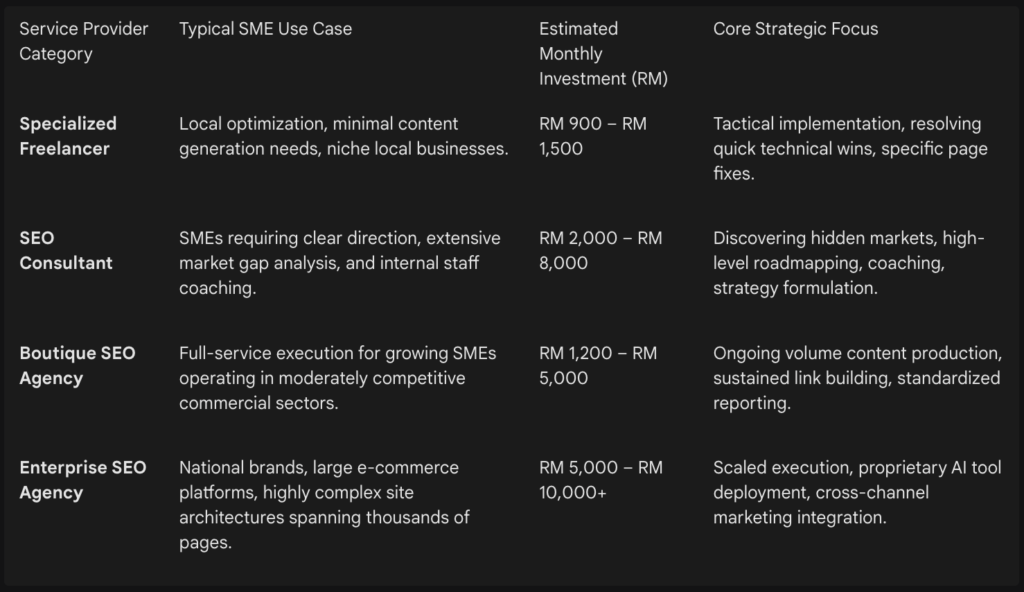
To provide further global context, industry studies demonstrate that the most common hourly rates charged globally by freelance professionals range between $75 and $100 per hour, while highly specialized strategic consultants charge a premium, typically ranging between $100 and $150 per hour (approximately RM455 to RM700 per hour), reflecting the massive financial premium placed on accurate strategic direction.
Analyzing ROI Timelines and Long-Term Value Creation
When evaluating the Return on Investment, the expected timeline and the ultimate depth of the commercial results distinctly differentiate the three operational models. Both structured agencies and independent freelancers typically begin to show initial traffic results within a standard 3 to 6 month window. Freelancers very often focus heavily on securing “quick wins” during this initial period—such as fixing broken 404 links, optimizing existing meta title tags, and building localized directory citations—which provide an immediate, albeit sometimes artificially capped, boost in digital visibility.
Agencies, demanding a higher initial capital cost, typically deliver significantly superior long-term commercial value through the continuous evolution of the strategy and the unique ability to scale execution efforts across hundreds or thousands of newly created pages as the client’s business grows. They also offer much greater risk mitigation against sudden, devastating algorithm changes due to their broader industry monitoring capabilities and collective team intelligence.
The ROI of a strategic consultant, however, is measured through a completely different financial lens. The consultant’s true financial value is often realized by preventing the SME from making catastrophic capital allocation errors. By correctly identifying the hidden market and setting the proper, profitable direction from day one, the consultant ensures that every single ringgit subsequently spent on execution (whether that execution is handled via internal staff, freelancers, or a massive agency) yields the maximum possible commercial returns. Preventing an SME from wasting RM50,000 on an agency retainer that targets an unwinnable keyword is a massive, immediate ROI.
A Decision Framework for Malaysian SME Executives
To synthesize this data into actionable commercial advice, Malaysian business owners should utilize the following decision framework:
When to Engage a Strategic Consultant: You are an SME owner with a clear overall business vision but entirely lack the deep technical expertise required to map out the complex digital strategy. You possess internal staff members who can write content or execute basic tasks, but they desperately need high-level coaching and strict direction. You need to uncover profitable hidden markets and require deep marketing consultation before committing capital to mass content production.
When to Engage an SEO Agency: Your dedicated monthly marketing budget is comfortably above RM5,000, you actively compete in a highly aggressive commercial industry, your website ecosystem is deeply complex, and you critically need a fully hands-off, dedicated execution team to handle all content generation, technical coding, and data reporting at a massive scale.
When to Engage an SEO Freelancer: You operate with a strictly limited budget, your website architecture is relatively small and simple (typically under 50 pages), you operate in a highly specific, geographically isolated local niche, and you require flexible, short-term tactical execution without being bound by long-term contractual commitments.
The 2026 Strategic Imperative: Adapting to E-E-A-T and Localized Search
Regardless of whether a business owner ultimately chooses to engage a consultant for strategic direction or an agency for mass execution, the underlying strategy must align perfectly with the unyielding realities of the 2026 search ecosystem. For Malaysian SMEs, two absolutely critical pillars dictate digital success: the ability to demonstrate localized trust and the necessity of adapting to stringent algorithmic evaluations of human expertise.
The Critical Importance of E-E-A-T in the AI Era
The core foundation of modern search algorithms relies exceptionally heavily on the concept of E-E-A-T: Experience, Expertise, Authoritativeness, and Trustworthiness. These are not mere marketing buzzwords; they are the fundamental, mathematically weighted signals that determine whether an AI model or a traditional search algorithm will choose to recommend a specific brand to a human user.
In previous eras of digital marketing, businesses could successfully rank by mass-publishing generic, uninspired content written by anonymous copywriters or cheap outsourcing farms. In the 2026 landscape, characterized by an absolute flood of AI-generated content, human content must be inherently verifiable, deeply authentic, and firmly rooted in real-world commercial experience. If a specialized dental clinic in Selangor publishes a comprehensive guide on advanced pediatric care, the algorithm now requires strict digital signals proving that the content was either authored or rigorously reviewed by a verified, licensed medical professional.
A strategic consultant will meticulously identify the unique E-E-A-T assets that already exist within an SME—such as the founder’s 20 years of documented industry experience, proprietary company datasets, or unique supply chain relationships—and meticulously design a structural plan to showcase them digitally. The executing agency or the agile freelancer will then tactically implement this strategic plan by building robust author biography pages, connecting the brand’s digital entity to reputable LinkedIn profiles, and securing authoritative industry backlinks to mathematically validate the claimed expertise.
Dominating Local SEO within the Malaysian Market
For service providers, retail storefronts, and highly localized commercial businesses across key economic regions like Selangor, Penang, and Kuala Lumpur, mastering Local SEO is the single most critical driver of physical foot traffic and high-intent commercial leads.
The Malaysian consumer market is uniquely characterized by exceptionally high mobile-first search behavior. Modern consumers utilize their smartphones to conduct location-based “near me” searches constantly throughout the day, looking for immediate, frictionless commercial solutions. To successfully capture this massive, urgent market segment, the tactical execution must be utterly flawless across several highly specific local signals:
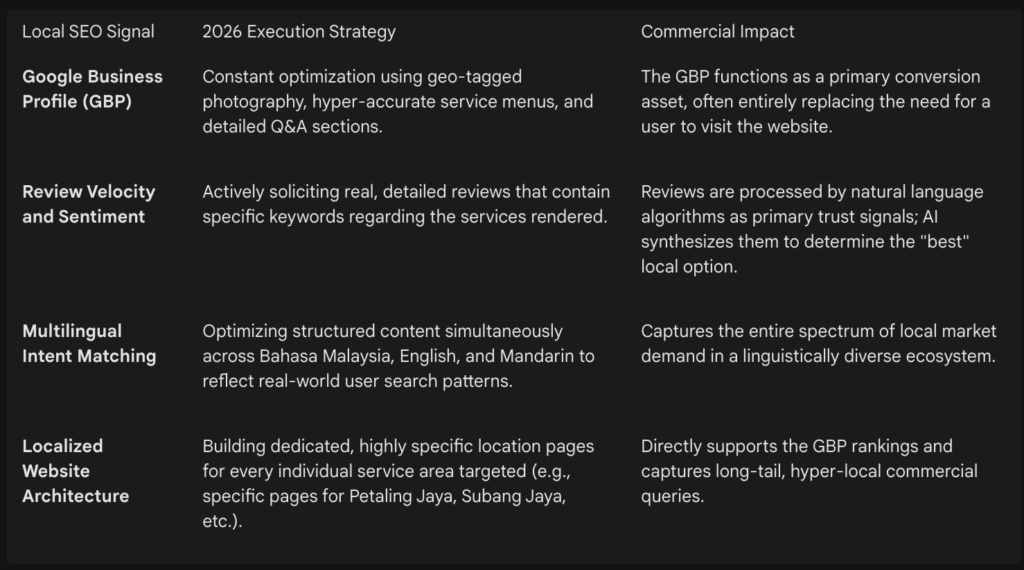
Handling this level of localized complexity requires clear division of labor. An agency possesses the manpower to handle the sheer scale of managing complex multilingual content across hundreds of distinct local landing pages, while an expert consultant ensures that the overarching localized strategy actually aligns with the physical geographic areas where the highest-margin local customers actually reside.
Synthesizing Strategy for the Answer Engine Era
As the Malaysian commercial industry moves deeper into the realities of 2026, the unprecedented convergence of Generative Engine Optimisation, highly complex, multi-layered search behaviors, and intense, localized commercial competition demands an incredibly sophisticated approach to digital visibility. Commercial brands can now be actively discussed, evaluated, and highly recommended by autonomous AI models entirely without the human user ever once visiting the brand’s actual physical website. If a Malaysian SME is completely missing from this first, critical synthesized answer layer, the business suffers an immediate, devastating loss of credibility and surrenders highly qualified commercial revenue directly to more digitally savvy competitors.
This harsh commercial reality underscores exactly why understanding the profound difference between strategic direction and tactical execution is absolutely paramount for SME survival.
If a business owner hastily hires an execution-focused freelancer and simply commands them to “get more traffic to the website,” the freelancer might execute that command perfectly by ranking the site for high-volume, incredibly low-intent informational queries. The analytics traffic graph will point sharply upward, satisfying the vanity metric, but actual commercial revenue will remain entirely stagnant because the underlying strategy completely lacked the required direction to target profitable commercial intent.
Conversely, if an ambitious SME attempts to execute a brilliant Generative Engine Optimisation strategy internally without possessing the dedicated resources, the manpower, or the technical coding knowledge required to implement complex schema code perfectly, the structural data will inevitably fail, and the AI models will simply bypass the site entirely in favor of technically sound competitors.
The optimal, most financially sound approach for many growing Malaysian SMEs is to adopt a hybrid model. They engage a highly experienced SEO consultant to provide the deep marketing consultation, comprehensively audit the competitive landscape, and definitively find the hidden market. The consultant establishes the demand, defines the precise direction, and builds the architectural roadmap. Then, the SME owner utilizes a structured agency or a carefully vetted team of specialized freelancers to actually execute that roadmap with precision, leveraging their scalable resources, dedicated time, and advanced software tools.
By strictly separating the architecture of the campaign from the construction of the assets, business owners ensure that their digital properties are not only built flawlessly from a technical perspective but are built in the exact digital location where the commercial market is rapidly moving.
Securing Your Digital Future
The functional distinction between an SEO consultant, an SEO agency, and an SEO freelancer is not merely a matter of industry semantics or varying pricing structures; it is a fundamental, structural difference in commercial value delivery.
The Consultant is the coach and the grand strategist. They leverage deep market insights and years of rigorous industry experience to provide the essential direction necessary to expand the business safely and profitably. Their primary commercial value lies in sophisticated market gap analysis—finding the highly profitable hidden markets that larger competitors have completely missed. They define the critical “what” and the essential “why.”
The Agency is the dedicated executor at scale. They take the strategic direction provided to them and implement it ruthlessly using structured teams, proprietary technology, and established operational workflows. They manage massive keyword planning operations, build complex, multi-lingual content structures, and handle comprehensive data reporting. They provide the “how” and “when” for complex, highly competitive commercial environments.
The Freelancer is the agile, hyper-specialized executor. They provide rapid tactical implementation with highly flexible commercial packaging. While the standard of communication and the quality of the output relies entirely on the individual, they offer critical, cost-effective execution services for specific projects and highly focused local market needs.
In the rapidly evolving, unforgiving 2026 landscape defined by AI overviews and the absolute necessity of Generative Engine Optimisation, commercial survival requires both razor-sharp strategic direction and relentless, flawless tactical execution. Understanding exactly which entity provides which specific service ensures that financial resources are allocated effectively, hidden commercial markets are aggressively captured, and lasting digital authority is firmly cemented for the long term.
If you are looking forward for someone to bring your SEO to another level, we are here to help.