- The Demands of the AI Search Evolution: Surviving the shift from traditional search to AI-driven Answer and Generative Engine Optimization requires advanced semantic intent clustering and multi-platform signal seeding, which are logistically impossible to manage effectively alongside daily business operations.
The Hidden Economic Reality: Attempting advanced optimization in-house carries severe hidden expenses; securing individual corporate licenses for mandatory enterprise software often exceeds the annual retainer of a professional agency that already possesses these tools and collective algorithmic pattern recognition.
The Transformation of the Malaysian Digital Economy
The operational realities for Small and Medium Enterprises (SMEs) across Malaysia have undergone a profound metamorphosis by the year 2026. Business owners navigating the complex commercial landscapes of dynamic hubs such as Petaling Jaya, Subang Jaya, and Shah Alam are currently facing unprecedented levels of market pressure. This pressure emanates from a confluence of factors: the rapid acceleration of digital transformation, shrinking profit margins due to heightened domestic and regional competition, and a fundamentally altered consumer behavior landscape. In this highly contested environment, achieving and sustaining digital visibility is no longer an optional marketing initiative; it is the foundational prerequisite for commercial survival and enterprise growth.
Historically, securing this digital visibility was a relatively straightforward endeavor. Early iterations of search engine algorithms functioned essentially as sophisticated digital directories. A business could achieve top rankings by ensuring their website contained specific, targeted phrases and by acquiring a rudimentary network of inbound hyperlinks. However, the technological paradigm of 2026 has completely eradicated this simplistic model. We have decisively exited the era of static search—characterized by the traditional display of ten blue links—and entered the highly complex, multi-dimensional age of the Search Generative Experience.
This evolution means that search engines have transitioned into autonomous answer engines, utilizing advanced artificial intelligence to synthesize data, construct conversational narratives, and provide immediate resolutions directly on the search results page. For the Malaysian SME, this technological leap presents a dual-sided reality: it offers an unprecedented opportunity to capture highly qualified, high-intent consumer traffic, while simultaneously posing an existential threat to businesses that fail to adapt their digital infrastructures. The fundamental question that every SME owner must now address is whether the intricacies of this new digital ecosystem can be managed internally, or if survival dictates the necessity of securing professional SEO Consultation.
This comprehensive report is engineered specifically for Malaysian SME owners, providing a forensic analysis of the 2026 search landscape. By systematically dismantling the operational mechanics of modern digital visibility, evaluating the daily workflows of professional optimization teams, and analyzing the economic implications of internal versus external resource allocation, this document will provide the definitive framework for making the critical choice between a Do-It-Yourself (DIY) approach and strategic professional partnership.
The Feasibility of DIY Optimization
When confronting the complexities of modern digital marketing, the immediate inclination for many budget-conscious SME owners is to explore the feasibility of internal execution. The definitive answer to whether a business owner can execute SEO internally is highly conditional: yes, you can do the SEO by yourself, as long as you have time, knowledge, and experience.
The democratization of digital information has made the theoretical frameworks of search engine optimization widely accessible. For a newly established enterprise operating with severely constrained capital, a DIY approach to SEO Marketing often serves as the only viable entry point into digital competition. Foundational optimization—the basic hygiene required to ensure a search engine can properly read and categorize a website—can indeed be implemented without the immediate intervention of an advanced specialist.
The Scope of Basic Internal Implementation
To understand the boundaries of DIY feasibility, one must define what constitutes foundational optimization in 2026. An internal practitioner can typically manage the initial structural requirements of a website, which include the meticulous crafting of metadata. This involves writing descriptive, accurate title tags and meta descriptions that clearly articulate the core offerings of the business. While AI systems are increasingly generating their own snippets, optimized metadata remains a critical secondary signal for traditional indexing mechanisms.
Furthermore, an internal team can manage the critical task of local directory synchronization. In the Malaysian context, where localized search intent is exceptionally high, ensuring absolute consistency of the business’s Name, Address, and Phone number (NAP) across platforms like Google Business Profile, local industry registries, and regional social commerce platforms is paramount. Discrepancies in this foundational data actively degrade the trust signals required by both traditional algorithms and emerging generative models.
The DIY approach also encompasses the creation of fundamental, informational content. A business owner possesses the deepest intrinsic knowledge of their own products and services. Translating this expertise into basic blog posts, detailed service descriptions, and transparent frequently asked questions (FAQs) provides the search engine with the raw textual material required to understand the commercial entity’s core competencies.
The Constraints of Time, Knowledge, and Experiential Pattern Recognition
However, the viability of this internal model deteriorates rapidly as the enterprise attempts to scale or when it operates within highly contested industry verticals. The limiting factors are not merely access to information, but the sheer volume of time, the depth of technical knowledge, and the crucial element of experiential pattern recognition required to compete in the modern era.
Time allocation represents the most immediate constraint. Basic implementation is a finite task, but SEO in 2026 is an attritional, continuous process of adaptation. Search engines deploy thousands of algorithmic adjustments annually. Monitoring these fluctuations, executing comprehensive competitor analyses, auditing technical site health, and maintaining the required velocity of high-quality content production demands hundreds of hours per year. For an SME owner whose primary directives must remain business development, supply chain management, and operational leadership, allocating this magnitude of time to digital marketing inevitably results in a severe opportunity cost, actively stunting overall corporate growth.
Knowledge acquisition presents a secondary, equally formidable barrier. The technical mechanisms governing search visibility have grown exponentially complex. A business owner must now comprehend the intricacies of dynamic rendering, the nuances of crawl budget optimization, and the strict parameters of Core Web Vitals—Google’s standardized metrics for assessing user experience, loading performance, and visual stability. Attempting to learn these highly specialized technical disciplines while simultaneously managing a business is an operationally precarious strategy.
Ultimately, the most critical deficiency of the DIY approach is the absence of experiential pattern recognition. A business owner executing their own optimization is doing so within a vacuum. When a sudden, catastrophic drop in organic traffic occurs, the internal practitioner lacks the comparative datasets required to rapidly diagnose the root cause. They cannot instantaneously determine if the traffic loss is the result of a subtle technical server error, an unintentional cannibalization of key search terms, or a broader, systemic algorithmic core update. Conversely, a professional who manages dozens of campaigns across various sectors possesses a refined, intuitive ability to recognize these patterns instantly, mitigating revenue loss and deploying immediate corrective protocols.
In summary, yes, you can do it by yourself, but strictly within the parameters of foundation and basic implementation. More advanced, competitive optimization will inherently require an SEO specialist to perform it, as they possess the requisite depth of experience in the field. To truly comprehend why advanced intervention is eventually necessary, one must deeply examine the intense, granular reality of what professional technical teams execute on a daily basis.
What the SEO Team Executes Daily
The disparity between amateur, DIY optimization and professional, enterprise-grade deployment is most starkly illustrated by examining daily operational workflows. In 2026, the daily tasks of an optimization team have shifted fundamentally away from rudimentary keyword insertion and generic content production. Modern SEO Marketing is a highly engineered, data-driven discipline focused heavily on behavioral psychology, semantic analysis, and continuous algorithmic monitoring.
The Evolution of Keyword Research and Intent Clustering
The bedrock of any successful digital strategy remains keyword research. However, the methodology utilized by professional teams in 2026 bears little resemblance to the practices of the past decade. It is no longer a simple exercise of identifying individual words with high search volumes and pasting them into website copy. Today, when it comes to keyword research, teams must meticulously navigate the complex interplay between long and short tail keywords, recognizing that each keyword serves a completely different purpose and targets a distinct consumer group. Therefore, you need to take considerable time and apply deep experience to research this ecosystem effectively.
Professional teams utilize advanced, proprietary enterprise software to execute continuous semantic clustering and intent modeling. This process involves segmenting the entire total addressable market based on the exact phrasing consumers use at different stages of the purchasing journey.
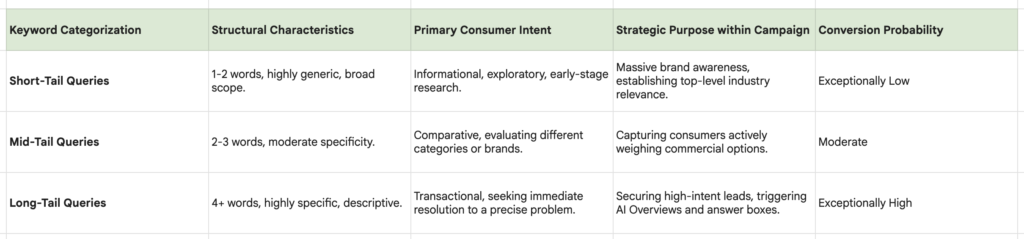
Short-tail keywords are broad, generalized phrases typically consisting of one or two words. Examples within the Malaysian context might include terms like “Logistics Malaysia” or “Accounting Software.” These queries represent immense search volume, but they concurrently represent extremely low commercial intent. The consumer utilizing a short-tail keyword is generally in the nascent, exploratory phase of their research. They are seeking broad definitions or sweeping industry overviews. Ranking for these highly competitive terms requires an astronomical accumulation of domain authority and extensive digital PR campaigns. While achieving visibility for short-tail keywords generates massive brand awareness, the conversion rate from this traffic is statistically minute.
Conversely, long-tail keywords are highly specific, descriptive phrases containing three, four, or even five words. Examples include queries such as “temperature controlled pharmaceutical logistics in Petaling Jaya” or “cloud accounting software for retail SMEs in Selangor.” While the raw mathematical search volume for these terms is significantly lower than their short-tail counterparts, the commercial intent is exceptionally high. A consumer executing a long-tail query has already defined their precise problem, evaluated potential methodologies, and is actively seeking a specific, immediate solution.
Crucially, in the 2026 search landscape, long-tail queries are the primary triggers for the Search Generative Experience and AI Overviews. Because generative artificial intelligence models are engineered to synthesize complex information and provide highly specific answers, optimizing for these long-tail queries is the most direct pathway to achieving digital dominance.
Identifying the optimal matrix of these keywords is an intensive, daily undertaking. It requires filtering thousands of permutations, analyzing competitive difficulty metrics, and evaluating semantic relevance to find the exact intersections where a business can realistically achieve ranking superiority and drive tangible revenue.
Strategic Content Direction and Persona Mapping
Following the rigorous mapping of the keyword ecosystem, the daily workflow of the professional team transitions into the highly specialized discipline of Content Direction. It is imperative to understand that in the modern era, the creation of content is not a generalized exercise in creative writing; it is a highly engineered, psychological process of mapping specific business solutions to precise consumer pain points.
Each distinct consumer group possesses its own unique set of friction points, anxieties, informational requirements, and desired solutions. For instance, a corporate procurement director searching for high-volume manufacturing services in Shah Alam possesses vastly different informational needs than a local consumer searching for a boutique café in Subang Jaya. The procurement director requires content heavily weighted with structured technical specifications, verifiable compliance certifications, data-driven reliability metrics, and comprehensive supply chain transparency. Conversely, the local consumer requires immediate access to location data, ambient descriptions, visual menus, and real-time pricing.
If an internal team lacks experience in psychological persona mapping and empathetic content engineering, it will take significantly more time and wasted effort to prepare the content. An expert team actively engineers Content Direction through several highly structured daily protocols:
Firstly, they employ the Inverted Pyramid Structure, which is specifically designed for the consumption habits of both modern users and artificial intelligence algorithms. This structural methodology involves leading every page, and indeed every sub-section of a page, with a highly direct, concise, and definitive answer that immediately satisfies the user’s core query. This immediate answer is then followed by paragraphs that progressively expand upon the topic, providing deeper context, supporting evidence, and nuanced explanations. Research indicates that this specific structure is mathematically proven to exponentially increase the likelihood of a piece of content being extracted and featured as the primary source within AI Overviews.
Secondly, daily Content Direction operations involve the relentless fortification of E-E-A-T signals. E-E-A-T stands for Experience, Expertise, Authoritativeness, and Trustworthiness. Search algorithms, particularly the advanced language models powering generative search, heavily penalize anonymous, generic, or superficially researched content. Building E-E-A-T requires attributing all content to verifiable, named experts with demonstrable credentials. It demands the inclusion of original data, the citation of verifiable industry statistics, the maintenance of highly transparent editorial standards, and the active linking of internal claims to recognized, authoritative external sources, such as academic journals or established industry databases.
Thirdly, Content Direction must proactively address what engineers refer to as the “Query Fan-Out” phenomenon. When a consumer inputs a complex query into an AI search interface, the engine does not process that query linearly. Instead, it utilizes a fan-out mechanism, instantaneously breaking the single complex question into dozens of distinct, smaller sub-queries, which are executed simultaneously to build a comprehensive, multi-faceted summary. To be recognized as an authoritative source, the content prepared by the SEO team must holistically anticipate and answer all tangential sub-queries within a single, comprehensive pillar page.
Technical Fortification, Entity Management, and Schema Deployment
Beyond the creation of visible text, a massive proportion of a professional team’s daily operations is dedicated to the invisible, underlying technical infrastructure of the website. No amount of exceptional content will yield visibility if the search engine crawlers cannot efficiently access, parse, understand, and render the digital architecture.
Daily technical tasks encompass a wide spectrum of diagnostic and corrective actions. Teams perform constant crawlability triage, deeply analyzing server log files to ensure that search engine bots are not wasting their allocated crawl budget on irrelevant, low-value pages, or becoming trapped in infinite redirect loops. They continuously scan the architecture to identify and resolve 404 error pages, repair broken internal link equity, and rectify instances of content cannibalization, where multiple pages on the same domain inadvertently compete against each other for the identical search term.
Furthermore, in the era of generative optimization, technical teams focus obsessively on “Entity Clarity”. Search engines no longer read text linearly like a human; instead, they categorize all information into discrete “entities”—which can be people, places, abstract concepts, or corporate brands—and build vast, relational knowledge graphs that map the connections between these entities. Daily operations require the deployment of advanced, machine-readable implementation, primarily executed through complex JSON-LD schema markup.
By hardcoding the website’s underlying data into these standardized, internationally recognized schema formats, the team explicitly feeds the artificial intelligence engine definitive data regarding product specifications, corporate identity details, customer reviews, and operational FAQs. This completely bypasses the engine’s need to infer meaning from standard paragraph text, establishing immediate, incontrovertible factual authority for the brand.
24/7 Citation Monitoring and Hallucination Correction Protocols
Perhaps the most dramatic shift in the daily workflow of a 2026 optimization team is the absolute necessity for active, continuous monitoring of AI platforms. As reliance on AI search intent rises, so too does the inherent risk of AI-generated misinformation and brand degradation.
Large Language Models (LLMs) are highly susceptible to “hallucinations”—instances where the artificial intelligence confidently generates and presents information that is factually incorrect, entirely fabricated, or severely outdated. An AI model might erroneously state to a prospective client that a company has discontinued its primary product line, or it may present vastly outdated pricing data, creating immediate friction in the sales process. Because modern consumers implicitly trust the outputs generated by these advanced AI systems, these uncorrected hallucinations can cause immediate, catastrophic, and largely unmeasured revenue loss for an SME.
To combat this, dedicated teams maintain rigorous, 24/7 continuous monitoring protocols across all major generative platforms, including ChatGPT, Perplexity, Google AI Overviews, and Claude. They track exactly how the brand is being summarized and referenced. When instances of misinformation or brand hallucination are detected, the team executes immediate correction protocols.
These protocols are multi-faceted. They involve rapidly updating the primary source content on the corporate website to ensure absolute clarity, aggressively altering third-party directory listings that the AI might be pulling flawed data from, submitting direct, structured feedback to the AI platform developers through official channels, and amplifying accurate brand citations across highly trusted external websites. This rapid amplification mathematically forces the AI model to re-weight its neural pathways and update its generated answers. This level of constant vigilance, requiring specialized tracking software and dedicated personnel, is a resource entirely unavailable within a standard DIY capacity.
AI Search, AI Overviews, and the Search Generative Experience
The necessity for such rigorous, granular daily operations is driven entirely by a massive structural shift in how information is indexed and, more importantly, how the consumer expects to interact with that information. AI Overview and AI Search is rising at an exponential rate. With the latest AI search and overview integrations, the SEO effort will be required more to align with the modern consumer mindset. All these developments will require heavy, continuous research to ensure you find the exact right search intent.
Understanding the Modern Consumer Mindset
To comprehend why search strategies must adapt, one must analyze the psychological evolution of the 2026 consumer. The modern searcher no longer wants to “search” in the traditional sense; they want to “accomplish.” They are increasingly unwilling to open multiple browser tabs, manually cross-reference conflicting information from various blogs, and synthesize their own conclusions.
When a user inputs a query into an AI interface today, they expect a fully synthesized, verified, and highly specific report delivered instantaneously. This shift in mindset has given rise to what industry experts term “Agentic Search”. In an agentic ecosystem, the artificial intelligence does not just return information; it autonomously executes tasks on behalf of the user, such as comparing complex B2B software pricing tiers, analyzing raw material costs across different suppliers, or booking logistical services.
If a business fails to structure its digital data in a format that these agentic crawlers can easily ingest and utilize, the business becomes entirely invisible to the consumer, regardless of how aesthetically pleasing their website might be. Consequently, heavy research into consumer intent is paramount. The optimization team must precisely categorize whether the user’s intent is purely informational (seeking broad knowledge), navigational (attempting to locate a specific digital destination), commercial investigation (comparing available options before a purchase), or transactional (ready to execute an immediate purchase). Misaligning the structural formatting of a webpage with the underlying psychological intent of the consumer will result in the AI engine actively suppressing the content, as it fails to satisfy the user’s immediate operational goal.
The Zero-Click Phenomenon and Traffic Valuation
The rise of the Search Generative Experience has ushered in the era of the “zero-click” search environment. Nearly half of all Google searches now conclude without the user executing a single click to an external website, because the AI Overview has thoroughly and completely answered their query directly on the results page. For an SME owner historically accustomed to tracking success via raw website traffic metrics, this reality can appear highly alarming.
However, the valuation of traffic has fundamentally shifted. While the overall volume of organic clicks may experience a decline, the quality and conversion potential of the traffic that does arrive via AI citations is exponentially higher. Current data indicates that traffic originating from AI sources converts at an astonishing average rate of 14.2%, compared to a mere 2.8% conversion rate from traditional organic search results.
This dramatic increase in conversion efficacy occurs because the consumer arrives at the website entirely pre-qualified. The AI engine, acting as an impartial, highly trusted third-party advisor, has already analyzed the market, evaluated the options, and explicitly told the consumer that this specific brand represents the optimal solution to their problem. Therefore, the strategic objective is no longer maximizing gross traffic volume; it is maximizing the brand’s Share of Voice within these highly trusted AI summaries.
Generative Engine Optimisation (GEO) vs Answered Engine Optimisation (AEO)
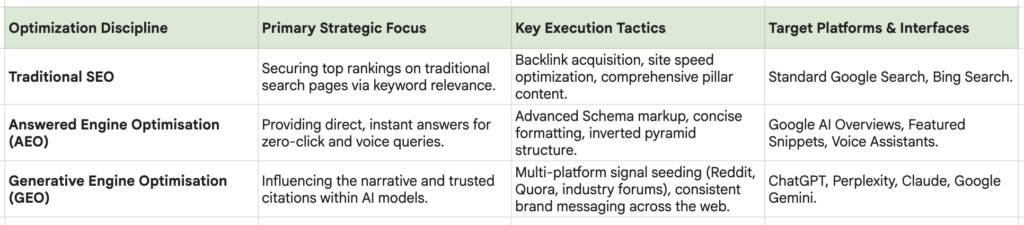
To capture this high-converting Share of Voice, professional Marketing consultation services have developed two distinct, highly advanced sub-disciplines that build upon the foundation of traditional SEO: Generative Engine Optimisation and Answered Engine Optimisation. Understanding the distinction between these practices highlights the immense technical gap between DIY efforts and professional execution.
Answered Engine Optimisation (AEO)
Answered Engine Optimisation is specifically engineered to capture zero-click searches and secure the highly coveted “Position Zero” in features like Google’s AI Overviews, quick answer boxes, and voice assistant responses (such as Siri or Alexa). The entire philosophy of AEO revolves around extreme structural clarity and extractability.
When executing AEO, the team meticulously formats content so that it can be instantly pulled and displayed as a definitive fact. This involves utilizing highly explicit, question-based H2 and H3 headings, followed immediately by concise, definitive answers devoid of marketing fluff or subjective “hedging” language. Furthermore, AEO relies heavily on the implementation of advanced schema markup, ensuring that the raw data regarding pricing, availability, and business hours is perfectly standardized for machine reading. AEO is an inherently on-page strategy, focused on optimizing the business’s proprietary website assets to feed answers directly to the engine.
Generative Engine Optimisation (GEO)
Generative Engine Optimisation, conversely, is a much broader, more complex, and predominantly off-page strategy. GEO focuses on shaping the fundamental narrative and perception of a brand across the entire internet, ensuring that Large Language Models (LLMs) like ChatGPT, Claude, and Perplexity inherently trust and reference the business when generating conversational summaries.
Because LLMs derive their knowledge by scanning massive, diverse datasets across the web, GEO requires a relentless focus on Multi-Platform Signal Seeding. An AI system assesses a business’s credibility not just by reading the company’s own website, but by analyzing the context gathered from external, independent sources. If a business claims to be the premier provider of cloud accounting software in Malaysia, but the AI cannot find any corroborating evidence of this claim on third-party tech forums, review sites, or established digital publications, the AI will not cite the business.
Therefore, daily GEO operations involve actively securing brand mentions on platforms that AI systems heavily weight as trusted knowledge nodes. In 2026, this means actively cultivating a presence on highly moderated User-Generated Content (UGC) platforms such as specialized subreddits, Quora, LinkedIn, and authoritative industry-specific directories. It requires ensuring that the brand’s language, messaging, and core value propositions are absolutely consistent everywhere the brand appears on the internet, creating a stable, undeniable semantic footprint that the AI can easily recognize and retrieve.
Attempting to simultaneously manage traditional SEO, execute precise Answered Engine Optimisation on the corporate website, and orchestrate a sweeping Generative Engine Optimisation campaign across third-party platforms is a logistical impossibility for an independent SME owner managing their own marketing in their spare time.
The Strategic Transition: From Basic to Advanced Consultation
The preceding analysis definitively reinforces the central thesis: yes, you can do it by yourself, but strictly with foundation and basic elements. More advanced operations will invariably require an SEO specialist to perform it. As they are significantly more experienced in the field, they possess the architectural knowledge and proprietary tools necessary to compete in the generative era.
The critical challenge for the Malaysian SME owner is recognizing the precise operational juncture at which the transition from DIY to professional consultation must occur. This transition is not an admission of failure, but a strategic escalation required to protect and expand market share. Business owners should initiate this transition when they encounter the following operational realities:
The Plateau of Organic Growth: The internal team has successfully optimized foundational metadata and established a basic content repository, but organic traffic and lead generation have stagnated. Breaching the upper echelons of search visibility—moving from Page 2 into the top 3 positions or securing consistent AI Overview citations—requires complex technical interventions and high-authority link acquisition that far exceed basic capabilities.
The Shift Toward Conversational Dominance: The enterprise notes a steady decline in traditional organic traffic, correlating directly with the industry-wide shift toward the Search Generative Experience. Completely restructuring the existing content architecture to comply with AEO formatting and GEO citation standards requires a dedicated, systemic overhaul.
Escalating Architectural Complexity: As the enterprise expands, the digital footprint grows from a simple brochure website into a massive, multi-faceted e-commerce platform or a deep technical resource portal. Managing crawl budgets, complex pagination, and dynamic rendering algorithms on large-scale architectures requires advanced engineering expertise to prevent catastrophic visibility collapse.
Intensifying Competitive Entrenchment: The business operates within a highly lucrative, aggressively contested sector—such as specialized B2B manufacturing in Selangor or competitive financial services in Kuala Lumpur. In these environments, competitors are deploying enterprise-grade retainers to dominate the AI landscape. Attempting to outmaneuver well-funded, professionally managed competitors using intermittent, foundational DIY tactics is a mathematical impossibility.
At these critical junctures, the engagement of a specialized professional ceases to be a discretionary marketing expense and transforms into a vital operational investment.
The Economic Reality: The True Cost of DIY vs. Agency Partnership
When an SME owner evaluates the decision to retain an SEO Consultant in Selangor, the financial analysis must extend far beyond the superficial metric of the upfront monthly retainer. The prevailing market rates for established, professional SEO services in Malaysia in 2026 range from RM 15,000 to RM 35,000 annually, with highly specialized, enterprise-level engagements scaling from RM 30,000 to RM 80,000 per year. Monthly localized engagements generally necessitate investments between RM 2,900 to RM 8,000.
To the budget-conscious executive, these figures represent a substantial capital allocation. The reflexive reaction is often to default to internal execution to preserve cash flow. However, a rigorous, holistic financial analysis reveals severe, often debilitating hidden costs associated with the DIY approach.
The most substantial hidden cost of internal execution is the software infrastructure required to compete effectively. Modern optimization is completely dependent upon proprietary analytics platforms to execute keyword clustering, perform technical backlink auditing, and track Generative Engine Optimisation metrics. Securing individual corporate licenses for industry-standard tools such as Ahrefs, Semrush, advanced server log analyzers, and enterprise-grade AI citation trackers can impose operational costs that far exceed the annual price of an agency retainer. When partnering with an agency, the cost of these elite software stacks is entirely absorbed into the service fee.
Furthermore, the professional agency operates with the immense benefit of scalable efficiency and collective intelligence. Because an expert consultant serves multiple clients across diverse industries simultaneously, they possess cumulative, real-time pattern recognition. They have already tested, validated, and refined specific tactical responses to the latest, unannounced Google core algorithm update. The DIY practitioner, isolated from this collective data, must learn these harsh lessons through trial and error on their own primary revenue-generating asset. In 2026, an algorithmic penalty caused by an amateur technical error can erase 80% of digital foot traffic overnight, resulting in catastrophic revenue loss that takes months, or even years, to recover.
Finally, one must account for the unique multi-cultural and multi-lingual nuances of the Malaysian market. Effective optimization in Malaysia often requires a deep understanding of how search intent varies across Malay, Chinese, and English-speaking demographics. It requires an understanding of how social-first trends on platforms like TikTok and Xiaohongshu intersect with traditional search behaviors. A professional agency provides a multi-disciplinary team capable of navigating these complex cultural architectures, a capability rarely present within a single, internal DIY practitioner.
Securing Your Digital Future in 2026
The digital landscape of 2026 is uncompromising, dynamic, and incredibly complex. The complete integration of generative artificial intelligence into the core mechanics of online information retrieval has fundamentally elevated the requirements for digital visibility. Success is no longer achieved through basic keyword placement and rudimentary site structures; it demands advanced semantic engineering, relentless technical fortification, and deep psychological alignment with the modern consumer mindset.
The comprehensive analysis clearly dictates that while independent execution of SEO is feasible for the absolute basic, foundational setups—assuming the business owner is willing to sacrifice substantial operational time to acquire the requisite knowledge—the strategic ceiling for DIY optimization is perilously low. The daily operations required to remain competitive—ranging from intricate semantic keyword clustering and persona-mapped content direction to the continuous monitoring of AI hallucinations and the deployment of advanced Generative Engine Optimisation—demand full-time, highly specialized, and deeply experienced attention.
The emergence of the Search Generative Experience dictates that digital visibility is now an enterprise-level engineering challenge. The consumer mindset has permanently evolved, demanding instant, verified, and highly specific answers, and the AI engines will aggressively penalize any brand that fails to structure its digital data accordingly. For Malaysian SMEs, attempting to navigate the algorithmic complexities of 2026 without deep experiential pattern recognition introduces substantial financial risk through lost market share, invisible technical penalties, and the overwhelming opportunity cost of distracted leadership.
The transition from DIY efforts to professional consultation represents the vital evolution necessary to protect your enterprise and ensure scalable, sustainable growth in the era of artificial intelligence. If you are looking forward for someone to bring your SEO to another level, we are here to help. Expert consultation services possess the architectural knowledge, the proprietary technology, and the seasoned pattern recognition required to transform your digital presence into a dominant, revenue-generating asset.