The Anatomy of SEO Guarantees: Keyword rankings can be promised through precise optimization, while traffic projections require a three-month incubation period to gather baseline data. Conversions are optimized by meticulously analyzing historical Google Analytics data.
The Generative Search Disruption: Traditional search is evolving into the Search Generative Experience, requiring brands to shift from seeking blue-link rankings to pursuing citations within AI Overviews via Generative Engine Optimisation.
Malaysian Market Dynamics & Data Tracking: With high AI adoption rates in Malaysia, robust tracking infrastructure is paramount. Consultants must interpret complex data—ranging from Core Web Vitals to interconnected performance signals—to translate raw metrics into valuable business insights.
The Metamorphosis of Digital Visibility in Malaysia
The digital economy within Malaysia has entered a defining decade of unprecedented technological acceleration. From the bustling corporate corridors of Kuala Lumpur to the rapidly expanding industrial and commercial hubs of Selangor, the competition for online visibility has escalated into a hyper-competitive mandate. In this fiercely contested environment, where national internet penetration rates have soared past the 90% threshold, the mechanisms governing how consumers discover, evaluate, and ultimately purchase from brands have fundamentally transformed. At the very epicenter of this transformation lies a critical, persistent question frequently posed by Small and Medium Enterprise (SME) owners navigating resource allocation: Can a good SEO consultant actually guarantee results in Malaysia?
The answer to this question in the year 2026 is a conditional, highly nuanced yes. However, the validity of this affirmative response depends entirely on what kind of result the organization is looking forward to achieving. The traditional architecture of search engine visibility does not operate as a single, monolithic outcome; rather, it functions upon a sequential, interconnected continuum. This progression dictates that keyword rankings lead to traffic, which subsequently leads to conversions. Understanding the distinct degree of certainty, predictability, and control a consultant possesses at each individual stage of this funnel is essential for setting realistic expectations and forging successful, long-term partnerships in SEO Marketing.
Furthermore, evaluating these guarantees is no longer confined to the traditional paradigm of the “ten blue links” that dominated the first two decades of the commercial internet. The deep integration of advanced artificial intelligence into core search algorithms has birthed the Search Generative Experience, an environment where search engines actively synthesize information to provide direct, conversational answers rather than merely directing users to third-party websites. This paradigm shift necessitates a broader, more holistic approach to digital visibility, demanding the integration of advanced methodologies such as Generative Engine Optimisation and Answered Engine Optimisation. Consequently, verifying the promises of an SEO consultant requires a comprehensive understanding of both traditional ranking mechanics and the emerging parameters of AI-driven search behaviors specifically within the Malaysian market.
This exhaustive report systematically details the modern parameters of search marketing guarantees, dissects the precise timeline of expected outcomes, explores the critical role of historical data in conversion rate optimization, and outlines the meticulous tracking methodologies required to interpret raw data into highly valuable business insights.
Deconstructing the SEO Guarantee Framework
To accurately assess the validity and ethical boundaries of any guarantee within the realm of SEO Consultation, it is necessary to rigorously deconstruct the digital marketing funnel. The user journey always commences with a query, which triggers keyword rankings based on algorithmic relevance. Visibility across these rankings generates organic traffic, and the quality, intent, and engagement of that traffic—paired seamlessly with the website’s user experience—dictate the ultimate conversion rate. Each phase of this sequence carries a vastly different level of predictability and operational control.
Keyword Rankings: The Predictable Foundation
The analysis begins at the top of the visibility funnel. The answer is unequivocally yes, but it depends entirely on what kind of result the organization is looking forward to. The fundamental architecture of SEO follows a strict progression: keywords ranking leads to traffic, which subsequently leads to conversions. Therefore, if an enterprise is looking forward to the keywords ranking, yes, the SEO consultant is able to promise exactly that.
Keyword rankings represent the most controllable and mathematically predictable variable in the search optimization equation. While search engine algorithms remain proprietary black boxes subject to constant updates, the foundational principles of semantic relevance, topical authority, and technical accessibility are steadfast and well-documented. An expert consultant secures keyword rankings through a deterministic, engineering-based process rather than speculative guesswork.
This process initiates with an exhaustive semantic analysis of the target market. By identifying the exact lexicon, phrasing, and questioning formats used by prospective customers, consultants can map search intent—whether it is informational, navigational, commercial, or transactional—to highly specific landing pages. The ability to guarantee rankings stems directly from comparative data analysis. By rigorously evaluating the domain authority, backlink velocity, content depth, and entity associations of the current top-ranking pages, a consultant can mathematically quantify the exact effort and resources required to surpass them.
For example, if a Malaysian SME targets a highly specific, commercially driven long-tail keyword related to industrial manufacturing, the consultant executes a series of precise actions. They optimize the technical infrastructure to ensure rapid crawlability, structure the internal linking architecture to flow PageRank efficiently, and deploy superior, structurally optimized content that comprehensively answers the user’s implicit and explicit needs. By systematically satisfying the algorithmic requirements better than the existing competition, climbing the Search Engine Results Pages (SERPs) becomes an inevitable outcome. Thus, promising upward mobility and page-one visibility for targeted, thoroughly researched keywords is a standard, achievable benchmark in professional SEO engagements.
Traffic Projections: The Three-Month Inflection Point
While keyword rankings can be reliably targeted and systematically achieved, guaranteeing immediate traffic volume introduces a secondary layer of complexity. Traffic generation relies entirely on the aforementioned keyword rankings; a website fundamentally cannot generate organic clicks until it occupies a visible position on the SERP. Conversely, if the objective is immediate traffic, forecasting might be hard. Traffic will heavily rely on the keywords ranking; therefore, traffic is able to be promised once the 3rd month of SEO is being implemented, as there is sufficient historical data that can show how well it performs.
The rationale behind this universally recognized three-month incubation period is deeply rooted in the mechanical realities of search engine indexing, crawl budgets, and the algorithmic testing of new entities. The timeline of predictability unfolds in distinct phases:
Month One: Technical Foundation and Algorithmic Introduction. The initial phase of an SEO campaign involves rectifying profound crawl errors, optimizing site architecture, neutralizing toxic backlinks, and ensuring flawless mobile responsiveness. Search engines operate on limited crawl budgets; they require substantial time to recrawl the site, register these foundational improvements, and update their localized indexes. During this month, traffic remains relatively stagnant as the foundation is poured.
Month Two: Content Deployment and Entity Testing. As highly optimized content is published, the search algorithms begin a phase of active testing. The search engine places these new pages in various ranking positions for a multitude of related queries to measure initial user engagement signals, such as bounce rate and dwell time. This testing phase involves significant algorithmic fluctuations, commonly referred to within the industry as the “sandbox” effect, as the search engine determines the optimal, permanent ranking position.
Month Three: Data Accumulation and Empirical Predictability. By the conclusion of the third month, the algorithmic volatility subsides, and there is sufficient empirical data to show how well the campaign is performing. Impressions—the frequency with which the site appears in search results—begin to stabilize. Most importantly, accurate Click-Through Rates (CTR) can be precisely measured.
Once this historical performance data is firmly established, the consultant possesses the mathematical variables necessary to extrapolate future traffic volumes. If a specific keyword stabilizes in the top three positions and the historical CTR is calculated at a consistent 15%, the consultant can confidently guarantee specific traffic thresholds moving forward, based on the known, verifiable search volume for that query. Thus, traffic guarantees fundamentally transition from speculative estimations to data-backed, contractual projections by the end of the first quarter of the engagement.
Conversion Optimization: The Supremacy of Historical Data
The ultimate, overarching objective of any commercial enterprise is not merely to accumulate raw traffic, but to drive tangible conversions—whether that entails high-ticket product purchases, qualified B2B lead form submissions, or direct consultation inquiries. Guaranteeing conversions represents the absolute highest degree of difficulty in digital marketing, as it introduces volatile variables that exist entirely beyond the control of the search engine, specifically user psychology and the website’s User Interface (UI).
It is entirely possible to drive thousands of highly targeted visitors to a website, only for them to abandon the session due to a convoluted checkout process, unclear pricing, or a lack of trust signals. Therefore, for conversion optimization, the focus will look into the past historical data. The SEO consultant will need to look into Google Analytics—specifically navigating the Traffic acquisition and Page & Screens reports—to see precisely which pages bring the conversion and to strategize on how to improve further.
The reliance on these specific analytical modules is critical for moving beyond vanity metrics.
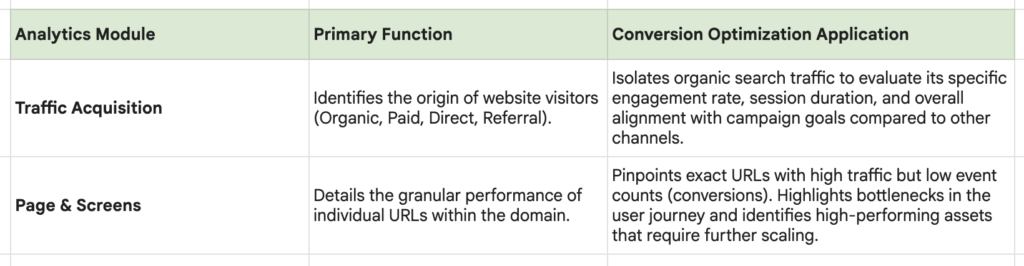
If the data reveals that a service page receives substantial organic traffic but exhibits a conversion rate of less than 0.5%, the diagnostic conclusion is clear: the issue lies not with the SEO visibility, but with the on-page experience or the alignment of the offer. The consultant leverages this past historical data to implement rigorous Conversion Rate Optimization (CRO) strategies. This might involve refining the call-to-action placement above the fold, accelerating page load speeds, rewriting the ad copy to better align with the specific search intent of the user, or introducing social proof elements. By meticulously interpreting this past data, the consultant maps a definitive strategy on how to improve further, shifting the guarantee from the shallow promise of “generating random clicks” to the highly valuable outcome of “delivering high-intent visitors to optimized, frictionless conversion pathways.”
Tracking and Analytics: Translating Data into Insight
The final component of evaluating what a consultant can legitimately promise revolves around the verifiability and transparency of the results. As emphasized in the foundational principles of modern digital marketing, a good SEO consultant will be able to share the end result supported by rigorous research and past data. Consequently, good tracking is profoundly important for a website. With the right tracking infrastructure, the SEO consultant is able to interpret the data to become valuable insight.
The Connected Signal Model
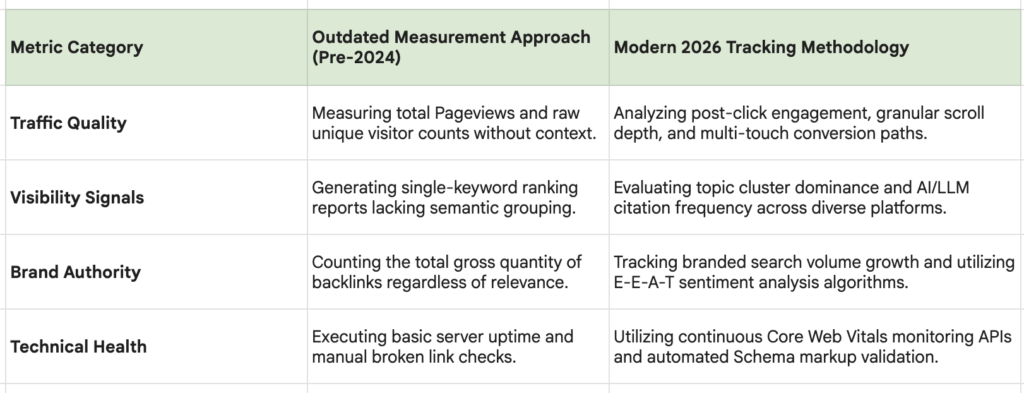
Historically, search performance was measured through highly isolated metrics: total keyword rankings, raw organic traffic volume, and simplistic bounce rates. However, as the digital landscape has grown exponentially more complex, relying on these isolated metrics is no longer sufficient and can often be dangerously misleading to stakeholders.
In 2026, it is entirely possible—and increasingly common—for a website’s overall rankings to improve while revenue stalls, or for total traffic to grow rapidly while the sales pipeline remains completely empty. For example, acquiring 5,000 low-intent visitors who immediately exit the site upon reading an informational summary is vastly inferior to securing 500 high-intent visitors who actively engage and convert into paying customers. Furthermore, an immense increase in AI visibility might result in zero measurable direct clicks to the website, yet significantly boost overall brand awareness and subsequent direct searches.
Therefore, sophisticated consultants utilize what is known as the “Connected Signal Model”. This advanced analytical framework unifies visibility, engagement, AI presence, and revenue into a cohesive, interconnected performance narrative. The tracking metrics that actually dictate success in 2026 include:
Cluster-Based Keyword Rankings: Rather than obsessing over single, disconnected keywords, tracking systems now monitor topical authority across an entire cluster of semantically related terms. This proves broader market dominance.
Branded Search Demand: Monitoring how frequently users search for the brand name directly in search engines. A rise in branded demand is a profound indicator of market trust and often reflects the upstream influence of being cited by AI models.
Post-Click Behavioral Engagement: Moving beyond the click, consultants analyze scroll depth, time on page, and pages per session. These metrics definitively prove whether the content genuinely satisfies the user’s intent after they arrive.
AI and LLM Visibility Metrics: Utilizing emerging enterprise tools to track how frequently a brand is explicitly cited in AI Overviews across major platforms like Perplexity, Google Gemini, and ChatGPT. This AI visibility is emerging as one of the most critical measurable authority signals in the modern era.
By interpreting these interconnected signals, a consultant can definitively prove the true Return on Investment (ROI) of the marketing campaign, moving the conversation far beyond vanity metrics to focus strictly on revenue-aligned outcomes.
Technical Tracking: Core Web Vitals and Schema Validation
To facilitate this high-level tracking and ensure the website operates at peak algorithmic efficiency, rigorous technical SEO tracking is mandatory. Automated, real-time monitoring systems must be deployed to immediately identify critical issues such as broken links, 404 errors, duplicate content, canonicalization failures, or severe server response degradation.
A primary, non-negotiable focus within this technical tracking infrastructure involves Core Web Vitals. These are specific, highly quantified metrics established by Google to evaluate the holistic user experience, specifically concerning loading speed, page interactivity, and visual stability during rendering. Page speed is a critical determinant of both ranking potential and conversion success. Extensive research definitively shows that as page load time increases from a mere 1 second to 3 seconds, the bounce rate increases by an alarming 32%. If a page takes 5 seconds to load, bounce rates jump to 38%. Mobile users, which represent the vast majority of search traffic, are particularly unforgiving; 53% of mobile site visits are completely abandoned if pages take longer than 3 seconds to load. An expert consultant constantly tracks, measures, and optimizes image compression, code efficiency, script execution, and server caching to maintain elite Core Web Vitals scores.
Equally critical to tracking and visibility is the implementation and continuous validation of Structured Data (Schema Markup). Schema is a specialized, standardized vocabulary of microdata embedded directly into the website’s HTML source code. It functions as a direct, unambiguous translation tool that converts human-readable content into machine-readable structured data. By actively deploying Article schema for blog posts, FAQPage schema for informational sections, and LocalBusiness schema via sophisticated JSON-LD formats, a consultant provides search engines and AI models with explicit context regarding the website’s entities. This meticulous tracking and implementation greatly increase the mathematical probability of appearing in coveted rich snippets and being accurately extracted and cited in generative AI summaries.
The 2026 Paradigm Shift: The Search Generative Experience
As the timeline advances deeply into 2026, the traditional SEO methodologies and tracking systems described above—while still absolutely foundational—are no longer entirely sufficient on their own. The global search landscape is currently undergoing a seismic, structural disruption catalyzed by the ubiquitous integration of Large Language Models (LLMs) directly into primary search interfaces. The rapid proliferation and immense public adoption of platforms such as ChatGPT, Google’s Gemini, Perplexity, and Copilot have fundamentally and irreversibly altered how human beings retrieve, process, and trust information.
Understanding the Disruption of SGE
The Search Generative Experience (SGE) represents a radical departure from the traditional search engine results page architecture. Instead of presenting the user with an indexed list of ten blue links pointing outward to external websites, the search engine now utilizes generative artificial intelligence to actively synthesize information from multiple disparate sources. It presents a comprehensive, conversational, and highly context-aware answer directly on the results page, often eliminating the user’s need to click anywhere else.
This profound shift has staggering implications for digital visibility and traffic acquisition models. Industry data collected throughout 2026 indicates that AI-generated summaries—commonly referred to as AI Overviews—now feature prominently in a highly significant portion of user queries, effectively pushing traditional organic listings further down the screen, often entirely below the fold.
The statistical reality of this disruption is stark. Comprehensive research shows that the presence of AI Overviews reduces organic clicks on the top traditional search result by an average of 34.5%. For certain queries, overall organic Click-Through Rates have plummeted by up to 61% when an AI Overview is present and fully satisfies the user’s intent. Furthermore, detailed intent analysis reveals that approximately 88% of searches that successfully trigger these AI Overviews possess informational intent—meaning the user is looking to learn a fact, understand a concept, or gather preliminary research, rather than immediately execute a transaction. By contrast, commercial queries account for only 8.69% of AI Overview triggers, and transactional queries a mere 1.76%.
This dynamic creates a highly complex scenario where a website might technically hold the number one traditional keyword ranking for a high-volume informational query, yet experience completely stagnant or rapidly declining traffic because the AI Overview is perfectly satisfying the user’s query at the very top of the page, without requiring an external click.
However, the data also reveals a massive opportunity within this disruption. While overall clicks decrease, the clicks that do occur within the AI ecosystem are highly valuable. When a user clicks through an AI Mode session, it is almost exclusively reserved for complex transactions or deep-dive research. Crucially, when a brand’s specific domain is cited as a source within the AI Overview itself, its organic CTR is observed to be 35% higher than average. Furthermore, brands are 6.5 times more likely to be cited through third-party sources (like Reddit or Wikipedia) than their own domains if their authority is weak. Therefore, a modern marketing strategy must urgently evolve beyond traditional keyword placement to capture these high-value citations.
Transitioning to Answered Engine Optimisation (AEO)
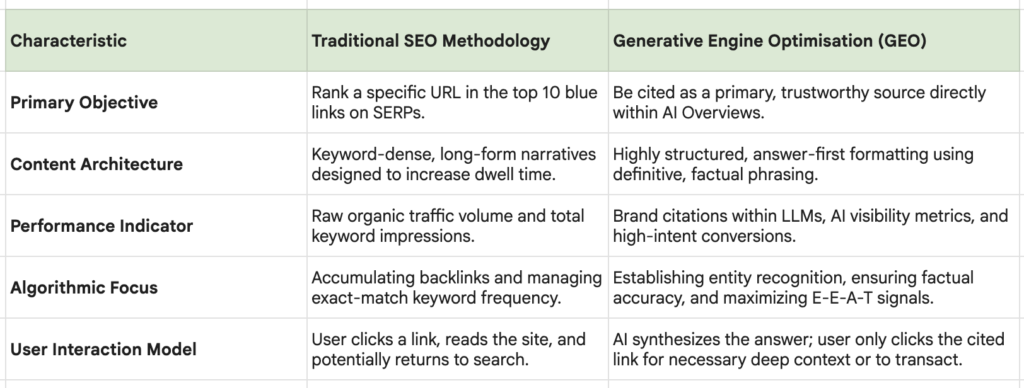
To survive the traffic compression caused by AI Overviews and to thrive in this new era of digital discovery, brands must fundamentally shift their primary objective. They must transition from merely hoping to “be found” as a blue link on a SERP to actively striving to “be cited” by the AI models that are generating the answers. This strategic evolution in digital marketing is formally known within the industry as Generative Engine Optimisation (GEO) or Answered Engine Optimisation (AEO).
Generative Engine Optimisation is the precise practice of architecting and structuring a brand’s digital content, data, and overall web presence so that AI-powered search platforms can easily retrieve, comprehend, verify, cite, and recommend the brand when synthesizing responses to complex user questions. In the landscape of 2026, earning a spot among the two to seven domains that large language models typically cite in a single response delivers an implicit, powerful endorsement of authority that no traditional organic listing could ever match.
Executing Generative Engine Optimisation Strategies
Executing a highly successful Answered Engine Optimisation strategy requires a departure from traditional narrative blogging and necessitates specific, highly structured engagement optimization tactics :
Targeting AI-Triggered Questions: Consultants must utilize advanced tools like Gemini or ChatGPT to systematically discover which specific user questions consistently generate AI Overviews in Google Search. By targeting the exact queries where AI summaries appear most often, the probability of being featured increases dramatically.
Answer First, Expand Second: AI models prioritize rapid information extraction. Therefore, the most critical, direct answer must be placed at the very top of each section. Extensive data analysis of LLM behavior indicates that an overwhelming 44.2% of all citations are extracted directly from the first 30% of a text. Burying the answer deep within a narrative guarantees it will be ignored by AI crawlers.
Direct, Definitive Language: AI models heavily favor specific, clear, and declarative statements over hedged, nuanced, or overly marketing-driven phrasing. Content must be inherently authoritative, factual, and devoid of unnecessary colloquialisms.
Optimizing for Algorithmic Extraction: The physical layout of the content must be highly structured to facilitate easy machine reading. This entails utilizing exceedingly short paragraphs, abundant and descriptive subheadings for every key idea, clear definitions, and presenting statistical data in bullet points or markdown tables. AI systems prioritize clarity and structural logic over narrative complexity.
Comprehensive Topic Clusters: Rather than publishing isolated articles, a domain must build massive, highly interlinked topic clusters. When interlinked pages provide exhaustive, 360-degree coverage of a broader subject, it sends a powerful mathematical signal to the AI that the domain is a definitive, comprehensive resource on the entity in question.
Pivoting Funnel Focus: Because AI Overviews dominate informational queries, consultants must heavily optimize bottom-funnel content. Data shows that assets like detailed case studies, technical whitepapers, and transparent pricing pages receive the highest AI referral traffic, whereas basic “what is” guides have seen massive traffic drops.
Consumer Behavior and AI Adoption in the Malaysian Market
To fully comprehend why an immediate shift toward Generative Engine Optimisation is a critical mandate rather than a future consideration, it is necessary to examine the rapid, unprecedented evolution of consumer behavior specifically within the Malaysian market. Over the past decade, Malaysia has quietly transformed into one of Southeast Asia’s most formidable and sophisticated digital marketing ecosystems, characterized by extraordinarily high internet penetration and a technically agile, digitally native population.
The Surge in AI Usage Among Malaysians
By 2026, artificial intelligence has unequivocally transitioned from a specialized technological novelty to a daily, mainstream consumer utility in Malaysia. Extensive market research and demographic surveys reveal that an astonishing 79% of the Malaysian workforce now regularly uses AI tools—a figure that sits a full six percentage points higher than the global average, placing Malaysia among the absolute top three markets in the Asia Pacific region for AI optimism, trailing only behind China and Indonesia. Furthermore, consumer-focused surveys indicate that 67% of the general population reports having actively used a generative AI tool within just the past three months.
This rapid, widespread adoption signifies a profound and permanent shift in core search behavior. For a rapidly growing segment of the population, generative AI is no longer just a tool; it is becoming a highly personalized “second brain” and the absolute preferred “answer engine,” entirely bypassing traditional search bars. Consumers are increasingly utilizing these advanced models for daily problem-solving, highly specific product recommendations, detailed travel planning, and complex financial comparisons.
However, this heavy reliance is distinctly balanced by a mature, healthy consumer skepticism. Market reports clearly indicate that data privacy and factual accuracy concerns remain widespread among Malaysian users. Consequently, people often utilize search engines to double-check and verify AI answers rather than accepting them at face value. Currently, only about 19% of users click through to the specific sources cited in AI overviews. This behavioral data underscores a critical reality: when users do choose to click through a citation, they possess extremely high intent. They are actively seeking authoritative verification, deep subject matter expertise, or immediate transactional pathways. Capturing this 19% is vastly more lucrative than capturing 100% of casual, low-intent informational browsers.
The Two-Tier AI Economy in Malaysian Business
The corporate and SME landscape in Malaysia closely mirrors this immense consumer enthusiasm, albeit with stark, highly consequential operational disparities. Extensive economic studies demonstrate that AI adoption among Malaysian businesses surged by an incredible 35% over the preceding year, reaching a total of 2.4 million businesses actively utilizing some form of AI. This staggering growth rate represents an integration velocity of more than one new business adoption every single minute throughout the year.
Despite these highly impressive top-line figures, deep analysis reveals that a distinct “two-tier AI economy” has rapidly emerged within the country. While 74% of all AI adopters firmly believe the technology will drive substantial revenue growth in the next year, a massive 73% of these businesses remain completely stuck at basic, internal efficiency levels. They are utilizing AI to draft emails or summarize internal documents, rather than driving market-facing innovation, product development, or advanced digital marketing strategies. Consequently, highly agile startups and forward-thinking tech firms are heavily outpacing large, traditional enterprises in advanced, revenue-generating AI integration.
For SME owners seeking high-level Marketing consultation, this data reveals a massive, unprecedented competitive opportunity. A vast majority of Malaysian businesses recognize that AI will transform their industry within five years , yet exceptionally few have actually modernized their external digital visibility strategies to reflect this. By engaging an expert consultant to aggressively implement Generative Engine Optimisation and Answered Engine Optimisation right now, a nimble Malaysian SME can capture the highly coveted “cited authority” status within LLMs long before slower-moving, larger competitors manage to adapt to the new algorithmic realities.
Elevating Content Quality: The Mandate of E-E-A-T
In the modern AI-driven landscape, traditional ranking signals such as exact-match keyword density and sheer volume of low-quality backlinks have been heavily depreciated. In their absence, search engines and large language models must rely on highly sophisticated, human-aligned frameworks to evaluate the genuine quality, safety, and reliability of content before choosing to cite it. The absolute cornerstone of this evaluation process is the E-E-A-T framework, explicitly defined within Google’s rigorous Search Quality Rater Guidelines.
E-E-A-T stands for Experience, Expertise, Authoritativeness, and Trustworthiness. While Google clarifies that E-E-A-T is not a single, direct ranking factor in a mathematical sense, it is the defining conceptual standard by which all underlying algorithms are trained to assess whether a piece of content is helpful, accurate, and safe to serve to users. In the context of 2026, where AI models act as incredibly discerning, risk-averse editors selecting sources for their summaries, demonstrating overwhelming E-E-A-T is strictly non-negotiable.
Deconstructing the E-E-A-T Pillars
A competent, highly experienced SEO consultant ensures that a brand’s entire digital footprint overwhelmingly and unambiguously demonstrates these four critical pillars:
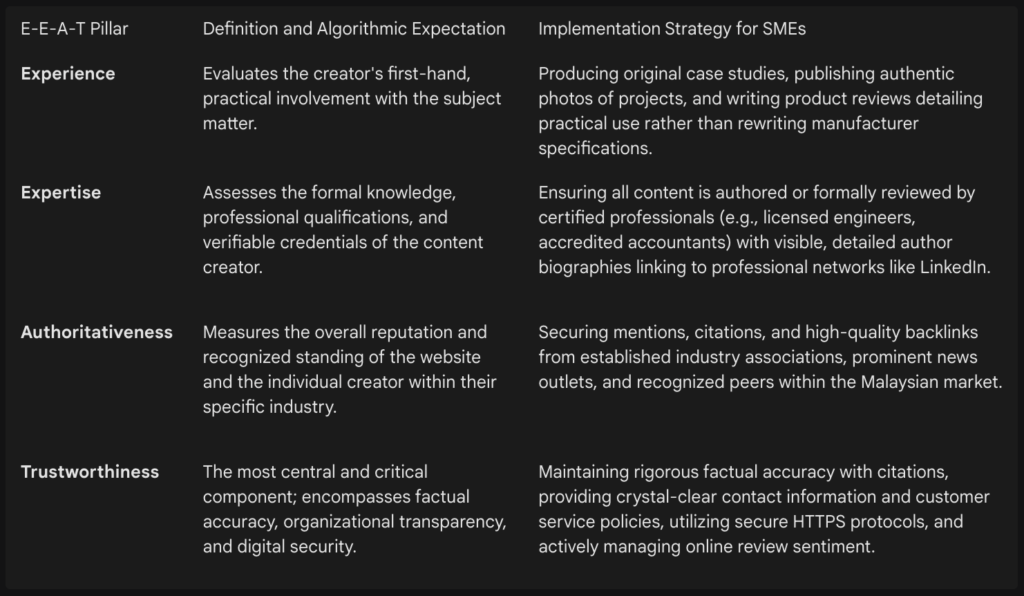
In an era where synthetic, AI-generated content is infinitely abundant and cheap to produce, demonstrating verifiable human experience and deep expertise is the only viable differentiator for a brand seeking to rank and be cited.
Strict Application in Your Money or Your Life (YMYL) Sectors
The rigorous application of the E-E-A-T framework is disproportionately critical for businesses operating within “Your Money or Your Life” (YMYL) niches. These are sensitive industries where inaccurate information, poor advice, or deceptive practices could cause significant financial devastation, physical harm, or severe emotional distress to the user. Prime examples of YMYL sectors include financial advisory services, healthcare and medical clinics, legal representation, and real estate investment.
For a wealth management firm operating in Kuala Lumpur or a specialized medical clinic in Penang, lacking robust E-E-A-T signals practically guarantees total algorithmic invisibility in organic search. Search engines are explicitly programmed to severely suppress unverified, low-authority pages in these sensitive categories to protect their users from harm. A professional consultant navigating a YMYL sector will implement exhaustive strategies, such as featuring deep insights from highly credentialed professionals, conducting interviews with recognized guest experts, and meticulously backing all claims with verifiable data and citations directly from peer-reviewed journals or official Malaysian government sources. This uncompromising editorial standard is precisely what allows a brand to be trusted by both human readers and AI retrieval systems alike.
Strategic Local SEO: Dominating the Selangor Market
While macroeconomic trends and global algorithmic shifts dictate the overarching strategy, digital visibility must ultimately translate into localized economic activity and foot traffic. For businesses situated in Malaysia’s most populous, industrialized, and economically hyper-active state, the role of an expert SEO Consultant Selangor is highly specialized, intensely competitive, and exceptionally lucrative.
Capturing the Economic Engine of Malaysia
The state of Selangor serves as the primary economic engine of Malaysia, bursting with commercial life and serving as home to over 7 million residents. Crucially, the mobile phone penetration rate in this region stands at an astonishing 99.3%, creating a scenario where practically the entire population is fully equipped to conduct immediate, high-intent local searches while on the move. Whether a procurement manager is searching for a nearby industrial logistics supplier in Shah Alam, a startup founder is seeking a boutique digital agency in Petaling Jaya, or a consumer is looking for premium retail outlets in Puchong, hyper-local search intent completely dominates the query landscape.
Deploying a generic, national-level SEO strategy is entirely insufficient for capturing this intense localized demand. Local SEO is a distinct sub-discipline that focuses exclusively on placing a business squarely in front of nearby customers by optimizing geographic relevance and proximity signals. This involves the meticulous, ongoing management of the Google Business Profile (GBP), ensuring absolute consistency in Name, Address, and Phone Number (NAP) data across all digital directories, aggregators, and mapping services. Furthermore, it requires a systemic approach to cultivating, managing, and responding to local customer reviews, which serve as massive localized trust signals.
Localized AI Responses and Entity Data Supremacy
The absolute necessity for highly specialized localized strategies is further amplified by emerging trends within the Search Generative Experience. One of the most underappreciated, yet highly impactful dynamics in generative search optimization in 2026 is the aggressive shift toward highly localized and personalized AI outputs.
When a user physically located in Subang Jaya asks a conversational AI assistant via voice search to recommend the “best corporate tax consultant near me,” the AI model does not return a generic, nationwide list of massive accounting firms. Instead, it applies real-time geographic context and draws heavily upon hyper-local entity data to formulate its answer. The AI actively synthesizes localized review sentiment, precise physical proximity to the user, and specific local website citations to generate a highly personalized, immediate recommendation.
An SEO consultant specializing deeply in the Selangor region ensures that a client’s business is digitally structured as a clear, geographically anchored entity. By flawlessly integrating LocalBusiness schema markup into the site’s code, embedding localized map data, and producing location-specific content that discusses local community involvement or regionally specific business challenges, the consultant effectively trains both traditional search crawlers and generative AI models. The models learn to unequivocally associate the brand with a specific geographic territory, thereby enabling the SME to systematically monopolize local digital discovery and secure high-converting physical foot traffic.
Strategic Synthesis and Future Outlook
The digital marketing environment in Malaysia has fundamentally evolved from a simplistic game of keyword manipulation into a highly sophisticated, multi-disciplinary science requiring technical precision, authoritative content generation, and deep, rigorous analytical capabilities. Returning to the central question that initiates this analysis—can a good SEO consultant actually guarantee results?—the empirical evidence and algorithmic realities dictate that highly predictable, measurable outcomes are entirely achievable, provided that organizational expectations are perfectly aligned with the mechanics of modern search systems.
Keyword rankings can be systematically and reliably acquired through meticulous competitive gap analysis, technical alignment, and superior content architecture. Predictable, sustainable traffic flows can be formally promised, but patience is an absolute prerequisite, as these critical metrics require maturation and algorithmic stabilization, typically becoming reliable by the third month of sustained implementation. Conversions, which represent the true lifeblood of any commercial enterprise, can be significantly augmented and scientifically improved through the rigorous interpretation of historical data within advanced analytics platforms.
Most importantly, successfully navigating the digital economy of 2026 requires aggressively adapting to the Search Generative Experience. Mastery over Generative Engine Optimisation and uncompromising adherence to rigorous E-E-A-T standards are no longer merely best practices; they are the absolute baseline prerequisites for maintaining digital relevance. Brands that proactively embrace these seismic shifts, leveraging specialized localized strategies in high-density economic zones like Selangor and utilizing advanced connected signal tracking to prove ROI, will unequivocally dominate their respective sectors.
The concluding philosophy for modern, forward-thinking agencies is clear: “If you are looking forward for someone to bring your SEO to another level, we are here to help.” The transition from traditional search to AI-driven digital discovery presents a unique, rapidly closing window of opportunity. Organizations that proactively align their digital infrastructure with these emerging parameters today will secure a definitive, insurmountable competitive advantage in the Malaysian market of tomorrow.