Define Objectives and Optimize for AI: Align your core business goals with targeted, long-tail keyword research to dominate AI-generated summaries and capture high-intent commercial leads.
Elevate Content with E-E-A-T Principles: Produce highly structured, authoritative content backed by original research and insights to signal undeniable trust to both human users and AI algorithms.
Adapt to the Selangor Market Environment: Overcome rising local operational costs by combining localized technical SEO with a highly efficient 70/30 hybrid marketing strategy to ensure sustainable long-term growth.
The Structural Transformation of Digital Visibility in 2026
The digital marketing ecosystem has reached a profound and irreversible inflection point. As the global economy transitions deeper into an era defined by artificial intelligence and machine learning algorithms, the fundamental mechanics of online visibility, consumer discovery, and enterprise lead generation have been structurally transformed. For small and medium enterprises (SMEs) operating within Selangor—the undisputed economic engine and commercial heart of Malaysia—relying on legacy search engine optimization tactics is no longer a viable pathway to sustainable market leadership. The widespread integration of the Search Generative Experience and sophisticated Large Language Models (LLMs) has fundamentally altered how consumers retrieve critical information, evaluate competing brands, and finalize their commercial purchasing decisions.
Industry data from advanced market analyses indicates that AI-generated overviews now appear in a substantial portion—ranging from 18% to over 21%—of all search queries globally, a figure that continues an upward trajectory as generative systems become deeply integrated into core search functionalities. This paradigm shift has led to a measurable and severe decline in organic click-through rates for traditional top-ranking results. Detailed empirical studies indicate a reduction of over 34.5% in organic clicks for top positions, as AI summaries provide immediate, zero-click resolutions directly on the search engine results page. Consequently, an enterprise’s digital architecture must evolve from merely ranking within a static list of blue links to becoming the definitive, trusted entity that is explicitly cited by autonomous AI agents.
For businesses situated across the dynamic districts of Selangor, this technological acceleration coincides with localized economic pressures and rapid digitalization mandates. The operating environment is characterized by intense regional competition, evolving consumer expectations, and a state-wide pivot toward a sophisticated digital economy under initiatives like the Selangor Digital Future Action Plan (DxF) 2026-2030. SMEs must navigate this digitally saturated environment while concurrently managing rising operational costs, talent retention challenges, and the complexities of modernized supply chains.
Surviving and thriving in this demanding landscape requires a comprehensive, forward-looking SEO Marketing strategy. This exhaustive roadmap delineates the precise strategic realignments, architectural shifts, and content methodologies necessary for Selangor-based enterprises to dominate the search ecosystems of 2026. From defining precise commercial objectives to mastering Generative Engine Optimisation and deploying entity-rich, research-backed content, this document serves as the ultimate professional blueprint for digital market dominance.
Phase 1: Establishing the Strategic Objective and Goal
The most critical point of failure in modern digital marketing initiatives is the premature execution of technical tactics without a unifying, overarching strategic vision. Before an enterprise implements SEO, it must ensure that it knows exactly what the objective and goal is. This rigorous pre-planning phase is absolutely essential to ensure that the organization is investing its time, capital, and human resources in the correct place, as the defined objective will directly relate to and dictate all upcoming keywords and on-page strategies.
Search engine optimization is not a monolithic, one-size-fits-all activity; rather, it is a highly adaptable framework that must be custom-engineered to produce specific business outcomes depending on the organization’s current lifecycle stage, market position, and capital liquidity. A rapidly expanding cloud kitchen operating in Petaling Jaya requires a fundamentally different architectural approach than an established, multi-generational industrial manufacturer in Shah Alam seeking to expand its regional export footprint. Setting the objective dictates the hierarchical architecture of the corporate website, the semantic density of the written content, and the specific key performance indicators used to evaluate financial success.
Without this meticulous alignment, enterprises run the severe risk of generating what industry professionals term “vanity traffic”—high volumes of website visitors that do not align with the company’s ideal customer profile and therefore never convert into qualified leads or recognized revenue. This misalignment artificially inflates customer acquisition costs and yields an ultimately negative return on digital investment.
Categorizing 2026 Business Objectives
Commercial objectives in the 2026 AI-driven search landscape generally fall into three distinct categories, each requiring a tailored strategic marketing consultation to execute effectively:
Direct Lead Generation and Immediate Conversion: For enterprises whose primary operational objective is immediate revenue generation and cash flow acceleration, the digital strategy must prioritize bottom-of-the-funnel, high-intent visibility. The goal is to capture consumers at the precise psychological moment of commercial evaluation and transactional readiness. This objective demands a rigorous, uncompromising focus on highly optimized commercial landing pages, localized service queries tailored to specific Selangor municipalities, and deep technical integration with AI recommendation engines that facilitate immediate, frictionless transactions.
Brand Exposure and Top-of-Funnel Awareness: For newer market entrants, organizations launching novel product lines, or startups looking to disrupt established industries, the objective naturally shifts toward capturing broad market share and building unshakeable brand recall. Here, the strategic focus is on educational content, comprehensive industry guides, and broad visibility across a wide array of informational queries. The objective is to embed the brand into the consumer’s consciousness long before a final purchasing decision is formulated, ensuring that when the need arises, the brand is the first entity that comes to mind.
Topical Authority and Institutional Leadership: Established, mature enterprises often utilize advanced SEO Consultation to cement their status as the definitive, unquestioned thought leader within a specific vertical. The goal is to be universally recognized by both human users and complex AI models as the paramount source of truth. This requires the consistent publication of highly sophisticated, research-backed content, the distribution of proprietary data sets, and extensive entity mapping that proves deep institutional knowledge.
By isolating the precise objective before a single line of code is written or a single piece of content is drafted, organizations can efficiently and ruthlessly allocate their digital marketing budget, ensuring that every piece of content published and every technical adjustment made serves a definitive, measurable commercial purpose. This strategic clarity forms the bedrock upon which all subsequent keyword research and on-page optimization efforts are constructed.
Phase 2: The New Economics of Keyword Research in the AI Era
The discipline of keyword research has undergone a radical, paradigm-shifting transformation. Legacy methodologies that prioritized high-volume, generic search terms have been rendered largely obsolete by the advent of semantic search, natural language processing, and the Search Generative Experience. In 2026, keyword strategy is no longer a simple exercise in identifying search volume; it is a highly nuanced exercise in behavioral psychology, entity recognition, and machine learning compatibility.
In-depth keywords research will be required to navigate this landscape successfully. Compared to previous SEO marketing paradigms, if an organization is looking forward to getting highly qualified leads or even securing indexation within AI-synthesized summaries, a distinct recalibration between long-tail and short-tail keyword targeting is an absolute necessity.
The Strategic Utility of Short-Tail Keywords
While the mechanics of search have evolved, short-tail keywords remain a foundational component of a holistic digital strategy. Short-tail keywords are broad, generalized terms usually consisting of one or two words (e.g., “Logistics Malaysia,” “Digital Marketing,” or “Accounting Software”).
For short-tail keywords, the primary utility is for exposure and awareness purposes. If an enterprise is looking for branding at the moment, then short-tail keywords will be highly suitable. Because these terms represent broad, highly ambiguous user intent, they do not typically yield high immediate conversion rates. A user searching “accounting software” might be a student doing a research project, an investor looking for stock trends, or a business owner looking to buy; the intent is entirely unclear.
However, targeting these terms is essential for casting a wide net and capturing consumers at the very beginning of their digital journey. It is exceptionally competitive to rank for these broad terms, but once an organization is being ranked, it helps massively in getting top-of-funnel traffic. Ranking for short-tail terms serves as a powerful, psychological trust signal; it establishes the brand as an apex predator and dominant player within the industry ecosystem, creating a formidable “digital moat” against regional competitors. When a user consistently sees a Selangor enterprise ranking for the most competitive terms in their vertical, it subconsciously reinforces brand authority, which pays massive dividends when the user eventually refines their search into a highly specific query deeper in the purchasing funnel.
The Dominance of Long-Tail Keywords for AI Indexation and Conversions
While short-tail terms build the brand, the long-tail drives the revenue. If an organization is looking forward to getting leads or being indexed in the AI engines, long-tailed keywords will be explicitly required. Long-tail keywords mean the users know exactly what they are looking forward to, and they are researching right now with high commercial intent and a readiness to transact. These queries are highly specific, multi-word phrases that articulate a precise need, operational constraint, or business problem (e.g., “automated payroll software for construction SMEs in Subang Jaya”).
Empirical research from the latest search analyses indicates that long-tail keywords—specifically queries consisting of four or more words—trigger AI-generated summaries and SGE responses at roughly twice the rate of broader, one- or two-word head terms. Furthermore, an overwhelming majority of all global search queries—approximately 91.8%—are categorized as long-tail, and these highly specific, intent-rich terms have been proven to convert at 2.5 times the rate of short-tail terms.
The structural reason for this overwhelming dominance lies in exactly how generative AI systems process and synthesize information. AI models, including Google’s AI Overviews and enterprise tools like ChatGPT, utilize complex Retrieval-Augmented Generation (RAG) architectures to construct their answers. A RAG system operates by first searching its massive index for relevant, factual documents before synthesizing a coherent, natural language response. Highly specific, long-tail queries encode multiple entities and a clear job-to-be-done, which provides these systems with incredibly clean, precise extraction targets compared to vague terms. By aggressively targeting the long tail, businesses provide the exact informational nodes and factual anchors that AI models crave when constructing detailed, zero-click answers.
Furthermore, long-tail queries perfectly and seamlessly align with the massive proliferation of voice search. As consumers and procurement officers increasingly utilize conversational queries through mobile devices, smart watches, and home assistants, they naturally speak in complete, grammatically complex sentences rather than barking disjointed keywords. Optimizing digital architecture for these natural language patterns ensures that a brand is positioned as the immediate, direct answer to spoken inquiries.
Developing a Hybrid Keyword Portfolio Framework
A sophisticated 2026 SEO Marketing strategy does not force a false dichotomy between short-tail and long-tail terms; rather, it expertly integrates both into a comprehensive, mathematically balanced portfolio.
Organizations must meticulously map their keyword portfolio directly to their predefined commercial objectives. Foundational pillar pages and core homepage structures should target broader short-tail terms to establish sweeping topical relevance, while individual hyper-localized service pages, technical blogs, and dedicated FAQ sections must aggressively and relentlessly target the long-tail to capture high-intent leads and secure AI citations.
Phase 3: The Generative Engine Optimisation (GEO) Imperative
The emergence and rapid scaling of artificial intelligence in search has birthed highly specialized sub-disciplines that run parallel to, and often supersede, traditional SEO frameworks. Understanding and flawlessly executing these methodologies is strictly non-negotiable for any enterprise seeking digital prominence in 2026. The most critical of these new disciplines is Generative Engine Optimisation.
Generative Engine Optimisation represents the advanced technical and creative tactical frameworks designed to make an organization’s digital content the preferred, authoritative choice for Large Language Models. Unlike traditional SEO, which historically optimized for a human reader and a simplistic web crawler indexing pages based on superficial inbound links and keyword density, GEO optimizes for what data scientists term the “consensus layer” of AI models.
When a user inputs a complex query into a Search Generative Experience, the AI synthesizes an original, fluid answer by rapidly aggregating, verifying, and cross-referencing information from multiple authoritative digital sources. GEO ensures that an enterprise’s content is formatted, structured, and factually dense enough to be selected as one of those primary, visible citations.
Architectural Requirements for GEO Integration
To achieve dominance in Generative Engine Optimisation, content must be re-engineered from the ground up to satisfy the parsing logic of retrieval bots:
High Entity Density and Semantic Clarity: LLMs do not read text; they process mathematical relationships between entities. Content must be incredibly rich in specific, recognizable entities—including specific people, geographic places, distinct concepts, operational metrics, and organizational names—rather than just repetitive keyword strings. The clearer the entity relationship, the higher the probability of AI extraction.
BLUF (Bottom Line Up Front) Structuring: Traditional blog posts that bury the answer beneath paragraphs of introductory fluff are penalized by AI systems. GEO demands the BLUF writing style, where the most critical, definitive information is presented immediately at the top of the page in concise, machine-readable formats, before expanding into deep, detailed prose for human readers who wish to explore further.
Data Serialization and Tabular Formatting: Information must be aggressively structured using semantic HTML elements. LLMs exhibit a strong preference for data presented in valid Markdown tables, ordered lists, and concise bullet points, as these formats are easily extracted, verified against the consensus layer, and rendered directly into AI Overviews.
By mastering these GEO principles, a Selangor SME ensures that when an AI model is tasked with summarizing the best service providers in the region, its digital footprint is the foundational source material the AI relies upon.
Phase 4: Mastering Answered Engine Optimisation (AEO)
While Generative Engine Optimisation focuses on capturing visibility within complex, synthesized, multi-source overviews, Answered Engine Optimisation is a distinct discipline designed to make content the primary, singular source for direct, unambiguous answers provided by search engines and voice assistants.
AEO targets conversational, highly specific question-based queries where the user is seeking a definitive fact, a rapid instruction, a pricing metric, or a clear definition. The ultimate objective of AEO is to capture the highly coveted “Featured Snippet” or the immediate voice response on a smart device, creating a zero-click interaction where the brand is explicitly cited as the singular, unquestioned authority.
Strategic Implementation of AEO
The tactical execution of Answered Engine Optimisation requires a hyper-focused approach to content creation:
Targeting Conversational “Micro-Moments”: AEO requires identifying the exact, verbatim questions that consumers ask at the precise point of decision-making. For example, a query like “What is the average cost of corporate accounting services in Petaling Jaya in 2026?” represents a critical micro-moment. The content must provide a definitive, unambiguous 40-to-60-word answer immediately following the heading.
Conversational Tone Alignment: The written content must carefully mimic natural human speech patterns to align seamlessly with the phrasing used in voice searches. Voice assistants rely heavily on natural language processing; content that reads like an academic textbook may be bypassed in favor of content that reads like a professional, conversational explanation.
FAQ Schema Architecture: The deployment of structured data is the engine of AEO. Injecting specific, machine-readable FAQPage schema code into the website’s backend explicitly tags the questions and answers for the search engine, literally spoon-feeding the isolated data points to AI crawlers and removing any ambiguity about the page’s purpose.
Mastering Answered Engine Optimisation allows a business to bypass the traditional competitive ladder of ten blue links, propelling the brand directly to “Position Zero” and establishing immediate trust with the searcher.
Phase 5: On-Page Optimisation and High-Quality Content Architecture
Once the exhaustive keyword research is completed and the technical objectives of both GEO and AEO are thoroughly understood, the organizational focus must rapidly shift to the actual construction of the digital assets. Once done the keywords research, implementing the right SEO strategies and content will be important, as this is the absolute foundation of SEO. The modern search algorithms, now driven by highly sophisticated neural networks, have grown remarkably adept at distinguishing between superficial, mass-produced marketing copy and genuine, authoritative expertise.
The Immutable Imperative of E-E-A-T
The more in-depth content you can provide, the more Google will index you in the SERP. To achieve this unprecedented level of indexation, organizations must rigorously and uncompromisingly adhere to the updated principles of E-E-A-T: Experience, Expertise, Authoritativeness, and Trustworthiness. In a digital era where generative AI can produce infinite volumes of generic, average-quality text in seconds, verified human experience and deep institutional expertise are the primary, most heavily weighted differentiators that algorithms use to rank content.
Experience: Content must vividly demonstrate first-hand, real-world experience with the subject matter. For a Selangor-based logistics firm, this means moving beyond generic shipping definitions and instead detailing specific supply chain challenges routed through Port Klang, providing actual photographic evidence of warehouse operations, and sharing localized operational anecdotes that an AI could never spontaneously invent.
Expertise: Content must be verifiably authored by recognized industry subject matter experts. Author bios can no longer be generic afterthoughts; they must be robust, linking to professional academic credentials, verified LinkedIn profiles, and historical industry publications to mathematically prove the author’s qualifications to the search engine’s knowledge graph.
Authoritativeness: The overall website must be recognized as an authority within its specific niche. This is systematically achieved by building comprehensive “content clusters” that exhaustively cover every conceivable facet of a specific topic, rather than publishing isolated, disjointed articles. A site that covers 50 interconnected sub-topics on digital marketing in Malaysia will always outrank a site with a single, superficial post.
Trustworthiness: Trust is the most critical pillar. The site must employ absolute technical security protocols (HTTPS), transparent business information, clear physical contact details, and verifiable customer reviews. Trust signals, including case studies, client logos, and verified testimonials, must be visible directly on all key conversion pages.
Structuring Content for Dual Comprehension
Therefore, enterprises must focus on high-quality content that is supported by rigorous research and proprietary insights. However, producing brilliant, human-readable insights is entirely insufficient if search engine crawlers cannot easily parse and mathematically comprehend the data. On-page optimization in 2026 requires a highly structured, architectural approach to content writing.
Logical Information Hierarchy: Web pages must be engineered with clear, descending HTML heading tags (H1, H2, H3) that create an unambiguous, logical outline of the topic. Each individual section should strictly address a specific sub-topic or entity related to the primary keyword, preventing semantic confusion.
Original Research and Primary Data Integration: AI models heavily prioritize unique data sets that cannot be found elsewhere in their training data. Businesses should conduct localized market surveys, publish proprietary financial case studies, and present original insights. For example, publishing a detailed statistical analysis on consumer behavior shifts specifically within the Subang Jaya retail sector provides unique value that algorithms will actively elevate and cite.
Multimodal Content Elements: The modern search experience is no longer strictly text-based. Complex algorithms analyze visual assets, charts, data diagrams, and video content to enhance their contextual understanding of a page. Integrating customized, branded infographics and technically optimized short-form video content significantly improves human engagement metrics while providing alternative vectors for algorithmic indexation.
Semantic Internal Linking Topography: Content must be deeply interconnected through a strategic internal linking architecture. This systemic linking passes domain authority between pages and helps crawlers understand the contextual relationship between different topics, solidifying the site’s overall topical map and reinforcing its E-E-A-T signals.
Phase 6: Technical SEO, Advanced Schema, and the Local Landscape
The most exceptional, brilliantly written content strategy will fail catastrophically if it is built upon a fractured, slow, or inaccessible technical foundation. Technical SEO is the invisible framework that ensures search engine crawlers and autonomous AI bots can seamlessly discover, render, comprehend, and index a website’s assets without encountering fatal errors.
The Necessity of Advanced Schema Markup
Advanced schema markup—specifically, machine-readable JSON-LD code injected deeply into a website’s backend architecture—is absolutely non-negotiable in 2026. This code serves as a universal translator; it translates human-readable text into standardized, globally recognized data formats that autonomous AI agents can perfectly and instantly categorize.
Organizations must implement diverse, layered schema types to map their business entities perfectly. This includes executing Organization schema to define corporate structure, LocalBusiness schema to define geographic coordinates and operating hours, Product schema for inventory, Review schema for social proof aggregation, and the highly critical FAQ and How-To schemas for AEO alignment. This flawless implementation allows AI engines to comprehend the exact localized service areas, product availability, and operational parameters of the business, literally spoon-feeding the exact data formats required for immediate citation and retrieval.
Core Web Vitals and Absolute Mobile Primacy
Google’s algorithms now heavily weight user experience signals, which are mathematically quantified through Core Web Vitals. These critical metrics measure the loading performance (Largest Contentful Paint), user interactivity (Interaction to Next Paint), and the visual stability (Cumulative Layout Shift) of a webpage. A slow, unstable website that shifts while a user attempts to click a button will not only suffer severe, systemic ranking penalties but will also exhibit catastrophic bounce rates as frustrated users abandon the page entirely.
Furthermore, with mobile devices now accounting for the vast majority of web traffic, mobile-first indexing is the absolute default standard. Websites must not merely be “mobile-friendly”; they must be engineered from the ground up specifically for the mobile user experience, ensuring instantaneous load times, touch-optimized navigational interfaces, and fully responsive design across all possible device frameworks and screen dimensions.
Hyper-Local SEO Optimization for Selangor SMEs
For SMEs heavily reliant on localized foot traffic and regional B2B clientele, localized SEO tactics are a distinct, highly specialized discipline. The strategy requires hyper-focused, targeted optimization to ensure absolute dominance in the highly visible “Local Pack” and map-based search results.
This involves the rigorous, daily management of the Google Business Profile (GBP). The profile must be comprehensively filled out, regularly updated with localized operational posts, and strategically optimized for specific service areas within Selangor (e.g., Petaling, Hulu Langat, Gombak, Sepang, and Klang). Furthermore, businesses must aggressively cultivate and manage local citations across all authoritative regional directories, ensuring complete, perfect consistency of Name, Address, and Phone Number (NAP) data across the entire web ecosystem. Localized reviews and user-generated content must be actively solicited and professionally responded to, as these serve as massive, undeniable trust signals for both human consumers evaluating a purchase and AI evaluation algorithms determining local relevance.
Cybersecurity and Data Privacy in SEO
As the state of Selangor moves toward deep digital integration, consumer expectations and regulatory scrutiny regarding data privacy and cybersecurity have intensified dramatically. Stricter data protection frameworks mandate that SMEs implement rigorous safeguards, moving far beyond basic compliance.
In the modern realm of search optimization, security is a direct, heavily weighted ranking factor. Search engines and AI models prioritize secure, compliant websites to protect their user base from malicious actors. An enterprise that neglects technical security—failing to implement sitewide SSL encryption, neglecting firewall protections, or ignoring vulnerabilities—will not only risk devastating corporate data breaches but will also suffer catastrophic loss of organic visibility. Search algorithms systematically and ruthlessly demote unverified or vulnerable domains, viewing them as a threat to the user experience.
Phase 7: The Hybrid Strategy and the Selangor Business Environment
Executing a world-class digital strategy requires deep, nuanced contextual awareness of the local economic environment. Selangor is universally recognized as the most developed, highly industrialized state in Malaysia, serving as a dynamic, high-velocity hub for commerce, manufacturing, and technological innovation. However, successfully operating an SME within this specific ecosystem in 2026 presents a unique set of macroeconomic challenges that directly influence and dictate marketing strategies.
Navigating Rising Operational Costs
Selangor SMEs are currently grappling with intense margin compression driven by rising operational expenditures across the board. A significant factor in this tightening economic environment is the steady, unavoidable climb of corporate operational costs, including logistics and the rising premiums associated with employee healthcare and retention.
When fixed human resource and operational costs escalate, business leaders are compelled to scrutinize marketing budgets with ruthless efficiency. Traditional outbound marketing methodologies and poorly targeted digital advertising campaigns that suffer from low conversion rates and exorbitant customer acquisition costs are fundamentally unsustainable in this unforgiving environment.
This stark economic reality amplifies the critical, foundational importance of SEO Marketing. While the initial capital and time investment required to build a formidable digital moat—optimizing complex technical architecture, producing high-tier E-E-A-T content, and acquiring domain authority—requires patience, the long-term ROI of organic search far outpaces purely paid channels. Once a robust organic presence is firmly established, the ongoing cost per acquisition drops dramatically, providing a steady, reliable stream of highly qualified, “free” leads that buffer the enterprise against rising macroeconomic costs and supply chain shocks.
The 70/30 Hybrid Approach to Digital Marketing
While the necessity of mastering organic search is absolutely undeniable, the most successful and resilient organizations in 2026 do not view SEO Marketing in complete isolation. Recognizing the extreme competition within the Selangor market and the volatile complexities of the digital ecosystem, market leaders deploy a sophisticated hybrid strategy that perfectly harmonizes organic and paid initiatives to maximize revenue.
A prevailing and highly effective model utilized by the most successful Malaysian brands is the 70/30 Hybrid Model. This strategic framework allocates corporate budgets and operational focus to maximize both long-term sustainability and short-term revenue generation simultaneously.
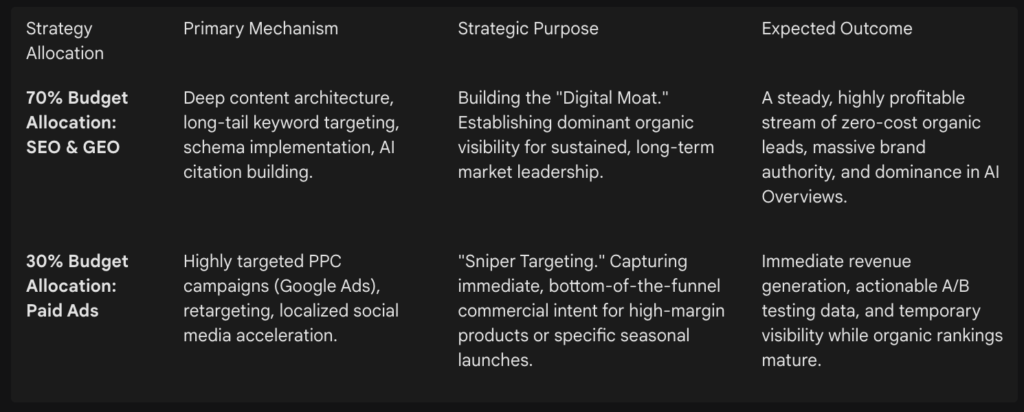
This synergistic approach ensures that the enterprise is never entirely dependent on the fluctuating, unpredictable algorithms of a single digital platform. Furthermore, the massive datasets generated from performance marketing campaigns—identifying precisely which ad copy converts best, which demographic segments are most responsive, and which micro-moments trigger sales—are continuously fed back into the organic SEO strategy. This creates a feedback loop that endlessly refines the content architecture and keyword targeting for maximum efficacy.
The Critical Role of an SEO Consultant Selangor
Executing this incredibly complex, multi-faceted roadmap requires a rare convergence of highly specialized technical engineering, content mastery, and visionary strategic foresight. The immense transition from legacy, keyword-stuffed web systems to AI-curated, semantic visibility requires a total architectural overhaul of a brand’s digital presence.
Attempting to manage the granular intricacies of JSON-LD schema implementation, Search Generative Experience alignment, Generative Engine Optimisation, and dynamic market analytics internally is a common mistake. It consistently distracts business owners from their core operational duties, leading to stagnant corporate growth, fractured implementation, and ultimately, poor digital visibility. Furthermore, engaging with sub-standard agencies or cheap freelancers utilizing outdated tactics or dangerous black-hat methodologies poses severe corporate risks, potentially resulting in catastrophic algorithmic penalties that can effectively erase a brand from the internet entirely.
A dedicated, highly experienced SEO Consultant Selangor brings indispensable value to the enterprise by localizing global best practices for the regional market. A professional consultant possesses the necessary enterprise-grade analytical tools to perform deep AI citation gap analysis, the technical acumen to implement complex structured data flawlessly without breaking site architecture, and the strategic expertise to align the marketing roadmap directly with the commercial realities of the local market. Professional marketing consultation ensures that all digital activities are strictly tied to measurable revenue generation, eliminating the costly inefficiencies that consistently plague amateur digital campaigns.
Phase 8: Redefining AI-Era Success Metrics
As the fundamental mechanics of search evolve from link retrieval to answer synthesis, the key performance indicators (KPIs) used by corporate boards to measure the success of an SEO Marketing campaign must similarly adapt. In the classic SEO era, the reporting logic was straightforward and easily quantifiable: rank on page one of Google, generate massive impressions, track the click-through rates, and optimize the landing pages for conversions.
However, in the entirely new world of AI-synthesized answers and zero-click results, traditional metrics provide an incomplete, highly fragmented, and often dangerously misleading picture of actual digital performance. It is now entirely possible—and indeed common—for a website to rank on the first page of traditional organic results and still not be named or cited in the dominant AI-generated answer positioned directly above it. If the user receives a fully synthesized, satisfactory answer from the AI module, they may never scroll down to view the traditional blue links, rendering the page one ranking functionally useless.
Brand Citation Share and AI Visibility Tracking
To accurately and mathematically gauge digital marketing effectiveness in 2026, organizations must radically pivot their reporting structures toward tracking advanced metrics such as “Brand Citation Share” and “AI Visibility”.
AI Mentions and Inclusion: This advanced metric evaluates exactly how frequently a brand appears as a cited, trusted source within AI-generated answers for high-value commercial queries. It directly measures the brand’s presence and authority within the AI consensus layer.
Share of Voice in the Search Generative Experience: This involves analyzing the absolute visibility of the brand across Google’s SGE and alternative, rapidly growing AI platforms like Perplexity, Gemini, and ChatGPT. It requires specialized, enterprise-level tracking tools to determine if the brand is positioned as an authoritative market leader or merely listed as a secondary afterthought.
Zero-Click Brand Impressions: Organizations must begin recognizing that highly valuable brand building occurs even when the user remains on the search engine results page without clicking a link. If a localized search for a B2B service immediately yields an AI overview prominently featuring the organization’s name, its primary value proposition, and positive attributes, a highly valuable brand impression has occurred, regardless of whether a physical click was registered in Google Analytics.
Tracking these advanced, multi-dimensional metrics requires enterprise-grade analytics, custom API integrations, and a deeply sophisticated understanding of how AI platforms index and retrieve data. Attempting to manage this transition internally without expert guidance inevitably leads to severe strategic blind spots, underscoring the absolute necessity of engaging professional marketing consultation to interpret these new data paradigms effectively.
Conclusion: Securing Sustainable Digital Dominance
The trajectory of the global digital economy is unmistakably clear. As artificial intelligence and machine learning models fundamentally and permanently reshape the mechanisms of digital search, product discovery, and commercial evaluation, the marketing strategies that generated phenomenal success in the past decade are rapidly losing their efficacy. For businesses operating in the vibrant, highly competitive, and rapidly digitizing landscape of Selangor, the time to adapt to this new reality is not at some undefined point in the future; it is right now.
The 2026 SEO roadmap demands absolute clarity of corporate strategic objectives before any resources are deployed. It requires completely abandoning superficial, vanity-driven search volume metrics in favor of deep, intent-driven, long-tail keyword research that perfectly feeds the voracious data requirements of Retrieval-Augmented Generation models. It necessitates the intensive creation of profound, highly authoritative content that adheres strictly to the E-E-A-T framework, structured meticulously for both human engagement and machine comprehension through the flawless implementation of advanced schema markup. Furthermore, organizations must aggressively expand their optimization efforts beyond traditional SERP rankings, fully embracing both Generative Engine Optimisation and Answered Engine Optimisation to capture vital, high-visibility AI citations and zero-click brand impressions.
Navigating these immense technical complexities while successfully managing the daily operational demands of a growing enterprise is a formidable challenge. However, it is a challenge that must be met head-on to ensure long-term sustainability, buffer against rising operational costs, and secure absolute market leadership in Malaysia’s premier digital hub.
If you are looking forward for someone to bring your SEO to another level, we are here to help.