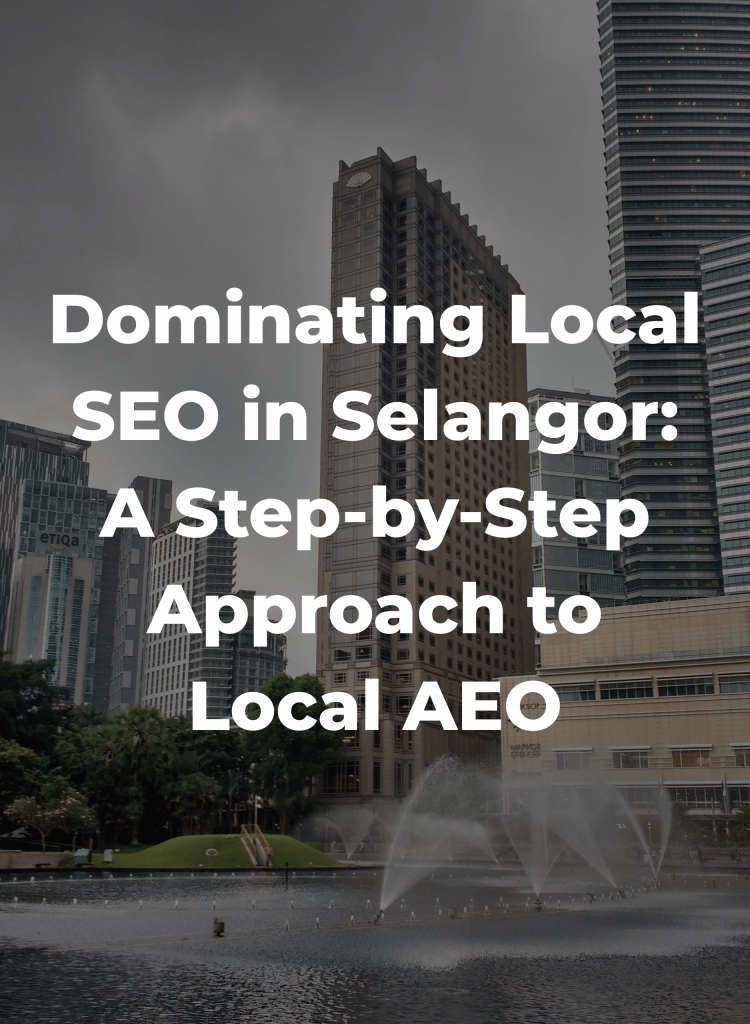
Map Search Intent by District: Kuala Lumpur is a hyper-local market; affluent residential areas (like Mont Kiara), B2B office zones (like KLCC), and mass-market districts (like Cheras) exhibit completely different search behaviours and require distinct messaging.
Build Authentic Location Pages: Search engines strictly penalise thin, copy-paste doorway pages. SMEs must build genuine district landing pages featuring real case studies, local landmarks, and precise LocalBusiness schema to rank safely.
Optimise for Local AEO: In 2026, AI generative search systems recommend local businesses based on entity consistency. Maintaining identical business details across all platforms and generating detailed, location-specific reviews are mandatory to secure AI visibility.
Local SEO for Kuala Lumpur SMEs: A District-by-District Strategy
“Why isn’t my business ranking in KL despite good local SEO?” is a common question—but the answer often lies not in generic optimisation, but in district-specific intent mapping. In KL, “near me” means something different in Bangsar, Cheras, and Mont Kiara. Rank in each district without creating thin copy-paste location pages.
The commercial landscape of Kuala Lumpur represents a dense, hyper-competitive search environment. The Klang Valley houses approximately eight million residents within a compact geographic footprint, generating search volumes comparable to much larger global metropolitan areas. For Small and Medium Enterprises (SMEs), treating Kuala Lumpur as a single, homogenous market is a strategic miscalculation. The modern search ecosystem demands a nuanced, district-by-district approach that aligns with localized consumer intent, adheres to strict 2026 search engine guidelines, and prepares the brand for AI-driven generative answers.
The 2026 Search Landscape in the Klang Valley
The digital marketing landscape for Malaysian SMEs has evolved significantly. In 2026, local and “near me” searches constitute up to 62% of all SME search traffic in Kuala Lumpur, with the vast majority occurring on mobile devices. The market is characterized by hyper-local clustering; businesses in adjacent districts like KLCC and Bukit Bintang compete not merely on a city-wide level, but within specific walking distances.
Furthermore, shorter ranking windows dictate that competitors actively monitor and respond to ranking changes rapidly. Maintaining visibility requires sustained effort, multilingual keyword research capabilities encompassing Bahasa Malaysia, English, and Mandarin, and a deep understanding of the diverse search intents behind each linguistic choice.
Mapping Search Intent by Kuala Lumpur District
Different neighborhoods in Kuala Lumpur exhibit vastly different search behaviors, purchasing power, and user intents. A robust local SEO strategy must decode these hyper-local nuances to capture qualified traffic.
Affluent Residential Zones: High-Intent, Premium Services
Districts such as Bangsar, Mont Kiara, and Damansara Heights are defined by higher-income demographics and expatriate communities. Search behavior here leans heavily toward premium, high-trust services, and queries are predominantly conducted in English.
Search Examples: “best interior designer KL,” “premium dental clinic Mont Kiara,” “international school near Damansara Heights.”
Content Strategy: Landing pages targeting these zones must emphasize credentials, luxury, bespoke solutions, and multilingual capabilities. Trust signals such as high-resolution portfolios, practitioner qualifications, and premium brand associations are mandatory. The market expects authoritative, frictionless user experiences.
Office and CBD Zones: B2B and Professional Services
The Golden Triangle (KLCC, Bukit Bintang) and modern commercial hubs like Bangsar South and KL Sentral drive Business-to-Business (B2B) and professional service queries. These areas demand strict adherence to Your Money or Your Life (YMYL) content standards.
Search Examples: “corporate law firm KLCC,” “accounting firm Bukit Bintang,” “B2B digital marketing agency Bangsar South.”
Content Strategy: Content must address corporate pain points, regulatory compliance, and operational efficiency. Lead generation forms, whitepapers, localized B2B case studies, and integration with LinkedIn thought leadership are highly effective in these districts. The focus is on establishing profound topical authority and corporate credibility.
Mass-Market Areas: Price-Sensitive, High-Volume Search
Suburban and highly populated districts like Cheras, Kepong, and neighboring areas like Puchong and Klang represent the mass market. Searchers in these zones are typically highly pragmatic, price-sensitive, and volume-driven. Multilingual optimization is critical here, as these demographics frequently search in Bahasa Malaysia and Mandarin.
Search Examples: “cheap car repair Cheras,” “affordable tuition Puchong,” “24 hour clinic Kepong.”
Content Strategy: Pages should highlight affordability, speed, promotional offers, and convenience. Clear pricing, high-visibility calls to action via WhatsApp, and promotional urgency drive conversions in these high-density residential zones.
| District Archetype | Key KL Neighborhoods | Primary Search Intent | Content & SEO Focus |
|---|---|---|---|
| Affluent Residential | Bangsar, Mont Kiara, Damansara | Premium quality, trust, exclusivity | English-first, credential-heavy, high-end portfolios |
| Office / CBD Zones | KLCC, Bukit Bintang, Bangsar South | Professionalism, B2B services, compliance | Case studies, corporate solutions, strict YMYL standards |
| Mass-Market Areas | Cheras, Kepong, Klang, Puchong | Affordability, speed, accessibility | Multilingual (BM/Mandarin), promotions, clear pricing |
Engineering Authentic District Pages Versus Doorway Pages
Historically, practitioners scaled local visibility by duplicating a single landing page and replacing the city name across dozens of URLs. Following the advanced SpamBrain algorithms and comprehensive spam policy updates of 2026, search engines actively penalize these thin, copy-paste “doorway pages”. A district page must operate as a genuine, high-value local asset.
Constructing Genuine Local Proof
To differentiate a district landing page from a penalized doorway page, the content must prove that the business actively operates and delivers value within that specific neighborhood.
Real Projects and Case Studies: A landing page targeting Petaling Jaya should detail a specific project completed in Petaling Jaya, complete with localized descriptions, challenges overcome, and measurable outcomes.
Neighborhood Landmarks: Text should naturally reference proximity to known landmarks to ground the entity geographically. Phrases such as “located 5 minutes from Mid Valley Megamall” or “serving clients near the Petronas Twin Towers” provide strong, natural geographic relevance.
District-Specific FAQs: Address hyper-local concerns directly on the page. For example, a plumbing service might include an FAQ answering, “Do you offer emergency call-outs to high-rise condominiums in Mont Kiara?
Advanced LocalBusiness Schema Implementation
Search engines rely on JSON-LD structured data to confidently parse business locations and service areas. Utilizing Schema.org/LocalBusiness or more specific subtypes (e.g., Dentist, HVACBusiness, LegalService) removes ambiguity for search crawlers.
For SMEs serving multiple KL districts without physical storefronts in each, the areaServed property is vital. Instead of keyword-stuffing city names into the page text, the areaServed array should explicitly list the administrative areas or cities the business covers. Furthermore, the Name, Address, and Phone number (NAP) within the schema must match the Google Business Profile character-for-character, including matching formats for suite numbers and street abbreviations. Utilizing the @id node allows the website to interlink multiple location pages back to a primary Organization entity, creating a cohesive knowledge graph.
Optimising the Google Business Profile for KL-Specific Visibility
The Google Business Profile (GBP) functions as the primary digital storefront in Kuala Lumpur. Capturing real estate in the Local Map Pack is often more lucrative than securing traditional organic links for local queries, driving up to 44% of local inquiries in KL.
Strategic Categorisation and Service Areas
Broad categories such as “Consultant” or “Restaurant” are oversaturated in Kuala Lumpur. Selecting the absolute most specific primary category (e.g., Corporate campus, Tax consultant) and utilizing relevant sub-categories is foundational for Map Pack eligibility. For service-area businesses, defining exact boundaries prevents the profile from being diluted across irrelevant geographic zones.
The Reality of Geotagged Photos and Local Relevance
A persistent local SEO myth suggests that manually injecting GPS coordinates (EXIF data) into images before uploading them directly boosts rankings. In reality, Google strips EXIF data from uploaded photos for privacy reasons. However, photos remain a critical prominence signal. Uploading high-quality, authentic photos of the physical premises, the team, and local landmarks reinforces geographic relevance through visual AI recognition. The true value lies in upload velocity—adding two to three new, high-quality photos per week signals to search engines that the business is active and consistently maintained.
Reviews as a Prominence Signal
Reviews are the currency of the Map Pack. Top-ranked businesses in competitive districts like Bukit Bintang or Mont Kiara often maintain significant review velocities with high average ratings. Responses to reviews must be prompt and professional, ideally incorporating natural mentions of the service provided and the local area to feed semantic context back into the algorithm.
Local Answer Engine Optimisation (AEO) and Generative Search
Generative Engine Optimization (GEO) and Answer Engine Optimization (AEO) are fundamentally reshaping how local businesses are discovered in 2026. When a user asks an AI assistant (like ChatGPT, Perplexity, or Google’s AI Overviews), “Who is the best corporate lawyer in KLCC taking new clients?”, the system does not return a list of blue links; it generates a definitive, synthesized recommendation.
Structuring Unstructured Data for AI
AI systems recommend businesses based on strict entity consistency and unstructured data signals. AI models hallucinate when fed conflicting data. If a business’s name or phone number varies across its website, GBP, and local directories, the AI will drop the entity from its knowledge graph due to low confidence.
Furthermore, unstructured review data is a primary trust signal. Large Language Models (LLMs) ingest customer reviews to perform sentiment analysis and extract context. A review stating, “Excellent accounting firm in Bukit Bintang, highly recommend their tax services,” provides the exact semantic vectors an AI requires to recommend that firm for tax-related queries in that specific district. SMEs must actively encourage clients to leave detailed, service-specific, and location-specific reviews.
Measuring GEO and AEO Success
Traditional ranking metrics are becoming obsolete in zero-click environments. Success in 2026 is measured by AI citation frequency, Share of Voice (SOV) within LLMs, and the volume of high-intent referral traffic generated directly from AI assistants. Tracking the reference rate—how often an AI overview cites the business as the grounding source—is the new standard for digital visibility.
Cultivating KL Citation Sources and Local Link Authority
Building local authority requires corroboration from independent, trusted local sources. Citations reinforce the business’s existence and geographic relevance to search algorithms and AI databases.
The National and Global Directory Layer: Securing identical, verified listings on platforms such as BusinessList.my, MalaysiaYP, and MalaysiaListings establishes a canonical national record. Global anchors like Foursquare and OpenStreetMap feed the places ecosystem that navigation apps and AI assistants draw upon. Enforcing identical bilingual formatting (e.g., deciding whether to include the “Sdn Bhd” suffix universally) prevents entity fragmentation.
Hyper-Local Chambers and Associations: Joining established organizations provides powerful, highly trusted local backlinks. The Kuala Lumpur Business Club (KLBC), the American Malaysian Chamber of Commerce (AMCHAM), and various regional industry groups pass significant domain authority and local relevance.
Local Media and Niche Portals: Mentions in Malaysian news outlets, community blogs, and localized industry platforms (e.g., property portals for real estate, food blogs for F&B in Bangsar) act as independent votes of confidence that elevate the entity’s prominence score.
Budgeting and Timeline Expectations for KL SMEs
Understanding the financial and temporal investment required for local SEO in the Klang Valley is crucial for SME planning. The cost is determined by industry competition, the number of target locations, and the technical starting point of the website.
| Business Type / Competition Level | KL Monthly Range (2026) | Target Search Outcomes |
|---|---|---|
| Local Starter (1 location) | RM1,500 – RM2,500 | Map Pack visibility, basic citations, profile cleanup |
| SME Growth (Multi-service) | RM2,500 – RM5,000 | Page 1 organic rankings, comprehensive content strategy |
| Competitive Niche (Legal, Clinic) | RM5,000 – RM9,000+ | Advanced AEO/GEO, multi-district dominance, PR signals |
| Multi-Location / E-commerce | RM8,000 – RM18,000 | Enterprise architecture, compounding organic ROI |
Data aggregated from 2026 KL SME SEO market averages.
In Kuala Lumpur, foundational movements in the Google Map Pack typically emerge within one to three months. Meaningful page-one organic rankings for competitive district keywords require four to six months of sustained effort, with compounding lead generation and AI citation visibility accelerating past the twelve-month mark.
Conclusion
Do not treat KL as one market. Map search intent by district, build genuine location pages with unique local proof, and optimise for local AEO through entity consistency and review signals. That is how you rank in each district without creating doorway pages—and build a local SEO strategy that actually drives leads.
If you are looking for someone to bring your SEO to another level, we are here to help.
Frequent Asked Questions
Why isn't the business ranking across all of Kuala Lumpur?
Kuala Lumpur is a highly competitive, dense market where search intent varies drastically by district. Search engines prioritize geographic proximity and hyper-local relevance. An enterprise struggling to rank city-wide often lacks specific, optimized district pages and a properly configured Google Business Profile that explicitly targets distinct neighborhoods like Mont Kiara or Cheras. To develop a tailored district strategy, visit http://woonyb.com/contact/.
How can a business avoid Google penalties when making location pages?
Google’s advanced spam algorithms actively penalize “doorway pages”—thin pages where only the city name is swapped out. To remain compliant and rank effectively in 2026, every district page must provide unique value. This requires integrating real local case studies, neighborhood landmarks, authentic customer reviews from that specific area, and accurate LocalBusiness schema. If a website requires a technical audit to ensure compliance, consult with experts at http://woonyb.com/contact/.
What is Local AEO, and why is it necessary in 2026?
Local Answer Engine Optimization (AEO) is the practice of structuring business data so AI systems (like ChatGPT, Perplexity, or Google AI Overviews) confidently recommend the brand for generative queries like “best interior designer in KL.” It relies on absolute consistency in Name, Address, and Phone (NAP) data across the web, alongside strong, descriptive customer reviews that AI models use for sentiment analysis. To future-proof a brand for AI search, reach out via http://woonyb.com/contact/.
Should a business create a separate Google Business Profile for every district?
A business should only create a Google Business Profile for locations where it maintains a physical, staffed office or a distinct, verified storefront. Creating fake profiles for districts where the business merely provides services violates search engine guidelines and risks total account suspension. Instead, service-area businesses must accurately define their geographic coverage zones within a single, authoritative profile. For professional profile management and compliance, connect with http://woonyb.com/contact/.
How long does it take to see local SEO results in the Klang Valley?
In a highly competitive market like Kuala Lumpur, foundational movements in the local map pack typically appear within one to three months of consistent optimization. Meaningful organic page-one rankings for competitive district keywords usually take four to six months, with compounding lead generation occurring past the twelve-month mark. To accelerate this timeline with a data-driven campaign, start a conversation at http://woonyb.com/contact/.