The Transition to Answer Engines: The rapid shift towards AI-generated search results means businesses must prioritize structured data (JSON-LD) as the foundational language to ensure Large Language Models accurately interpret, verify, and cite their content.
Strategic SERP Domination: Implementing specific schema types—such as Recipe for carousel placement, LocalBusiness for local map pack dominance, and Product schema to drastically boost e-commerce click-through rates—proves highly effective in capturing visually dominant search features.
Constructing a Machine-Readable Entity Graph: Long-term digital success requires building a schema-first architecture. By linking Organization, Person, and FAQPage markup, brands can establish undeniable E-E-A-T signals that AI algorithms explicitly look for and trust.
From Traditional Search to AI-Driven Discovery
The digital search ecosystem has undergone a profound and irreversible structural metamorphosis. The era defined exclusively by optimizing for ten blue links has officially sunset, rapidly replaced by an environment where artificial intelligence synthesizes information and delivers composed answers directly to the user. This evolution has fundamentally redefined the parameters of digital visibility, consumer discovery, and enterprise lead generation. As we navigate deeper into 2026, the statistics surrounding consumer search behavior paint a stark reality for businesses clinging to legacy strategies. Organic click-through rates (CTR) for queries featuring AI-generated overviews have experienced a precipitous decline—dropping by an astonishing 61% year-over-year. Simultaneously, the impact on paid search has been even more severe, witnessing a devastating 68% decline in CTR as users increasingly find their answers satisfied without ever leaving the search interface.
This shift is not a mere algorithmic update; it is a complete restructuring of human-computer interaction. Search engines are no longer simple document retrieval systems; they have evolved into sophisticated Answer Engines. The adoption of these platforms has crossed into mainstream consumer behavior across all demographics. As of 2026, 37% of consumers now initiate their searches with AI tools instead of traditional Google Search. ChatGPT alone commands over 900 million weekly active users—processing over 5 billion monthly visits—while Google’s AI Overviews, powered by Gemini, reach 2 billion monthly users across more than 200 countries. Even specialized platforms like Perplexity AI, which processes 780 million queries per month, boast a highly lucrative demographic where 80% of users are college graduates and 65% are high-income professionals.
Within this new reality, standard SEO Marketing methodologies are increasingly insufficient for maintaining market share. Success is no longer measured solely by a domain’s ranking position, but rather by citation frequency, entity inclusion, and the ability to capture user attention within rich, zero-click interfaces. As search algorithms pivot toward predicting user intent and collating direct answers, structured data—specifically schema markup deployed via JSON-LD—has emerged as the foundational language of the modern web. It acts as a direct translator between digital content and Large Language Models (LLMs), providing explicit, machine-readable signals about entity relationships, factual claims, and brand authority.
The Triad of Modern Visibility: SEO, AEO, and GEO
To navigate the complexities of this digital landscape, enterprise architecture must integrate three distinct but fundamentally overlapping optimization frameworks into a cohesive digital strategy. The boundaries between these disciplines are blurring, but understanding their unique mechanics is critical for sustained visibility.
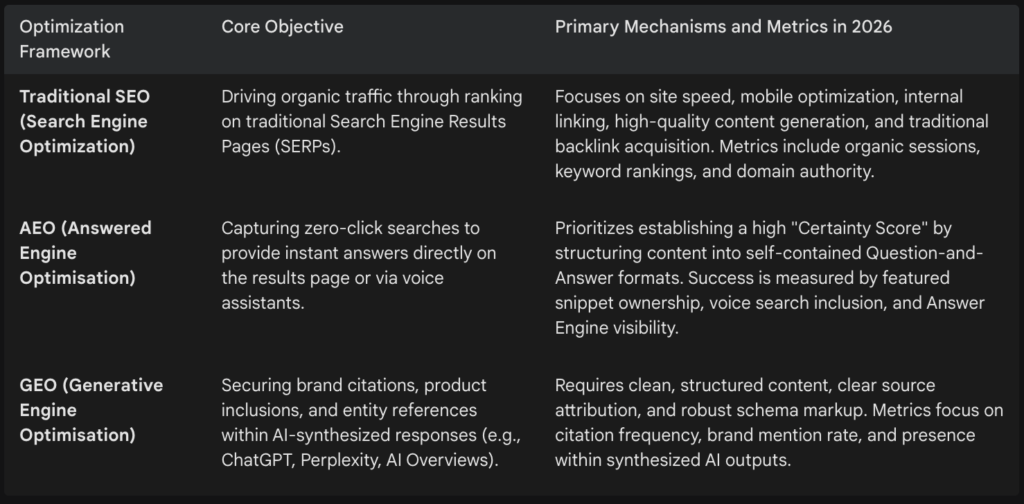
Schema markup serves as the crucial API contract connecting these three paradigms. By explicitly defining entities and their attributes, structured data mitigates the ambiguity inherent in unstructured text, allowing generative models to extract, verify, and cite information with absolute mathematical confidence. If a business operating in the highly competitive commercial hubs of Malaysia requires an SEO Consultant Selangor, the consultant’s primary objective will no longer be simply acquiring backlinks, but architecting a digital entity graph that AI models can instantly interpret and trust.
The Technical Infrastructure of Answer Engines: Schema Markup and JSON-LD
To comprehend the real-world utility of schema markup, one must first examine the technical mechanics of how AI systems parse web documents. When a Large Language Model crawls a webpage, standard text tokenization often strips away contextual formatting, making it exceedingly difficult for the model to ascertain the complex relationships between disparate pieces of text. For instance, a numerical value like “49.99” floating within a paragraph could represent a retail price, a shipping weight, a dimensional measurement, or a software version number. While advanced models possess strong inferential capabilities, inference requires computational resources and introduces the risk of “hallucination”—a scenario AI companies are desperately trying to avoid.
Schema markup, deployed predominantly via JSON-LD (JavaScript Object Notation for Linked Data), solves this ambiguity by creating an isolated, highly structured data layer in the backend of the webpage. Google explicitly prefers JSON-LD because it separates the structured semantic data from the visible HTML content, rendering it infinitely scalable and significantly easier to maintain without disrupting the visual user interface.
Entity Graphs and Machine-Readable Truth
Modern schema deployment in 2026 transcends the rudimentary tagging of individual pages; it involves the deliberate construction of an internal Knowledge Graph. In traditional SEO, many implementations stopped at adding isolated Article or Organization tags. Today, utilizing stable @id nodes and @graph arrays, developers can establish continuous, bidirectional relationships between entities across an entire domain.
By explicitly defining that a specific article was authored by a specific person, and that this person represents a verified organization with confirmed external citations (using sameAs properties), the schema significantly amplifies Experience, Expertise, Authoritativeness, and Trustworthiness (E-E-A-T) signals. This level of mathematical certainty is precisely what generative engines require before synthesizing a citation.
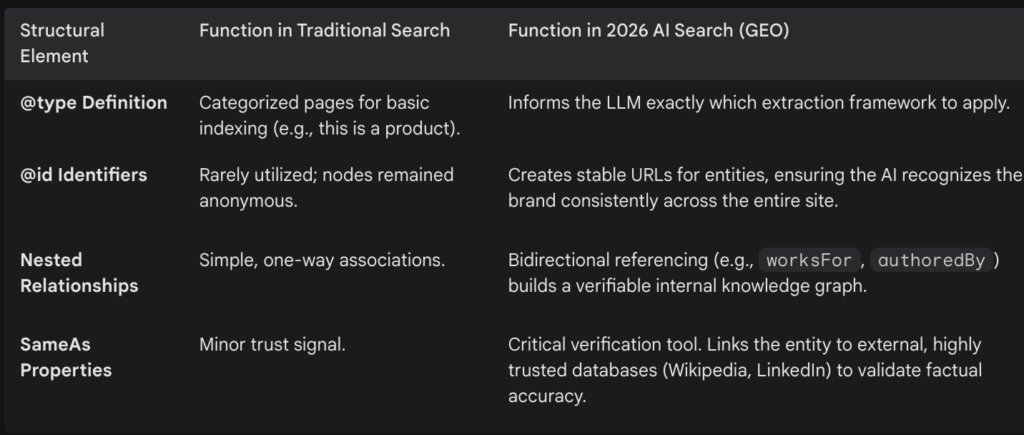
When these variables are maximized through precise JSON-LD, the resulting impact on market visibility is transformative. In fact, comprehensive industry analyses reveal that 71% of all web pages cited by ChatGPT currently utilize sophisticated schema markup. It is the ultimate differentiator between content that is merely read by an algorithm, and content that is actively utilized as source material.
Furthermore, the introduction of AI-specific technical protocols has expanded the utility of structured data. The implementation of specialized text files, such as llms.txt, is becoming an industry standard best practice in 2026. Similar in function to the traditional robots.txt file, llms.txt provides specific, direct guidance to AI coding assistants and LLM crawlers (such as GPTBot, ClaudeBot, and PerplexityBot) regarding how to optimally interpret the site’s structured data and markdown content. This ensures maximum token efficiency during the indexing process, allowing the AI to ingest the site’s most critical entity data without burning computational resources parsing irrelevant HTML scaffolding.
Application 1: The "Recipe" or "How-To" Domination Strategy
The most dramatic and empirically measurable illustration of schema markup’s power lies in its ability to completely bypass standard organic search results. In industries heavily reliant on instructional or process-based content—such as culinary publishing, DIY home repair, software tutorials, and educational platforms—the traditional top-ten listings have been rendered practically invisible by massive, visually dominant carousels anchored at the absolute top of the Search Engine Results Page (SERP).
Bypassing Organic Listings with Carousel Capture
Consider the operational dynamics of a high-traffic cooking blog or a hardware brand publishing DIY content. Historically, capturing the number one organic position for a highly lucrative query like “gluten-free chocolate cake recipe” or “how to install drywall” required massive backlink profiles, years of domain maturation, and relentless content output. In 2026, a strategically configured page can leapfrog higher-authority domains simply by providing flawless, machine-readable instructional data that the Answer Engine can immediately render into an interactive widget.
By implementing comprehensive Recipe or HowTo schema, the publisher feeds the search engine a perfectly structured dataset. The required architecture for maximum visibility and carousel capture in 2026 demands meticulous attention to detail. The following properties must be explicitly defined in the JSON-LD payload:
Core Metadata: The precise recipe name, a concise description, the author’s name (linked to a verified
@type: Personentity), and strictly formatted publish and modification dates.Media Asset Arrays: High-resolution image URLs provided in specific aspect ratios (
1x1,4x3,16x9) bound directly to the recipe entity to ensure flawless rendering across mobile, desktop, and smart display devices.Temporal Metrics: Preparation time, cooking time, and total time, explicitly coded in the machine-standard ISO 8601 duration format (e.g.,
PT30Mrepresenting precisely 30 minutes).Quantitative and Categorical Data: Nutritional information, exact yield counts, cuisine categories, and aggregate rating metrics reflecting real user sentiment.
Sequential Instructions: Granular
HowToStepelements that break down the procedure into modular, distinct actions. This is arguably the most critical component, as AI Overviews rely on these isolated steps to generate the conversational, step-by-step guidance users request.
When an AI engine processes a user query, it algorithmically prioritizes sources that require the least computational effort to verify, synthesize, and format. Because the JSON-LD provides the exact sequential steps, required materials, and corresponding imagery needed to construct a rich carousel, the search engine intrinsically elevates this content above standard text-based pages.
Extensive programmatic SEO case studies confirm the monumental impact of this strategy. For example, domains that aggressively scale recipe and instructional schema have achieved massive organic growth. In one documented case study of the food blog Iowa Girl Eats, the strategic and generous implementation of Recipe and Review schema markup allowed the publisher to consistently win highly attractive recipe snippets and secure permanent placement in Google’s recipe carousels. This structured data strategy catalyzed a surge in traffic, scaling the blog to 1.5 million monthly organic visits in just a three-month timeframe.
Similarly, the mobile application Transit utilized programmatic SEO to dynamically generate thousands of landing pages featuring precise transportation data. By structuring this content to highlight specific commutes and regional transportation methods, they achieved a staggering 1,134% year-over-year growth. The outcome of these strategies is a phenomenon where the rich carousel or the AI Overview becomes the primary point of user interaction, capturing the vast majority of clicks and entirely bypassing the traditional organic results positioned below it. The blue links are left fighting for the scraps of residual traffic.
Application 2: The Local SEO Map Pack Win
While global e-commerce and digital publishing are profoundly impacted by AI search, the stakes are arguably highest for local service providers and brick-and-mortar enterprises. For these businesses, local search visibility is the primary, indispensable conduit for consumer acquisition and revenue generation.
The Google Map Pack—the localized cluster of three business listings displayed prominently for geographically implicit queries—is the ultimate digital real estate. Statistical analysis from 2026 confirms that listings within the local pack generate 126% more traffic and 93% more direct actions (such as phone calls, website clicks, and direction requests) compared to businesses ranked in positions four through ten. Achieving dominance in this space requires more than just a well-designed website; it requires an airtight geographic entity graph.
Structuring Geospatial Data for Brick-and-Mortar Dominance
Securing a permanent position within the Map Pack requires absolute algorithmic consensus across the digital ecosystem regarding a business’s exact identity, physical location, and specific service offerings. While optimizing the Google Business Profile (GBP) remains the single most heavily weighted signal—accounting for approximately 32% of the local ranking algorithm according to the 2026 Whitespark Local Search Ranking Factors Survey—the technical deployment of LocalBusiness schema on the enterprise’s native website serves as the critical validating mechanism.
In the 2026 landscape, basic schema tags are no longer sufficient to move the needle. Advanced implementations must utilize highly detailed, nested JSON-LD to communicate real-world operational complexities directly to the AI models. AI assistants require explicit data to confidently answer conversational queries, and structured data is the “native language” that ensures these machines can accurately read operating hours, service menus, and addresses without ambiguity.
Consider the strategic architecture required for a large retail hardware store, a multi-specialty medical clinic, or an automotive dealership. A standard, legacy schema tag simply states the brand name and the primary street address. However, an elite implementation maps the exact geospatial and departmental realities of the organization:
Precise Geolocation and Service Areas: Utilizing the
GeoCoordinatesproperty to explicitly define the exact latitude and longitude of the premises, effectively hardcoding the business’s physical location into the AI’s spatial awareness. In highly competitive regional hubs, elite strategies utilizeGeoShapeschema to define exact geographic service areas. This provides search engines with explicit boundary data, reinforcing geographic authority for hyper-local “near me” queries without relying solely on the physical address.Complex Temporal Availability: Standardizing the
OpeningHoursSpecificationarray to account for variable schedules, holiday closures, and specific day-of-week operations. AI voice assistants deployed in smart speakers and vehicles rely heavily on this explicit data when answering user queries such as, “Is the hardware store open right now?” or “Find a pharmacy open until midnight.”Nested Departmental Frameworks: For multifaceted enterprises, utilizing the
departmentarray allows the schema to define distinct entities operating within the primary business structure. For instance, a major department store’s schema can feature nested data for its internal pharmacy. The masterStoreschema will dictate the main building’s hours (e.g., 08:00 to 23:59), while the nestedPharmacyschema will contain its own distinct telephone number, its own$ priceRangeindicator, and its own restrictedOpeningHoursSpecification(e.g., 09:00 to 19:00).
When analyzing performance data provided by top-tier Marketing consultation professionals, the competitive advantage for localized Small and Medium Enterprises (SMEs) becomes distinctly evident. By perfectly matching the real-world operational structure with machine-readable JSON-LD, businesses remove all algorithmic ambiguity. The search engine does not have to guess which specific services are offered, nor does it have to infer whether a particular department is currently staffed; the data is provided as an indisputable, pre-verified factual layer.
This precise alignment between the Google Business Profile, external directory citations, and the on-site LocalBusiness schema significantly boosts the entity’s Prominence and Relevance scores. Real-world case studies, such as the optimization of a local painting contractor in a highly competitive market, demonstrate that combining precise schema with robust local link building results in capturing both the number one spot in the map pack and the number one spot in the organic links—achieving total market dominance.
Application 3: The E-commerce CTR Theft
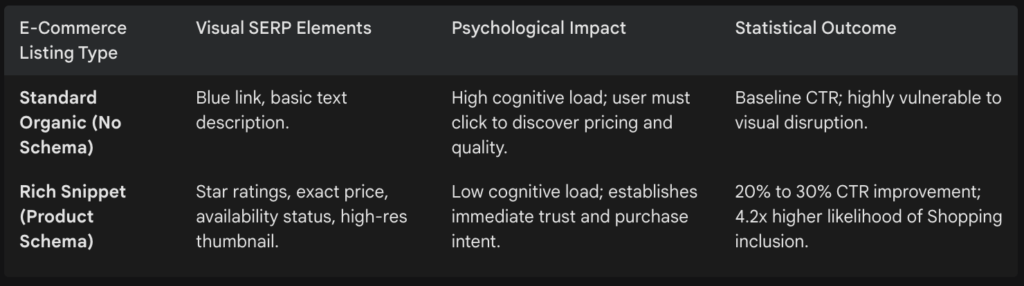
In the highly saturated e-commerce sector, the battle for consumer attention and conversion is frequently won not by the highest-ranking URL, but by the most visually compelling and information-dense search result. Standard organic listings present a generic, text-heavy output consisting of a blue title and a brief meta description. In stark contrast, listings enhanced with Product schema are transformed into rich, interactive elements that visually disrupt the SERP and command the user’s immediate attention.
Rich Snippets and the Psychology of Click-Through Rates
The phenomenon known within the industry as “CTR Theft” occurs when a lower-ranking search result disproportionately captures user clicks by rendering superior contextual data. This is a direct exploitation of consumer psychology and behavioral economics.
Consider a common scenario on a 2026 search engine results page. An unoptimized, legacy product page currently ranks in Position 1 due to historical domain authority. Meanwhile, a technically optimized competitor utilizing aggressive JSON-LD ranks in Position 3.
The Position 1 listing displays a standard text snippet. It requires the user to click the link, wait for the page to load, and manually search the page to discover the price, the shipping status, and the product reviews.
The Position 3 listing, however, is empowered by flawless, error-free Product, Offer, and AggregateRating schema. Because the search engine can instantly parse this structured data, it generates a highly visual rich snippet directly on the SERP featuring:
A vibrant 4.8-star rating graphic derived directly from verified customer reviews.
A bold
$49.99price tag, dynamically updated via real-time inventory synchronization.An authoritative “In Stock” badge, communicating immediate commercial availability.
From a psychological perspective, this rich data drastically reduces the consumer’s cognitive load. The user receives all critical purchasing information—price transparency, community quality validation, and immediate availability—before ever initiating a click. Consequently, the visual gravity of the rich snippet draws the user’s eye downward, resulting in the Position 3 listing essentially stealing the click and the associated revenue that would traditionally belong to Position 1.
The empirical data supporting this aggressive technical strategy is overwhelming. Websites leveraging comprehensive structured data consistently observe click-through rate improvements ranging from 20% to 30%, which directly translates into increased traffic, highly qualified leads, and superior revenue generation. Furthermore, products fortified with complete schema markup are 4.2 times more likely to appear within highly lucrative, visually dominant Google Shopping results.
In an era where generative AI models are aggressively synthesizing product comparisons, scraping specifications, and delivering direct purchase recommendations to consumers, the technical deployment of Product schema is no longer an optional enhancement; it is a mandatory survival mechanism. AI engines require clean, structured data to accurately assess product specifications, verify real-time pricing, and gauge market sentiment. By actively feeding this explicit data to the models through JSON-LD, e-commerce enterprises ensure their digital catalogs remain highly visible, immune to misinterpretation, and heavily cited across all generative discovery platforms.
Developing a Schema-First Architecture for SMEs
Transitioning an enterprise from legacy optimization techniques to a modern, schema-first digital architecture requires significant technical foresight and precise execution. While many modern Content Management Systems (CMS) such as WordPress, Webflow, and Shopify attempt to automate basic structured data out-of-the-box, these default implementations frequently fall short of the rigorous, error-free standards demanded by advanced AI systems. Default plugins often generate conflicting code, missing required properties, or broken nested arrays that actively confuse AI parsers.
Overcoming Implementation Friction
For Business-to-Business (B2B) and Business-to-Consumer (B2C) operations aiming to dominate their sectors, strategic SEO Consultation is essential for designing a bespoke entity graph that accurately reflects the organization’s unique value propositions. An effective schema-first architecture encompasses several deeply interlinked data layers:
Organizational Identity and Disambiguation: Utilizing the
Organizationschema enriched with comprehensivesameAsproperties. This explicitly links the website to external social profiles, industry databases, recognized Wikipedia entities, and verified third-party reviews. This constructs a unified, cross-platform digital footprint that LLMs can easily verify against external sources, drastically reducing entity ambiguity.Authorial Authority and Credibility: Deploying detailed
PersonandArticleschema to validate the expertise of the content creators. In a digital landscape increasingly flooded with synthetic, AI-generated content, linking specific articles to verified human experts with documented credentials and active social profiles is a paramount E-E-A-T signal. AI models are explicitly trained to favor content that demonstrates real-world human experience and accountability.Conversational Extraction: Implementing strict
FAQPageschema to directly feed precise Question-and-Answer pairs into Answer Engines. To maximize extraction potential, the 5W1H Content Architecture (Who, What, Where, When, Why, and How) must be deployed. By ensuring each Q&A is self-contained, factually dense, and devoid of marketing fluff, the content becomes highly extractable, significantly increasing the likelihood of capturing “People Also Ask” snippets and direct voice search answers.
A critical caveat to this strategic implementation is the fundamental principle of visible truth. Schema markup does not possess the capacity to magically compensate for fundamentally weak content, poor site architecture, or toxic backlink profiles. The structured data placed in the JSON-LD must accurately and truthfully reflect the visible, human-readable information presented on the webpage. Attempting to manipulate search engines by injecting deceptive schema—such as faking 5-star aggregate review scores, claiming false geospatial coordinates, or marking out-of-stock items as available—explicitly violates search engine guidelines. This manipulation will inevitably trigger severe algorithmic penalties, resulting in complete removal from rich results and AI Overviews.
Measuring the Impact of Generative Engine Optimisation
The industry-wide pivot toward the Search Generative Experience and LLM-driven discovery necessitates a complete recalibration of how digital success is measured and reported. Because zero-click behavior is rapidly becoming the statistical norm—where users derive complete, satisfying answers directly from the SERP without ever navigating to a destination URL—traditional metrics like raw organic session volume and top-line keyword rankings are steadily losing their primacy as ultimate indicators of success.
If an SME’s primary KPI remains “website traffic,” they are inherently misaligned with the realities of 2026. Visibility now supersedes the click.
New Key Performance Indicators for 2026
To accurately assess the return on investment for schema markup, content restructuring, and comprehensive GEO initiatives, advanced analytics frameworks must track a new suite of visibility metrics :
Citation Frequency and Share of Voice: The exact rate at which the brand, product, or domain is referenced within generative AI responses and LLM outputs relative to industry competitors. This requires monitoring tools specifically designed to query platforms like Perplexity, ChatGPT, and Google Gemini.
Rich Result Impressions: The sheer volume of visibility gained specifically through visually enhanced SERP features, such as recipe carousels, review snippets, Map Packs, and product cards. This metric is closely monitored via advanced segments within platforms like Google Search Console.
Entity Consistency: The mathematical consistency with which the brand is accurately associated with its target concepts, specific services, and localized markets across the broader digital ecosystem.
Assisted Conversions: The precise measurement of down-funnel actions (purchases, lead form submissions, phone calls) generated by users who arrived at the site. While overall traffic volume may experience compression due to AI syntheses, the quality and intent of the traffic that does click through is mathematically proven to be significantly higher. These users arrive pre-qualified by the rich data they consumed within the search interface, driving superior conversion rates and tangible revenue growth.
This paradigm shift requires a sophisticated approach to tracking and attribution, moving beyond linear click models to holistically evaluate how brand entities influence purchasing decisions across multiple AI touchpoints.
Conclusion
The transition toward generative, AI-driven search in 2026 is an irreversible market reality. As search engines rapidly evolve from rudimentary document retrieval systems into sophisticated, conversational Answer Engines, the ability to communicate directly and flawlessly with these algorithms via explicit, machine-readable data is the ultimate determinant of digital survival. The models that dictate consumer discovery no longer read between the lines; they require programmatic certainty.
Schema markup has definitively transcended its origins as a supplementary technical tactic to become the absolute core of modern digital infrastructure. The strategic deployment of JSON-LD is the API contract that bridges human-readable content and artificial intelligence. Whether it involves deploying granular HowTo schema to monopolize instructional carousels and bypass organic listings, architecting deeply nested LocalBusiness data with exact geospatial coordinates to dominate regional Map Packs, or aggressively leveraging Product schema to hijack click-through rates from higher-ranking competitors, structured data provides the factual clarity that artificial intelligence inherently demands.
Organizations and SMEs that persistently rely on unstructured text, legacy keyword stuffing, and traditional ranking methodologies will find themselves increasingly marginalized and rendered invisible by the algorithms that curate modern discovery. In a zero-click ecosystem, ambiguity is the enemy of visibility. Conversely, enterprises that proactively adopt a schema-first architecture—carefully mapping their internal entity graphs, verifying external citations, and deeply fortifying their E-E-A-T signals—will secure a definitive, highly lucrative, and sustainable competitive advantage in the AI era.
Navigating the complexities of Generative Engine Optimisation and implementing error-free, advanced structured data requires specialized technical expertise. If you are looking forward for someone to bring your SEO to another level, we are here to help.