The 2026 Schema Landscape: The Schema.org vocabulary, currently operating on version 30.0, features exactly 823 distinct types. Structured data has officially transitioned from acting merely as a visual trigger in search results to serving as a foundational trust signal for artificial intelligence systems.
Algorithmic Evolution: Following the highly volatile Google March 2026 core update, deploying foundational, e-commerce, and informational schemas is mandatory for securing AI citations, as search engines now aggressively prioritize entity verification and information gain over traditional keyword density.
The Structural Transformation of Digital Visibility in 2026
The digital marketing ecosystem has reached a profound, irreversible inflection point. As the global economy transitions deeper into a technological era defined by artificial intelligence and machine learning algorithms, the fundamental mechanics of online visibility, consumer discovery, and enterprise lead generation have been structurally transformed. At the absolute center of this transformation lies the underlying data architecture of the internet: Schema Markup. In 2026, search engines are processing over 8.5 billion queries daily. However, the methodology by which those queries are answered has shifted entirely from providing lists of blue hyperlinks to synthesizing comprehensive, AI-generated responses.
For small and medium enterprises (SMEs), relying on legacy digital tactics is no longer a viable pathway to sustainable market leadership. The aggressive integration of sophisticated Large Language Models (LLMs) into primary search interfaces—most notably through Google’s AI Overviews and the broader Search Generative Experience—has fundamentally altered how consumers retrieve critical information, evaluate competing brands, and finalize their commercial purchasing decisions. In this modern environment, schema markup transcends its historical role as a mere optimization tactic; it operates as a strategic data layer, effectively serving as a localized Knowledge Graph that empowers machines to confidently understand, trust, and act upon the semantic information presented on a webpage.
This exhaustive technical report details exactly how many types of schema markup are available in the 2026 landscape, provides a granular analysis of the sweeping algorithmic changes introduced by the Google March 2026 Core Update, and delivers a comprehensive blueprint for navigating the complex transition toward advanced optimization disciplines.
The Quantitative Landscape of Schema.org in 2026
To fully comprehend the sheer scale and strategic potential of structured data available to modern web developers and digital marketers, one must examine the foundational repository of the semantic web: Schema.org. Founded originally as a collaborative, community-driven activity by technology conglomerates Google, Microsoft, Yahoo, and Yandex, the vocabulary provides a standardized, universally recognized methodology for structuring data across the internet.
The vocabulary is developed continuously through an open community process managed via GitHub and the World Wide Web Consortium (W3C) mailing lists. As of the current technological cycle, the global adoption rate is staggering, with reports indicating that over 45 million web domains markup their pages utilizing more than 450 billion Schema.org objects. This massive data infrastructure forms the backbone of how artificial intelligence systems comprehend human knowledge.
Exactly How Many Types of Schema Markup Are Available?
As of April 2026, following the major release of Schema.org Version 30.0 on March 19, 2026, the vocabulary has expanded significantly to address the highly nuanced requirements of AI-driven search engines and global regulatory frameworks. The exact, current count of available elements within the hierarchical schema ontology is defined as follows:

The availability of 823 distinct schema types illustrates the immense granularity achievable when mapping a localized website’s content directly to the global Knowledge Graph. At the absolute root of this complex ontology is the Thing class, from which all other entities cascade into specialized, highly descriptive categories.
Deep Dive: Schema.org Version 30.0 Release Notes
The expansion to Version 30.0 was not merely a superficial update; it introduced several highly specialized types and properties specifically designed to facilitate better machine understanding of professional credentials, electronic commerce, and digital supply chain transparency. Understanding these additions is crucial for executing advanced technical SEO.
The
CredentialType andhasCredentialProperty: A newly introduced class designed to work in tandem with thehasCredentialproperty. This architectural expansion allows organizations and professionals to formally mark up specific certifications, operational licenses, and professional qualifications. This is a direct, engineered response to the search engines’ heightened algorithmic need for robust E-E-A-T (Experience, Expertise, Authoritativeness, and Trustworthiness) verification signals in the era of generative AI.The
ErrorType anderrorCodeProperty: Introduced to provide machine-readable, semantic context to system states, software diagnostics, and technical troubleshooting guides. This allows AI assistants to better parse and deliver technical solutions directly to users.Digital Product Passports (DPP) Integration: Version 30.0 added highly specific examples and equivalence annotations for the EU Digital Product Passport, deliberately aligning the markup with United Nations UN/CEFACT codes. This facilitates strict global e-commerce compliance, environmental tracking, and supply chain transparency for international retailers.
Workforce and Economic Analytics: The targeted addition of the
jobDurationproperty for theJobPostingtype addresses the rapidly growing complexity of contract labor, freelance engagements, and gig-economy employment mapping.Dietary and Lifestyle Enhancements: The range of the
suitableForDietproperty was officially extended to include theDietclass, allowing for more precise semantic clustering of recipes and nutritional content.
While the vast availability of over eight hundred schema types represents unparalleled technical potential, executing a profitable digital marketing strategy requires extreme, deliberate focus. Implementing every available schema type simply because it exists is highly inefficient and often counterproductive to indexing. The strategic objective is to identify, isolate, and deploy the specific foundational schemas that actively serve as measurable revenue drivers and verifiable AI trust signals.
The Google March 2026 Core Update
The historical trajectory of structured data is defined primarily by its utility as a visual enhancement tool. For years, the primary incentive for implementing schema markup was the activation of rich results—triggering review star ratings, dynamic recipe carousels, event schedules, and expansive FAQ dropdowns directly within the traditional Search Engine Results Page (SERP). However, the Google March 2026 Core Update served as a definitive, permanent turning point, fundamentally altering the strategic, underlying value of schema markup.
The Strategic Retirement of Seven Legacy Schema Types
In a concerted, highly publicized effort to simplify the visual search results page and adapt to the advanced semantic parsing capabilities of modern Large Language Models, Google officially dropped rich result display support for seven specific structured data types. This marked a significant departure from the previous era of SERP gamification. The formally retired schemas include:
Book Actions: Previously utilized by publishers to provide direct “Buy” or “Preview” execution buttons adjacent to organic book listings.
Course Info: Utilized extensively by e-learning platforms to surface intricate details such as course providers, total duration, and specific start dates directly in the SERP interface.
Claim Review: Historically leveraged by fact-checking organizations to boldly display verdict snippets regarding controversial statements.
Estimated Salary: Used heavily by recruitment agencies and job boards to visualize aggregate salary ranges for employment queries.
Learning Video: Designed to graphically enhance educational multimedia snippets with specialized learning context and curriculum milestones.
Special Announcement: A schema type that gained massive global prominence during the COVID-19 pandemic for broadcasting public safety alerts and urgent municipal messaging.
Vehicle Listing: Used within the automotive dealership sector for direct, in-SERP inventory visibility.
The retirement of these seven schema types for visual rich results emphatically does not imply that structured data is losing operational relevance. Rather, it highlights a profound structural evolution: search engines are now utilizing their integrated LLMs to parse basic informational context naturally and directly from the on-page text without relying on manual tagging for visual display. Consequently, Google has severely restricted visual rich result eligibility, leaving exactly 31 schema types that retain active, visual rich result support as of the March 2026 landscape.
The Transition from Visual Triggers to AI Trust Signals
The most crucial, high-level insight derived from the March 2026 algorithmic volatility is the shifting primary purpose of schema markup. While visual rich results have been strategically narrowed, structured data’s backend role as an authoritative entity verification mechanism has exponentially increased.
During the active rollout of the March 2026 update, websites that relied heavily on superficial, templated, or purely AI-generated content devoid of genuine, human-verified value suffered catastrophic visibility losses. Thin affiliate websites, generic SaaS blogs built around merely summarizing existing SERP content, and clickbait news platforms were among the hardest hit, experiencing sudden drops of up to 35% in organic sessions.
Conversely, a parallel change went largely unnoticed by traditional marketers: websites possessing clean, accurate, and deeply integrated entity schema saw measurably improved citation rates within Google’s Gemini-powered AI Mode answers. The update emphatically did not diminish the value of structured data; rather, it completely changed what structured data is highly valuable for.
Search engines now actively read structured data primarily as a core trust signal. It is utilized to verify factual claims, establish indisputable entity relationships, and continuously assess the credibility of a source prior to the complex process of answer synthesis. If a site lacks proper E-E-A-T signals, it is no longer just a missed optimization opportunity; it is treated actively as a ranking liability. Thus, schema that accurately describes the primary intent of the content increases the statistical probability of an AI Overview citation, even when no traditional visual rich result is triggered for the user.
The Imperative of "Information Gain"
A critical concept solidified during the March 2026 update is “Information Gain.” Information Gain refers to the algorithmic preference for content that adds net-new facts, original perspectives, or proprietary data to the global index, rather than merely repeating existing explanations. Google now aggressively prioritizes pages that provide original insights, localized context, or verified first-hand experience. Articles that simply repeat existing SERP explanations without adding any new insights are systematically losing their AI Overview visibility. Furthermore, anonymous “Admin” authorship has collapsed entirely in performance, particularly within Your Money or Your Life (YMYL) sectors.

Strategic Schema Categorization: The Three Essential Pillars
With an overwhelming 823 types available in the vocabulary, but only a specialized fraction acting as high-leverage assets in the era of generative AI search, meticulous resource allocation becomes a critical management function. The optimal architectural approach categorizes structured data into three mandatory pillars, each serving a distinct, revenue-generating function in the digital ecosystem.
1. The Foundational Identity Schema
Every single digital property requires a robust structural bedrock to definitively establish its digital footprint, broadcast core business details, and verify contact information. This foundational layer is absolutely non-negotiable for entity recognition and inclusion within the overarching Knowledge Graph.
Organization Schema: This constitutes the ultimate entity foundation. It establishes a business as a recognized, verified corporate entity within Google’s semantic ecosystem. It effectively disambiguates a commercial brand from generic industry terms and definitively links the primary domain to corporate headquarters, official social media profiles, subsidiary brands, and customer service contact points.
LocalBusiness Schema: For SMEs operating within specific geographical domains (such as retail outlets, clinics, or regional service providers), this schema is the lifeblood of local pack dominance. It transmits immutable, structured facts directly to the search engine, including precise operational hours, highly specific geo-coordinates, accepted payment methods, and physical addresses. This ensures total accuracy when mobile users query location-aware AI assistants for nearby commercial services.
Person Schema: In a digital age rapidly becoming saturated with automated, AI-generated text, cryptographically proving human authorship and lived experience has never been more vital. Person schema, intricately connected to detailed author biographies, establishes E-E-A-T by linking individual subject matter experts to their broader digital footprint across the web (such as academic publications or professional networking profiles). This establishes the human credibility that algorithms desperately require to mitigate the risk of AI hallucinations.
2. The E-commerce Revenue Drivers
For digital storefronts, direct-to-consumer brands, and expansive online marketplaces, commercial schema acts as the primary mechanical vehicle for capturing buyers exhibiting exceptionally high commercial intent.
Product Schema: Universally critical for e-commerce visibility, Product schema feeds raw, structured commercial data—such as brand manufacturer, unique SKU numbers, Global Trade Item Numbers (GTIN), and physical item condition—directly into the search index without requiring HTML scraping.
Offer Schema: Traditionally nested directly within the Product markup, the Offer schema communicates the highly dynamic variables that actively influence consumer purchasing decisions, most notably real-time retail price and immediate stock availability. Providing this transactional data cleanly prevents search engines from serving outdated pricing information in the SERP, a massive friction point that notoriously destroys e-commerce conversion rates.
AggregateRating (Reviews) Schema: This specific schema pulls authenticated social proof directly into the search ecosystem. By aggregating star ratings and total verified review counts, businesses deploy a powerful, proven psychological trigger that measurably increases initial click-through rates and establishes immediate consumer trust before the prospective buyer ever initiates a page load.
3. The Content & Informational Multipliers
To successfully capture top-of-funnel informational traffic and establish unassailable topical authority, digital content must be structurally accessible to both traditional indexing bots and emerging AI retrieval systems.
Article Schema: This vital markup powers news publisher and blog content visibility, signaling to the search engine the precise editorial nature of the content, its original publication date, subsequent modification dates, and its primary author.
FAQPage Schema: Despite the global tightening of visual rich results following the core updates, FAQ schema explicitly and unambiguously signals to crawlers that specific on-page content is structurally arranged as definitive question-and-answer pairs. Without this explicit markup, FAQ content remains technically present but structurally invisible to many primitive AI retrieval mechanisms. Google actively prioritizes schema-tagged FAQs for synthesizing chat responses, as it allows the algorithm to instantly pull direct, factual responses into generative interfaces.
HowTo Schema: This highly specialized markup structures educational and instructional content sequentially. It allows generative algorithms to seamlessly parse complex, multi-stage processes into easily readable, numbered steps, vastly increasing the statistical likelihood of the content being cited directly in instructional AI Overviews and voice-assistant readouts.
The Mastery of knowsAbout
As traditional, keyword-stuffing ranking tactics become entirely obsolete, establishing unassailable topical authority is the foremost priority for digital success. Following the structural realignment of the March 2026 core update, the knowsAbout property has rapidly emerged as a profoundly impactful mechanism for entity-based schema optimization.
The knowsAbout property serves as a direct, machine-readable declaration of expertise that explicitly informs AI systems regarding the operational focus of an entity. Rather than forcing algorithms to slowly infer a brand’s specialty from statistical keyword density analysis, this property explicitly specifies the overarching industries, nuanced topics, and complex subject matter in which an organization or human author possesses genuine, verifiable expertise.
For Organization schema, declaring expertise (e.g., "knowsAbout":) provides advanced AI models with the precise, targeted context necessary to resolve the entity’s exact hierarchical position within the global Knowledge Graph. Organizations that deploy accurate, highly specific topic declarations are measurably more likely to be actively cited in AI Mode answers for queries falling within those specific semantic domains compared to competing entities lacking these structured declarations.
Similarly, in the critical context of E-E-A-T analysis for Person schema, the knowsAbout property directly maps a human author’s name to specific domains of knowledge. This architectural feature facilitates authoritative mapping, allowing AI systems to seamlessly match an author’s declared expertise directly against the user’s underlying query intent. This action effectively removes algorithmic ambiguity, ensuring that generative engines can confidently determine the entity is a verified, trustworthy authority on the specific subject matter being queried.
Data harvested from post-March 2026 implementations reveals a highly consistent, lucrative pattern: comprehensive entity schema, specifically utilizing the knowsAbout property in conjunction with the SameAs property (to cryptographically link external, high-trust identifiers like Wikidata, academic journals, or LinkedIn), produces significant, measurable improvements in AI Mode citation rates over a standard 30-to-60 day indexing window.
SEO, AEO, and GEO
To successfully navigate the treacherous 2026 search landscape, marketing professionals and enterprise directors must master a complex triad of interconnected optimization disciplines. Simply relying on traditional keyword insertion is wholly insufficient. Modern digital visibility requires the simultaneous, orchestrated execution of Search Engine Optimisation (SEO), Answered Engine Optimisation (AEO), and Generative Engine Optimisation (GEO).
Defining the Optimization Triad
Search Engine Optimisation (SEO): The foundational, legacy practice of optimizing baseline web architecture, acquiring high-quality external backlinks, and crafting comprehensive content to rank within traditional, link-based search engine results pages like classic Google and Bing. Traditional SEO operates as the essential prerequisite, providing the baseline of website authority, server crawlability, and technical indexation.
Answered Engine Optimisation (AEO): A highly specialized, tactical subset focusing exclusively on structuring content to directly answer discrete user queries. AEO specifically targets the capture of featured snippets, direct SERP answers, voice search results triggered by smart speakers, and “People Also Ask” conversational matrices. It relies heavily on absolute formatting precision and extreme conciseness.
Generative Engine Optimisation (GEO): The most recent, highly advanced, and critical evolution in the digital marketing sector. GEO involves optimizing content specifically for consumption by AI-driven platforms and conversational LLM agents such as ChatGPT, Perplexity, Anthropic’s Claude, and Google’s Search Generative Experience (SGE). GEO strategies focus predominantly on ensuring content is machine-friendly, logically segmented, mathematically structured, and backed by robust entity signals so that AI systems extract, synthesize, and cite the brand positively in their dynamic, generated responses.
Generative AI Ranking Factors: The Algorithmic Variance
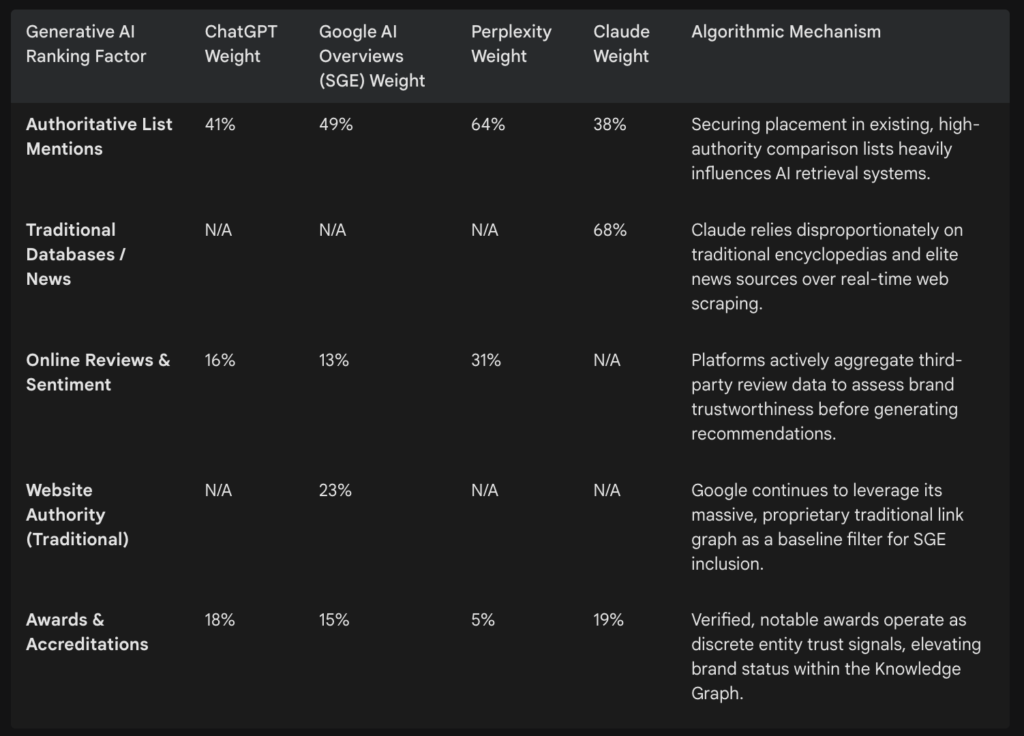
Structuring Content for Generative Engine Optimisation
The algorithms powering generative search operate fundamentally differently than traditional indexing bots. They aggressively prioritize content that is highly structured, mathematically factual, and easily parsed into discrete variables. A successful Generative Engine Optimisation strategy requires a meticulous, almost scientific approach to on-page formatting, commonly referred to in the industry as the 5W1H Content Architecture (Who, What, Where, When, Why, and How).
To optimize for consistent AI citations, content formatting must strictly adhere to the following architectural best practices :
Hierarchical Clarity: Utilize strictly ordered heading structures (H1, H2, H3), dedicating only one highly focused, singular topic per section. Any deviation confuses the extraction models.
Direct Answering Mechanics: Lead each section with a direct, unambiguous answer immediately following the header before expanding into broader narrative context. This feeds the extraction layer perfectly.
Extreme Brevity and Scanning: Keep paragraphs exceptionally concise, ideally limited to a maximum of 2-3 sentences. Dense walls of text are abandoned by efficiency-seeking models. Aggressively utilize bullet points, comparison tables, and numbered lists to present data arrays.
Expert Integration: Synthesize primary statistics, explicitly naming the original sources. Integrate verified expert quotes featuring the full name, official title, and company attribution to satisfy entity mapping requirements.
Modular Semantic Architecture: Write in modular, standalone sections, maintaining perfectly consistent terminology throughout the entire domain. LLMs highly reward semantic clarity and stable, predictable meaning. Inconsistent descriptions severely impair the ability of AI systems to connect a business to specific semantic queries.
Furthermore, generative engines exhibit a powerful, built-in recency bias. Important cornerstone content must be subjected to ongoing maintenance—at minimum once every three months—refreshing the text with updated statistics, fresh operational data, and current timestamps to maintain active citation eligibility.
Technical Implementation: Delivering the Knowledge Graph
Possessing a deep theoretical understanding of the 823 schema types and GEO content structures is rendered entirely meaningless without flawless technical execution. Implementing schema markup involves selecting the optimal coding format to ensure maximum comprehension by both legacy search engine crawlers and advanced AI retrieval systems.
JSON-LD: The Uncontested Industry Standard
The vast Schema.org vocabulary can theoretically be encoded using several syntactic frameworks, primarily JSON-LD, Microdata, and RDFa. However, as the industry stabilizes in 2026, JSON-LD (JavaScript Object Notation for Linked Data) remains the absolute, undisputed preferred implementation method officially endorsed and recommended by major search engines, including Google.
JSON-LD operates elegantly by injecting structured data directly into the <head> of the HTML document as an independent, encapsulated script block. This sophisticated architectural separation provides distinct, operational advantages:
Maintenance Efficiency: It completely and permanently separates the underlying structured data layer from the visual HTML presentation layer. Developers can radically modify the page design, CSS, and structural layout without ever risking the semantic integrity of the markup.
CMS Integration: JSON-LD integrates seamlessly and securely with dominant global content management systems like WordPress, allowing for dynamic, scalable, and automated schema generation via enterprise-grade plugins and APIs.
Complex Semantic Nesting: It handles deeply nested entity relationships with absolute precision. For instance, linking an
Organizationseamlessly to itsfounder, and subsequently linking that founder to theiralumniOfinstitution, is executed far more elegantly in JSON-LD than the cumbersome inline tagging required by Microdata.
The highly scrutinized March 2026 core update explicitly reaffirmed that the delivery format itself was not the target of the algorithm’s punitive actions; rather, the strict factual alignment between the hidden schema and the genuine, visible on-page content was the focal point. JSON-LD remains the most reliable, robust vehicle for delivering clean, unambiguous entity verification signals.
System Accessibility for Advanced AI Crawlers
Technical optimization in the Generative AI era extends significantly beyond schema injection. A critical, often overlooked component of GEO involves auditing deep server-level accessibility. If AI systems are computationally barred from accessing the raw data, they cannot parse the structured schema or synthesize the written content.
It is absolutely imperative for technical teams to thoroughly review the site’s robots.txt file to ensure that AI-specific extraction crawlers—such as GPTBot, ClaudeBot, and PerplexityBot—are explicitly permitted to crawl high-value informational pages. Blocking these bots effectively erases a brand from the generative landscape. Furthermore, the rapidly emerging technical standard of implementing an llms.txt file at the root directory is rapidly becoming a mandatory best practice. This specific file provides generative systems with explicit, structured guidance on how to systematically interpret, summarize, and navigate the site’s complex architecture.
The Economic Imperative: Navigating the Malaysia CPC Crisis
The global transition from traditional keyword search to the synthesized Search Generative Experience is not merely an abstract technical evolution; it carries profound, immediate financial implications. This is particularly devastating for small and medium enterprises operating in rapidly digitizing, highly competitive regional markets.
The 2026 Advertising Cost Inflation Reality
In highly industrialized, competitive economic zones—such as Selangor, the commercial heartland of Malaysia—the business environment for SMEs has been dramatically and permanently altered by the aggressive integration of AI Overviews. Historically, for the better part of a decade, local businesses relied heavily on Google Ads as a “quick fix” for immediate, reliable lead generation. However, by 2026, a severe economic phenomenon identified by analysts as the “CPC Crisis” has firmly materialized across the ASEAN region.
The full, global rollout of generative AI search features has fundamentally altered the physical, pixel-based real estate of the search engine results page. Massive AI Overviews now monopolize the highly coveted “Above the Fold” visual space, severely shrinking the available inventory for traditional sponsored advertisements. This drastic inventory shrinkage, combined with aggressive local digital transformation trends and a massive influx of SMEs entering the online marketplace, has triggered unprecedented, localized auction inflation.
Verified industry benchmarks from Q1 2026 indicate that the average Cost-Per-Click (CPC) in high-value, service-based sectors across Malaysia has surged exponentially. For example, within the fiercely competitive real estate, legal, and consumer services sectors, acquiring a single click for high-intent keywords (e.g., “KLCC condo for rent”) regularly demands an investment of RM10 to RM15. Mathematically, if an SME operates with a standard, respectable 2% conversion rate, the raw acquisition cost for a single, unverified lead spirals to an unsustainable RM500 to RM750. For the vast majority of local businesses, these margins are economically terminal.
The Strategic Value of Enterprise SEO Marketing
Faced with exorbitant, inflationary paid acquisition costs, relying solely on a “rental” model of visibility—where total digital traffic ceases the absolute millisecond the advertising budget is depleted—constitutes a critical, existential vulnerability for any modern enterprise. In this highly challenging macroeconomic climate, comprehensive SEO Marketing transitions forcefully from being an optional, experimental marketing channel to a fundamental, non-negotiable corporate asset.
Unlike paid advertising platforms, SEO operates strictly on an ownership model, generating a compounding Return on Investment (ROI) over extended timelines. While the initial financial outlay required to retain a professional SEO Consultant Selangor inherently involves a monthly retainer—typically ranging from RM2,000 to RM8,000 for standard Malaysian SMEs—the effective cost-per-visit decreases consistently and mathematically every single month as organic rankings stabilize and lucrative AI citations accumulate.
Furthermore, shifting consumer behavior metrics in 2026 indicate a rapidly growing, sophisticated skepticism toward paid ad placements. Savvy digital users actively and intentionally bypass “Sponsored” labels, aggressively seeking out organic results and AI-synthesized answers, which are psychologically perceived as human-vetted, objective, and inherently more trustworthy. Quality organic traffic, driven by rigorous SEO protocols, builds a foundational layer of deep brand trust that paid advertisements—which inherently target cold audiences possessing no prior brand relationship—simply cannot replicate or forcibly acquire.
The Synergistic Effect of Organic Authority and Paid Visibility
Interestingly, robust organic optimization does not render paid media obsolete; rather, it exponentially enhances the efficacy of any remaining paid advertising expenditures. Groundbreaking digital data analysis from 2026 reveals a profound, measurable interconnectedness within the AI search environment. While standalone, traditional search ads suffer from rapidly declining user engagement, “Sponsored” links that appear concurrently with an organic AI Overview citation experience an astonishing 91% higher Click-Through Rate. This metric conclusively proves that established, organic trust serves as a massive force multiplier, exponentially amplifying paid visibility and significantly lowering overall Customer Acquisition Cost (CAC).
To survive, scale, and expand within hyper-competitive metropolitan markets, enterprises desperately require expert Marketing consultation to navigate these compounding technical complexities. The precise integration of traditional technical SEO architecture, advanced Schema Markup deployment across hundreds of web pages, and tailored Generative Engine Optimisation services requires a level of sophisticated, multi-disciplinary engineering expertise that most SMEs simply cannot organically cultivate with in-house resources.
By partnering strategically with a data-driven SEO Consultant Selangor, businesses can implement the precise entity disambiguation strategies, structural 5W1H content formatting, and explicit E-E-A-T signaling required to aggressively capture the rapidly expanding “Share of AI Voice”. This proactive, highly technical adaptation ensures that an enterprise’s brand is consistently retrieved, mathematically verified, and prominently cited by the next generation of generative search algorithms.
Securing Dominance in the AI Ecosystem
The state of global search in 2026 is defined by a fascinating technical paradox: while the underlying semantic vocabulary of the internet has never been larger or more capable—boasting an incredible 823 distinct types within Schema.org Version 30.0—the practical margin for error in digital marketing strategy has never been smaller. The historical era of successfully manipulating primitive search algorithms with repetitive, low-value content and superficial metadata tags ended definitively and permanently with the Google March 2026 Core Update.
Today, the most powerful AI-driven search engines prioritize absolute information gain, verifiable human experience, and unassailable entity authority above all other metrics. Schema markup has permanently transcended its humble origins as a visual SERP enhancement tool, evolving into the critical, underlying data layer that explicitly dictates how Large Language Models perceive, trust, and ultimately cite corporate entities to millions of daily users.
To maintain baseline visibility, protect market share, and successfully combat the paralyzing inflation of digital advertising costs, enterprises must rapidly evolve their operational strategies. This requires wholeheartedly embracing the highly structural, mathematically rigorous disciplines of Answered Engine Optimisation and Generative Engine Optimisation. For those operating within the modern economy, digital visibility is no longer a marketing concern; it is the core foundation of enterprise revenue.
If an enterprise is looking forward for someone to bring its SEO to another level, dedicated consultancy is here to help. Professional, data-driven intervention ensures that a brand’s digital architecture is meticulously calibrated for the generative AI era, permanently transforming algorithmic updates from an existential threat into a compounding, unassailable competitive advantage.