Structural Clarity for AI: Schema markup acts as backend structural data, allowing Google and AI platforms to easily scrape, understand, and index specific entities in the right position without parsing entire paragraphs.
Traditional SERP Ranking: Meta data remains the foundational algorithmic element for traditional search engines, providing the contextual signals necessary for a page to rank accurately on standard search engine results pages.
Strategic AI Integration: Utilizing the right schema types—such as video, paragraph, and FAQ markup—is absolutely essential for capturing visibility in emerging Search Generative Experiences and driving successful Answered Engine Optimisation.
Schema Markup vs Meta Tags: Understanding the Key Differences
The architecture of digital visibility has fundamentally transformed. By the second quarter of 2026, artificial intelligence has irrevocably altered how search algorithms index, retrieve, and display information. Traditional search paradigms, defined primarily by generating a list of blue hyperlinks based on keyword proximity, have given way to dynamic, conversational interfaces and autonomous answer engines. In this sophisticated digital ecosystem, the mechanisms deployed to communicate with search engine crawlers and large language models (LLMs) have distinctly bifurcated. The focal point of this technical evolution is the critical distinction between schema markup and meta data.
While both elements reside within the backend code of a digital document and function as communication conduits to external systems, their underlying purposes, structural designs, and target audiences are profoundly different. Meta data exists fundamentally to dictate how a search engine processes a page to rank it within a traditional Search Engine Results Page (SERP). Conversely, schema markup operates as the semantic structural data, explicitly showing data to Google and emerging AI platforms so that digital entities are easily crawled, understood, and indexed in the right position. Furthermore, schema markup data is heavily aimed at AI platforms; these autonomous systems mathematically favor structured data that is easily scraped, circumventing the computationally expensive process of reading whole paragraphs to find a summary.
This exhaustive report dissects the granular differences between schema markup and meta tags, examining their respective roles in modern digital ecosystems. It explores how specific schema vocabularies—such as video, paragraph, and FAQ—must be leveraged to ensure optimal indexation, and details how enterprises must adapt their digital architecture through Generative Engine Optimisation (GEO) and Answered Engine Optimisation (AEO) to maintain relevance.
The Foundational Architecture of Meta Data
To comprehend the paradigm shift occurring in 2026, it is necessary to first analyze the historical foundation of search visibility: meta data. Embedded primarily within the HTML <head> of a document, meta tags are discrete snippets of text that describe a page’s content, intended audience, and indexing parameters. They do not render on the visual interface of the website; rather, they serve as explicit directives and descriptors for traditional search engine crawlers.
The Role of Meta Data in Traditional SERP Ranking
For over two decades, the primary objective of search engines was to match a user’s textual query with the most relevant textual document indexed on the internet. Meta data facilitates this matching process. The core function of meta data is for Google to rank a webpage accurately within the traditional SERP. The architecture of meta data is built upon several critical elements:
Title Tags: The title tag is the most critical meta element for traditional SEO Marketing. It dictates the clickable headline displayed on the SERP. Algorithms heavily weight the keywords present within the title tag to determine topical relevance. Furthermore, the title tag serves a psychological function, directly influencing the click-through rate (CTR) of the human searcher.
Meta Descriptions: While search engines have long stated that the meta description is not a direct algorithmic ranking factor, it provides a crucial summary of the page’s content displayed beneath the title tag. A strategically crafted description drives user engagement, signaling contextual relevance and satisfying search intent, which indirectly supports sustained ranking stability.
Robots Meta Tags: These directives instruct automated crawlers on how to handle the specific page. They dictate whether the crawler should index the page, follow the hyperlinks embedded within the content, or serve the page as a cached result. The precise configuration of robots meta tags determines the flow of crawl equity throughout a domain.
Canonical Tags: In expansive digital architectures, canonical tags are utilized to prevent algorithmic penalization for duplicate content. They signal the authoritative “master” version of a specific page to the search engine, ensuring that link equity is consolidated and ranking potential is not diluted across multiple identical URLs.
The Algorithmic Limitations of Meta Data in 2026
While precise meta data configuration remains an absolute baseline necessity for any SEO consultation, its utility degrades significantly when interfacing with the advanced LLMs and AI indexing systems defining the modern internet. Traditional meta data relies fundamentally on “string matching”—the computational process of connecting words in a user’s query to identical or highly synonymous words located within a tag.
However, generative AI engines do not retrieve mere text strings; they retrieve, analyze, and synthesize mathematical concepts, relationships, and entities. An AI system cannot fully comprehend the nuanced relationship between a specific service offering, the credentialed expert providing that service, the enterprise’s physical location, and its aggregate customer sentiment merely by parsing a 160-character meta description.
Traditional meta data lacks the structured, standardized vocabulary necessary to eliminate algorithmic ambiguity. Consequently, an enterprise relying solely on meta tags in 2026 is effectively restricting its digital strategy to competing only for traditional SERP positions. This represents a critical strategic vulnerability, as traditional blue-link SERPs are rapidly losing impression share to the Search Generative Experience, where up to 70% of queries triggering an AI Overview end without a user clicking through to any external site.
The Semantic Revolution of Schema Markup
If meta data functions as the brief summary on the back of a book, schema markup is the highly organized relational database cataloging every character, theme, location, publication detail, and conceptual relationship within that book. Schema markup is a specialized vocabulary of microdata—most commonly implemented via JSON-LD (JavaScript Object Notation for Linked Data)—that provides explicit, unambiguous meaning to the raw information on a webpage.
Structural Data for Exact Digital Positioning
The fundamental definition of schema markup is that it operates as structural data; it explicitly shows data to Google and other search engines to allow the content to be easily crawled and indexed in precisely the right position within the search engine’s Knowledge Graph.
When the digital landscape shifted from surfacing blue links to presenting synthesized AI-generated answers, algorithms evolved from processing strings of text to understanding specific entities. An entity is defined as a singular, unique concept—such as a specific person, geographical location, corporate organization, product, or chronological event. Schema markup utilizes the standardized, globally recognized vocabularies from Schema.org to define these entities and mathematically map their interconnected relationships.
For example, when a commercial enterprise publishes a detailed service page, schema markup allows the backend code to explicitly declare:
This digital document is an
Articlefocusing on specific financial regulations.The document was
authoredBya specificPersonholding verified credentials.That individual
worksFora specificOrganizationlocated in a precise municipality.The organization offers a
Servicethat resolves the user’s query, priced in a specificCurrency.
By utilizing stable identifier values (such as the @id tag) and relational mapping architectures (such as the @graph structure), comprehensive schema implementation begins to behave as a localized, internal knowledge graph. This structural precision ensures that when Google categorizes the domain, it positions the data exactly where it belongs conceptually, triggering highly visible rich results such as aggregate star ratings, complex image carousels, real-time pricing data, and detailed event listings directly on the traditional results page.
The AI Preference for Scrapeable, Structured Data
The most profound technological shift defining the 2026 digital ecosystem is the aggressive transition toward AI-driven data retrieval. AI visibility has become functionally equivalent to, and in many sectors more important than, traditional organic click-through rates. Systems such as Google’s Gemini, OpenAI’s ChatGPT (specifically its integrated search functions), and Perplexity rely on advanced Retrieval-Augmented Generation (RAG) architectures to pull real-time data from the web to formulate accurate responses.
Schema markup data is explicitly aimed at these AI platforms. Large language models demonstrate a massive mathematical preference for structured data because it is easily scraped and ingested. Processing unstructured, free-flowing text is computationally expensive and highly prone to error or “hallucination.” Rather than forcing the AI engine to expend processing power reading a whole paragraph to find the summary or infer the implicit relationship between disparate data points, schema markup delivers a perfectly organized dataset directly to the parsing algorithm.
Empirical data from 2026 highlights the critical nature of this preference. Research indicates that LLMs grounded in structured knowledge graphs achieve a 300% higher accuracy rate compared to models relying solely on unstructured textual data. Furthermore, pages with properly implemented structured data are cited up to 3.1 times more often in AI Overviews. In controlled testing environments, GPT-5’s response accuracy regarding specific brand metrics improved dramatically from 16% to 54% when the source content relied heavily on structured data layers. Without this markup, AI systems are forced into probabilistic guessing, an inefficient process that often leads algorithms to bypass unstructured sites entirely in favor of competitors who have utilized schema to remove semantic ambiguity.
Comparative Analysis: Schema Markup vs. Meta Data
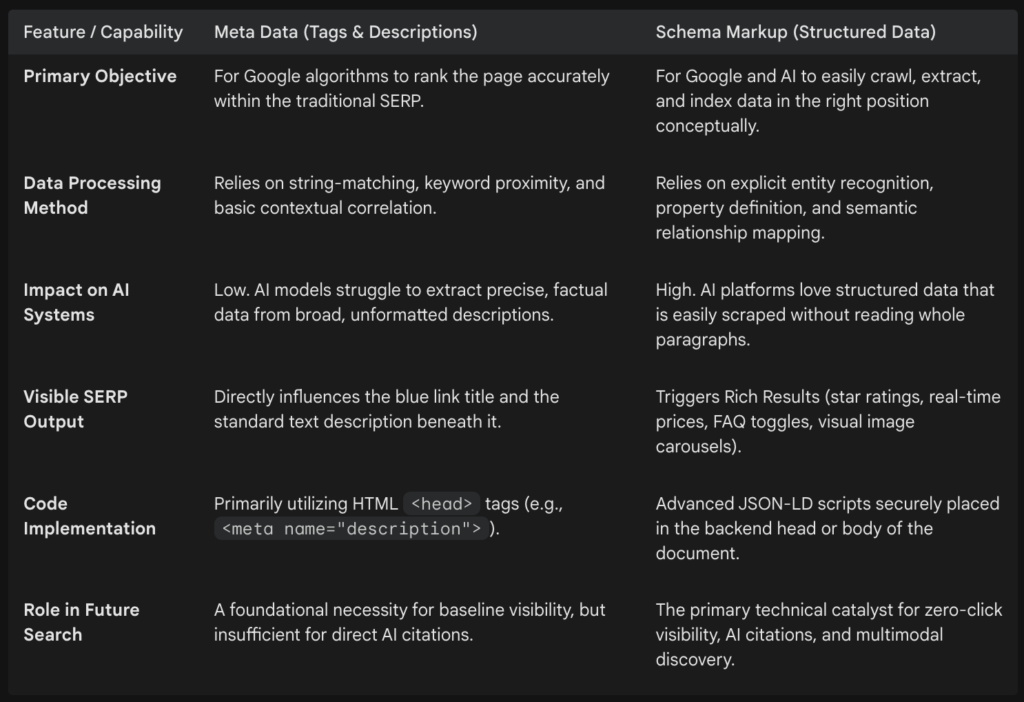
To architect a resilient digital presence, enterprises must deploy both meta data and schema markup symbiotically. However, understanding their functional divergence is crucial for appropriate resource allocation and technical deployment. The following table delineates the key differences between the two frameworks.
Generative Engine Optimisation (GEO) and Answered Engine Optimisation (AEO)
The maturation of structured data, coupled with the rapid adoption of AI search interfaces, has given rise to two distinct but highly overlapping disciplines required for digital success: Generative Engine Optimisation (GEO) and Answered Engine Optimisation (AEO). Traditional SEO Marketing frameworks are being actively replaced by these specialized optimization protocols.
The Principles of Generative Engine Optimisation (GEO)
Generative Engine Optimisation (GEO) represents a specialized approach designed specifically to appease the parsing logic and consensus layers of large language models. While traditional SEO focused heavily on backlink acquisition and keyword density to manipulate ranking algorithms, GEO demands that content be architected in a highly succinct, machine-readable format.
The execution of GEO relies heavily on the BLUF (Bottom Line Up Front) writing style. In this framework, the most critical, definitive information must be presented immediately at the top of the page in concise formats before expanding into deeper, detailed prose designed for human readers. Traditional marketing styles that bury critical answers under lengthy introductory text are actively penalized by AI systems, as GEO demands a structural style that allows for rapid aggregation by AI agents. By combining BLUF prose with comprehensive schema markup, GEO ensures that generative engines select the enterprise’s content to synthesize into their rapid, multi-source responses.
Furthermore, GEO prioritizes data serialization and tabular formatting. Information must be aggressively structured using semantic HTML elements, as LLMs exhibit a strong algorithmic preference for data presented in valid Markdown tables, ordered lists, and concise bullet points. These formats are easily extracted and verified against the broader consensus layer of the internet, increasing the probability of selection.
The Mechanics of Answered Engine Optimisation (AEO)
Answered Engine Optimisation (AEO) operates as a highly specialized subset of GEO, focusing almost exclusively on securing inclusion within direct answer boxes, AI Overviews, and conversational voice assistant outputs. The overarching goal of AEO is to capture and dominate the zero-click search market.
In 2026, organic click-through rates for traditional top results have declined significantly, as AI engines synthesize comprehensive answers directly on the results page. Data indicates that 55% of searches trigger an AI Overview, and nearly 70% of those queries end without a user clicking through to any external website. Consequently, if an enterprise is not explicitly cited within that AI-generated response, it loses the visibility battle entirely, rendering its traditional SEO efforts largely ineffective.
Measuring AI citations, monitoring assisted conversions, and tracking placements inside AI answers have become the primary Key Performance Indicators (KPIs) for AEO strategies. To achieve this inclusion, AEO relies heavily on establishing profound E-E-A-T (Experience, Expertise, Authoritativeness, and Trustworthiness) signals. Generative AI engines prioritize content based on its credibility to prevent generating mathematical “hallucinations”. Properly structured schema markup verifies this credibility by computationally linking authors to verified social profiles, linking organizations to governmental or corporate registries, and mapping the entire domain to recognized digital knowledge graphs.
Essential Schema Markup Types for AI Dominance
Because schema markup has many types—ranging from simple organizational contact data to complex interactive modules—it is vital to choose the right schema markup to help content index easily in the Google ecosystem and autonomous AI platforms. Applying inappropriate or misaligned schema can result in algorithmic confusion, whereas precise, targeted alignment ensures aggressive extraction by AI models. The digital landscape of 2026 requires the implementation of several high-priority structured data formats.
1. Paragraph Schema and Text-Block Markup
As LLMs parse vast quantities of text, they continually search for definitive, factual answers to specific micro-queries. “Paragraph schema” and related text-block structuring technologies serve as an indispensable semantic layer over the written content.
While traditional HTML simply indicates to a browser that a block of text is visually formatted as a paragraph using <p> tags, schema markup tells the AI exactly what that paragraph means computationally. For instance, schema can explicitly identify a specific text block as a definitive definition, a sequential step in a complex process, or a statistical summary of empirical data.
When AI platforms require specific data points to construct a response, they seek formats that are most easily extracted. By explicitly marking a text block with appropriate structured data, the algorithmic guesswork is completely removed. AI models can directly pull the marked paragraph as a discreet retrievable unit and index it accordingly, guaranteeing significantly higher fidelity in the AI’s final synthesized answer. This explicit declaration increases the likelihood that AI systems will accurately represent the enterprise’s content in their responses.
2. Video Schema and Transcript Integration
As generative search experiences become increasingly multimodal, blending text, imagery, and audio-visual components, AI models give disproportionate algorithmic weight to video content that is properly marked up. The VideoObject schema is critical for allowing search engines to index the video effectively and surface it in relevant carousels.
However, in the advanced AI environment of 2026, simply providing a video title, description, and thumbnail URL is deeply insufficient. The most potent application of VideoObject schema requires the injection of a full textual transcript directly into the structured data architecture. AI models utilize this transcript schema to extract semantic context and identify highly specific quotes within the video file. This granular structuring allows the generative engine to surface a specific timestamp from a multimedia video directly into a text-based AI overview, seamlessly bridging the gap between video media and textual search queries.
3. FAQ Schema and RAG Optimization
Despite significant Google core updates in March 2026 that reduced the visual display of FAQ rich results in the traditional SERP for non-governmental and non-health websites, FAQ schema remains an incredibly powerful tool for underlying AI indexation.
While the interactive toggles may no longer visually appear on a standard Google search page, the backend code remains highly active and influential in the AI ecosystem. FAQ schema structures question-and-answer content in a specialized format that aligns perfectly with the conversational nature of AI platforms. AI models actively utilize the FAQPage markup during the Retrieval-Augmented Generation (RAG) process as a massive algorithmic trust signal and a direct, verified data feed.
To optimize FAQ schema for AI Overviews, the actual prose answers nested within the schema code must be highly refined. The established “sweet spot” for AI citations is providing answers that are strictly 40 to 60 words in length. These answers must lead immediately with factual information, incorporating high entity density (specific dates, brand names, concrete statistics) rather than relying on promotional filler or introductory fluff. When FAQ schema is implemented alongside factual, 50-word answers, empirical observation shows a 2.7x higher citation rate by generative models.
4. Product, Offer, and Review Schema
For enterprises engaging in any form of digital commerce or service provision, Product schema is absolutely non-negotiable. This specific structured data communicates the exact name, comprehensive description, brand affiliation, Stock Keeping Unit (SKU), Global Trade Item Number (GTIN), and material composition of an item directly to AI indexing systems.
When Product schema is comprehensively paired with Offer, Review, and AggregateRating schemas, the AI system is provided with granular, verified data regarding pricing variables, real-time stock availability, and broad sentiment analysis. If a user asks a voice assistant or AI chat interface to “find the highest-rated corporate accounting software under 500 dollars,” the AI does not expend resources reading entire product pages. It immediately scans the structured data layers.
AI systems utilize universal identifiers like GTINs to match products against global databases, while pricing schema ensures accuracy using standardized ISO 4217 currency codes. Pages with complete, comprehensive product schema see an extraordinary CTR lift of up to 74.1% when price, rating, and availability are displayed together, and are cited up to 3.1 times more frequently in AI comparative overviews. Every empty field within the product schema is essentially an AI query that the product mathematically cannot match.
5. Speakable and Article Schema
As voice search, smart speakers, and screenless AI interfaces continue their rapid proliferation, Speakable schema has emerged as a direct, powerful signal indicating precisely which sections of an article are best suited for audio extraction. Microsoft Bing Copilot and Google’s Audio Overviews actively utilize Speakable markup to identify conversational summaries that translate well to text-to-speech outputs. By wrapping the most critical BLUF paragraph in this specific schema, an enterprise positions itself as the literal voice of authority, ensuring its content is read aloud word-for-word to users querying through mobile AI assistants.
Simultaneously, Article schema must be deployed on all editorial content to reinforce E-E-A-T signals. This is achieved by linking the content to verified author credentials using Person schema, explicit topic expertise declarations using knowsAbout properties, and professional titles using honorificPrefix. In an era saturated with automated content generation, proving human authorship and verifiable expertise through structured data is paramount for maintaining visibility.
Localized Technical Architecture: Strategies for SMEs
The theoretical application of GEO, AEO, and complex structured data must be effectively contextualized into a functional, execution-ready roadmap, particularly for regional markets. For Small and Medium Enterprises (SMEs) operating in highly competitive regions, broad, generalized digital tactics are frequently overshadowed by the requirement for localized precision. Developing an effective roadmap requires a comprehensive shift from traditional ranking metrics to advanced entity management.
The Strategic Advantage of Localized Entity Mapping
For an enterprise targeting specialized local visibility, the rigorous integration of LocalBusiness schema is paramount. This robust schema explicitly defines the exact geographical coordinates, operational opening hours, municipal service areas, and standardized local contact protocols of the organization. When autonomous AI models attempt to surface confident recommendations for localized service queries, they rely almost entirely on consistent NAP (Name, Address, Phone Number) data that has been computationally validated through organizational schema.
Furthermore, maintaining a highly consistent brand tone of voice across all digital interfaces—from standard website copy to technical documentation and social media profiles—acts as a powerful semantic anchor. Advanced AI models form complex semantic associations regarding brand identity and corporate trustworthiness. A jarring visual transition, a broken layout due to poor responsive coding, or an inconsistent digital footprint can trigger entity confusion within the AI’s internal knowledge graph, severely damaging the organization’s E-E-A-T scores. To prevent this algorithmic degradation, successful marketing consultation strategies must combine highly localized technical structures with rigorous, unwavering semantic consistency.
Executing the 70/30 Hybrid Marketing Strategy
Dominating the sophisticated digital landscape requires a highly balanced portfolio approach. Current industry consensus advocates for a 70/30 hybrid strategy: ensuring that localized technical SEO and base-level SERP optimization (utilizing rigorous meta tags and traditional indexing practices) capture the foundational 70% of the market still reliant on traditional search interfaces, while dedicating the remaining 30% of technical resources entirely to high-level Generative Engine Optimisation and Answered Engine Optimisation through complex schema deployment.
Within this framework, the strategic deployment of long-tail keywords—search phrases consisting of four or more distinct words—is uniquely essential for triggering AI indexation. These highly specific long-tail queries feed directly into the RAG architectures utilized by models like Gemini and ChatGPT, and they trigger AI-generated summaries at roughly twice the rate of broader, highly competitive terms. Furthermore, these specialized queries convert at significantly higher rates.
By developing modular content specifically designed around these localized, high-intent long-tail queries, and subsequently wrapping that content in highly precise schema markup, enterprises establish a formidable digital moat. This sophisticated architecture creates a level of authority and verifiable entity recognition that traditional competitors relying solely on outdated keyword-stuffing tactics mathematically cannot breach.
Advanced Technical Implementation and Validation
The deployment of schema markup is a highly complex engineering task that must be executed with extreme technical precision. Search engines and AI algorithms strictly evaluate code integrity and will aggressively penalize manipulative or inaccurate data structures.
The Ascendancy of JSON-LD Formatting
In 2026, the unequivocal, universally demanded standard for implementing structured data is JSON-LD. Unlike obsolete microdata formats that required developers to nest schema vocabulary directly within the visible HTML text—a practice that drastically increased code complexity, frequently broke visual page layouts, and negatively impacted Core Web Vitals—JSON-LD operates autonomously as a clean, independent script placed securely within the document’s backend head or body. This efficient methodology currently holds an 89.4% market share of all structured data implementations globally.
When deploying complex schema via JSON-LD, it is imperative to utilize stable, unchanging identifiers, particularly the @id tag, to link related entities together permanently. This advanced practice creates a cohesive, highly dense internal knowledge graph that explicitly demonstrates to the scanning AI precisely how an author relates to a specific article, how that article provides context to a video asset, and how the entire digital ecosystem is owned by the central corporate entity.
Entity Disambiguation and External Source Verification
Following Google’s significant algorithmic updates in early 2026, entity disambiguation firmly established itself as the highest-leverage schema implementation strategy available to technical marketers. Generative AI systems evaluate content credibility primarily by assessing source verification. Implementing explicit SameAs and knowsAbout properties that point directly to authoritative external identifiers—such as official government business registries, verified Wikidata entries, Crunchbase financial profiles, or established LinkedIn corporate pages—dramatically improves the AI model’s ability to accurately recognize the entity.
When an AI system can confidently, computationally resolve exactly who or what the source is, it is mathematically far more likely to select and cite that source in its final generated answer. This verifiable precision directly fortifies the critical Trustworthiness metric of the E-E-A-T framework, ensuring that the enterprise is recognized by the algorithm not merely as an opportunistic digital publisher, but as an authoritative, enduring fixture within its specific industry.
Rigorous Validation and Algorithmic Maintenance Protocols
Deploying schema markup is never a singular, isolated event; it is a dynamic process that requires ongoing validation, monitoring, and maintenance.
Implementing “schema-only” content—data that is hidden from human users via CSS but aggressively fed to AI bots through backend code—is universally classified as a critical risk factor. This manipulative practice frequently results in severe manual algorithmic penalties and complete domain de-indexing. The structured data layer must always represent an accurate, verifiable, 1:1 reflection of the primary visible content rendered on the page.
Following any technical deployment, rigorous diagnostic testing using official tools such as the Google Rich Results Test, Search Console Enhancement reports, and Schema.org validators is absolutely mandatory. Furthermore, because AI engines exhibit an overwhelming algorithmic preference for recency and freshness, actively maintaining the dateModified field within the schema architecture ensures that autonomous models continually recognize the content as highly relevant to immediate, real-time micro-queries.
The Strategic Imperative for Future-Proof Visibility
The bifurcation of digital communication strategies is now absolute. Meta data remains an indispensable, foundational requirement for ensuring standard Google SERP ranking, effectively signaling baseline topical relevance to traditional search indices. However, it is fundamentally inadequate for the immense computational demands and entity-resolution requirements of the modern generative search era.
Schema markup represents the structural data language of the future. By systematically translating unstructured web copy into highly organized, explicitly defined entity graphs, schema markup provides advanced AI platforms with the easily scraped, highly verifiable data they mathematically crave to function. Through the strategic application of carefully selected markup types—specifically video, paragraph, FAQ, and organizational schemas—digital properties can successfully transcend traditional, highly competitive ranking metrics. They achieve prominent visibility within the Search Generative Experience, capturing highly lucrative zero-click traffic through advanced Generative Engine Optimisation and Answered Engine Optimisation.
As search algorithms continue their rapid evolution, prioritizing explicit contextual understanding over rudimentary keyword density, mastering this semantic data layer remains the definitive key to sustained digital dominance. Should an enterprise be looking forward for someone to bring its SEO to another level, expert consultants are here to help execute these complex, critical technical architectures.