The Shift to AI Search (SGE & GEO): Search is evolving into AI-generated answers, meaning traditional SEO must pivot to Generative Engine Optimisation (GEO) to ensure your brand is the trusted, cited source by AI models.
The 5W1H Content Architecture: To be easily indexed and cited by AI, content must be structurally sound and factual. Using the Who, What, Where, When, Why, and How framework creates “Atomic Answers” that AI algorithms can effortlessly extract.
The Importance of E-E-A-T & Local Expertise: AI models aggressively filter out poor content to avoid “hallucinations.” Establishing strong Experience, Expertise, Authoritativeness, and Trustworthiness (E-E-A-T) through a localized Selangor SEO strategy is critical for sustainable, high-converting lead generation.
The Structural Transformation of Digital Visibility in 2026
The digital marketing ecosystem has reached a profound and irreversible inflection point. As the global economy transitions deeper into an era defined by artificial intelligence and machine learning algorithms, the fundamental mechanics of online visibility, consumer discovery, and enterprise lead generation have been structurally transformed. For small and medium enterprises (SMEs) operating within Selangor—the undisputed economic engine and commercial heart of Malaysia—relying on legacy digital tactics is no longer a viable pathway to sustainable market leadership. The integration of sophisticated Large Language Models (LLMs) has fundamentally altered how consumers retrieve critical information, evaluate competing brands, and finalize their commercial purchasing decisions.
In highly competitive, industrialized environments like Selangor, achieving high-impact market penetration demands either a substantial financial budget for immediate advertising visibility or a significant, highly strategic investment in sustainable organic growth. However, with cost-per-click (CPC) rates experiencing severe inflation across the Klang Valley, organic search is transitioning from a supplementary marketing tactic to a critical digital asset. The data indicates that industries with high average order values and extended, trust-based sales cycles—specifically industrial manufacturing, logistics, specialized healthcare, and real estate—extract the highest financial returns from targeted organic visibility.
To triple lead generation in this environment, an enterprise must abandon the outdated pursuit of sheer traffic volume and instead focus on becoming the definitive, cited authority within the modern search ecosystem. This requires a comprehensive mastery of modern SEO Marketing, a deep understanding of algorithmic consumer behavior, and the precise execution of structural content methodologies designed specifically for artificial intelligence parsers.
The Macroeconomic Pressures on Selangor SMEs
The trajectory of marketing investments in Malaysia for 2026 is intrinsically linked to the nation’s broader economic performance and the unique pressures faced by local enterprises. Selangor serves as a dynamic, high-velocity hub for commerce and technological innovation, but operating an SME within this specific ecosystem presents a unique set of macroeconomic challenges.
Enterprises are currently facing a complex “triple threat” of structural demands. The compliance ceiling is lowering, with the implementation of strict digital invoicing regulations and increasing pressure for transparent reporting, transforming the business environment into a “compliance economy”. Simultaneously, liquidity squeezes and intense competition from larger regional players force SMEs to scrutinize every marketing expenditure for maximum return on investment.
In this demanding environment, traditional advertising channels are losing their efficiency. Platforms such as programmatic display networks and social media advertising operate on a deterministic model: capital is directly converted into temporary visibility. The precise moment the capital expenditure ceases, the visibility evaporates, leaving no residual digital equity. Consequently, businesses in Selangor are pivoting toward SEO Marketing to build compounding digital assets that continuously generate leads and significantly lower their long-term customer acquisition costs.
The Evolution of Search: Embracing the SGE and GEO
For over two decades, the discipline of search engine optimization operated on a relatively straightforward premise: secure a position within the “ten blue links” on the first page of search engine results. Today, however, the digital discovery landscape has shifted entirely. Nowadays the SEO have been evolved from the normal top 10 positions become the generatie content which called the Search Generative Experience. Also knwon as the AI Overview.
Defining the Search Generative Experience (SGE)
The Search Generative Experience utilizes advanced multimodal AI models to synthesize massive datasets from across the internet, providing immediate, conversational answers directly at the top of the results page. Instead of requiring the user to click through multiple websites to gather information, the artificial intelligence functions as an autonomous research assistant, extracting facts, comparing options, and presenting a unified response.
Current industry data reveals the staggering scale of this shift. AI Overviews now appear on over 50% to 60% of all search queries in major markets, a dramatic increase from previous years. This paradigm shift has birthed the era of “zero-click” searches, where the user’s intent is satisfied instantly by the AI-generated summary without the need to visit a traditional webpage.
The proliferation of these synthesized answers has been shown to reduce organic clicks on top traditional results by an average of 34.5%, with some sectors experiencing organic click-through rate (CTR) drops of up to 61% when an AI Overview is present. While this phenomenon reduces raw, top-of-funnel traffic volume, it drastically increases the quality of the traffic that does choose to click through. Users who proceed to an enterprise website after reading an AI summary are essentially “pre-sold” on the brand’s expertise, converting at significantly higher rates than traditional organic traffic.
The Rise of Generative Engine Optimisation (GEO)
To adapt to the Search Generative Experience, a new technical discipline has emerged that must be mastered by any enterprise seeking digital growth: Generative Engine Optimisation. GEO is the highly strategic practice of structuring a brand’s entire digital presence so that large language models and AI platforms can seamlessly retrieve, accurately cite, and confidently recommend the brand within their synthesized responses.
Unlike traditional SEO, which evaluated content quality through proxy behavioral signals such as dwell time, bounce rate, and click-through rates, GEO evaluates content based on internal architectural metrics. Artificial intelligence algorithms utilize advanced natural language processing to assess factual density, structural clarity, and the authoritative weight of the source material. For a Selangor SME, mastering Generative Engine Optimisation means ensuring that when an AI model is tasked with summarizing the best local service providers or manufacturing partners, the enterprise’s digital footprint serves as the foundational source material the AI relies upon.
The mechanisms by which different generative engines select their citations vary, highlighting the necessity for a comprehensive GEO strategy. Research mapping the citation distributions across major AI models reveals the overwhelming importance of diverse, highly structured digital assets.
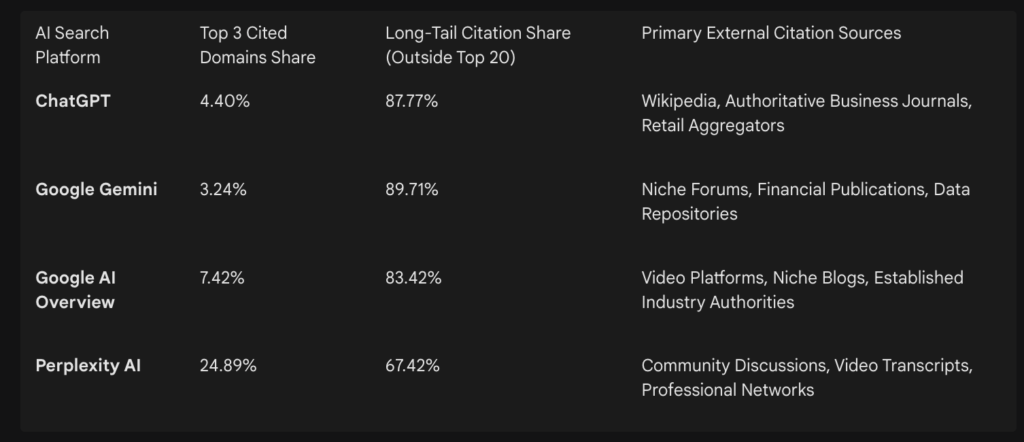
The data clearly demonstrates that the vast majority of AI citations—up to 89% in some models—come from what is considered the “long tail” of the internet. This means that an enterprise does not necessarily need to be the absolute largest website in the world to be cited; they simply need to be the most clearly understood, factually dense, and structurally optimized source for a specific sub-topic.
SGE Indexing and the 5W1H Content Architecture
One of the most significant operational advantages of the modern search ecosystem is the speed at which machine learning algorithms process structured information. SGE requires a shorter time and is very easy to index, provided the underlying content is fundamentally sound and machine-readable. The retrieval-augmented generation systems that power these AI Overviews constantly scan the web for the most accurate, concise, and definitive statements to construct their responses.
Your content need to solve the user’s concern immediately and comprehensively. AI parsers are not impressed by excessive word counts, decorative storytelling, or keyword stuffing; they are engineered to seek out factual, extractable data points. So your content direction need to be 5W1H types of content—focusing explicitly on Who, What, Where, When, Why, and How.
Deploying the 5W1H Framework for Maximum Extraction
To ensure rapid indexing and high-confidence citation, the structural direction of the content must rigidly adhere to this 5W1H framework. By systematically addressing these fundamental interrogatives, the content becomes perfectly aligned with the extraction protocols of large language models.
Who (Entity Clarity and Expertise): The content must clearly define the entities involved, backed by explicit author credentials and expert biographies. AI systems must verify who is speaking to determine if the source possesses the necessary expertise. Incorporating quotes from named experts, complete with their professional titles and organizational affiliations, acts as a high-authority signal that drastically increases the likelihood of citation.
What (Concise Definitions and Atomic Answers): The architecture of the content must prioritize immediate value. The most effective method for this is the deployment of “Atomic Answers”. This involves placing a concise, 40 to 60-word paragraph directly beneath a question-based heading. These bite-sized blocks provide precise definitions of products, services, or industry concepts without jargon. The AI prefers these structures because they are easily ingested and can be summarized or reused essentially verbatim in the AI Overview.
Where (Localized Context and Geographic Relevance): For SMEs aiming to capture regional market share, localized context is paramount. The content must explicitly declare geographic relevance, specific service perimeters, and localized expertise. This involves creating dedicated, hyper-structured pages for specific geographic locations within Selangor, such as Petaling Jaya or Shahalam, ensuring the AI can confidently match the business to “near me” or geographically modified queries.
When (Content Freshness and Recency): Artificial intelligence models exhibit a massive recency bias. Content that is older than three months often sees a sharp, dramatic drop in citation frequency. Maintaining absolute content freshness is mandatory. Organizations must schedule regular updates for their key pages, refreshing outdated statistics, adding recent examples, and incorporating new industry developments to signal ongoing relevance to the algorithms.
Why (Information Gain and Proprietary Data): To be selected over competitors, the content must demonstrate high “Information Gain”—a measure of how much new, unique information the page provides. This addresses the why by explaining underlying mechanisms, offering proprietary data analysis, and providing deep case studies that validate the enterprise’s methodology. AI models heavily prioritize unique data sets and contrarian expert opinions that cannot be found elsewhere in their training data.
How (Scannable Formats and Procedural Clarity): When addressing complex processes, the content must be highly scannable. Delivering step-by-step, actionable processes formatted in numbered lists or bullet points is critical, as AI models heavily favor these structures for procedural queries. Leading each section with the specific action required makes it exponentially easier for the AI to extract individual steps while maintaining the overall context.
By flawlessly solving the user’s concern through the execution of this rigorous 5W1H architecture, Google will reward the content with quality traffic. The search algorithm prioritizes sources that eliminate ambiguity, ensuring that the enterprise’s digital footprint becomes the definitive reference point for its specific industry.
Mastering the AI Citation Area
However SGE is not worth anythings if you are not utilise it properly. Securing a traditional ranking on the first page is no longer the final victory; the ultimate objective is to be selected as the foundational source material for the generative answer. When comes to AI Overview, Google will showcase your page in the citation area, providing a highly visible, implicit algorithmic endorsement that no standard organic listing could ever achieve.
The transition from standard search engines to intelligent “answer engines” necessitates a parallel discipline alongside GEO, known as Answered Engine Optimisation.
Answered Engine Optimisation (AEO) Mechanics
Answered Engine Optimisation operates as a highly specialized methodology specifically targeting inclusion in direct answer boxes, AI Overviews, and conversational voice assistant responses. As consumers and B2B procurement officers increasingly utilize voice search via smartwatches and home assistants, queries are shifting from disjointed keywords to complete, grammatically complex conversational sentences. The overarching objective of AEO is to secure visibility in these “zero-click” environments, establishing immediate trust with the searcher by propelling the brand directly to “Position Zero”.
To achieve this, the technical foundation of the website must be meticulously engineered to communicate directly with machine learning parsers. This communication is facilitated through advanced structured data, specifically Schema markup.
The Role of Schema Markup in Citation Selection
Schema markup acts as a direct, machine-readable translator between the website’s raw textual content and the search engine’s semantic database. It is the syntax through which a business communicates its identity, authority, and precise value proposition to the artificial intelligence. Without comprehensive schema, a business’s website is merely unstructured text—ambiguous, prone to algorithmic misinterpretation, and easily ignored by the rigorous confidence filters of modern LLMs.
Implementing specific microdata formats is absolutely essential for triggering rich snippets and securing citations in the AI Overview.
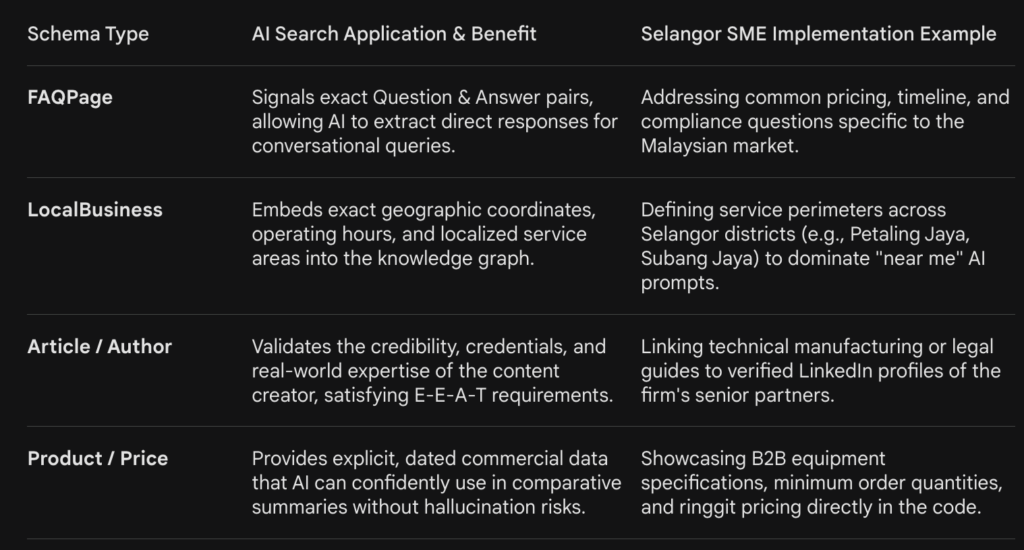
When a brand’s entities—its products, executives, geographic locations, and services—are clearly defined via these schema architectures, the AI is exponentially more likely to cite that brand accurately in a comparative summary against competitors.
Professionalism, Engagement, and the Call to Action
Securing a prominent position in the citation area successfully captures the user’s attention, but that visibility is commercially sterile if the ensuing user experience fails to convert. So in your overall content need to be professional, engaging and last but not least, the call to action for the users to engage with you.
By 2026, fluid and adaptive digital layouts dominate best practices. This fluid approach ensures that websites scale gracefully across an infinite combination of mobile devices, resolutions, and screen orientations, providing an absolutely seamless experience. When the narrative flow of a website is seamless, the cognitive load placed on the consumer is minimized. The user is intuitively guided from initial awareness, through highly educational and authoritative content, directly toward commercial interaction.
Furthermore, once the user’s immediate informational need is satisfied by the AI Overview and they click through to the cited source, there must be a clear, frictionless path to purchase. A well-optimized landing page with a definitive, contextually relevant Call to Action (CTA) acts as the critical bridge between digital visibility and tangible revenue generation. Whether the objective is to schedule a professional consultation, download a proprietary data report, or initiate a direct purchasing sequence, the CTA must be prominently displayed and logically aligned with the preceding narrative, capturing the prospect exactly when their commercial intent is highest.
Decoding Search Intent: The Core of Lead Generation
The most sophisticated technical architecture and the most elegantly written content are ultimately useless if they are deployed to attract the wrong audience. In the era of AI Search, the algorithms have evolved far beyond rudimentary keyword volume metrics; they now operate on complex semantic entity recognition designed to understand the deep behavioral psychology driving the user’s query.
Therefore, also the team need to research for the search intent of the users that are looking for your services and product. Understanding why a consumer is searching is now vastly more critical than knowing how many people are searching for a specific term.
The Danger of Blind Content Preparation
Without the Search Intent, you will be preparing the content blindly. Relying on outdated strategies that target generic, high-volume “short-tail” keywords (such as “manufacturing Malaysia” or “accounting software”) may generate superficial, top-of-funnel traffic, but it will fail catastrophically to drive measurable business leads. These broad terms represent highly ambiguous user intent; the searcher could be a student conducting academic research, a competitor analyzing the market, or a consumer seeking basic definitions.
Conversely, targeting hyper-specific, intent-driven “long-tail” conversational queries captures users at the precise moment of decision-making. For a B2B software provider in Selangor, a user searching for “SST compliant cloud accounting for Malaysia SME” has transitioned entirely out of the awareness phase and is actively evaluating solutions in the decision phase. While the raw search volume for this specific query is mathematically lower, the conversion rate and resulting revenue potential are exponentially higher.
Mastering Query Fan-Out and Semantic Clusters
To fully align with AI search intent, organizations must understand the backend technology driving the Search Generative Experience, specifically a mechanism known as “query fan-out”. When a user poses a complex, multi-layered question, AI engines do not simply search for that exact string of words. Instead, they break the long question down into a multitude of smaller, highly specific sub-queries.
For example, if a user asks an AI assistant about “best commercial solar panel installation for SMEs in Selangor,” the AI fans this out into sub-queries regarding average regional installation costs, Malaysian government tax incentives, long-term maintenance protocols, and grid-parity timelines. To dominate this intent, the enterprise’s content strategy cannot rely on a single, superficial webpage. The content must be “topologically complete,” forming a comprehensive semantic cluster that systematically addresses every single sub-query generated by the fan-out process.
If a piece of content repeatedly stuffs a primary keyword but lacks the semantic richness of related industry concepts, the vector engine will classify the page as shallow and actively exclude it from the citation area. Diagnosing these intricate intent patterns and mapping them to a comprehensive content architecture requires profound analytical expertise and access to enterprise-grade diagnostic tools.
If you want to know about your potential client search intent, do WhatsApp us for more in depth research.
This level of granular, empirical research separates high-performing, lead-generating digital assets from stagnant websites that merely consume marketing budgets without providing a measurable return on investment.
E-E-A-T Principles: The Algorithmic Trust Barrier
As artificial intelligence models scrape millions of unstructured data points across the web to generate synthesized answers, their primary operational vulnerability is “hallucination”—the authoritative presentation of false, outdated, or entirely fabricated information. To combat this critical flaw and ensure user safety, search engines have drastically elevated the importance of the E-E-A-T framework.
In the 2026 digital landscape, E-E-A-T (Experience, Expertise, Authoritativeness, and Trustworthiness) is no longer merely a set of best-practice guidelines; it is a non-negotiable, fundamental metric by which AI algorithms determine if a site is a credible source safe enough to cite. If an SME in Selangor fails to establish undeniably robust E-E-A-T signals, generative engines will actively bypass their content in favor of more credible competitors, permanently relegating the brand to digital obscurity.
Deconstructing the Four Pillars of Trust
To secure visibility and drive triple-digit lead growth, every digital asset produced by the enterprise must be meticulously engineered to project these four signals to both human readers and machine parsers.
1. Experience: The content must vividly and authentically demonstrate first-hand, real-world experience with the subject matter. Theoretical or generic knowledge compiled by inexpensive AI writing tools is actively penalized. AI algorithms prioritize content that features original datasets, proprietary market research, detailed operational case studies, and practical, ground-level applications that prove the organization has physically executed the services they are discussing.
2. Expertise: The information must be verifiably authored by recognized industry subject matter experts. The anonymous publication of corporate blogs is highly detrimental to AI citation efforts. Content must feature comprehensive author biographies that clearly outline the creator’s professional credentials, industry tenure, and specialized qualifications. Linking these biographies to active professional networks, such as LinkedIn profiles, provides the knowledge graph with the exact entity validation it requires to confirm true expertise.
3. Authoritativeness: The overall website must be recognized as a leading authority within its specific niche. This is heavily influenced by sophisticated off-page optimization and digital public relations. In 2026, AI models weigh unlinked brand mentions, expert commentary in reputable industry journals, and high-domain-authority backlinks as critical indicators of market leadership. When third-party platforms independently reference the enterprise, the AI’s confidence in citing that brand increases exponentially.
4. Trustworthiness: Trust serves as the absolute foundational pillar of the entire framework. The digital architecture must employ strict technical security protocols, such as flawless HTTPS encryption, while maintaining highly transparent business information. Clear physical contact details, comprehensive “About Us” documentation, and, crucially, verifiable customer reviews must be prominently displayed. Trust signals must be visible directly on all key conversion pages, assuring the AI that the enterprise is a legitimate, legally compliant commercial entity.
Furthermore, maintaining a consistent Brand Tone of Voice across all digital touchpoints—from guest blogs and social media profiles to technical documentation—acts as a powerful semantic anchor. This consistency solidifies the semantic associations AI models form about the company, preventing entity confusion and reinforcing overall trustworthiness.
The Strategic Advantage of Localized SEO Consultation
Executing a world-class digital strategy that harmonizes Generative Engine Optimisation, Answered Engine Optimisation, complex search intent mapping, and rigorous E-E-A-T compliance is an exceptionally intricate undertaking. Attempting to implement generic, globalized best practices without deeply ingrained localized context almost universally results in misaligned search intent, highly inefficient budget allocation, and stagnant digital growth.
For commercial entities operating within highly specific, rapidly expanding geographic markets—such as the vibrant, economically dense business landscape of Selangor—the successful application of these modernized pillars requires profound local adaptation.
Marketing Consultation vs. Automated Reporting
This is where the distinction between a traditional digital marketing agency and an expert SEO Consultant becomes critical. Business owners often view these roles as interchangeable, leading them to hire high-volume agencies that rely on automated playbooks and toxic, mass-produced content. In the 2026 digital landscape, deploying “cheap” SEO packages inevitably results in severe algorithmic penalties, causing catastrophic damage to the brand’s digital entity graph that can cost thousands of ringgit to rectify.
An expert SEO Consultant Selangor does not merely provide automated data reporting detailing superficial traffic metrics. Instead, they provide high-level Marketing consultation, acting as a strategic stakeholder in the enterprise’s long-term organic growth pipeline. They translate complex algorithmic data into clear, revenue-generating marketing directions.
A dedicated consultant understands the nuances of the Selangor market. When a user asks an AI assistant for the best specialized contractor in Selangor, the AI applies precise geographic context and draws heavily on local entity data, regional citations, and directory consistencies. A local consultant executes rigorous citation engineering—maintaining flawlessly consistent organizational profiles across platforms like Google Business Profile, local chambers of commerce, and industry portals. This hyper-localized approach ensures that the enterprise dominates the spatial parameters set by modern AI engines, capturing leads that national or generic campaigns completely miss.
Conclusion: Securing Your Digital Future
The digital marketing landscape of 2026 demands a level of technical precision, semantic relevance, and strategic foresight that was unimaginable just a few years ago. The era of optimizing for isolated keywords on a static page of ten blue links has been permanently replaced by the dynamic, intelligent, and highly synthesized responses of the Search Generative Experience.
For SMEs operating in Selangor, the pathway to tripling high-quality lead generation requires a decisive and permanent migration toward Generative Engine Optimisation and Answered Engine Optimisation. By strictly adhering to the 5W1H content architecture, meticulously researching deep user intent, deploying robust schema markup, and continuously fortifying E-E-A-T signals, businesses can ensure their digital assets are not only found by AI engines but actively cited as the definitive industry authority.
This transformation cannot be achieved through passive observation or outdated tactics; it requires the intervention of seasoned digital strategists who understand how to convert algorithmic visibility into tangible, compounding revenue. By abandoning rented advertising models and investing in highly structured organic equity, enterprises can lower their long-term customer acquisition costs and build a resilient, future-proof digital presence.
If you are looking forward for someone to bring your SEO to another level, we are here to help.