Short-Term Limitations vs. Long-Term Core Needs: A one-month engagement is solely sufficient for baseline technical auditing; it fundamentally fails to address the ongoing, foundational on-page optimizations that drive modern search visibility.
The Development and SEO Disconnect: Website development teams prioritize aesthetics and decentralized delivery, often leaving significant structural gaps that fail modern search engine requirements.
Misalignment of Goals in AI Search: Standard website fixes do not ensure indexing within AI-driven search environments; securing a presence in these new models requires continuous schema markup deployment and entity-based optimization strategies.
Can I Hire an SEO Consultant for Just 1 Month to Fix My Website?
Small and medium-sized enterprise owners frequently seek rapid, cost-effective solutions for declining digital visibility. A common inquiry within the corporate sector is whether contracting a specialist for a single month is sufficient to permanently “fix” a website and restore organic traffic. While technically feasible to execute a short-term contract, the reality of the 2026 digital ecosystem renders this approach highly ineffective and fundamentally misaligned with modern algorithmic demands. Understanding the complex intersection of contemporary web architecture and advanced search algorithms is essential for achieving sustainable, compound digital growth.
The Disconnect Between Web Development and Search Architecture
A prevalent issue in the digital sector arises from the fundamental difference in priorities between standard website development and specialized SEO Marketing. Most website development companies possess deep expertise in building aesthetically pleasing, functional, and highly interactive digital platforms. However, they frequently lack the specialized, deeply technical knowledge required for advanced search engine integration. Development teams in 2026 prioritize decentralized delivery frameworks, relying heavily on meta-frameworks and component-based architectures to ensure rapid load times and seamless user experiences across various devices.
While these development practices yield beautiful interfaces and improve developer productivity significantly through AI-first workflows , they often inadvertently create massive computational roadblocks for search engine crawlers. When an optimization team steps in to review a newly launched site, a predictable scenario unfolds: the underlying website structure does not match modern search requirements. Developers prioritize state management, API integrations, and visual rendering, whereas search algorithms require precise crawl paths, impeccable bot governance, and explicit structured data.
While an organization can certainly hire a professional for a brief period to identify these structural mismatches, it is rarely recommended as a standalone strategy. Bridging the significant gap between initial visual development and long-term algorithmic visibility requires ongoing, meticulous alignment, not a temporary architectural patch.
Why Short-Term Technical Fixes Are Not Recommended
Relying on a thirty-day contract is fundamentally flawed because repairing website architecture represents only a minute fraction of the necessary workload. This preliminary phase falls strictly under the categories of technical analysis and site auditing. During a brief engagement, a professional will thoroughly review the domain, analyzing issues such as broken rendering pipelines, conflicting canonical tags, and improper server responses. The specialist will provide strategic directions detailing precisely where the infrastructure requires improvement.
However, the completion of this technical audit does not signify the end of the optimization process; it merely signifies the creation of a functional foundation. Once this baseline technical foundation is established, the actual mechanics of digital growth begin. The subsequent steps involve rigorous, continuous on-page optimization, which represents the true core of modern search strategy.
A one-month SEO Consultation concludes exactly when the most critical execution phase should be initiating. Optimizing a site in 2026 involves constantly refining content, mapping informational intent to specific user prompts, and continuously updating data structures to match shifting algorithmic preferences. Treating optimization as a one-time maintenance task leaves the platform structurally sound but competitively stagnant, resulting in uneven exposure and highly reactive, unpredictable growth patterns.
Aligning Objectives and Goals in the Era of AI Search
The primary objective of any robust search strategy historically has been to generate high-quality traffic and secure authoritative keyword rankings. If an organization’s overarching strategies are disconnected from continuous refinement, simply fixing broken links or updating XML sitemaps will not yield meaningful results. The necessity of long-term engagement becomes even more apparent when analyzing specific corporate goals.
For example, if the overarching corporate objective is to be consistently indexed and cited within the modern Search Generative Experience, the implementation of highly dynamic, deeply nested schema markup becomes paramount. Merely “fixing” static website elements, such as improving image compression or updating SSL certificates, will not assist a brand in dominating AI search results. AI engines require continuous data feeds that explicitly translate content into machine-readable formats.
Therefore, organizations must first confirm their long-term marketing objectives. Only after establishing whether the goal is traditional keyword ranking, AI citation, or hybrid visibility should leadership seek specialized Marketing consultation to enhance the digital infrastructure accordingly. If the objective is AI indexing, a one-month fix is inherently inadequate, as AI models require constant, stable citation rates to categorize a brand as a definitive authority.
The 2026 Paradigm Shift: From Search Engines to Answer Engines
To fully comprehend why short-term interventions fail, it is necessary to examine the profound transformation of the digital search landscape. The conventional methodology of organic discovery, characterized by users manually sifting through a list of “ten blue links,” is rapidly fading. Search platforms have irrevocably evolved into complex answer engines designed to satisfy user intent instantly through synthesized, computationally generated responses. The integration of artificial intelligence into primary discovery mechanisms represents the most significant architectural shift in the history of digital information retrieval.
The Surge of AI Overviews and Zero-Click Environments
By early 2026, AI Overviews (formerly recognized as SGE) appear in at least 16% of all standard search queries, with visibility surging significantly higher for comparison shopping and high-intent informational queries. For informational queries specifically, recent comprehensive data reveals that an overwhelming 88.1% trigger AI-generated overviews directly at the top of the interface.
This deep technological integration has precipitated a dramatic, measurable change in user behavior. It has led to a record surge in “zero-click” searches, wherein users bypass the traditional information-gathering stage entirely, moving directly from query to solution without ever clicking through to a source website. Consequently, traditional organic clicks on top-ranking organic results have declined by an average of 34.5%.
While traditional organic click-through rates (CTR) are declining sharply, the aggregate volume of searches globally is increasing. The paradox of the 2026 digital landscape is that overall brand impressions are higher than ever, but traffic distribution methodologies have completely changed. Platforms utilizing large language models (LLMs) have captured massive audience shares. ChatGPT boasts over 800 million weekly active users, while Google’s Gemini application has surpassed 750 million monthly active users. For many bootstrapped software companies and enterprise SMEs alike, AI interfaces have become the foremost referral sources, effectively replacing traditional search engine results pages (SERPs).
This transition underscores precisely why a one-month technical audit is entirely insufficient for sustained business growth. Technical optimization in 2026 is no longer about simply pleasing a basic crawler to index a text-based page; it is about establishing computational reliability, verifying entity relationships, and cementing brand authority within the neural networks of large language models.
The Strategic Imperative: Generative and Answered Engine Optimisation
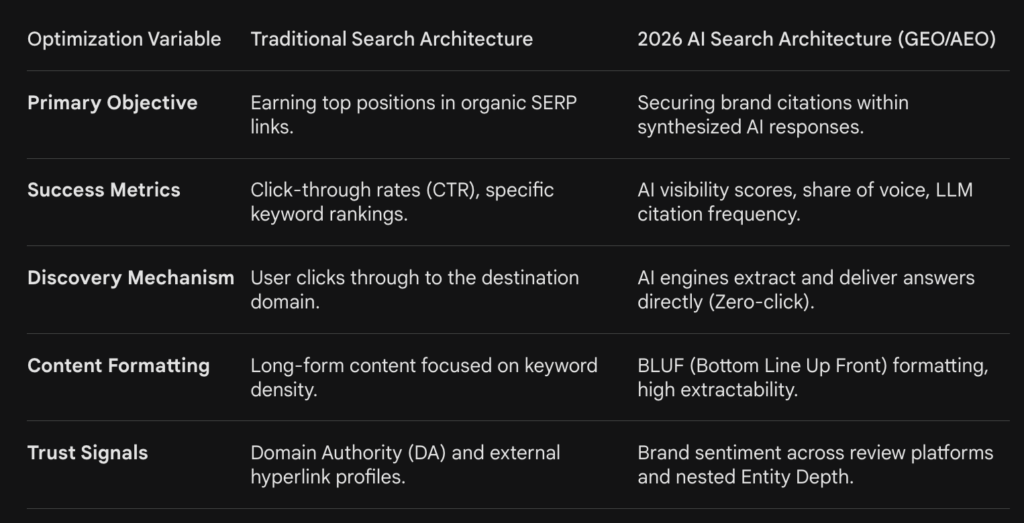
The emergence of AI-driven search has birthed highly specialized sub-disciplines that require continuous oversight: Generative Engine Optimisation (GEO) and Answered Engine Optimisation (AEO). While traditional methodologies prioritize ranking in top search positions via external backlinks and dense keyword placement, GEO focuses specifically on positioning a brand so that AI platforms explicitly cite, recommend, or mention the corporate entity when users prompt questions.
The metrics for defining success have fundamentally diverged between these disciplines. Traditional success is measured by tracking rankings, click-through rates, and page-level optimization metrics. Conversely, AEO and GEO measure success through “AI visibility scores,” citation frequency, overall share of voice across LLMs, and multi-channel brand sentiment.
The Seen & Trusted Framework
Achieving prominent visibility in generative engines requires the execution of the “Seen & Trusted” (S&T) Framework. This is a complex, multi-layered strategy demanding continuous, ongoing oversight rather than a single thirty-day diagnostic patch.
The first pillar of this framework involves the “Sentiment Battle,” which determines whether a brand is seen. AI systems do not merely retrieve brands from a database; they characterize and evaluate them based on vast amounts of ingested data. To be included in an AI response, an entity must dominate market sentiment. AI algorithms actively mine third-party review platforms (such as G2, Capterra, Amazon, and Yelp) alongside unstructured community discussions on networks like Reddit, Quora, and Stack Overflow to derive authentic context. A static, one-time website fix does absolutely nothing to influence these critical off-site trust signals. Continuous engagement, prompting detailed user reviews, and authentic community interaction are required to feed positive sentiment continuously into the LLMs.
The second pillar involves the “Citation Game,” which dictates whether a brand is trusted enough to be utilized as a verifiable source for factual claims. AI engines heavily prioritize high-confidence data sets. Establishing this trust involves publishing original, statistically significant research and securing continuous external media coverage. When reputable news outlets or industry journals cite original corporate data, a compound algorithmic effect occurs, signaling to the AI that the brand is a definitive, unassailable authority. This level of authority-building requires sustained effort over several quarters, rendering a one-month contract virtually useless for achieving these highly desirable citations.
Managing Perception Drift and Brand Identity
A critical new metric monitored by advanced data analysts in 2026 is “Perception Drift”. The future of organic digital visibility is dictated heavily by how brands establish and maintain their digital identities over time. If a brand experiences significant fluctuations or declines in its AI citation data, it clearly indicates that the underlying LLM has not been adequately trained on the brand’s sustained presence within its specific market category.
Stable, high-quality, and continuous citation rates prompt the language model to categorize the brand definitively as an “authority”. Furthermore, AI systems are aggressively shifting toward localized and highly personalized outputs, meaning geographic context and local entity data are applied to generate specific, non-generic responses. Managing perception drift requires ongoing content parity checks, multi-channel alignment, and continuous training of AI systems through highly targeted content marketing. A brief thirty-day intervention simply cannot adequately train an LLM; it merely establishes a baseline that immediately begins to decay if left unmaintained.
Technical Realities: Web Development vs. SEO Architecture
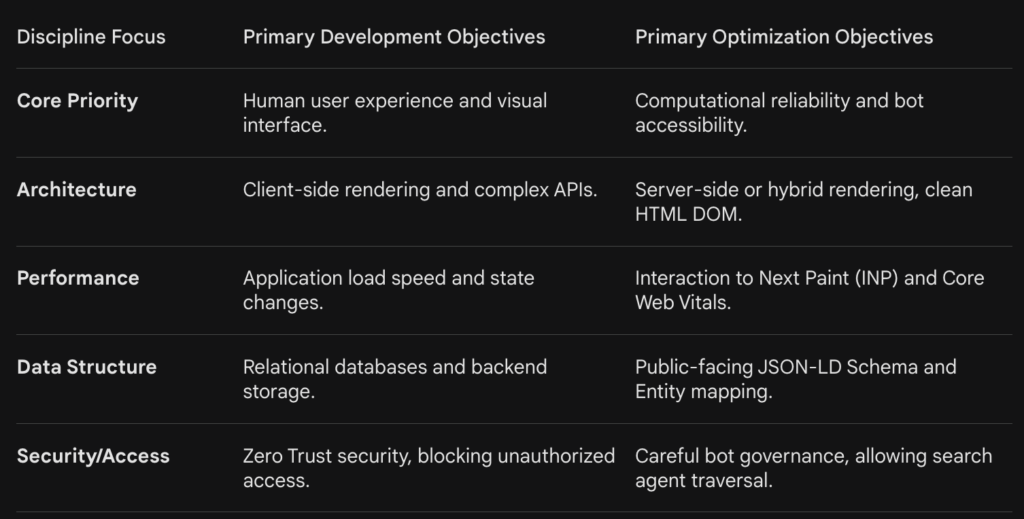
The persistent assertion that standard web development and search optimization are interchangeable disciplines remains a primary point of failure for modern enterprise infrastructure. While web development has entered a highly sophisticated new phase focusing on decentralized delivery frameworks and meta-framework architectures , the end goals of developers and search marketers frequently diverge, necessitating specialized intervention.
Decentralized Frameworks and AI-First Development
Modern web development replaces traditional, monolithic server systems with globally distributed frameworks that substantially improve load times, enhance reliability, and ensure consistent user experiences regardless of geographic location. Professional enterprise projects increasingly utilize advanced meta-frameworks, which have been shown to cut ongoing maintenance costs by up to 25% while laying the foundation for scalable, component-based architecture. Furthermore, AI-first development workflows have roughly tripled developer productivity, drastically shortening deployment cycles and allowing teams to iterate rapidly.
However, a structurally sound, blazingly fast, and visually appealing web application built on a decentralized framework means absolutely nothing if it lacks computational clarity for automated search bots. Developers naturally prioritize human user experience, complex state management, and seamless API integrations. Conversely, technical search specialists prioritize bot governance, clean crawl paths, and explicit entity extraction. Without an ongoing optimization strategy, the rapid deployment cycles enabled by modern development often introduce continuous technical errors that block search engine visibility.
The Complexity of the SEO Architectural Audit
When an optimization professional conducts a technical audit on a newly developed site, they frequently uncover deep, systemic architectural flaws inadvertently left behind during the development phase. A typical 30-day engagement is consumed entirely by identifying and attempting to rectify these gaps. Common technical gaps that require immediate remediation on newly developed sites include critical issues regarding rendering, performance metrics, and bot governance.
One major issue involves modern rendering pipelines. Google has explicitly clarified in recent updates that pages returning non-200 status codes (such as 4xx client errors or 5xx server errors) may be entirely excluded from the rendering queue. Web applications that rely heavily on client-side JavaScript rendering without implementing proper server-side or hybrid rendering fall out of the index entirely because bots cannot “see” the dynamically loaded content.
Furthermore, performance metrics have shifted drastically. First Input Delay (FID) is now considered a legacy metric; 2026 optimizations demand supremacy in Interaction to Next Paint (INP) to ensure that the site provides conversion-ready responsiveness. Ensuring INP compliance requires highly specialized adjustments to how scripts execute on the page, an ongoing task as new features are added to a site.
Bot governance has also become incredibly complex. Managing a simple robots.txt file is no longer sufficient. Developers and optimization specialists must collaborate to differentiate between beneficial retrieval agents (such as OAI-SearchBot, which drives AI citations) and non-beneficial, resource-draining training scrapers that steal content without providing citation value. Additionally, uncontrolled faceted navigation on large e-commerce platforms heavily dilutes domain authority, requiring strategic, ongoing pruning rather than a default “index everything” approach.
As observed in extensive industry case studies, executing technical optimization from scratch reveals that poor rankings are rarely due to content quality alone. They are almost universally caused by foundational errors such as schema conflicts, improper canonical tags pointing to incorrect domain versions, and rendering blocks. Building high-quality content on top of a broken technical layer is akin to building a skyscraper on sand. Fixing this foundation takes a month, but maintaining and building upon it requires years.
Structured Data: The Connective Tissue of Generative Search
If there is a single, non-negotiable technological mandate for digital survival in 2026, it is the flawless, continuous implementation of advanced Schema Markup. In the era of AI search, structured data is no longer merely an optional best practice used for earning aesthetic rich snippets; it has become the literal computational language of LLMs.
Search platforms use sophisticated AI models to interpret web pages, analyzing entities, relationships, and context to synthesize answers. Schema markup acts as the definitive “translator” that reduces ambiguity. It tells the AI precisely what the content means, who it serves, why the entity matters, and exactly how various data points interrelate.
The Necessity of Entity Depth and Complex Nesting
Simple, flat schema implementations (such as a basic tag indicating an article’s author) are no longer sufficient to guarantee indexing. Achieving high visibility in 2026 requires “Entity Depth”—complex, deeply nested structured data that allows AI agents to verify facts programmatically across the web. An optimal data architecture chains entities together logically. For example, a single page’s schema must move from defining a specific Product, nesting it under its Manufacturer, which is nested under the parent Organization, which is linked to its individual Founder.
To establish absolute, unassailable authority, modern strategy dictates linking on-page content directly to global knowledge bases. This is achieved by utilizing Wikidata IDs with mentions and about properties within the JSON-LD payload. This strict entity-based approach perfectly aligns with how AI systems operate, as they “think” computationally in interconnected entities rather than stringing together text-based keywords.
Mandatory Schema Implementation Protocols
Organizations must deploy and continuously maintain core schema types tailored specifically to their commercial operations.
Organization and LocalBusiness Schema: This feeds directly into the Knowledge Panel and provides critical geographic context (including exact address, operating hours, and accepted payments). This is highly vital as AI increasingly shifts toward localized, hyper-specific outputs for users seeking immediate local solutions.
Product and Offer Schema: This ensures accurate representation in AI-generated shopping comparisons. Highlighting precise pricing and real-time stock availability drastically reduces bounce rates from users clicking on out-of-stock items.
Review and FAQPage Schema: This provides essential social proof and generates collapsible answers directly within search interfaces. Extensive data shows that pages featuring valid structured data earn up to 35% higher click-through rates from rich results.
The actual process of generating this complex JSON-LD code has been heavily automated using powerful LLMs like Gemini 3 Flash, which can rapidly extract entities from raw HTML to output Schema.org Version 29.x compliant data. However, this rapid automation introduces severe risks that demand ongoing professional oversight, proving once again why a one-month contract is dangerous.
Content Parity and Syntax Firewalls
Search engines in 2026 strictly enforce a rule known as “Content Parity.” This means that every single property defined in the backend schema markup must be visibly rendered to the human user on the front end of the page. If AI-generated schema includes hallucinated data, extra promotional text, or hidden variables not visible on the screen, the domain will be heavily penalized for deploying “Spammy Structured Data”.
To combat this risk, ongoing technical maintenance requires the implementation of advanced Syntax Firewalls (such as Pydantic validators in Python environments) to prevent schema injection attacks and rigidly validate output against Google’s requirements before it ever deploys to the live server. Furthermore, all dates must conform to strict ISO 8601 formatting, and absolute URLs must be used over relative paths. A consultant hired for a single month cannot possibly build, test, and maintain these continuous validation pipelines. While the algorithms change constantly, properly maintained structured data acts as a counterbalance, serving as a permanent credibility infrastructure.
The Fallacy of the 40-Hour Manual Audit
Historically, a technical SEO audit consisted of a linear, 40-hour manual process culminating in a static spreadsheet containing hundreds of line items. A senior specialist would compile this list over a week, hand it to the client, and conclude the contract. By the time the internal web development team formatted and deployed the requested fixes, the deliverable was already obsolete due to algorithmic updates.
In 2026, this outdated methodology is officially defunct. The scope of optimization is now substantially wider, encompassing AI bot rendering protocols, dynamic INP assessments, and continuous verification of schema validity. Because of this increased complexity, the frequency of auditing must be elevated to a constant, rolling monthly schedule rather than a superficial annual review. Optimization is no longer about working harder through longer manual checklists; it is about utilizing integrated software and continuous professional oversight to ensure the site remains compliant.
Search engines no longer behave as simple indexers that visit a site once and file it away; they operate as continuous evaluators. They constantly assess the quality of the user experience, the stability of the structural code, the clarity of the context provided by schema, the consistency of performance metrics, and the validity of external authority signals. Businesses that treat technical infrastructure as a one-time setup experience highly uneven exposure and find themselves constantly reacting to traffic drops. Conversely, those that maintain optimization as an ongoing, integrated strategic layer build compound authority that withstands algorithm volatility.
Strategic Budget Allocation and Cross-Departmental Synchronization
Given the severe complexities of the modern search landscape, executive leadership must recalibrate how digital marketing budgets are allocated and deployed. Advanced financial data models for 2026 strongly recommend allocating 70-80% of the overall search marketing budget toward maintaining traditional SEO foundations, as these still drive the massive majority of baseline organic traffic. The remaining 20-30% must be dedicated exclusively toward advanced AI search optimization. This dual, integrated approach is absolutely essential because data proves that AI-powered platforms are converting at a rate 4.4 times higher than traditional search platforms. Brands that invest heavily in both approaches simultaneously will maintain high visibility as user search behaviors continue to evolve.
Furthermore, achieving market prominence in AI search is no longer the sole purview of an isolated technical department; it requires intense cross-departmental synchronization.
Customer Success Teams: Must actively manage the quality, length, and detail of third-party reviews to feed the AI sentiment algorithms with highly positive, descriptive data.
Product Teams: Must ensure that specific product features, pricing matrices, and technical specifications are highly extractable and clearly defined on-page, rather than hidden behind gated lead forms or complex JavaScript interactions.
Public Relations Teams: Are tasked with actively landing high-quality media citations and comprehensive analyst reports to satisfy the “Trusted” pillar of the GEO framework, proving the brand’s authority.
Technical Content Teams: Must meticulously map informational content to specific prompt intents using “Bottom Line Up Front” (BLUF) formatting, enabling maximum AI extractability without requiring the bot to parse conversational filler.
A one-month, isolated consultancy is fundamentally incapable of orchestrating this high level of inter-departmental alignment. Modern visibility requires a long-term, ongoing partnership where an SEO Consultant Selangor or equivalent specialist acts as a strategic director. This specialist ensures all corporate outputs align perfectly to form a single, cohesive “Truth Set” that AI systems can read, verify, and confidently cite without ambiguity.
The Imperative for Continuous Infrastructure Development
The overwhelming body of evidence indicates that contracting a search optimization specialist for a mere thirty days is a critical strategic error in 2026. While such a brief engagement may successfully identify baseline architectural flaws resulting from initial web development—such as repairing 404 errors, updating sitemaps, or applying basic schema tags—it completely fails to execute the continuous, compounding work required for deep digital market penetration.
The transition from traditional search engines to highly complex, generative answer engines has fundamentally rewritten the rules of digital visibility. Success in this era is no longer defined by the ability to manipulate static algorithms through dense keyword placement and exact-match anchor text. Instead, success is defined strictly by the organization’s ability to maintain a computationally reliable, structurally stable data source that AI platforms can trust, extract, and cite globally on a daily basis.
This ambitious goal requires the ongoing, error-free implementation of dynamic, nested schema markup. It requires the active mitigation of perception drift through sustained brand sentiment management across decentralized platforms. It demands the continuous governance of rendering pipelines, server responses, and bot access. For SMEs aiming to scale aggressively and capture market share, technical and on-page optimization must be viewed not as a backend maintenance task to be checked off a list once a year, but as the permanent, evolving credibility infrastructure of the organization.
Only through sustained, deeply integrated strategic alignment can a brand ensure it remains visible, highly cited, and ultimately profitable in the era of the Search Generative Experience. If an organization is looking forward for someone to bring its SEO to another level, the professionals at Woonyb are here to help. Engaging in long-term, dedicated optimization ensures that a corporate platform does not merely exist online, but actively thrives and dominates within the modern, AI-driven digital landscape.