Establish Precise Objectives and Goals: Defining these goals ensures that expectations are properly managed and that the ensuing strategy focuses on qualified lead generation rather than superficial traffic metrics.
Integrate Current Marketing Strategies: SEO functions as a supporting strategy designed to capture existing demand; therefore, solely relying on SEO is insufficient for sustained growth.
Master AI Search Capabilities and Schema: By grasping how schema markup explicitly defines content for artificial intelligence, business owners can effectively question their consultant’s AI strategy and ensure upcoming campaigns align with the latest Search Generative Experience trends.
The 2026 Digital Search Paradigm: A Watershed Moment for SMEs
The landscape of search engine optimization has undergone a profound metamorphosis by the year 2026. The traditional methodologies of the past decade—which predominantly focused on securing top positions among ten blue links through repetitive keyword density and rudimentary backlink acquisition—have been permanently disrupted by the deep integration of artificial intelligence. Industry analysts have accurately tracked the realization of predictions indicating that traditional search engine volume would experience significant declines, with search marketing losing substantial market share to AI chatbots and virtual agents. As artificial intelligence models reach billions of users globally, the fundamental behavior of the digital consumer has shifted from seeking a list of resources to demanding immediate, synthesized answers directly on the results page.
For Small and Medium-sized Enterprises (SMEs), this algorithmic paradigm shift represents both a formidable operational challenge and an unprecedented commercial opportunity. The modern search environment mandates that optimization can no longer be treated as an isolated, one-time technical exercise relegated to the IT department. Instead, it has evolved into a holistic, multidisciplinary endeavor that intersects deeply with brand identity, user experience design, public relations, and highly technical semantic structuring. Websites possessing strong brand signals and comprehensive cross-platform visibility demonstrate far superior resilience against the continuous, aggressive updates deployed by major search engines.
Consequently, when SME business owners prepare to engage in an SEO Consultation, the initial dialogue must transcend basic rank tracking and keyword brainstorming. A modern, effective consultation requires a strategic alignment of the organization’s overarching commercial operations with the technological realities of the Search Generative Experience. The ensuing sections of this comprehensive report provide a nuanced, exhaustive framework detailing the precise preparatory steps, conceptual understandings, and strategic alignments an organization must establish prior to initiating dialogue with a search optimization professional.
Defining Your Objectives and Goals Before Engagement
The foundation of any successful digital partnership is built upon the alignment of technical deliverables with commercial realities. Before engaging with any marketing strategies, you need to know about your objective and goals. The technical mechanics of search optimization are merely tools; their efficacy is entirely dependent upon the architectural blueprint they are meant to construct. When the goals are firmly confirmed prior to the first consultation, it becomes exponentially easier to manage your expectations and define Key Performance Indicators (KPIs) that truly matter to the operational health of the enterprise.
The Fallacy of Traffic and the Focus on Conversion
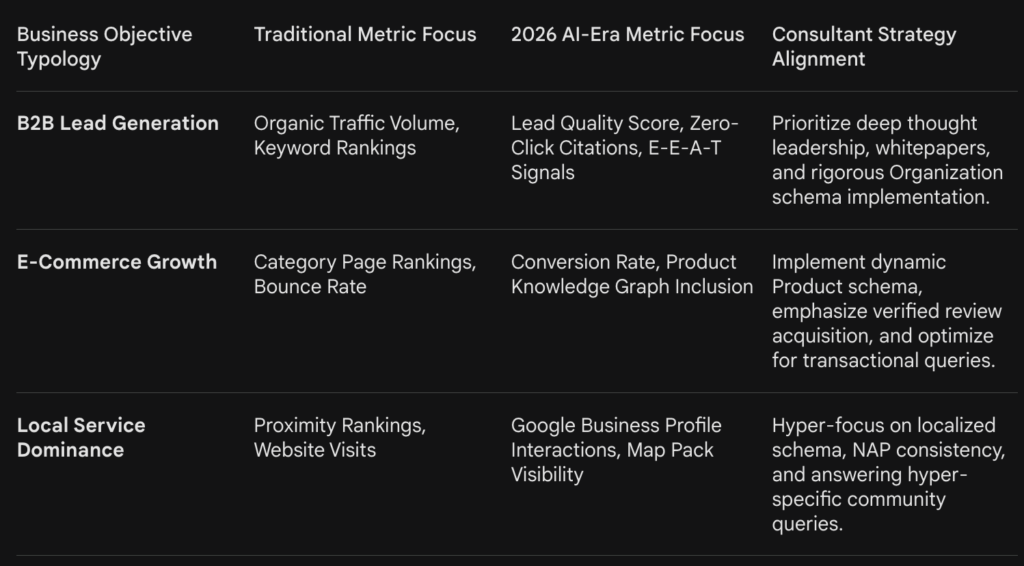
Historically, businesses approached search engine optimization with a singular, often flawed focus on increasing raw organic traffic volume. However, in the context of 2026, traffic alone is a highly deceptive metric. The proliferation of AI Overviews and synthesized answers has been shown to reduce organic clicks on top traditional results by an average of 34.5%. If an organization’s sole objective is to increase top-line visitor numbers, the resulting strategy will likely fail to generate a positive return on investment. The modern objective must be tethered to lead quality, user engagement, and ultimate conversion rates.
During the preparatory phase, business leaders must explicitly define what constitutes a successful commercial outcome. The consultant needs to know if the primary goal is to drive localized foot traffic to a physical storefront in a specific geographic zone. Alternatively, the objective might be to increase the volume of highly qualified Business-to-Business (B2B) leads submitting consultation requests, or the focus could be directed toward scaling transactional volume across an e-commerce platform. By articulating these precise, outcome-oriented goals, the SEO consultant can reverse-engineer a content and technical strategy that prioritizes the user journey and conversion optimization over mere visibility.
Establishing Financial Metrics and Timelines
A critical component of objective setting involves understanding the financial mechanics of search visibility and clearly communicating these constraints during the SEO Consultation. Organizations must calculate and document their baseline metrics, including the current Customer Acquisition Cost (CAC), the Lifetime Value (LTV) of a client, and the average profit margin per transaction. By bringing these specific financial figures to the initial meeting, the dialogue instantly transitions from abstract technical jargon to ROI-focused strategic planning.
This mathematical approach allows the strategist to construct realistic forecasting models and prioritize technical interventions that offer the highest immediate commercial impact. Furthermore, establishing the objective of long-term brand authority rather than overnight lead generation is vital for a productive consulting relationship. A fundamental truth that must be acknowledged prior to the first meeting is that search engine optimization remains a long-term, compounding investment. Unlike paid advertising, which ceases to generate visibility the exact moment funding is halted, organic strategies build lasting digital equity. However, this equity requires temporal maturation. The integration of advanced semantic strategies requires search engine models to crawl, parse, verify, and synthesize new structural data into their vast knowledge graphs—a computational process that typically spans several weeks to months.
Integrating Current Marketing Strategies for Synergistic Growth
A pervasive and damaging misconception among business owners is the belief that SEO operates in a vacuum, entirely divorced from other promotional activities. In reality, SEO is a supporting strategy designed to systematically bring you the leads and explicitly improve on your conversion rate. Because of the multi-faceted nature of modern algorithms, solely relying on SEO is insufficient to achieve market dominance. Search engines in 2026 evaluate websites through the rigorous framework of E-E-A-T (Experience, Expertise, Authoritativeness, Trustworthiness), and these critical signals are rarely generated by on-page content alone. They are heavily influenced by the brand’s broader digital footprint and real-world reputation.
The Necessity of Omnichannel Transparency
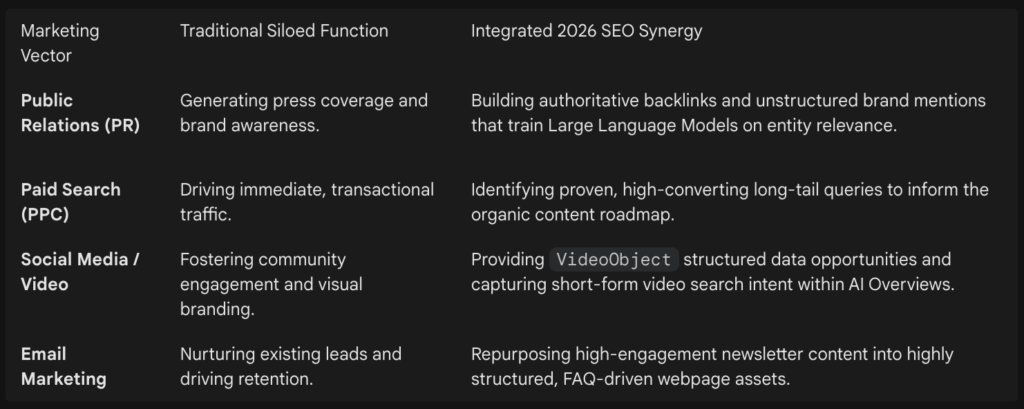
If there are any additional marketing strategies that the internal team or external agencies have carried out, these details must be shared comprehensively with the consultant during the very first Marketing consultation. When multiple strategies are aligned, they produce powerful synergistic effects that will bring a better result to the entire team. Before the meeting, compile a highly detailed inventory of all active, paused, and historical marketing vectors.
The consultant requires deep visibility into public relations campaigns, as digital PR generates high-authority backlinks and natural brand mentions, which serve as critical validation signals for both traditional ranking algorithms and AI source selection protocols. Social media management is equally vital; authentic community engagement on platforms like LinkedIn or localized forums provides essential behavioral data and alternative discovery channels that signal brand legitimacy to search evaluators.
Furthermore, historical performance data from paid advertising—such as Google Ads or programmatic display campaigns—provides invaluable, immediate intelligence regarding high-converting search terms and specific audience demographics. By analyzing this paid data, the SEO consultant can eliminate months of exploratory keyword guesswork and immediately target the specific semantic entities known to drive revenue.
The Omnichannel Data Loop
By providing the search professional with unhindered access to the data generated by these diverse channels, the organization enables the creation of a synergistic data loop. For instance, if the digital marketing team notes that short-form video content regarding a specific product feature is generating massive engagement across social platforms, the SEO consultant can immediately prioritize optimizing the corresponding website landing page. They can implement specific structural code to capture the inevitable surge in secondary organic search queries related to that trending topic. When the consultant is made completely aware of all moving parts within the organization, they can orchestrate an overarching digital strategy that amplifies the efficacy and reach of every individual marketing effort.
Navigating AI Search Capability: The New Frontier
The technological foundation of information retrieval is evolving at an unprecedented, almost chaotic velocity. Industry professionals frequently note that SEO evolves every 2 days, driven by continuous micro-adjustments to natural language processing models and the rapid deployment of new generative features by major tech conglomerates. If you want to expand further into SEO and secure long-term digital viability, it is absolutely essential to look beyond the ten blue links. The business owner must comprehend the mechanics of Generative Engine Optimisation, Answered Engine Optimisation, and the overarching Search Generative Experience.
During the initial meeting, you must ask the SEO consultant what their specific, actionable plan is regarding AI Search capability. This crucial line of questioning ensures that your upcoming strategies are being strictly aligned with the latest trends, guaranteeing that the organization’s digital assets are optimized for machine synthesis rather than just human readability.
Deciphering the Search Generative Experience
The Search Generative Experience represents a fundamental, irreversible evolution in both user behavior and technological delivery. Traditional search engines operated as digital librarians, presenting a list of hyperlinks and leaving the human user to sift through multiple web pages to compile a satisfactory answer. Modern generative engines, powered by advanced Large Language Models, operate entirely differently. They crawl the web not merely to index pages, but to deeply understand, extract, and synthesize key information from a multitude of sources, weaving this data into a cohesive, context-rich narrative delivered directly on the results page.
This zero-click environment requires website content to be optimally structured for algorithmic extraction. AI Overviews and virtual assistants evaluate millions of potential sources to construct a single, authoritative answer; if a website’s content is poorly formatted, lacks clear hierarchical structure, or is devoid of verifiable citations, it will be entirely excluded from the generative response—even if the underlying prose is expertly written.
The Triad of Modern Optimization Strategies
To facilitate a highly strategic discussion with the consultant, SME leaders must understand the distinct yet overlapping disciplines of modern search optimization, which function together as a unified triad.
The first component is traditional Search Engine Optimization (SEO). This remains the practice of optimizing web pages to rank highly in standard organic search results, focusing on crawling, indexing, keyword relevance, backlink profiles, domain authority, and user page experience. Traditional SEO remains highly vital for capturing users who are executing deep, investigative research or seeking complex transactional avenues where they wish to compare multiple vendors manually.
The second component is Answered Engine Optimisation (AEO). This is a highly targeted, structural strategy that focuses on formatting content to appear seamlessly in featured snippets, voice assistant responses, and localized answer boxes. AEO strictly prioritizes providing clear, direct, and unembellished answers to specific user queries—the “who, what, when, where, and why” of an industry. It leverages meticulous structured data to secure inclusion directly on the results page, catering to the growing demographic of users demanding immediate, factual data without clicking through to a website.
The third, and arguably most complex, component is Generative Engine Optimisation (GEO). This is the most advanced frontier of the industry, focusing specifically on how Large Language Models retrieve, evaluate, and cite information during the synthesis process. GEO emphasizes natural language processing, semantic entity relationships, and extreme contextual relevance over traditional keyword density. The ultimate objective of GEO is to ensure that when an AI chatbot or search engine overview synthesizes a response regarding a specific industry or service, the organization’s brand is explicitly cited, recommended, and sourced within the generated narrative. Earning a place among the highly limited number of domains that language models cite delivers an implicit algorithmic endorsement that no standard organic listing could ever achieve.
The Technical Imperative: Understanding Schema Markup and Structural Data
If an organization wishes to survive and thrive in the era of AI-driven search synthesis, mastering the conceptual application of structural data is entirely non-negotiable. To prepare for a productive consultation, you need to know what the schema markup and structural data look like, and understand the profound mechanism by which they communicate with search engines.
The Mechanism of Schema Markup Explained
To properly explain the schema markup, one must view it as the foundational translation layer between human language and machine comprehension. At its core, schema markup is a highly standardized vocabulary of code—most effectively and cleanly deployed in the JSON-LD format—that acts as explicit “subtitles” or “labels” for web content. While a human user can look at a webpage and intuitively understand that a specific sequence of numbers represents a product’s price, or that a particular block of italicized text is a customer review, artificial intelligence systems require explicit programmatic confirmation to utilize that data confidently.
Without the implementation of schema markup, AI systems are forced to infer meaning based on surrounding context, a computationally expensive process fraught with ambiguity and potential error. Schema eliminates this ambiguity entirely. For example, it programmatically differentiates whether the word “Apple” on a webpage refers to the botanical fruit or the multinational technology corporation. By explicitly defining content types, contextual relationships, and entity properties, schema guides the artificial intelligence along a clear, mathematically verifiable path from a raw keyword, to a recognized entity, and ultimately into the engine’s overarching Knowledge Graph.
How AI Systems Utilize Structural Data
When processing complex, conversational user queries, AI systems and generative engines rely heavily on schema to perform several critical extraction and verification functions. First, it allows for immediate content identification, rapidly determining if a page is definitively an Article, a Product page, a How-To guide, or a repository of Frequently Asked Questions. Second, it enables precision extraction, allowing the AI to pull precise data points—such as pricing, stock availability, or operational hours—without relying on flawed algorithmic interpretation of the surrounding text. Third, it facilitates information verification by cross-referencing the claims made within the structured code against established global knowledge bases to confirm factual accuracy. Finally, it guarantees accurate source attribution, ensuring that when the generative engine synthesizes a response, it correctly credits the original source with proper context and a functional citation link.
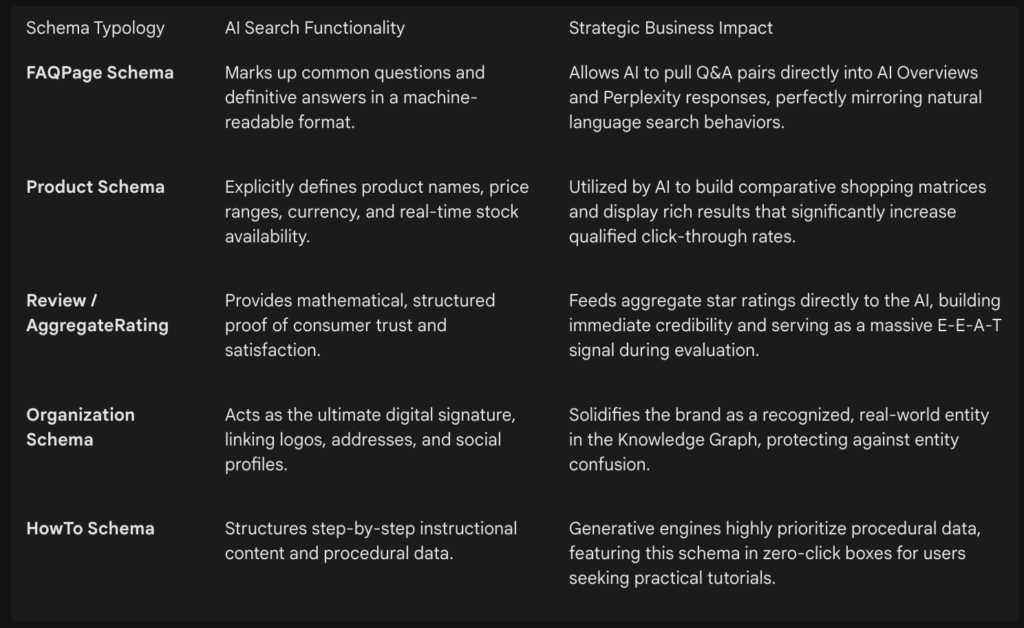
Implementing comprehensive schema markup represents a fundamental shift toward semantic web principles, where the absolute meaning of content is explicitly defined rather than merely inferred by algorithms. Empirical data indicates that websites with properly validated and accurately mapped structured data experience significantly higher click-through rates and vastly superior positioning within emerging AI search technologies. During your meeting, with this knowledge firmly in hand, you must ask the SEO consultant about their plan on the AI Search capability to ensure your upcoming strategies are being aligned with the latest trend. Their ability to articulate a clear strategy for generating, implementing, and constantly validating this JSON-LD code against strict engine requirements is a definitive test of their modern competency.
Localized Dominance: The Selangor SME Landscape
For organizations operating within specific geographical ecosystems, the consultation must address the nuanced, hyper-competitive mechanics of local search algorithms. Engaging an SEO Consultant Selangor requires a deep understanding of the region’s specific digital maturity, rapid economic expansion, consumer behavioral trends, and competitive density.
Economic Drivers and Digital Adoption in Selangor
The digital economy is a massive, accelerating driver of commercial activity, with regions like Selangor demonstrating explosive growth and highly sophisticated consumer bases. The state’s population forms a diverse, highly urbanized, and high-income consumer market characterized by immense smartphone penetration and an intrinsic reliance on mobile search for daily decision-making. As a direct result, consumer demand spans rapidly moving, high-growth sectors such as retail shopping, food manufacturing and halal sectors, advanced logistics, aerospace maintenance, and sophisticated healthcare technology.
In this hyper-competitive, technologically fluent environment, digital transformation is no longer merely an operational upgrade; it is a fundamental, existential requirement for business survival. Businesses are dealing with an ecosystem where users execute conversational, highly localized queries—such as seeking precise recommendations for nearby sustainable supply chain solutions or specialized medical services. The search strategy proposed by the consultant must be aggressively localized to capture this hyperlocal intent. General, broad-stroke SEO tactics designed for international audiences will completely fail to penetrate the highly specific search patterns of the domestic Malaysian market.
Local SEO Mechanics in a Zero-Click World
Local SEO in 2026 transcends simply placing a city name in a meta title or header tag. It requires adapting to sophisticated AI-powered local packs, managing the industry-wide decline of traditional organic click-to-call rates, and optimizing for extreme proximity and relevance through advanced algorithmic signals.
A critical component of this localized strategy—which must be a central topic of your consultation—is the comprehensive, ongoing optimization of the Google Business Profile (GBP). The consultant should be prepared to discuss a complex multi-location architecture if the enterprise operates multiple branches , and emphasize the absolute necessity of maintaining perfect Name, Address, and Phone Number (NAP) consistency across the entire web ecosystem.
Furthermore, proactive utilization of all available GBP features is mandatory. This includes categorizing services with microscopic precision, uploading high-quality localized multimedia regularly, and pre-seeding the Q&A section with accurate, schema-backed answers. These actions provide the local AI algorithms with the rich, verified, and continuously updated data required to confidently recommend the SME to nearby consumers over a less-optimized competitor. The consultation should establish a clear cadence for review acquisition and management, as local algorithms heavily weight review velocity and sentiment analysis when constructing the local map pack rankings.
The Preparation Blueprint
The digital ecosystem of 2026 is uncompromising in its demand for technical excellence and strategic clarity. The rapid evolution of artificial intelligence, the mass implementation of the Search Generative Experience, and the increasing complexity of localized search algorithms have permanently rendered obsolete the simplistic optimization tactics of the past decade. For SMEs striving to capture and expand their market share, visibility is no longer guaranteed by sheer volume or keyword repetition; it is painstakingly earned through digital authority, technical precision, and absolute clarity of commercial purpose.
Preparing for an SEO consultation requires an organization to look deeply inward before looking outward. It demands the explicit definition of commercial objectives, ensuring that every digital maneuver proposed by the consultant is tied directly to revenue generation, lead qualification, or brand preservation. It requires a holistic, integrated mindset, where SEO is not viewed as a solitary operational function, but as a deeply integrated supporting pillar that amplifies the efficacy of all other marketing endeavors. Furthermore, it necessitates technical vigilance. Understanding how advanced mechanisms like schema markup act as the foundational language communicating with AI search models is essential for any business leader attempting to navigate this new frontier.
The organizations that will thrive in this highly competitive era are those that reject the notion of optimization as a one-time configuration, embracing it instead as an ongoing, strategic adaptation to the mechanics of human and machine inquiry. By utilizing the frameworks, technical methodologies, and strategic alignments detailed within this comprehensive guide, businesses can enter their consultations equipped to build resilient, high-performing digital architectures.
If you are looking forward for someone to bring your SEO to another level, we are here to help. By combining deep technical proficiency with an intimate understanding of complex SME business objectives and emerging AI search capabilities, specialized experts are uniquely positioned to architect search strategies that dominate the algorithmic landscapes of today and tomorrow.