Demand a Complete Scope of Work: Ensure the proposal comprehensively covers the four essential pillars: on-page semantic optimization, advanced technical audits, ethical off-page strategy, and cutting-edge AI Search Capability. Missing any pillar is a definitive red flag.
Prioritize Strategic Consultation Over Reporting: Automated reports only prove the technical work was executed; the true business value lies in the immediate follow-up marketing consultation where experts translate raw data into actionable business intelligence.
Establish Clear Communication Protocols: Because SEO is an intangible service requiring 4 to 6 months to mature, require clear communication frameworks regarding meeting schedules, deliverables, and realistic timelines for compounding growth.
Methodologies for Evaluating and Comparing SEO Agency Proposals for SMEs in 2026
The digital marketing ecosystem has undergone a radical transformation, evolving from a straightforward system of keyword-based indexing to a highly complex, artificially intelligent semantic web. For small and medium-sized enterprises (SMEs), navigating this evolution is no longer merely a matter of marketing strategy; it is a fundamental requirement for business survival and revenue generation. Selecting the correct digital marketing partner in this environment is a critical strategic imperative. Comparing two Search Engine Optimization (SEO) quotes in 2026 requires a highly sophisticated, nuanced understanding of emerging algorithmic behaviors, artificial intelligence integration, structural service agreements, and the intrinsic value of strategic advisory.
Because SEO is an inherently intangible product—representing a future promise of visibility rather than a physical asset—decision-makers cannot inspect a prototype before committing capital. Instead, enterprise leaders must evaluate the architecture of the proposed strategy, the transparency of the communication frameworks, and the precise delineation of deliverables. As search algorithms transition definitively from retrieving localized blue links to generating synthesized, AI-driven answers, the criteria for evaluating an SEO proposal have expanded exponentially.
An exhaustive analysis of modern service agreements reveals that successful partnerships hinge on strict adherence to comprehensive scopes of work, proactive communication protocols, and the critical distinction between automated data reporting and high-level marketing consultation. This exhaustive report delineates the exact mechanisms, financial models, psychological consumer shifts, and strategic pillars that define a robust SEO Marketing contract in 2026, equipping SME leaders with the analytical depth required to make empirical, data-driven partnership decisions.
Artificial Intelligence and the Evolution of Discovery
To effectively evaluate an SEO quote, one must first possess a comprehensive understanding of the environment the proposed services are designed to manipulate. The year 2026 represents a definitive inflection point in digital discovery, characterized by the omnipresence of generative artificial intelligence within core search algorithms. The integration of AI has fundamentally altered how consumers and B2B buyers search for, interact with, and consume information, permanently shifting the focus from traditional positional ranking metrics to authoritative presence within AI-generated responses.
The Rise of Generative Engine Optimisation and Answered Engine Optimisation
When evaluating vendor proposals, it is essential to recognize the profound impact of the Search Generative Experience (SGE). Major search engines and independent AI platforms—such as Google’s AI Overviews, OpenAI’s Search, Microsoft Copilot, Perplexity, and Claude—now synthesize data from across the web to provide immediate, conversational answers. This technological shift has introduced two critical new disciplines that must be reflected in any modern SEO quote: Generative Engine Optimisation (GEO) and Answered Engine Optimisation (AEO).
Traditional SEO focused almost exclusively on traditional search engine rankings, attempting to push a specific URL to the top of a results page. Conversely, Generative Engine Optimisation is the practice of optimizing content to appear directly within the responses generated by AI-powered search engines. Instead of competing to be the top link on a page, the content is competing to be part of the synthesized answer itself, effectively serving as the foundational knowledge the AI utilizes to inform the user.
The ramifications of this shift are statistically significant. Industry data from 2026 indicates that AI Overviews and summarized search results have reduced organic clicks on traditional top results by an average of 34.5%. When an AI overview successfully handles the initial research phase—synthesizing pricing, comparisons, and basic facts—users often have their search intent satisfied without ever needing to click through to a traditional website, resulting in a massive rise in “zero-click” searches. Consequently, brands have lost their traditional B2B mechanism of discovery through standard search clicks.
The Psychological Shift in Consumer Search Behavior
However, while click-through rates on standard links have compressed, overall search volume and total query impressions have increased. Users are engaging more frequently and conversationally with generative engines, asking highly complex, multi-variable questions that previously would have required hours of manual research across dozens of websites.
In this new reality, if an AI-generated answer mentions an enterprise’s brand, product, or service, that business is instantly injected into the consumer’s consideration set. If there is no mention, the business effectively does not exist in the modern buyer journey. Furthermore, user intent has bifurcated. While top-of-funnel informational queries are often resolved entirely within the AI interface, the clicks that do occur have shifted to much deeper, high-intent queries, such as specific local providers, detailed pricing consultations, and direct transaction initiations.
Implications for Evaluating Agency Proposals
This dynamic necessitates a dual-pronged approach in any modern SEO proposal. Traditional technical and organic ranking optimization must be seamlessly paired with GEO and AEO strategies. If an agency’s proposal focuses solely on legacy metrics—such as attempting to secure the number one positional ranking for a specific, high-volume short-tail keyword without addressing AI synthesis—it demonstrates a critical, fatal misunderstanding of the current digital ecosystem. The objective for SMEs in 2026 is not merely to rank on a page, but to be explicitly cited, referenced, and trusted by the AI assistants that now govern global information retrieval. The absence of AI-specific optimization strategies within a service proposal is a definitive indicator of an outdated approach, rendering the quote functionally obsolete.
The Four Mandatory Pillars
The foundational element of any SEO proposal is the Scope of Work (SOW). A meticulously crafted SOW serves as the binding operational blueprint for the campaign, detailing the exact methodologies, deliverables, timelines, and resource allocations the agency intends to deploy. In evaluating competitive quotes, the SOW must be scrutinized for both breadth and depth.
A proficient, enterprise-grade SEO contract in 2026 must unequivocally cover four distinct strategic pillars: On-Page Optimization, Technical Audit and Architecture, Off-Page Optimization, and AI Search Capability. If any of these four pillars are missing, vague, or inadequately defined, the proposal presents a severe red flag and should be rejected.
Pillar 1: On-Page Optimization and Semantic Architecture
On-page optimization remains the bedrock of contextual relevance. However, the execution methodology has evolved far beyond the primitive insertion of target phrases into header tags. A modern proposal must detail advanced strategies for intent-based content architecture, semantic entity optimization, and the rigorous reinforcement of E-E-A-T (Experience, Expertise, Authoritativeness, and Trustworthiness) signals.
Intent Matching and Content Structuring
The agency should propose a comprehensive audit of all existing digital assets, identifying content gaps and mapping new assets to specific, nuanced stages of the modern user journey. Gone are the days of stuffing pages with random phrases. Modern SEO demands an intent-focused keyword strategy, understanding precisely why users are searching and matching the content to those underlying motivations.
Furthermore, generative engines inherently favor structured, succinct content that provides immediate, definitive answers. Therefore, the on-page strategy detailed in the SOW must include specific formatting tactics designed to appease AI parsers. These tactics include:
Providing an immediate, definitive answer at the very top of a section before expanding on the underlying details.
Utilizing direct, authoritative language, as AI models favor specific, clear statements and statistically discount hedged or ambiguous phrasing.
Building comprehensive FAQ sections that address natural, long-tail follow-up questions rather than just the primary topic.
Structuring content into distinct topic clusters, where highly interlinked internal pages provide comprehensive, exhaustive coverage of a subject, thereby establishing deep topical authority.
E-E-A-T and Freshness Signals
The proposal must also address the human element of content creation. AI platforms are programmed to prioritize human expertise. The SOW should outline the optimization of author bios, the display of verified credentials, and complete source transparency to align with Google’s E-E-A-T framework. Additionally, the proposal must outline a schedule for continuous content review and refinement. Setting a visible revision schedule sends vital “freshness” signals to both traditional web crawlers and AI models, ensuring the content remains eligible for citation in real-time generative responses.
Pillar 2: Technical Audit and Algorithmic Parity
The technical pillar ensures that a website possesses the architectural integrity and code efficiency required for seamless crawling, rendering, and indexing by both traditional bots and advanced AI agents. A proposal lacking a deep, highly specific technical roadmap is fundamentally flawed.
Core Web Vitals and User Experience
The SOW must include provisions for a comprehensive technical audit that rigorously addresses site speed, mobile responsiveness, server latency, and overall Core Web Vitals. Google’s algorithm increasingly favors sites that provide a frictionless user experience. In 2026, a slow, poorly rendered, or navigationally confusing website not only damages traditional rankings but also actively deters the AI agents that scrape the web for real-time information. The SOW must commit to continuous performance monitoring and iterative UX improvements.
Structured Data: The API Contract with AI
Crucially, in the context of 2026, the technical scope must heavily emphasize advanced structured data implementation. Schema markup acts as the literal API contract between a business’s website and global AI systems. Without properly formatted schema, LLMs (Large Language Models) struggle to parse the specific context of the data they are scraping.
A high-quality SEO quote will explicitly specify the deployment of advanced schema types, including:
FAQPageschema to feed direct questions and answers to AI overviews.HowToschema for step-by-step procedural queries.Articleschema with proper, verified author attribution to satisfy E-E-A-T requirements.Organizationschema with extensivesameAsproperties, linking the brand to its social profiles, Wikipedia entries, and corporate directory listings.Datasetschema for original research content, which AI models heavily rely upon for statistical citations.
These elements allow language models to instantly understand the exact nature of the content, the credentials of the author, and the corporate entities involved, facilitating accurate retrieval, compliance, and citation. Furthermore, any technical SEO quote must address the management of crawl budgets, the resolution of complex rendering issues in JavaScript-heavy web applications (such as React or Angular sites), and the strategic use of semantic internal linking to distribute PageRank and establish clear hierarchical context.
Pillar 3: Off-Page Optimization, Brand Resonance, and Digital PR
Off-page optimization is historically the most resource-intensive and opaque pillar of SEO, and consequently, it is the area where lower-tier or unethical agencies attempt to cut corners to maximize their profit margins. A rigorous SEO quote must detail ethical, high-quality strategies for link acquisition, digital public relations, and holistic brand building.
The Danger of Toxic Link Acquisition
Evaluating the off-page section of a quote requires extreme vigilance. Bulk link purchasing, opaque “private blog network” (PBN) placements, or guarantees of a specific number of backlinks per month are severe red flags. These indicators point to high-risk, black-hat methodologies that violate search engine guidelines and can result in catastrophic manual algorithmic penalties, effectively removing the SME from search results entirely.
Citations and Brand Mentions
Instead of focusing purely on link volume, a modern off-page scope should focus on targeted digital PR, securing unlinked brand mentions, and fostering authentic community engagement. Because generative engines do not operate on a traditional positional ranking system, the frequency, context, and sentiment of brand mentions across the broader web are massive drivers of AI visibility. To secure these valuable citations, brands must establish a robust, highly visible presence on third-party platforms, reputable aggregate websites, industry-specific forums, and social media ecosystems.
Brand Tone of Voice: The Semantic Anchor
A critical, highly sophisticated component of off-page optimization that elite agencies will include in their SOW is the development and enforcement of a consistent Brand Tone of Voice. Brand tone shapes how an audience perceives the enterprise, but more importantly in 2026, it plays a crucial role in the semantic associations AI models form about a company.
A premier proposal will acknowledge the four dimensions of brand voice: Personality, Style, Vocabulary, and Energy.
Personality defines the core traits of the corporate entity.
Style dictates the structural cadence of the writing.
Vocabulary limits or expands the specific lexicon associated with the brand.
Energy dictates the emotional undertone of the messaging.
By maintaining a consistent verbal identity across guest blogs, social media profiles, press releases, and technical documentation, the brand becomes a distinct, mathematically recognizable entity to algorithms. Consider the semantic consistency of iconic brands: Nike maintains an inspirational, empowering voice focused on the user’s journey and triumphs, completely eschewing technical product specs in its top-level messaging. Apple shifts seamlessly between a friendly consumer tone and a highly polished professional business voice depending on the specific URL, yet retains a unified underlying aesthetic.
This consistency ensures that when AI systems scrape external data from dozens of disparate sources to synthesize a response about the enterprise, the ingested information aligns perfectly with the desired corporate identity, enhancing algorithmic trust and authoritative weight. An agency that understands how off-page mentions, social media strategy, and brand voice integrate to feed AI algorithms is an agency operating at the forefront of the industry.
Pillar 4: AI Search Capability and Generative Integration
The defining characteristic of a competent 2026 SEO proposal is the explicit, dedicated inclusion of AI Search Capability. While the previous three pillars support AI visibility, the SOW must contain specific deliverables engineered solely for generative optimization.
As previously established, traditional SEO optimizes for ranking positions on standard results pages; Generative Engine Optimisation optimizes for citation within AI-generated responses. The SOW must itemize the tactics used to achieve this.
Structuring for AI Ingestion and Agentic AI
Agencies must demonstrate how they intend to capture queries where the AI overview handles the research step entirely. This involves creating highly citable, proprietary statistics, formatting content to provide direct, non-hedged answers, and deploying semantic keywords that reinforce topical fluency without resorting to legacy keyword stuffing. For example, an article optimized for B2B telecommunications should naturally include semantic terms like “latency,” “bandwidth,” and “dedicated connection” to signal deep contextual expertise to the AI.
Furthermore, the proposal should address the imminent rise of Agentic AI. As AI systems evolve from merely answering questions to executing complex tasks on behalf of users (such as automatically booking services, initiating purchases, or requesting quotes), the brands cited in AI-generated recommendations will overwhelmingly be the brands that secure the revenue. Advanced data integration, structured product feeds, and a maintained content ecosystem are the technical foundations that separate market leaders from those left behind. If the quote does not feature a dedicated strategy for SGE preparedness, AEO techniques, and Agentic AI readiness, it is inherently incomplete, and the SME risks complete invisibility in the modern discovery process.
The Financial Architecture: Decoding SEO Pricing Models
Evaluating the financial aspect of an SEO quote requires a granular understanding of the underlying economics of digital marketing services. Agencies do not pull pricing out of thin air; they calculate retainers based on two primary cost centers: time costs and material costs.
Time Costs: This is calculated by multiplying the estimated hours required by the hourly rate of the specialists involved. In 2026, hourly rates for senior SEO strategists, technical auditors, and AI integration experts typically range from $75 to $250 per hour, depending heavily on the complexity of the market and the seniority of the talent.
Material Costs: These are the hard overhead costs the agency incurs to execute the campaign. This includes expensive software subscriptions (enterprise SEO tools, data warehousing, AI platforms), fees for digital PR outreach and premium link acquisitions, and the substantial costs of high-quality, human-led content creation (writers, editors, graphic designers).
Most SEO companies will not show a granular time-versus-material breakdown in their initial proposal. Instead, they present a synthesized SOW that summarizes the monthly retainer fee or the one-time project cost. In 2026, the monthly retainer remains the dominant and most effective billing model, as SEO is a compounding discipline that requires continuous, iterative improvement over many months.
2026 Industry Pricing Benchmarks for SMEs
When comparing quotes, stakeholders must align the proposed costs with established industry benchmarks to ensure they are neither overpaying for standard services nor accepting a suspiciously low bid that mathematically guarantees subpar, outsourced execution. Market analysis indicates clear stratification in ongoing SEO retainers based on the size, scope, and competitive nature of the campaign:
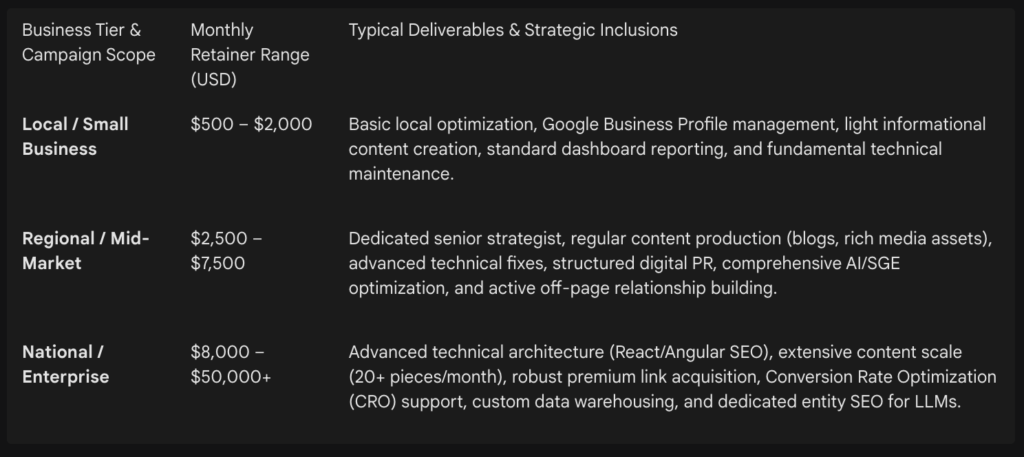
For bespoke consulting, AI readiness assessments, or ad-hoc technical troubleshooting, hourly consulting remains viable. Project-based fees for one-time, highly intensive engagements—such as a comprehensive technical site migration, an international platform move, or a complete domain redesign—generally span from $5,000 to over $30,000 depending on the platform’s architectural complexity.
Evaluating the Value Proposition
When evaluating these figures, decision-makers must view the gross price relative to the stated deliverables. A quote offering a complete, four-pillar national campaign including extensive digital PR and AI optimization for $500 a month is mathematically impossible given the labor and material costs involved. Such pricing strongly signals the use of automated “checkbox” work, offshore content spinning, or toxic link generation. Conversely, an agency charging premium enterprise rates must transparently justify the cost through highly specialized strategic oversight, extensive high-quality content production, and advanced technical capabilities.
The mathematical evaluation of an SEO quote ultimately involves calculating the projected Return on Investment (ROI). While SEO is an ongoing operational expense, its financial architecture differs fundamentally from paid media. Paid advertising (PPC) ceases to generate traffic the exact moment the daily budget is depleted. In contrast, search engine optimization builds a compounding digital asset.
A higher initial quote from a premium agency may result in a substantially higher, compounding ROI if their rigorous inclusion of AI capabilities, high-authority digital PR, and technical depth successfully captures high-intent organic leads that a cheaper, baseline agency would miss entirely. SME leaders must look beyond the gross monthly fee and evaluate the total economic value of the proposed strategic architecture.
Communication Frameworks: Managing Intangible Services
Search Engine Optimization is an inherently intangible product. Unlike acquiring enterprise software, real estate, or physical machinery, an SME investing in SEO Marketing is purchasing intellectual expertise, operational time, and the promise of future digital visibility. Because the immediate output is not physically verifiable upon signing the contract, the communication protocols established during the proposal phase become the absolute primary mechanism for accountability, transparency, and project management.
A superior SEO quote will not only list the technical deliverables but will also rigorously define the communication architecture. Effective management of intangible services requires proactive scheduling and strict expectation alignment. The proposal should clearly state the cadence of strategic meetings, outlining exact protocols for onboarding, monthly performance reviews, and quarterly strategy realignments.
Timeline Realities and Managing Expectations
Furthermore, the agency must communicate the harsh realities of organic search timelines. SEO is a long-term strategic investment, not an immediate lead-generation switch. Reputable agencies will clearly state in their proposals or initial consultations that for most SMEs, significant results, compounding traffic growth, and AI citation visibility require four to six months of sustained, continuous effort. Some highly competitive national niches may require up to a year to disrupt incumbent market leaders.
If an agency fails to manage these expectations upfront, or worse, promises immediate algorithmic dominance to secure the signature, it demonstrates a severe lack of operational integrity. Clear, proactive communication regarding meeting schedules, expected turnaround times for deliverables, and the realistic timeline for measurable financial impact is non-negotiable for a healthy, profitable vendor-client relationship.
The Critical Distinction: Automated Reports Versus Strategic Consultation
One of the most profound differentiators between a mediocre SEO service provider and a high-performance digital marketing partnership is how the agency handles data dissemination and client education. Evaluating a quote requires a highly critical examination of the reporting and consultation clauses.
The Limitation of the Dashboard
Reports, dashboards, and automated analytics exports are fundamental; they serve as the empirical ledger proving that the technical and creative teams have actually carried out the agreed-upon work. Monthly reports provide essential visibility into fluctuating search impressions, keyword clustering movements, link acquisition velocity, and overall traffic health.
However, a report is merely a historical record of raw data. In isolation, raw data offers exceptionally little value to an SME owner focused on revenue generation, payroll, and business operations. If an agency’s deliverable is simply an emailed PDF populated with charts from Google Analytics, they are providing an administrative task, not a growth engine.
The True Value: Marketing Consultation
This is where the distinction between automated reporting and true SEO Consultation becomes paramount. Consultation is the actual value driver of an SEO contract. While a report proves the work was done, the consultation interprets the data, extracts actionable business intelligence, and pivots the strategy based on real-time algorithmic shifts and competitor movements.
When analyzing a quote, stakeholders must specifically identify the latency between report generation and the consultation execution. Once the monthly report is compiled and released, how long does it take for the Marketing consultation to occur? A proficient, high-tier agency will ensure that these properties are continuously on hand, scheduling the strategic advisory call immediately following the data delivery.
During these marketing consultation sessions, the lead strategist should explain the underlying “why” behind the metrics. They must contextualize traffic drops or surges against macroeconomic trends, seasonal shifts, or unannounced search engine algorithm updates. Furthermore, they must clearly outline the strategic action items for the subsequent operational sprint. Agencies that prioritize face-to-face (or virtual) strategic consultation demonstrate a commitment to their client’s actual business outcomes rather than just fulfilling a contractual data quota.
Geographic Relevance and Local Authority Optimization
For service-based SMEs—such as legal practices, contractors, healthcare providers, and specialized B2B vendors—geographic targeting is the absolute most critical vector for lead generation. The data surrounding local search behavior is staggering: over 90% of consumers utilize search engines to locate local services, and an overwhelming 76% of people who search for something nearby visit a related business within 24 hours. When comparing quotes for a locally focused enterprise, the inclusion of hyper-local entity optimization is vital.
For instance, if an enterprise requires an SEO Consultant Selangor to dominate a specific, highly competitive regional market, the proposal must reflect a deep understanding of localized AI search behaviors. Generative engines do not return generic, national answers for localized queries. When a user asks an AI assistant for the best specialized contractor in Selangor, the AI applies precise geographic context and draws heavily on local entity data, regional citations, localized reviews, and directory consistencies.
Therefore, the quote must detail specific strategies for managing Google Business Profiles, acquiring regional citations in local chambers of commerce or industry hubs, and developing localized content clusters that signal geographic relevance. If a quote for a local service business focuses on broad, national keyword terms rather than high-intent, location-modified long-tail keywords (e.g., “emergency commercial plumber in [City]” versus just “plumber”), it demonstrates a fundamental misunderstanding of local lead generation dynamics.
Securing the Digital Future
The process of evaluating an SEO quote in 2026 is no longer a simple vendor comparison; it is an exercise in identifying operational maturity, technological foresight, and communicative transparency. The digital landscape is too volatile, and the penalties for algorithmic non-compliance too severe, to relegate this decision solely to the lowest bidder.
The optimal service provider will not merely offer a checklist of standardized technical tasks. Instead, they will propose a comprehensive, multi-disciplinary business partnership engineered specifically to navigate the profound complexities of both traditional algorithmic ranking and emerging generative AI citation.
By demanding a robust, highly detailed Scope of Work that explicitly covers on-page semantic architecture, rigorous technical auditing, ethical off-page brand building, and cutting-edge AI Search Capabilities, SME decision-makers can effectively safeguard their digital investments. Furthermore, by insisting on proactive communication frameworks and demanding high-level strategic Marketing consultation rather than settling for automated data reporting, businesses ensure they receive actual, revenue-driving intelligence.
As the complexities of Generative Engine Optimisation and the Search Generative Experience continue to evolve, standing still is functionally equivalent to moving backward. If you are looking forward for someone to bring your SEO to another level, we are here to help. Leveraging specialized expertise, a focus on E-E-A-T aligned strategies, and deep technical parity, enterprises can secure dominance in both traditional search engine environments and the rapidly expanding ecosystem of AI platforms.