1-Hour Contracts for Immediate Triage: Hourly SEO engagements offer zero-commitment, rapid-response fixes for acute technical crises (like sudden traffic drops), but they lack the long-term accountability and comprehensive strategy needed for sustained organic growth.
12-Month Retainers for Strategic Dominance: A yearly contract transitions SEO from an operational expense to a capital investment. It provides continuous direction, deep market research, and shared responsibility for generating highly qualified leads over time.
The Great SME Pivot and the 2026 Search Landscape
As the digital economy matures, Malaysia’s 1.2 million Small and Medium Enterprises (SMEs) find themselves at a historic crossroads. The operational paradigms that dictated business survival throughout the early 2020s have definitively closed. In 2026, maintaining a stable economic trajectory requires far more than basic digitization; it demands a fundamental pivot in how businesses approach digital visibility, market authority, and technological adoption. We have officially entered the “compliance economy,” an era where stringent data transparency, e-invoicing integrations, and ESG reporting form the new baseline for corporate survival. In this highly regulated and fiercely competitive environment, remaining offline or relying on outdated marketing frameworks guarantees obsolescence.
Simultaneously, the foundational mechanisms of digital discovery have been radically disrupted. The traditional concept of Search Engine Optimization—historically defined by injecting keywords into web pages to secure blue links on Google—has been systematically dismantled by the integration of artificial intelligence. With AI-driven platforms like ChatGPT, Gemini, and Perplexity changing how consumers and B2B buyers discover content, businesses require strategic interventions that go far beyond basic technical optimizations.
This monumental shift in consumer behavior and algorithmic processing has forced Malaysian enterprises to reevaluate how they procure marketing consultation. When faced with the complexities of the 2026 digital landscape, business owners must make a critical operational decision: Do they engage a 1 hour SEO Consultant to execute immediate, tactical triage, or do they partner with a 12 month SEO consultant on a comprehensive retainer basis? The answer to this question dictates not only the financial architecture of the enterprise’s marketing department but also its long-term viability in an AI-dominated marketplace.
The Anatomy of the 1 Hour SEO Consultant: Immediate Triage and Zero Commitment
The digital ecosystem is inherently volatile, and technical infrastructure is prone to catastrophic failures. In these moments of acute crisis, the engagement model of the marketing professional shifts from strategic planning to emergency response.
Solving the Immediate Crisis
A 1 hour SEO Consultant means that the internal business team is only looking for an SEO consultant that can solve their issue immediately without any commitment and responsibility. These are the consultants that solve the urgent things such as the traffic becoming 0 in 1 day. Consider a scenario where an enterprise transitions to a new Content Management System or updates its server architecture, inadvertently triggering a catastrophic misconfiguration in the site’s routing protocols. Within hours, organic visibility vanishes, and revenue pipelines run dry.
In this high-stakes environment, the 1-hour consultant is deployed purely as a tactical technician. Their mandate is singularly focused: diagnose the algorithmic penalty, rectify the severe technical malfunction, or reverse the manual action that triggered the traffic collapse. They log into the backend infrastructure, execute the necessary code corrections or server redirects, and immediately exit the ecosystem.
The Absence of Long-Term Accountability
The defining characteristic of this hourly engagement is the complete lack of enduring responsibility. The consultant is paid for their immediate time and the specific, tangible deliverable they produce—such as a rapid audit report or a localized technical fix. Once the immediate crisis is averted and the traffic returns to its baseline, the contractual relationship terminates.
Because the scope is microscopically narrow, anyone also can be the 1 hour SEO consultant, as the business owner doesn’t need to verify their strength; they just need to solve the immediate issue only. The enterprise does not require this consultant to possess deep industry acumen, nor do they expect the consultant to engineer a multi-year growth trajectory. The operational requirement is strictly confined to immediate problem resolution, making the vetting process rapid and transactional.
Financial Predictability and Strategic Myopia
From a fiscal perspective, the 1-hour model offers extreme short-term flexibility and fixed, predictable costs. For micro-businesses or entities with severely constrained operational budgets, a one-time engagement provides expert intervention without the burden of recurring monthly fees.
However, this financial flexibility breeds strategic myopia. In the complex landscape of 2026, a consultant hired for a single hour cannot possibly map the semantic relationships of an entire corporate domain, nor can they build the topical authority required by modern AI search engines. Hourly rates may be suitable for quick fixes, but they inherently focus on immediate technical symptoms rather than long-term strategic architectures. Relying exclusively on hourly consultants leaves the enterprise vulnerable to slow, compounding market share losses, as competitors actively invest in robust, continuous digital transformation.
Strategic Partnerships for Serious Enterprises
In stark contrast to the transactional nature of the hourly model, the 12-month engagement is designed for organizations that view digital visibility as a core component of their overarching business strategy. A 12 month SEO consultant is for businesses that are really serious about their business. As for 12 months SEO Consultants, they operate on a retainer basis, where they will be providing the support and direction to the business for the next 12 months time.
The Requirement for Deep Research
Where else, for a 12 months SEO consultant, it will require deep research into the business and the potential market to plan and strategize the upcoming steps. This profound level of research is the fundamental differentiator of the retainer model. Before executing a single technical optimization, the consultant must fully immerse themselves in the client’s operational realities.
This deep research phase involves a meticulous analysis of the enterprise’s supply chain dynamics, profit margins, target audience demographics, and immediate competitors. In 2026, it also requires advanced semantic gap analysis. The consultant maps the existing digital footprint of the business, identifying not just missing keywords, but missing perspectives and unique data points that the broader market lacks. By understanding the intricacies of the potential market, the consultant architects a 12-month roadmap that aligns digital marketing outcomes with broader corporate revenue goals.
Continuous Direction and Support
A 12-month retainer guarantees that the enterprise has continuous access to high-level strategic direction. As search algorithms evolve—often without warning—the retained consultant is already positioned to pivot the strategy, update content architectures, and deploy new technical schemas to maintain market dominance. This ongoing support structure means the business is never left reacting to market changes; instead, it is proactively maneuvering ahead of them.
Furthermore, the 12-month model allows for the compounding effects of SEO Marketing. Digital visibility is not a switch that can be flipped; it is an asset that must be built incrementally over time. A retained consultant systematically builds topical authority, engineers authoritative backlinks, and consistently publishes high-value content over the course of the year, resulting in an exponential return on investment that far exceeds the capabilities of any short-term, ad-hoc intervention.
The Core Divergence: Evaluating Costing and Responsibility
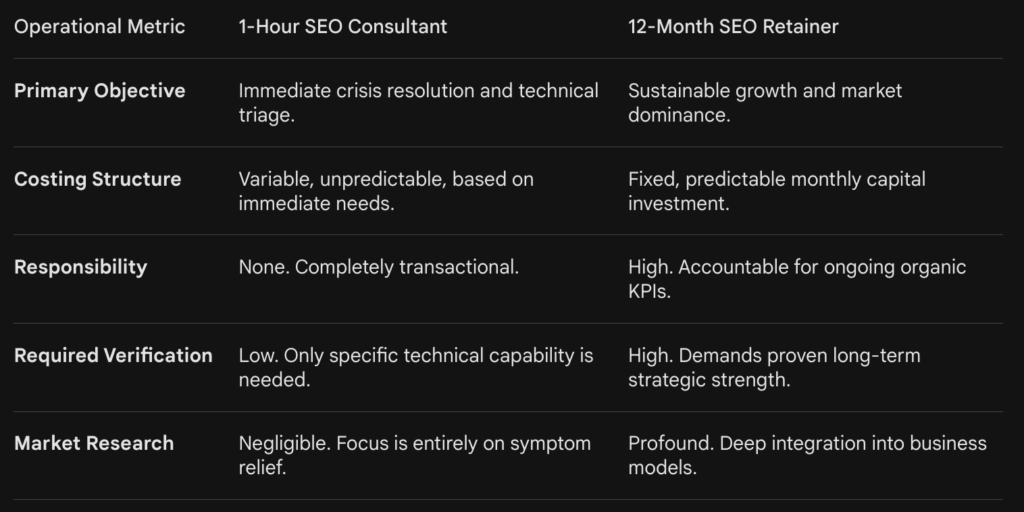
The difference between these two modes is the costing and also the responsibility. When a Malaysian SME leadership team sits down to allocate their 2026 operational budget, they must rigorously evaluate these two variables to ensure their digital procurement aligns with their corporate realities.
The Costing Paradigm
The financial structures of the two models represent opposing philosophies regarding marketing investment. The hourly model treats SEO Marketing as a purely operational expense—a cost center to be minimized and activated only when absolutely necessary. While it avoids the commitment of a monthly invoice, it introduces the hidden costs of a “DIY” approach. When an enterprise attempts to manage its own digital presence and only calls an expert when things break, it suffers from a steep learning curve, slower results due to part-time attention, and the opportunity cost of internal employees struggling with advanced technical optimization.
Conversely, the 12-month retainer treats SEO Consultation as a capital investment. The enterprise commits to a predictable monthly allocation, establishing a dedicated budget that covers strategy, content production, technical maintenance, and advanced reporting. While the absolute annual cost is higher, the business gains seamless access to a team of specialists without the immense overhead of hiring full-time internal marketing employees. The retainer model funds the continuous, methodical work required to secure highly qualified leads and measurable organic revenue over the long term.
The Distribution of Responsibility
The most profound distinction lies in accountability. In the 1-hour model, the consultant assumes zero long-term responsibility for the business’s success. If the consultant fixes a broken link structure but the company goes bankrupt six months later due to a lack of inbound leads, the consultant bears no fault; their contractual obligation was fulfilled the moment the immediate issue was resolved.
In a 12-month retainer, the marketing consultation firm assumes shared responsibility for the enterprise’s organic growth pipeline. The consultant becomes a stakeholder in the company’s visibility. Because the relationship spans a full year, the consultant must continuously prove their value through measurable key performance indicators (KPIs), such as organic traffic growth, lead quality improvements, and direct revenue attribution. This enduring responsibility is precisely why business owners must rigorously verify the strength, track record, and operational capacity of an agency before entering into a 12-month agreement.
Decoding the Search Crisis: The Great Unclicking and AI Disruption
To fully understand why a 12-month retainer is practically mandatory for serious enterprises in 2026, one must examine the fundamental crisis occurring within the search ecosystem. The digital marketing playbook that worked in 2020 is now obsolete, replaced by a hyper-complex, AI-driven environment.
The Evaporation of Traditional Organic Traffic
For over two decades, search engines operated as document retrieval systems. A user typed a query, and the engine provided a list of blue links. The goal of SEO was to secure the top link and capture the click. However, the landscape of 2026 is defined by the “Great Unclicking”. As AI-powered platforms synthesize information directly on the results page, the necessity for a user to click through to a website has plummeted.
Data from the 2026 market indicates that traditional search engine volume is projected to drop by a staggering 25%. Concurrently, zero-click searches—where a user’s query is entirely satisfied by an AI-generated answer without ever clicking a link—now account for up to 60% of total search behavior, reaching an overwhelming 77% on mobile devices. When Google’s AI Overviews are present on a search page, the organic click-through rate for traditional links collapses from an already low 1.62% down to a microscopic 0.61%.
This paradigm shift means that standard organic web traffic is disappearing. Businesses that rely solely on outdated SEO tactics to drive raw traffic volume are experiencing devastating declines in visibility. This crisis cannot be solved by a 1-hour consultant; it requires a complete architectural overhaul of the enterprise’s digital content strategy, a feat that takes months of dedicated effort.
The Paradigm Shift to Generative Engine Optimisation
To survive the disappearance of the traditional click, the 12-month SEO consultant must pivot the enterprise’s strategy toward a new discipline: Generative Engine Optimisation.
Defining GEO in 2026
Generative Engine Optimisation (GEO) is the modern approach to ensuring that large language models and generative AI systems—such as ChatGPT, Perplexity, and Claude—accurately understand, summarize, and credit a brand’s content. While traditional SEO focused on making websites technically accessible to search crawlers, GEO focuses on making the content synthetically palatable to AI models.
In a generative search environment, the AI builds a complete narrative, pulling data from multiple sources to construct an immediate answer for the user. The objective of GEO is to ensure that your specific enterprise becomes a definitive part of that synthesized story. It is a shift from optimizing for discovery through lists to optimizing for discovery through synthesis.
Entity Optimization: The Core of GEO
The mechanical foundation of GEO is Entity SEO. In 2026, AI algorithms do not read keyword density; they interpret content using an entity-first lens. Entities are defined as unambiguous concepts—people, products, brands, organizations, and geographical places. The AI models map the relationships between these entities to gauge authority and relevance.
A 12-month consultant systematically builds this entity authority. They reinforce entity relationships by creating consistent semantic coverage across the web, ensuring that the brand is recognized as the ultimate authority in its specific niche. This involves deploying rigorous schema markup (such as Organization, Person, and Local Business data structures) that directly communicate the brand’s entity status to machine learning algorithms in a format they inherently trust.
The Necessity of Citation Engineering
Because AI engines have faced intense public scrutiny for generating inaccurate information (hallucinations), the algorithms have been recalibrated to be highly cautious. They now require overwhelming proof of credibility before citing a source.
To secure visibility, a 12-month consultant engages in advanced “citation engineering”. This practice involves shaping the enterprise’s content so that it is extraordinarily easy for an AI to quote, verify, and trust. AI models inherently prefer to cite content that features short, definitive answer blocks, clear conceptual definitions, and information backed by proprietary data or original research. Engineering a corporate website to meet these rigorous, algorithmic trust thresholds is an ongoing endeavor that requires the full commitment of an annual retainer.
Answered Engine Optimisation and the Zero-Click Economy
Operating in parallel with GEO is the critical practice of Answered Engine Optimisation. While GEO targets expansive conversational AI models, AEO is focused on optimizing content to dominate direct answers, featured snippets, and voice search results within hybrid search environments.
Capturing Micro-Intent and Driving Conversions
The primary objective of AEO is not necessarily to drive raw traffic, but to capture “micro-intent”. When a user asks a highly specific, complex question, they are typically deep into the buyer’s journey. If a brand’s insights are extracted and served directly in an AI answer block, the lead quality improves dramatically. The user receives immediate value from the enterprise’s expertise, establishing profound trust before a click ever occurs.
For example, a user comparing enterprise software might prompt an AI engine with a highly specific query. If the AI synthesizes an answer that directly cites a specific brand as the optimal solution, the resulting prospect is highly qualified. Data from 2026 indicates that AEO directly impacts revenue attribution; prospects who find a brand through an AI-synthesized answer often bypass the traditional sales funnel entirely, closing rapidly because the AI has already established the brand’s absolute credibility.
Structuring Content for AEO Extraction
To succeed in AEO, a 12-month consultant must fundamentally restructure how the enterprise publishes information. Traditional long-form, rambling blog posts are highly inefficient for AI extraction. Instead, the consultant must mandate strict formatting protocols :
Publishing concise, authoritative answer blocks at the very top of articles.
Utilizing clear, structured headings aligned precisely with specific user intents.
Incorporating easily digestible “TL;DR” (Too Long; Didn’t Read) sections, bulleted summaries, and numbered steps.
Integrating precise, updated statistical data and clear external references to signal factual rigor.
Implementing this structural discipline across hundreds of corporate web pages requires the persistent oversight and strategic guidance that only a 12-month retainer can provide.
Deep Research Methodologies: Navigating the Semantic Web
To effectively execute GEO and AEO, the 12-month SEO consultant must employ deep research methodologies that go far beyond the capabilities of legacy digital marketing. The concept of the “content gap” has evolved dramatically.
Beyond Keywords: The Four Strategic Gaps
In the past, identifying a content gap meant finding a high-volume keyword that competitors had not yet targeted. In 2026, AI tools can generate thousands of words of consensus-based content on any keyword in milliseconds. Therefore, simply publishing “more content” is entirely ineffective. The deep research conducted by a retained consultant focuses on identifying and closing four highly specific strategic gaps :
Semantic Gaps: Identifying missing entity relationships and conceptual context that the AI requires to fully understand a topic.
Intent Gaps: Discovering highly specific, complex user queries that broad, AI-generated consensus content fails to adequately address.
Format Gaps: Restructuring existing information into the specific formats (tables, exact definitions, data sets) that AI extraction engines prioritize.
Value Gaps (Information Gain): This is the most critical metric in 2026. Information Gain measures the unique, proprietary value a piece of content adds to the collective knowledge base. If a page provides novel data, unique customer usage examples, or original expert perspectives that the AI cannot generate on its own, the engine is forced to cite the brand.
A 1-hour consultant lacks the temporal bandwidth and the intimate business knowledge required to identify Information Gain. Only a 12-month consultant, deeply embedded in the client’s operations and market realities, can extract these unique perspectives and engineer them into the digital strategy.
Platform-Specific Optimization: ChatGPT, Gemini, and Claude
The complexity of the 12-month retainer is further magnified by the fragmentation of the AI search landscape. An enterprise can no longer optimize solely for a single Google algorithm. The consultant must orchestrate a comprehensive strategy that appeals to the distinct ranking factors of multiple, competing AI engines.
Each generative model weights data differently, requiring a nuanced, multi-faceted optimization approach :
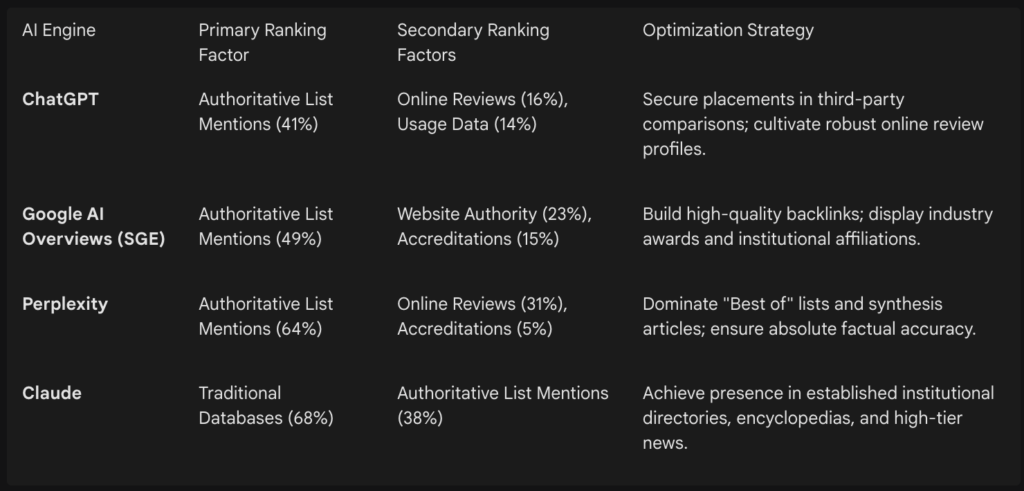
Managing this diverse array of platform-specific requirements is a continuous, year-round operation. A 12-month SEO consultant meticulously tracks the brand’s presence across all these platforms, adjusting the off-page PR strategy, review generation campaigns, and content structuring to ensure universal AI visibility.
Digital Transformation and Hyper-Localization in Malaysia
For Malaysian business owners, this highly technical optimization must be grounded in the economic realities of Southeast Asia. The region represents one of the most dynamic digital markets globally, with e-commerce sales projected to exceed $300 billion by 2026.
The Necessity of Hyper-Localization
To capture this explosive growth, SMEs must execute sophisticated, hyper-localized digital marketing campaigns. A broad, generic SEO approach will fail against competitors who are leveraging AI-powered personalization. Top brands in the region utilize AI to create hyper-targeted content that adapts in real-time based on specific user behaviors and geographical nuances.
This is where the expertise of an SEO Consultant Selangor becomes an invaluable asset for a business operating in the Klang Valley. A 12-month consultant deeply understands the regional market intricacies. They utilize advanced Local Business schema markup to explicitly connect the SME’s physical operations to nearby geographic entities, instantly boosting local search visibility and ensuring the brand dominates highly localized AI queries.
Bridging the Competitiveness Gap
The stark reality is that 77% of Malaysian SMEs remain at a basic digital stage, relying on outdated processes and limited online capabilities. These traditional companies are vastly outmatched by digital-native giants built with technology at their core. Retaining a 12-month marketing consultation firm provides the critical intellectual capital required to bridge this competitiveness gap. The consultant acts as the digital transformation architect, optimizing internal digital processes, ensuring compliance with new data transparency regulations, and elevating the overarching customer experience to match the expectations of the 2026 consumer.
International and Regional SEO Realities in 2026
For Malaysian SMEs looking to expand beyond domestic borders into the broader ASEAN market, the 12-month retainer becomes even more critical. International SEO in 2026 has evolved significantly; the old playbook of simply translating content and deploying hreflang tags is no longer sufficient to guarantee global visibility.
Combating Semantic Collapse
In an AI-mediated search environment, algorithms are highly sensitive to “semantic equivalence”. If a business publishes identical page structures, shared offers, and exact entity relationships across multiple country-specific domains, the AI systems will often detect redundancy. When multiple pages answer the exact same intent without offering localized value, the AI consolidates them, selecting a single representative version to cite and effectively collapsing the brand’s international visibility.
A 12-month consultant mitigates this risk through deep research into regional intent differentiation. They ensure that market-scoped URLs reflect real, localized differences—such as specific legal disclosures, regional pricing, localized shipping requirements, and culturally nuanced entity relationships. This meticulous approach ensures that the AI models retain and retrieve the correct, localized version of the content for users across different international markets.
Building a 12-Month Strategic Roadmap
When a serious business commits to a 12-month retainer, the consultant executes a structured, multi-phased methodology designed to systematically build digital dominance.
Phase 1: Assessment and Deep Research
The first phase of the engagement is entirely diagnostic and research-focused. The consultant conducts a comprehensive audit to assess the enterprise’s current AI search readiness. This involves querying multiple AI engines to determine if the brand is currently visible, mapping the semantic gaps in the existing content, and executing the deep research required to understand the target audience’s precise problem statements.
Phase 2: Structural Optimization and Entity Building
In the second phase, the consultant overhauls the technical infrastructure. They deploy the necessary schema markup to establish unambiguous entity relationships, restructure existing web pages into AI-friendly formats (AEO), and begin publishing pillar pages that establish deep topical authority. The consultant also initiates off-page citation engineering, securing placements in authoritative industry lists to satisfy the algorithmic requirements of models like ChatGPT and Perplexity.
Phase 3: Measurement and Refinement
Unlike traditional SEO, which tracked simple keyword rankings, measuring success in 2026 requires sophisticated analytics. Because there is no traditional “ranking report” for a generative AI output, the consultant must monitor the brand’s presence inside generative responses, track micro-intent conversions, and analyze lead quality improvements resulting from AI citations. The consultant continuously refines the strategy based on these advanced data points, adjusting to real-time shifts in algorithmic behavior.
Phase 4: Iteration and Scaling
In the final phases of the year, the focus shifts to scaling the success. The consultant expands the entity mapping to cover broader topics, consistently refreshes cornerstone content to maintain the “freshness” algorithms demand, and continues to publish original research to maximize Information Gain. By the end of the 12-month cycle, the enterprise has established an unshakeable, compounding digital asset that consistently drives high-quality revenue.
Conclusion
The evolution of digital discovery in 2026 has fundamentally altered the rules of corporate visibility. As traditional click volumes evaporate and advanced AI platforms take control of the search ecosystem, the strategies required to maintain a competitive advantage have become deeply complex and highly technical.
For Malaysian SMEs navigating this critical juncture, the choice between a 1-hour tactical intervention and a 12-month strategic partnership represents a defining operational decision. A 1 hour SEO consultant provides necessary, commitment-free triage for immediate technical disasters, allowing a business to quickly recover from a sudden collapse in traffic without undergoing rigorous agency verification. However, this hourly model is entirely reactive, offering zero long-term responsibility and completely ignoring the profound, strategic shifts required to survive the Generative AI revolution.
Conversely, a 12 month SEO consultant is a strategic architect designed for enterprises that demand sustained market dominance. Operating on a retainer basis, these professionals execute the deep research into the business and potential markets required to orchestrate a year-long trajectory of growth. The core difference between these two modes is the costing and also the responsibility; the 12-month model demands a capital investment in exchange for ongoing accountability, advanced Generative Engine Optimisation, and the meticulous entity building required to force AI engines to cite your brand as the ultimate industry authority.
If you are looking forward for someone to bring your SEO to another level, we are here to help. Contact the team at woonyb.com today to discuss how a strategic 12-month partnership can secure your enterprise’s visibility in the 2026 digital economy.