High Success Rate via the 80/20 Rule: Approximately 80% of established SEO consultants in KL successfully deliver on their promises by focusing strictly on the critical 20% of high-impact, controllable actions—such as fixing Core Web Vitals, building semantic Topic Clusters, and dominating local SEO infrastructure.
The “Overpromise Trap” Causes Failure: The 20% of consultants who fail to deliver typically do so not from a lack of technical knowledge, but because of a flawed sales philosophy. They make unrealistic guarantees and manipulate proprietary reports rather than focusing on sustainable, data-driven growth.
The Evolution of the Malaysian Digital Economy
The digital economy across Malaysia has entered a defining, highly accelerated decade. From the bustling, high-density corporate districts of Kuala Lumpur to the rapidly expanding industrial and technological hubs of Selangor, local Small and Medium Enterprises (SMEs) face an environment where the competition for online visibility is exceptionally fierce. Every brand, whether a localized retail SME, a growing eCommerce platform, or a robust B2B enterprise, now operates under the undeniable reality that search engine ranking and digital entity recognition fundamentally define corporate reputation and revenue generation. In this hyper-connected era, advanced SEO Marketing is no longer an optional digital luxury; it forms the absolute foundation of modern commercial survival.
However, the rapid acceleration of the digital marketplace has introduced profound complexities for business owners attempting to navigate external vendor relationships. As internet penetration in Malaysia surpasses 90%, the consumer base has become overwhelmingly digital-first. This shift is compounded by unique regional challenges, such as highly diverse, multilingual search behaviors where users alternate seamlessly between English, Malay, and various Chinese dialects (Mandarin and Cantonese) to express identical commercial intents. Furthermore, shifting macroeconomic trends reveal that 65% of consumers now prioritize businesses with sustainable, ESG-compliant processes, altering the very nature of how search queries are formulated and what consumers expect to find upon clicking a link.
In response to these demands, the reliance on external digital expertise has surged dramatically. SMEs are aggressively seeking professional Marketing consultation to capture market share. This surge in demand, however, introduces the most critical question facing corporate decision-makers today: What percentage of SEO consultants in the region actually deliver on their promises?
The landscape of search visibility is undergoing a seismic, irreversible transformation in 2026. The traditional search paradigm, defined exclusively by securing a position among “ten blue links” on a static results page, is being systematically disrupted by the profound integration of artificial intelligence. The proliferation of Large Language Models (LLMs) and intuitive, conversational search interfaces requires a completely recalibrated approach to digital discovery. Consequently, evaluating the efficacy and the success rate of an SEO consultant in 2026 demands a nuanced understanding of both foundational search mechanics and next-generation visibility metrics. The answer to the delivery question is not a simple binary, but rather a statistical distribution governed by specific strategic philosophies.
The 80/20 Rule: Why the Overwhelming Majority Deliver
When analyzing the longitudinal success rates of established SEO consultants operating within the Kuala Lumpur and Selangor markets, operational data and industry patterns suggest that an overwhelming majority—approximately 80%—are entirely capable of delivering on their stated professional promises. This exceptionally high success rate within the upper echelon of the industry is fundamentally anchored in the Pareto Principle, commonly referred to in economic and marketing circles as the 80/20 rule.
The 80/20 rule dictates an inherent imbalance between inputs and outputs, suggesting that a remarkably small portion of strategic efforts (roughly 20%) typically generates the vast majority of tangible, high-impact results (80%). The most reputable and effective professionals in the field of SEO Marketing apply this principle with rigorous discipline. They do not attempt the impossible task of simultaneously manipulating hundreds of minor, unpredictable algorithmic variables. Instead, they ruthlessly concentrate their resources on the high-impact, foundational actions that reliably, mathematically move the needle for client visibility.
Because these core actions fall entirely within the technical and operational control of the consultant, promises related to their execution are consistently and successfully met.
The Mechanics of High-Impact Execution
To understand why the 80% succeed, one must deconstruct the specific elements that comprise the critical 20% of effort. When applied to search visibility, the Pareto Principle manifests across several distinct operational pillars:
1. Technical Infrastructure and Algorithmic Accessibility
Before a single piece of content can rank, the underlying architecture of the digital property must be flawless. The 80/20 rule dictates that fixing major technical bottlenecks yields outsized visibility returns. Capable consultants focus heavily on Core Web Vitals, ensuring that pages load with near-instantaneous speed, interactivity is smooth, and visual stability is maintained across all mobile devices. They guarantee clean, logical URL structures, secure HTTPS protocols, the elimination of duplicate content via canonical tags, and the repair of broken redirect chains. A consultant who promises a technically pristine website can easily and definitively deliver on this promise through systematic, methodical auditing.
2. Topical Authority and Entity Centralization
The era of generating hundreds of superficial, 500-word blog posts stuffed with exact-match keywords has been rendered obsolete by advanced Natural Language Processing (NLP) algorithms. In 2026, search algorithms reward semantic depth and comprehensive topical coverage. The 80/20 rule applied to content marketing reveals a stark reality: roughly 80% of a domain’s organic traffic and subsequent revenue is routinely generated by just 20% of its most well-researched, deeply informative articles. Consultants who succeed promise to build “Topic Clusters,” creating centralized, authoritative pillar pages surrounded by interlinked sub-topics. Because they promise semantic structure rather than mere word counts, they successfully deliver the entity authority that algorithms crave.
3. Hyper-Localized Domination
For an SME operating specifically as an SEO Consultant Selangor or a localized retail and service brand, national rankings are irrelevant. The vast majority of their visibility and localized foot traffic stems directly from the optimization of the Google Business Profile (GBP) and integration into the localized Map Pack. Successful consultants apply the 80/20 rule here by focusing intensely on Name, Address, and Phone Number (NAP) consistency across the web, generating localized schema markup, and maintaining an active, weekly posting schedule on the GBP. They optimize for distance and relevance by incorporating specific neighborhood and street names into the site’s metadata. Promises made regarding local infrastructure optimization are entirely controllable and, thus, consistently delivered.
4. Asymmetrical Link Acquisition
Domain authority, a critical metric for ranking capability, remains heavily influenced by external validation through backlinks. The Pareto principle applies powerfully to off-page SEO: approximately 80% of a website’s total domain authority is derived from the top 20% of its highest-quality, most authoritative backlinks. Ethical professionals do not promise thousands of links; they promise to secure highly relevant, legitimate placements through digital PR and outreach. By focusing on the acquisition of the vital 20%, they safeguard the client’s site against toxic link penalties while reliably delivering the authority needed to rank.
The Human Element of the 80/20 Rule
Furthermore, the 80/20 rule extends beyond digital tactics and into the organizational structure of the consulting agencies themselves. Analysis of high-performing niche site portfolios and SEO teams reveals that 20% of the staff or contracted team members will typically produce 80% of the highest-quality results. The successful 80% of consultants recognize this talent dynamic. They personally oversee or assign their most elite specialists to execute the high-impact “easy wins,” ensuring these critical tasks are handled with maximum speed and precision, while intelligently delegating mid-to-low impact maintenance tasks.
When a consultant’s promises are strictly aligned with these verifiable, high-impact inputs, the delivery rate is nearly absolute. They succeed because they promise the execution of the 20% that dictates the 80% of the outcome.
The Anatomy of Failure: Why 20% Fail to Deliver
If the mechanics of search optimization are so heavily reliant on controllable technical and content inputs, why is there a persistent, highly visible 20% of consultants who catastrophically fail to meet their clients’ expectations? The failure within this cohort is rarely due to a fundamental lack of technical knowledge regarding how a search engine operates. Rather, the failure is almost exclusively the result of a misaligned, fundamentally flawed operational and sales philosophy known as the “Overpromise Trap.”
The core error made by this specific demographic of consultants is the act of guaranteeing outcomes that exist entirely outside the boundaries of their direct operational control. Specifically, these individuals utilize immediate financial conversions, specific revenue targets, or an exact, guaranteed number of qualified sales leads as the primary metrics to measure the performance of their SEO campaigns.
This is a profound misapplication of marketing principles. As industry thought leaders have noted, strategy must precede tactics; confusing performance marketing (the tactical generation of clicks) with marketing performance (the holistic financial health of the business) leads to inevitable failure.
Deconstructing the Immutable Search Funnel
To fully comprehend why promising immediate, guaranteed conversions is a structural fallacy, business owners must dissect the rigid chronology of the digital acquisition funnel. The mathematical reality of SEO dictates a strict sequence of events: Keywords Ranking -> Traffic -> Conversion.
Understanding the consultant’s degree of control over each phase of this funnel is the key to differentiating between a realistic promise and a manipulative sales pitch.
Phase 1: Keyword Ranking (High Consultant Control)
The initial stage of the digital funnel involves optimizing a digital property to achieve visibility for specific, high-value search queries. At this stage, a skilled SEO consultant exercises an exceptionally high degree of control. Through the application of technical optimization, precise content architecture, elimination of crawl errors, and strategic backlink acquisition, the consultant sends clear, unambiguous signals of relevance and authority to the search engine algorithms.
If a consultant promises, “We will improve your organic visibility and secure top ten placements for these specific commercial queries within six months,” they are making a highly measurable, realistic, and attainable promise. The variables required to achieve this are within their technical grasp.
Phase 2: Traffic Generation (Moderate Consultant Control)
Once a keyword successfully ranks on the first page of a search engine, it begins to generate impressions—defined as the number of times users physically see the link on their screens. However, translating a passive impression into an active click (traffic) depends entirely on the Click-Through Rate (CTR).
While a consultant can influence the CTR by crafting highly compelling Meta titles, utilizing persuasive Meta descriptions, and implementing rich schema markup (such as review stars or product pricing in the search results), they cannot physically force a user to click the link. Furthermore, the landscape of traffic generation in 2026 is heavily complicated by the presence of AI summaries that answer queries directly on the results page. This specific phenomenon is statistically proven to reduce organic clicks on the top result by an average of 34.5%.
Therefore, while an agency can confidently promise to increase ranking positions, promising exact, guaranteed volumes of traffic introduces a significant margin of error due to algorithmic volatility and user behavior shifts.
Phase 3: The Conversion (Low Consultant Control)
The final and most critical stage of the funnel occurs when a user lands on the SME’s website and makes the conscious decision to execute a transaction, fill out a lead generation form, or initiate a phone call. This exact point is where the failing 20% of consultants trap themselves in an inescapable cycle of under-delivery.
The mandate of an SEO professional is to capture existing search demand and drive highly targeted, high-intent traffic to a specific landing page. However, whether that targeted traffic actually converts into revenue is contingent upon a vast multitude of complex, internal business factors that the external consultant simply does not control. These conversion-dependent variables include:
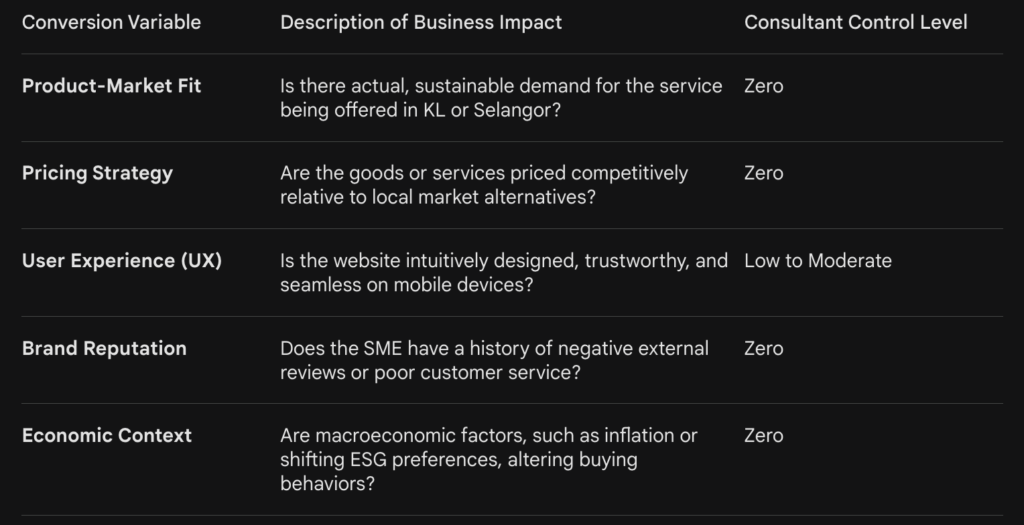
When a consultant guarantees that a six-month SEO campaign will definitively yield “50 new paying customers a month,” they are arrogantly making a promise on behalf of the client’s internal sales team, the intrinsic quality of the product, and the overarching pricing structure. Immediate promises regarding conversion rates will definitively and negatively affect the perceived outcomes of the campaign.
When the promised conversions inevitably fall short—perhaps due to a clunky checkout process, an uncompetitive price point, or poor inventory management—the client deems the SEO campaign a total failure, even if the consultant successfully increased targeted organic traffic by 300%. The failing 20% suffer from a lack of boundary setting.
Legitimate, high-tier SEO Consultation requires the courage to educate the client on the realities of this funnel. The most reputable professionals will clearly state during initial negotiations that their primary, measurable mandate is dominating search visibility and driving qualified traffic. They will then offer secondary assistance in collaborating with the business to refine the on-page elements that optimize for the ultimate conversion, but they will never guarantee the financial transaction itself.
The 2026 Search Ecosystem: Adaptation, AI, and Evolution
Evaluating a consultant’s ability to deliver requires a profound understanding of the specific environmental conditions in which they currently operate. The year 2026 marks a definitive tipping point where traditional search engine optimization strategies, implemented in isolation, are no longer sufficient to guarantee digital survival.
According to robust market forecasts, traditional search query volume has dropped by 25% this year as users aggressively shift their behaviors toward AI-powered answer engines. With platforms like ChatGPT natively serving over 800 million weekly users, Perplexity processing hundreds of millions of queries, and Google’s AI Overviews reaching billions of users globally, the fundamental mechanism of digital discovery has been permanently altered. Consequently, any SEO consultant operating in Kuala Lumpur who focuses exclusively on securing “ten blue links” is deploying an antiquated, depreciating strategy.
The Rise of Generative Engine Optimisation (GEO)
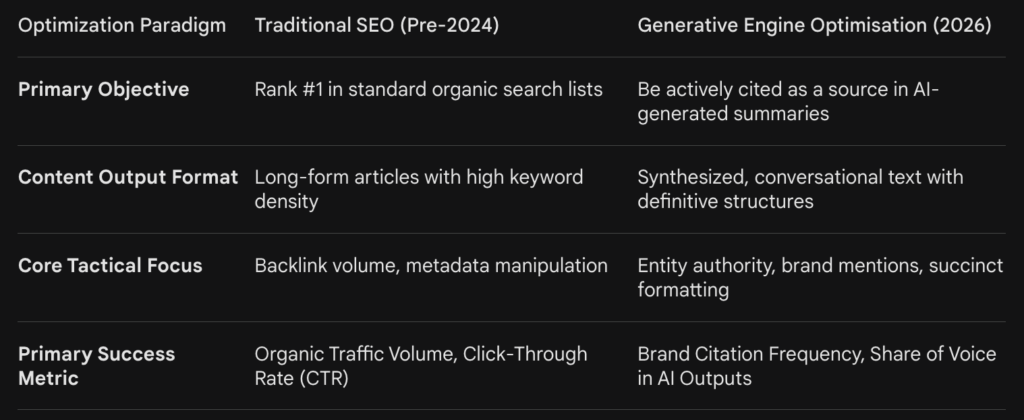
To deliver promises in 2026, a consultant must be an expert in Generative Engine Optimisation. Coined through foundational academic research by institutions such as Princeton and Georgia Tech, GEO is the highly specialized practice of structuring digital content and brand presence so that AI-powered large language models (LLMs) can retrieve, cite, and proactively recommend a brand when synthesizing answers to user questions.
If traditional SEO was the practice of earning a ranking position on a list, GEO is the practice of earning a coveted place among the highly limited two to seven domains that an AI model typically cites in a single, comprehensive response. When an AI engine natively names a brand in its generated answer, it provides an implicit endorsement that carries immense psychological credibility, fundamentally bypassing the need for a user to evaluate multiple search results.
The data surrounding this shift illustrates the severity of the new paradigm. Pew Research Center data confirms that when users encounter a synthesized AI summary in their search results, only 8% proceed to click through to a traditional website. This is compared to a 15% click-through rate when no summary is present. More alarmingly for traditional traffic models, a staggering 26% of users end their session entirely after simply reading the AI-generated answer, satisfied with the immediate resolution of their intent. Therefore, if a brand’s content is not optimized to be cited directly within the AI response itself, the brand essentially ceases to exist for that specific user session.
Incorporating Answered Engine Optimisation (AEO)
Operating in tandem with GEO is the critical rise of Answered Engine Optimisation. While GEO focuses on the broad retrieval of entities, AEO focuses strictly on formatting content architectures to directly satisfy conversational, question-based queries often delivered via voice search or direct, long-form AI prompts.
The strategic pivot toward AEO requires consultants to fundamentally modify how content is structured to appease generative engines, which prioritize brevity and structural clarity over lengthy, narrative introductions. A consultant equipped for 2026 must demonstrate mastery of specific engagement optimization tactics, including:
Immediate Resolution: Providing an immediate, succinct, and highly accurate answer directly beneath a heading, prior to expanding on the broader context.
Definitive Language Processing: Utilizing direct, highly definitive language. Data proves that AI language models statistically favor specific, clear statements and factual declarations over hedged, ambiguous, or overly academic phrasing.
Comprehensive Interrogation: Building dense FAQ sections that anticipate and address natural, conversational follow-up questions, rather than just covering the primary topic.
Freshness Signaling: Establishing a rigorous content review schedule with highly visible revision dates to send continuous freshness signals to AI crawlers, ensuring the data remains citable.
Navigating the Search Generative Experience (SGE)
Google’s Search Generative Experience represents the aggressive integration of these AI capabilities directly into the world’s primary search interface. A consultant promising to deliver local visibility for SMEs must demonstrate a profound understanding of how SGE prioritizes localized and personalized outputs.
One of the most defining trends in 2026 is the localization of generative engines. When a user in Selangor queries an AI engine for a commercial service, the AI does not return a generic, nationally aggregated answer. It applies deep geographic context, draws upon local entity data, and synthesizes hyper-local recommendations. If an SME’s digital footprint lacks robust local entity signals, it will be entirely omitted from the SGE output, rendering traditional national SEO efforts useless for local foot traffic.
How to Identify a Capable Consultant: The Verification Protocol
Given the inherent complexities of the modern search conversion funnel and the rapid, disruptive evolution of AI-driven search, how can an SME owner in Malaysia definitively identify the 80% of consultants who deliver, while successfully avoiding the 20% who trap themselves in overpromises?
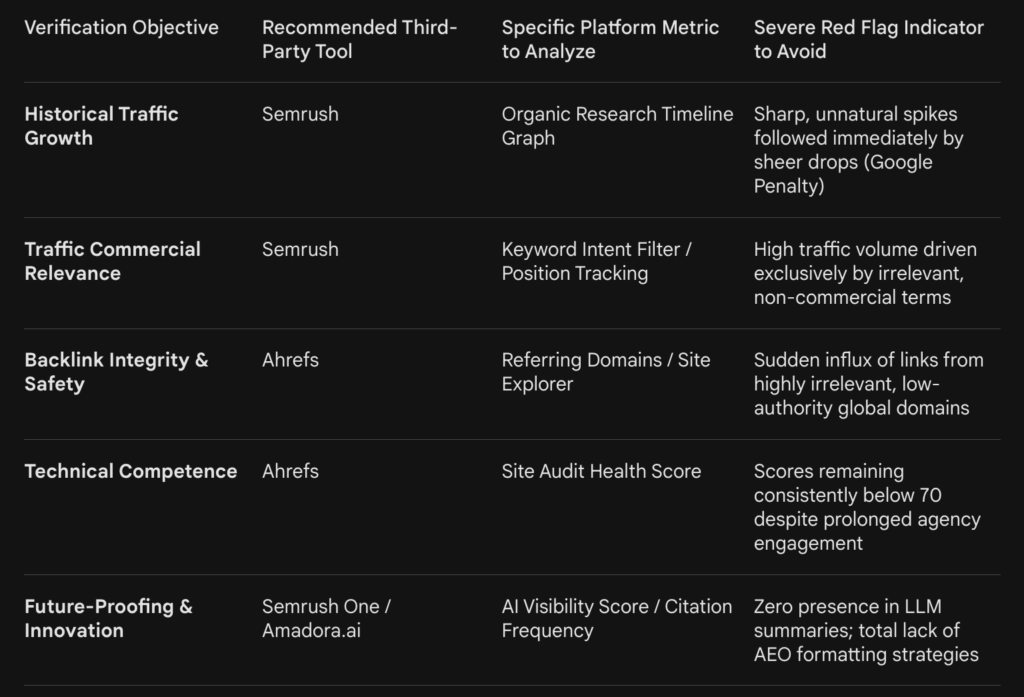
The identification process relies entirely on demanding empirical evidence and rejecting proprietary metrics. By explicitly asking for the historical success cases that the consultant has completed, and critically, using sophisticated third-party tools to independently check on the validity of those claims, a business owner can objectively define whether they want to initiate a business relationship with the agency or not.
Relying solely on proprietary PDF reports generated by the agency itself is a massive corporate vulnerability. Data can be easily manipulated, graphs can be strategically framed to show out-of-context growth, and toxic link-building practices can be hidden. Independent verification using industry-standard, unbiased enterprise software removes this risk entirely, pulling back the curtain on the agency’s actual operational capabilities.
Step 1: Requesting and Deconstructing Success Cases
During the initial phase of Marketing consultation, the business owner must request thoroughly documented case studies. A legitimate success case from a competent agency should never merely state a vague metric such as “Increased traffic by 500%.” It must provide specific, verifiable data points:
The baseline traffic and ranking metrics at the exact start of the campaign.
The specific target keywords pursued and the strategic rationale behind their selection.
The precise timeframe required to achieve the stated results.
The exact URL of the client’s domain (to allow for the independent verification process).
Once the specific URL is provided, the business owner can utilize enterprise-grade platforms like Semrush and Ahrefs. While these platforms are engineered for advanced data science and technical optimization by agencies , their primary graphical interfaces are highly accessible for non-technical business owners seeking to verify historical performance.
Step 2: Verifying Organic Growth and Intent Using Semrush
Semrush is an immensely powerful, comprehensive digital marketing platform boasting a staggering database of over 27.3 billion keywords globally. With over 10 million users and serving approximately 117,000 paying enterprise customers, it is the premier tool for verifying whether a consultant’s claimed traffic growth is legitimate, sustainable, and commercially valuable.
Analyzing the Organic Research Trends:
By entering the provided case study URL into the Semrush “Organic Research” tool, a business owner can instantly view a multi-year graphical representation of the domain’s estimated organic traffic. The timeline of this graph must be cross-referenced with the consultant’s stated engagement period. If the consultant claims to have worked with the client from January to December 2025, there should be a corresponding, verifiable, and steady upward trend in traffic during that exact window.
Evaluating Keyword Intent and Relevance: Not all traffic generates revenue. A common, highly deceptive tactic among the 20% who fail to deliver sustainable business value is to artificially inflate overall traffic numbers by ranking the site for highly irrelevant, high-volume “informational” keywords that will never result in a conversion. By using the Semrush Position filter (isolating positions 2-15) and analyzing the “Keyword Intent” metric, the SME owner can verify the true value of the growth. If the case study involves an SME selling industrial manufacturing machinery in Selangor, but the Semrush data reveals that the traffic spike was entirely driven by a generalized blog post defining “what is manufacturing,” the traffic is commercially useless. The growth must be validated by “Commercial” or “Transactional” intent keywords.
Checking for Algorithmic Penalties:
The organic traffic graph will also instantly reveal if the agency utilized manipulative, “black-hat” tactics that violate search engine guidelines. If the historical graph displays a massive, vertical, unnatural spike in traffic that is followed almost immediately by a sheer cliff-drop to near-zero, it strongly indicates the site was penalized by Google for manipulative practices. This visual signature is an immediate, non-negotiable disqualifier for the consultant.
Step 3: Verifying Link Quality and Technical Health Using Ahrefs
While Semrush excels at intent and overall market visibility, Ahrefs is widely considered the industry “gold standard” for auditing the structural integrity of a website’s backlink profile. Ahrefs possesses an unmatched proprietary database of 500 million referring domains, processing trillions of data insights to track backlink growth in real-time.
Examining the Referring Domains: Input the case study domain into the Ahrefs “Site Explorer”. A steady, gradual, and persistent increase in referring domains is the hallmark of a healthy, white-hat link-building strategy. Conversely, if the graph displays thousands of links acquired rapidly over a single weekend, it is a clear indicator that the consultant is utilizing automated spam networks, putting the domain at severe risk of future penalties.
Auditing the Link Context and Toxicity:
A highly reputable consultant builds links from topically relevant, authoritative websites within the client’s specific industry. If the case study involves a Malaysian financial services firm, the corresponding backlinks should originate from reputable financial blogs, local news outlets, and verified business directories. If Ahrefs Site Explorer reveals that the vast majority of inbound links are originating from foreign gambling domains, irrelevant personal blogs, or low-quality link farms, the consultant is utilizing toxic networks.
Assessing the Technical Health Score: A successful SEO campaign requires pristine underlying technical health. Ahrefs provides a comprehensive “Site Audit” feature that crawls the domain and generates a definitive Health Score out of 100. If an agency claims to offer premium, full-suite technical SEO, but the case study domain registers a Health Score consistently below 60, it exposes a profound failure to execute the foundational technical requirements necessary for modern search visibility.
Step 4: Verifying AI Search Visibility Metrics
Because the 2026 digital landscape demands visibility far beyond traditional search engines, the verification process must extend into the realm of artificial intelligence platforms. Modern SEO agencies should be actively optimizing for AI assistants, and their toolsets must reflect this reality.
When evaluating an agency, demand to see their AI tracking metrics. Tools like Semrush’s integrated AI Toolkit, or dedicated GEO platforms such as Amadora.ai, Peec AI, and Meridian, are utilized to calculate specific “AI Visibility Scores” by benchmarking how frequently a brand is mentioned across LLM-driven results.
A forward-thinking, 2026-ready consultant should be able to open an AI visibility dashboard and demonstrate precisely how their content strategies have actively increased a client’s citation frequency within ChatGPT, Perplexity, and Google Gemini over time. If an agency cannot intelligently discuss citation sentiment, coverage gaps, share of voice in AI outputs, or how they specifically format content to satisfy Answered Engine Optimisation requirements, they are operationally unprepared for the current digital reality and belong to the cohort that will ultimately fail to deliver.
The 2026 Actionable SME Blueprint for SEO Success
To effectively collaborate with the elite 80% of consultants who reliably deliver on their promises, SME owners in Malaysia must understand the foundational blueprint of a modern, highly successful campaign. When reviewing a proposed strategy during a marketing consultation, business owners should ensure the following critical elements are heavily featured and prioritized.
1. Comprehensive Local Entity Optimization
For businesses operating with a physical footprint, multiple localized branches, or specific service areas across Kuala Lumpur and Selangor, dominating local search is paramount. A rigorous, 2026-compliant local checklist must include:
Claiming, verifying, and meticulously optimizing the Google Business Profile (GBP) as the central hub of local visibility.
Ensuring hyper-accurate NAP consistency (Name, Address, Phone Number) across all global digital directories and local citation sources.
Implementing Local Schema Markup directly into the website’s HTML code to feed structured, unambiguous data to search algorithms regarding operating hours, service locations, and exact geographic coordinates.
Establishing a proactive, systematized protocol for generating, monitoring, and responding to localized reviews, utilizing relevant keywords within the responses, as review velocity strongly influences both traditional local map packs and localized generative AI recommendations.
2. Architectural and Technical Excellence
Before any content is actively published or external links are built, the digital infrastructure of the SME must be flawless.
The immediate deployment of HTTPS security protocols across all digital assets.
The creation of clean, highly logical URL structures that accurately reflect the hierarchy of the business’s core services.
Deep optimization of Core Web Vitals (using tools like PageSpeed Insights) to ensure rapid page loading times, visual stability, and seamless mobile interactivity, catering to Malaysia’s mobile-dominated user base.
Continuous, automated monitoring of 404 errors, proper utilization of canonical tags to prevent algorithm confusion over duplicate content, and the submission of pristine XML sitemaps via Google Search Console.
3. Topic Clusters and Semantic Depth
Content strategies must revolve around semantic depth rather than keyword repetition.
Strategies should be built entirely around “Topic Clusters,” where a highly comprehensive, authoritative pillar page is supported by dozens of interlinked sub-topic pages, proving exhaustive, niche expertise to the algorithm.
Content must be structured not just for human readability, but for machine ingestion. This requires utilizing clear header hierarchies (H1, H2, H3) that provide immediate, actionable answers directly beneath the heading before expanding into complex, nuanced details, directly satisfying AEO requirements.
4. Continuous Analytics and Data Synchronization
A successful, sustainable engagement is highly data-dependent. A modern SME must move far beyond basic lead tracking and integrate advanced, cross-channel analytics.
The mandatory implementation of Google Analytics 4 (GA4) alongside Google Search Console to monitor precise user behavior and engagement metrics.
The use of centralized data systems (such as ERP or CRM platforms) to track a highly qualified lead from the exact moment they enter the site via an organic search to the moment they complete a financial transaction, finally providing absolute clarity on the true ROI of the SEO campaign.
The utilization of API-integrated reporting dashboards that pull trusted, unbiased metrics from tools like Moz, Majestic, or Semrush, offering transparent, real-time views of cross-channel performance directly to the business owner.
Conclusion
The digital marketplace across Kuala Lumpur and Selangor offers truly unprecedented opportunities for SMEs that can successfully navigate the deep complexities of modern search visibility. The data clearly indicates that the vast majority of professional SEO consultants—approximately 80%—possess the necessary technical acumen, strategic foresight, and operational discipline to deliver exceptional, measurable results. By strictly adhering to the Pareto Principle, these experts focus ruthlessly on the structural, content, and authority-building tasks that reliably drive sustainable organic growth.
However, protecting a business’s critical marketing budget requires intense vigilance against the 20% who rely on the dangerous overpromise trap. Business owners must internalize the unyielding reality of the digital acquisition funnel: SEO perfectly secures the algorithmic ranking, top-tier rankings generate high-intent traffic, but the ultimate financial conversion relies on holistic business operations. An agency that guarantees immediate sales numbers is offering a mathematically impossible promise, setting the stage for inevitable failure.
Furthermore, the rapid shift toward Generative Engine Optimisation and Answered Engine Optimisation exponentially raises the standard for what constitutes a successful campaign. Digital visibility in 2026 is no longer confined to static blue links; it demands complex entity recognition, authoritative brand citations within synthesized AI summaries, and localized generative dominance.
By demanding highly transparent success cases and utilizing third-party analytical platforms like Semrush and Ahrefs to independently verify the underlying data—evaluating traffic relevance, link integrity, and technical health—SMEs can confidently separate the empirical experts from mere theorists. With the right strategic partnerships, robust verification protocols, and an acute understanding of the rapidly evolving AI search narrative, businesses can construct formidable digital assets that dominate both traditional search engines and the generative AI models defining the future.
If you are looking forward for someone to bring your SEO to another level, we are here to help. Discover expert solutions tailored for the 2026 digital landscape at https://woonyb.com/.