The Unfairness of the Three-Year Asset Lifespan: Search engine optimization is a long-term strategy. Once a domain secures a ranking within the Google AI Overview and SERP, that visibility can be long-lasting, often remaining stable for up to three years. Charging per lead would theoretically entitle an agency to three years of continuous payment for past work, creating an unfair financial burden that taxes the business owner perpetually.
Standard Retainer Models Ensure Clarity and ROI: Most reputable marketing agencies charge on a package or monthly retainer basis. This standard structure ensures that there is a clear cut between both parties, aligns strategic output with business economics, and establishes a framework to measure long-term Return on Investment (ROI) without resorting to risky, black-hat ranking tactics.
The Evolving Paradigm of Digital Visibility
In the highly competitive commercial landscape of 2026, Small and Medium Enterprises (SMEs) face an array of unprecedented challenges that threaten their operational margins and growth trajectories. From rising advertising and customer acquisition costs to persistent supply chain disruptions, severe labor shortages, and complex cybersecurity risks, the pressure to secure high-quality, cost-effective revenue channels has never been more intense. As organizations meticulously scrutinize their marketing budgets to ensure maximum efficiency, a recurring question emerges among decision-makers evaluating digital strategies: is it possible to pay for search engine optimization only when tangible leads are delivered?
This inquiry is rooted in a highly understandable desire to minimize financial risk. For an SME business owner, the concept of directly correlating marketing expenditure with immediate, verifiable revenue generation is inherently attractive. The allure of a pay-per-lead or pay-for-performance model presents a hypothetical scenario where the business owner bears absolutely no upfront cost, transferring the entirety of the operational and financial risk to the service provider. However, an exhaustive analysis of the contemporary digital ecosystem reveals that this perspective exposes a profound misunderstanding of how modern search architecture operates.
The search landscape has undergone a radical, irreversible transformation. The year 2026 represents a definitive, systemic shift away from the traditional model of “ten blue links” toward highly intelligent, generative systems. Algorithms no longer merely index web pages based on keyword frequency; they synthesize, evaluate, and generate comprehensive responses through artificial intelligence before the user ever clicks a link. In this sophisticated environment, digital visibility requires robust technical infrastructure, authoritative entity building, and exhaustive content strategy deployed months in advance.
Attempting to apply a transactional, per-lead pricing model to this complex, long-term discipline creates severe structural misalignments. When a business owner asks to pay only upon lead delivery, they are fundamentally conflating the outbound, high-volume tactics of Business Process Outsourcing (BPO) firms with the intrinsic, asset-building nature of SEO Marketing. This comprehensive report deconstructs the strategic fallacy of pay-per-lead SEO, analyzing the economic hazards of performance-based search pricing, the profound shifts toward Generative Engine Optimisation, and why structured retainer models remain the industry standard for securing long-lasting, sustainable digital growth.
The Shift to Generative and Answer Engines
To comprehend why paying for SEO purely on a lead-generation basis is fundamentally flawed, one must first deeply understand the operational reality of search engines in 2026. The arrival of generative search and autonomous AI agents dictates that optimizing solely for keywords or search volume is no longer remotely sufficient. Content must be inherently understood, consistently cited, and actively utilized by virtual assistants that make preliminary decisions on behalf of the user.
The Search Generative Experience and AI Overviews
Search behavior has fundamentally transformed across all demographic cohorts. When a user enters a query today, the primary interface they interact with is no longer a list of competing websites but rather a response generated and synthesized by artificial intelligence, known broadly as the Search Generative Experience (SGE) or AI Overviews. The scale of this shift is staggering: Google’s AI Overviews now reach more than two billion monthly users, ChatGPT serves 800 million users each week, and specialized platforms like Perplexity process hundreds of millions of highly specific queries every month.
This technological evolution has led to a dramatic surge in “zero-click” searches. Because AI systems satisfy user intent instantly by summarizing the best available information directly on the results page, the traditional click-through rates (CTR) for organic top results have experienced a proportional decline, dropping by an average of 34.5% across various sectors. The intent of the searcher shifts rapidly from the information-gathering stage directly to the solution or transaction stage. For example, if a user queries a complex commercial problem, the AI provides the top three options complete with reasoning, severely diminishing the necessity for the user to click through multiple websites. Consequently, earning visibility is no longer about simply driving raw traffic; it is about becoming the trusted, cited source within the AI-generated response itself.
The Emergence of Generative Engine Optimisation (GEO)
The transition from standard search engines to intelligent “answer engines” necessitates entirely new, highly sophisticated methodologies: Generative Engine Optimisation (GEO) and Answered Engine Optimisation (AEO). These are not superficial, cosmetic adjustments to existing strategies, but rather rigorous, highly technical disciplines focused entirely on the real, verifiable value a brand provides to the digital ecosystem.
Generative Engine Optimisation involves structuring a brand’s entire digital presence so that large language models (LLMs) and AI platforms can seamlessly retrieve, accurately cite, and confidently recommend the brand when synthesizing answers for users. The competition in this arena is exceptionally fierce. While traditional optimization sought a place among ten results on a primary page, modern GEO strategies must compete to be one of the mere two to seven exclusive domains that an LLM selects as its cited source for any given response.
This degree of optimization requires deep, cross-functional integration across editorial teams, IT departments, user experience (UX) designers, and public relations professionals. It demands the flawless implementation of specialized structured data, the continuous publication of original research, and the cultivation of strong brand signals across various external platforms. Earning a citation from an AI engine delivers an implicit endorsement that far exceeds the value of a traditional organic listing, directly shaping consumer brand perception before a click ever occurs.
HubSpot’s Consumer Trends Report highlights that consumers predominantly feel positive emotions—such as appreciation, satisfaction, and optimism—when shopping or researching using generative AI. Therefore, securing a position within these AI responses is critical for brand equity. Because AI engines prioritize these complex, holistic authority signals, the preliminary labor required to achieve a ranking is monumental. This reality renders any deferred, per-lead compensation model entirely unfeasible for the executing agency, as the sheer volume of upfront work cannot be sustained without structured capital.
BPO Operations vs. SEO Marketing
When an enterprise indicates that they are looking forward to only paying by leads, they are, perhaps unknowingly, seeking a service model that is exclusively offered by Business Process Outsourcing (BPO) companies and dedicated advertising agencies, not by specialized search optimization firms. Blurring the lines between these distinct disciplines leads to critical strategic failures and ultimately harms the SME’s long-term growth prospects.
The Mechanics of BPO Lead Generation
The BPO industry operates on entirely different mechanical principles than digital inbound marketing. BPO services cover highly defined, measurable, and repetitive processes that can be systematically transferred to an external team. In the context of lead generation, a BPO utilizes outbound Sales Development Representatives (SDRs), high-volume telemarketing, mass email outreach, and proprietary contact databases to prospect and qualify opportunities rapidly.
Agencies such as the Martal Group, Callbox, or CIENCE Technologies specialize in this exact model. They employ multi-touch, multi-channel strategies, connecting with decision-makers through live conversations and direct marketing, acting as a fractional extension of a client’s internal sales department. An outsourced BPO team can commence operations and start booking meetings within a matter of weeks, scaling fast by simply adding more human capital and utilizing pre-verified contact profiles from massive databases.
They operate on a high-volume, transactional basis. The leads generated are the direct, immediate results of cold outreach or targeted digital advertising campaigns (Pay-Per-Click) where an immediate capital injection into an ad platform yields immediate, albeit temporary, visibility. Because the effort is highly linear and predictable—a specific number of dials or ad impressions equals a predictable number of leads—BPOs and performance ad agencies can mathematically justify a pay-per-lead or commission-based pricing structure.
The Hazards of the Pay-Per-Lead BPO Model for Local SMEs
However, this BPO model carries intrinsic, often severe limitations for businesses seeking sustainable growth. When a business outsources to a BPO on a per-lead basis, they are essentially renting pipeline capacity rather than building institutional equity. The moment the payments cease, the pipeline stops entirely, leaving the business with zero residual value.
Furthermore, leads procured through generic pay-per-lead systems are frequently plagued by quality issues. These leads are often too generic; a vendor may send a list of phone numbers and emails without any guarantee that the prospects possess a genuine intent to purchase the specific product or service offered. If a company serves a highly specific niche, generic BPO leads yield abysmal conversion rates, wasting the time of internal sales teams.
Equally concerning is the issue of market saturation and speed. Generic pay-per-lead providers frequently share the same lead lists among multiple competitors within the same industry. This creates a hostile, race-to-the-bottom scenario where businesses must compete aggressively on price or response speed just to convert a lead they have already paid for. The perceived edge of buying leads vanishes when five other competitors are calling the exact same prospect.
The Upfront Strategic Mandate of SEO
In stark contrast to the rented capacity of BPO operations, SEO Marketing is the meticulous process of building a permanent, owned digital asset. The biggest reason a pay-per-lead model fundamentally fails in this context is because comprehensive optimization requires implementing the right strategies, exhaustive keyword research, and highly sophisticated content copywriting long before any results manifest.
Achieving visibility in modern Answered Engine Optimisation frameworks requires establishing unshakeable foundational architecture. This includes comprehensive technical SEO audits, clean code implementation, ultra-fast load times, and the flawless execution of structured data to boost visibility and organic traffic. It requires understanding a business’s fundamental economics, customer acquisition costs, and lifetime value before a single piece of content is ever drafted. A successful strategy must integrate Conversion Rate Optimization (CRO) principles, intuitive site navigation, authoritative entity building, and compelling Call-to-Actions (CTAs) to ensure that when traffic eventually arrives, it seamlessly transforms into definitive leads.
There are countless essential items that an agency must complete in advance to secure a ranking. Demanding to only pay when getting leads means that the business explicitly fails to recognize the immense foundational value of SEO. It indicates that the business owner is merely looking at the end result while willfully ignoring the intensive structural engineering, technical labor, and strategic planning required to build the asset. Search optimization is not a faucet that can be turned on and off based on lead flow; it is a cumulative, capital-intensive investment that builds compounding institutional equity over time.
The Three-Year Retained Value Dilemma
The fundamental incompatibility of paying per lead for search visibility is deeply rooted in the temporal nature of organic rankings. SEO is definitively a long-term marketing strategy. Unlike paid advertising or BPO telemarketing, where visibility vanishes the very second funding is withdrawn, organic rankings possess immense durability and residual value.
Once a domain successfully secures a high-ranking position within the Google AI Overview and standard SERPs, that visibility can be incredibly long-lasting. It is common for high-quality, authoritative content to sustain organic traffic and passive lead generation for up to three years without requiring massive ongoing intervention. This extended lifespan creates an insurmountable economic paradox for pay-per-lead models, rendering them practically impossible to enforce fairly.
The Inherent Unfairness to the Business Owner
Consider the mathematical reality of a successful pay-per-lead SEO arrangement. If an optimization agency agrees to charge exclusively on a per-lead basis, and they successfully execute a strategy that ranks a client’s core commercial pages at the top of the AI Overviews, the client will begin receiving a steady, high-volume stream of organic leads. Because the ranking is sustained by the underlying strength of the domain architecture and the initial quality of the published content, those leads will continue to arrive passively for the next three years, independent of any further daily labor by the agency.
Under a strict pay-per-lead contract, the agency would be fully, legally entitled to demand payment for every single organic lead generated over that entire three-year lifespan. This scenario is staggeringly unfair for the business owner. What should have been a fixed, predictable investment into digital infrastructure transforms into an uncapped, perpetual tax on the company’s gross revenue. The business owner would end up paying exponentially more over the three-year lifecycle than they ever would have under a standard monthly retainer model, effectively penalizing themselves severely for the campaign’s success.
Conversely, if the contract attempts to cap the lead payments after a certain short period (e.g., three months), the agency is inherently cheated out of the massive long-term value their foundational work created. The three-year longevity of search assets means that tying compensation strictly to individual leads creates a hostile, zero-sum environment where one party is inevitably and heavily exploited. Therefore, the concept is hard to justify for either party.
The Structural Hazards of Pay-for-Performance SEO Models
While pay-for-performance (PFP) or pay-per-lead SEO may initially seem like a protective measure for cautious SMEs, industry data consistently demonstrates that it creates profound operational hazards and toxic incentives. This pricing structure inherently pits the client against the agency, compromising the collaborative relationship necessary for deep integration and sustained corporate growth.
The Incentive for Black-Hat Tactics and Domain Destruction
Like any commercial enterprise, search optimization agencies must maintain steady cash flow to sustain operations, pay highly skilled staff, and utilize expensive enterprise software. Agencies that are forced to rely entirely on delivering immediate results before receiving any payment are placed under immense, artificial financial pressure. Consequently, they are inherently more likely to resort to “Black Hat” SEO tactics—manipulative, unethical strategies designed to trick search algorithms into granting temporary visibility to trigger lead payouts.
These toxic tactics frequently include purchasing vast networks of low-quality backlinks, aggressive keyword stuffing, spinning plagiarized content, or exploiting temporary algorithm loopholes. While these methods might generate a brief, artificial surge in traffic and trigger the agency’s lead payments, they carry severe, terminal long-term consequences. Search engines continuously update their algorithms to identify and brutally penalize manipulative behavior. When a site utilizing black-hat tactics is inevitably caught and penalized, the domain loses all visibility overnight, effectively destroying the business’s primary digital asset. The agency, having already collected their per-lead fees during the brief traffic spike, suffers no long-term consequence, leaving the business owner with a toxic, blacklisted domain that may take years and thousands of dollars to rehabilitate.
Misalignment with Business Outcomes and Intent
In a pay-per-lead framework, the success of the agency is measured purely on raw numbers rather than long-term business health or brand alignment. This heavily incentivizes the agency to implement strategies that benefit specific numerical metrics rather than the overarching profitability of the business.
For instance, it is relatively easy to rank for low-competition, low-intent informational keywords that do not drive revenue. An agency operating on a performance model might flood a client’s website with generic, poorly written content targeting obscure phrases, generating a high volume of low-quality traffic that occasionally converts into weak, unqualified leads. The agency gets paid for delivering the lead, but the SME’s sales team wastes vital resources and time chasing unqualified prospects who have no intent to purchase.
True optimization requires focusing intensely on actual business outcomes, prioritizing high-intent commercial queries, and aligning content perfectly with the actual customer journey. This level of strategic alignment is impossible when the agency is simply racing to trigger a lead payout.
The Illusion of Guarantees in a Volatile Landscape
Furthermore, because search algorithms and AI generative models update frequently and are entirely beyond the control of any third-party agency, guaranteeing specific lead volumes or ranking positions is functionally impossible and highly unethical. A reputable, professional agency will provide realistic timelines and strategic projections based on historical data, but making ironclad assurances regarding exact traffic or lead metrics is fundamentally negligent.
The variables dictating how long it takes to see results—ranging from historical domain authority, competitor budget activity, local market saturation, and macro-economic factors—are simply too numerous to control. Any firm offering guaranteed leads through organic search is almost certainly misrepresenting their methodology, relying on black-hat tactics, or secretly operating an outbound BPO operation under the guise of an SEO label.
The Standard 2026 Agency Pricing Models
Recognizing the severe limitations, toxic incentives, and mathematical impossibilities of pay-per-lead structures, the digital marketing industry has firmly standardized its financial models. In 2026, most established, reputable marketing agencies charge their clients on either a highly defined project package basis or a monthly retainer basis.
Ensuring a Clear Division and Measurable ROI
The standard retainer model ensures that there is a crystal clear cut between both parties. It provides the agency with the predictable resources and capital necessary to dedicate advanced technical teams, expert copywriters, and data analysts to the project without cutting corners. For the client, it locks in dedicated, elite resources without the anxiety of fluctuating, unpredictable costs associated with uncapped per-lead models. By 2026, the monthly retainer is the overwhelmingly top choice for digital marketing agencies, with 78% using it as their main model, reflecting a market consensus that clients prefer locking in dedicated resources.
Crucially, this structure allows for a measurable, holistic Return on Investment (ROI). By treating search visibility as a strategic, long-term capital channel—much like investing in commercial real estate or enterprise software—businesses typically see exponentially higher returns. Comprehensive ROI case studies consistently demonstrate 5x to 10x returns when SEO is treated as a collaborative, long-term asset rather than a transactional, performance-based commodity.
The 2026 Agency Pricing Benchmark
Understanding the financial landscape requires examining the established pricing benchmarks for reputable services in 2026. Agencies structure their pricing to reflect the technical complexity, geographic scope, and competitive demands of the specific campaign.
Table 1: Standard Agency Retainer Models in 2026
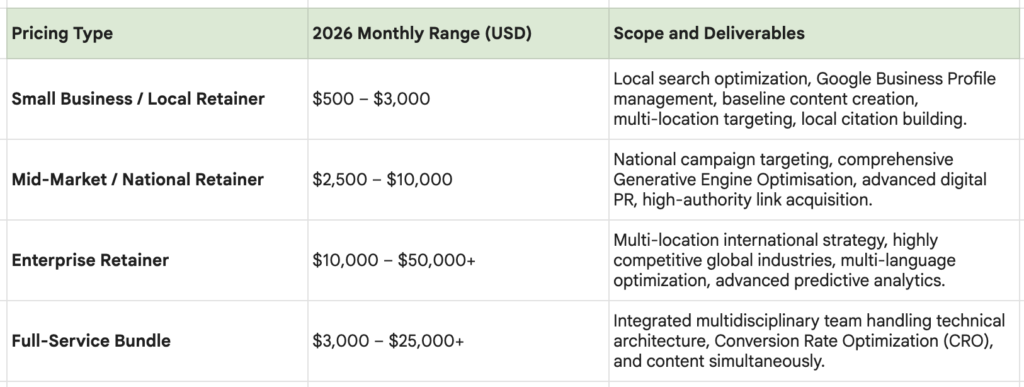
Table 2: Project-Based and Hourly Consulting Structures
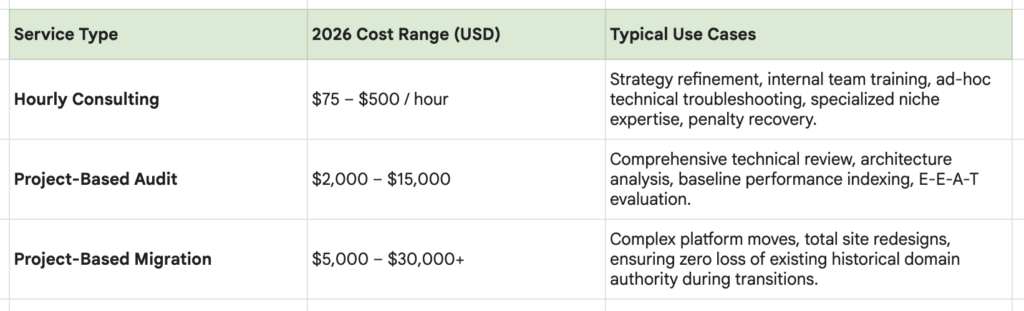
These tables illustrate that professional digital marketing requires substantial financial and intellectual investment. The proliferation of AI tools does not inherently make optimization “cheap”; rather, it shifts the labor toward high-level strategy, rigorous quality assurance, and complex cross-platform integration, adding necessary layers of sophistication to the workflow. The retainer model reflects the true, uncompromised cost of securing highly skilled labor capable of navigating the complex AI search ecosystem.
The Imperative for Professional SEO Consultation and Marketing Alignment
Given the high financial stakes and the substantial structural investment required, businesses must exercise rigorous due diligence when selecting a digital partner. A premier SEO Consultant Selangor or a globally recognized agency approaches digital visibility not merely as a superficial traffic exercise, but through the lens of comprehensive Marketing consultation and deep operational alignment.
Business Economics First
The defining characteristic of an elite consulting operation is the strict requirement to understand the client’s fundamental business economics before a single keyword is ever researched. Agencies must comprehensively analyze what customer acquisition actually costs for the SME, the established lifetime value of a client, and the exact percentage of top-of-funnel leads that historically convert to paying customers.
If an agency jumps straight to proposing deliverables or guaranteeing rankings without fiercely auditing these foundational financial numbers, they are operating blindly and recklessly. These economic metrics must shape every strategic decision, ensuring that the optimization efforts meticulously target commercial queries that generate actual net revenue, rather than chasing vanity traffic metrics that fail to impact the bottom line. This level of integration is why in-house and deeply integrated agency partnerships dominate; when you build organically, you build a durable asset of playbooks and institutional knowledge, whereas outsourcing to a BPO simply rents capacity.
Leveraging E-E-A-T to Future-Proof Growth
Professional consultation also focuses heavily on aligning the brand with Google’s core quality guidelines: Experience, Expertise, Authoritativeness, and Trustworthiness (E-E-A-T). In an era where generative systems evaluate and summarize brand credibility autonomously, demonstrating genuine, verifiable value is paramount. This requires deploying authentic visuals, verifying expert authorship, encouraging user-generated content, and building detailed corporate biographical pages that signal deep industry integration.
A dedicated consultant helps businesses leverage deep sector expertise to build customized roadmaps, rejecting the inherently flawed “one-size-fits-all” approach. They work tirelessly to integrate technical execution with clean code, structured data, and intuitive UX, actively transforming casual browsers into dedicated consumers. Transparent reporting, specific Key Performance Indicators (KPIs), and clear communication ensure that the strategy remains strictly aligned with the overarching corporate trajectory. This level of bespoke, intensive, and continuous consultation is categorically impossible to deliver under a contingent, pay-per-lead framework where the agency’s only goal is triggering a transactional payout.
Executing Generative Engine Optimisation: A Technical Framework
To further illustrate exactly why sustainable marketing requires upfront retainer investment, one must examine the actual, intensive execution of a modern Generative Engine Optimisation (GEO) strategy. Preparing a brand to be discovered, recommended, and cited by AI engines involves a rigorous, labor-intensive four-phase framework.
Phase 1: Assess AI Search Readiness
Before any new content is generated, an agency must establish a highly accurate baseline of how autonomous AI engines currently perceive the brand. This involves executing a comprehensive GEO audit to determine if major platforms (like ChatGPT or Perplexity) are currently citing existing content. The team must deeply analyze the ability of AI crawlers to parse the site’s structured data, evaluate the overall brand sentiment within AI-generated responses (identifying whether the AI’s perception is positive, negative, or hallucinated), and identify critical gaps where competitors are successfully capturing citations that the SME is missing. This audit alone requires weeks of specialized analytical labor.
Phase 2: Tactical Optimization and Restructuring
This is the core execution phase, demanding significant technical, developmental, and editorial resources. AI engines evaluate content fundamentally differently than traditional algorithms; they parse information in individual passages rather than reading whole pages cohesively. Consequently, legacy content must be meticulously restructured.
Every major section of a webpage must begin with a clear, direct answer before expanding into broader context. Headings (H2 and H3) must maintain a flawless logical hierarchy, and precise “TL;DR” statements should be integrated immediately under key sections so they can function as standalone answers for AI synthesis. Furthermore, robust FAQ sections utilizing exact question-and-answer pairs are mandatory, as AI engines rely heavily on this structured format to build responses.
Beyond mere content rewriting, technical foundations must be heavily fortified. This requires the deployment of advanced Schema markup (such as Article, Organization, HowTo, and Breadcrumb schema) to seamlessly translate site context into machine-readable data. Agencies must carefully configure the robots.txt file to permit access to modern crawlers like GPTBot, ClaudeBot, and PerplexityBot, and implement newly standardized llms.txt files to guide generative systems on exactly how to properly interpret the domain’s architecture.
Phase 3 and 4: Measurement, Iteration, and Scaling
Traditional metrics like raw click-through rates are no longer sufficient to gauge success. Agencies must establish complex, proprietary tracking systems to monitor AI Citation Frequency, measure the brand’s Share of Voice across different generative platforms, track Citation Sentiment, and measure highly specific AI-Referred Traffic utilizing advanced GA4 attribution models. Because the AI landscape shifts rapidly as new LLMs are released, this data must be continuously analyzed to scale successful content, rapidly repurposing high-performing guides into data pages, video scripts, or targeted FAQ entries.
The sheer complexity, depth, and technical rigor of this four-phase framework utterly underscore the absurdity of the pay-per-lead request. Executing a successful GEO campaign requires hundreds of hours of highly coordinated labor from web developers, content strategists, and data scientists long before the first AI-generated lead is ever captured.
2026 Threats for Selangor SMEs
For SMEs operating within specific geographic boundaries, such as those in Selangor or the broader Malaysian market, the digital challenges of 2026 extend beyond generalized generative AI. Local search parameters are evolving rapidly, presenting distinct threats that require proactive, retainer-based management to survive.
The Impact of AI on Local Pack Visibility
The integration of AI into local search packs fundamentally alters how brick-and-mortar businesses and service-area operations gain visibility. Generative platforms are now actively summarizing local business reputations, instantly aggregating years of reviews, service offerings, and sentiment into concise overviews. This elevates the absolute necessity of consistent entity data across the entire web. A local business can no longer simply rely on physical geographic proximity to rank; they must demonstrate profound local authority through active community partnerships, geo-tagged authentic visuals, and sophisticated local public relations. Using stock images is heavily penalized by E-E-A-T algorithms; businesses must use real photos of their location, team, and operations to signal locality and uniqueness.
Defending Against Platform Volatility and Malicious Attacks
Furthermore, local businesses face incredibly aggressive external threats, including coordinated fake review attacks, review extortion, and severe algorithmic fluctuations. Securing a domain against these attacks, navigating the complexities of Google’s “Review Jail” algorithms, and maintaining strict compliance for service-area business addresses (especially concerning co-working spaces or subleasing) requires constant, vigilant management.
When businesses invest in a professional agency on a retainer basis, they are not merely paying for upward growth; they are retaining a vital defensive perimeter. A dedicated team continuously monitors local grid tracking, resolves platform suspensions, tracks LLM visibility, and ensures that the business remains entirely insulated against volatile SERP changes. A pay-per-lead contractor, hyper-focused solely on triggering a fast payout, has absolutely zero financial incentive to engage in this crucial, defensive brand protection, leaving the SME highly vulnerable to catastrophic ranking drops.
The Case for Professional Alignment
The transition into the era of Generative Engine Optimisation requires SMEs to partner with consultants who fundamentally understand the intersection of technical architecture, compelling brand narrative, and strict financial KPIs. It requires an agency that builds conversion-centered development, applying CRO principles, clear CTAs, and rigorous A/B testing to transform traffic into tangible revenue.
This is the exact philosophy championed by elite consulting firms that focus deeply on data-oriented growth. For instance, agencies that have completed thousands of consultations understand that growing organic traffic is meaningless unless it is paired with improving conversion rates and maximizing Return on Ad Spend (ROAS) to drive measurable, bottom-line results. They offer end-to-end design and development services, integrating technical SEO, clean code, and fast load times directly into the website’s architecture.
Crucially, reputable agencies operate on the principle of client ownership. Upon completion and full payment for project-based developments, the business owner retains complete ownership of the website and the digital assets built, ensuring the equity remains with the SME, unlike the rented pipeline of a BPO. They leverage deep sector expertise to build customized marketing roadmaps, providing the personalized consultation, strategic guidance, and business planning tailored specifically to the unique challenges of the SME. Operating with transparency, they utilize real-time dashboards and jargon-free reporting, completely removing the smoke and mirrors often associated with performance-based lead vendors.
Conclusion
The digital marketplace of 2026 is an incredibly intricate ecosystem, heavily dominated by intelligent, generative systems and rapidly shifting consumer search behaviors. As search algorithms definitively evolve from simple indexing tools into sophisticated, autonomous answer engines, the strategies required to capture and retain market share have become exponentially more complex, technical, and labor-intensive.
While the desire of an SME business owner to strictly minimize financial exposure by requesting a pay-per-lead SEO arrangement is highly understandable from a traditional budgetary perspective, it represents a fundamental, catastrophic strategic error in the modern context. Pay-per-lead models are strictly the domain of outbound BPO operations and short-term performance advertising agencies. They rely inherently on rented capacity, generic data lists, short-term tactics, and ephemeral visibility that vanishes the moment the transaction concludes.
True SEO Marketing is the rigorous process of constructing a permanent, highly authoritative inbound digital asset. It absolutely demands the implementation of precise technical strategies, exhaustive keyword architecture, and high-level, E-E-A-T compliant copywriting months before any tangible results materialize. Demanding to pay only when a lead is delivered wholly invalidates the monumental upfront labor required to satisfy the complex technical parameters of Generative Engine Optimisation. Furthermore, because a successful ranking will generate passive, organic leads for up to three years, paying a per-lead commission for the entire lifespan of that asset becomes an unjustifiable, mathematically crippling financial burden for the business owner.
To build a resilient, future-proof digital presence that withstands algorithmic volatility and captures the power of AI search, businesses must embrace standard retainer or package-based pricing models. These established frameworks ensure a perfectly clear alignment of goals, foster deep strategic collaboration, prevent the catastrophic risks of black-hat tactics, and provide the measurable ROI necessary for sustainable corporate expansion. By moving decisively beyond transactional relationships and investing heavily in comprehensive inbound architecture, organizations can firmly establish themselves as the definitive, trusted sources that modern AI systems consistently recommend to consumers.