Poor Communication and Monitoring: A lack of transparent, ongoing reporting indicates your agency is neglecting the daily technical monitoring required to survive core algorithmic updates and align with your real-world business activities.
Failure to Adapt to AI Search Paradigms: Agencies still focused strictly on traditional ten-blue-link rankings—rather than Answer Engine Optimization (AEO) and structured data for AI overviews—are actively driving your brand toward digital obsolescence.
Unsustainable Pricing and Black Hat Risks: Ultra-cheap SEO packages (below RM 1,000) are economically incapable of funding the skilled labor needed for modern campaigns, often resulting in automated, black-hat tactics that will severely penalize your website’s domain authority.
The 2026 Digital Search Paradigm in Selangor
As the global digital ecosystem advances deep into 2026, the search engine optimization landscape has undergone a radical, foundational, and irreversible transformation. Driven by immense, compounded advancements in artificial intelligence and fundamental shifts in how human consumers retrieve, process, and trust information online, traditional keyword-ranking strategies are rapidly giving way to a vastly more sophisticated, context-aware environment. For Small and Medium Enterprises (SMEs) operating within the highly competitive, diverse, and digitally mature market of Selangor, Malaysia, this evolution presents both an unprecedented commercial opportunity and an imminent existential threat. Historically, achieving visibility on digital search engines required a relatively straightforward manipulation of on-page text and off-page hyperlink building. Agencies could guarantee top positions by leveraging sheer volume over qualitative depth. The search engines of the past operated essentially as sophisticated card catalogs, reading text density and matching user queries to the most frequently cited pages.
However, the modern paradigm operates on fundamentally different architectures. Search engines have evolved far beyond their original design as mere directories of hyperlinked pages. Today, they operate as autonomous answer engines capable of synthesizing highly complex information, drawing from multiple unstructured sources, and presenting unified, AI-generated responses directly to the user. This profound paradigm shift has birthed the era of the Search Generative Experience, a foundational technology that has now fully matured into the ubiquitous AI Overviews seen across billions of daily queries. In this environment, the user often receives the answer to their query without ever needing to click a traditional blue link, a phenomenon known as the zero-click search. To survive, a business must ensure its data is structured so perfectly that the AI chooses its brand as the authoritative source of the synthesized answer.
Within Selangor’s dynamic economy, which encompasses everything from vast retail franchises and advanced manufacturing hubs to localized professional services, businesses are increasingly relying on hyper-localized digital visibility to capture high-intent consumer traffic. Search intent in Malaysia has grown highly nuanced, often requiring a blend of Bahasa Malaysia, English, and localized colloquialisms, alongside rigorous technical architecture to capture mobile-first consumers. Yet, a significant and dangerous disconnect remains between the rapid evolution of this search technology and the methodologies employed by many regional marketing firms. The proliferation of substandard service providers continues to severely damage the digital infrastructure of local SMEs.
When a business engages an underperforming agency, the consequences extend far beyond wasted capital. It results in the active degradation of the brand’s digital entity trust, severe algorithmic penalties, and a catastrophic loss of market share to more technologically adapted competitors who understand how to feed data to Large Language Models (LLMs). Recognizing the symptoms of a failing digital partnership is essential for business continuity and long-term asset building. The comprehensive analysis detailed in this report outlines the seven definitive signs that an SME has hired a bad SEO agency. By thoroughly understanding the mechanisms behind communication breakdowns, technological stagnation, black-hat methodologies, opaque reporting, inadequate tool utilization, unsustainable pricing models, and poor servicing, enterprise leaders can effectively audit their current vendor relationships and pivot toward sustainable, forward-facing growth strategies.
Sign 1: A Critical Lack of Communication and Consistent Monitoring
In the context of modern SEO Marketing, proactive, transparent, and continuous communication is not merely a courtesy; it is an absolute operational imperative. The search landscape in 2026 is characterized by extreme algorithmic volatility. Search engines continuously deploy core updates, adjust the parameters of their generative AI models, refine the quality thresholds required for content inclusion, and dynamically alter how search engine results pages (SERPs) are visually constructed based on real-time user intent. Consequently, search visibility requires consistent monitoring and a highly responsive feedback loop between the consulting firm and the enterprise client.
When an agency exhibits a lack of communication, the damage inflicted upon the campaign is twofold. First, it demonstrates a structural failure in the agency’s ability to monitor the client’s digital assets actively. Search optimization is an ongoing process of hypothesis, execution, measurement, and refinement. It requires daily vigilance. An agency must monitor crawl logs to ensure bots are accessing priority pages, track indexation status across multiple search engines, and watch for unexpected drops in organic impressions that signal a technical failure or an algorithmic demotion. If a provider is not regularly communicating performance shifts, algorithmic updates, or required strategic pivots, it is an unequivocal indicator that they are not monitoring the campaign with the necessary rigor. In a landscape where AI crawlers parse data daily to construct real-time answers, missing out on consistent monitoring leads directly to a loss of citation visibility. When monitoring is absent, the client misses out entirely on the micro-adjustments required to maintain a competitive edge.
Second, poor communication masks deeper operational negligence. A defining characteristic of substandard agencies is their tendency to operate in complete secrecy during the early months of a contract, often citing that “optimization takes time” as a convenient excuse for radio silence. While it is scientifically accurate that organic entity building and authority acquisition is a long-term endeavor that generally requires six to twelve months to reach full maturity, the operational milestones leading to that growth should be highly visible and clearly articulated. Quality communication involves translating complex technical metrics into actionable business intelligence. An expert SEO Consultant Selangor will maintain regular syncs to discuss how shifts in search intent impact the enterprise’s broader commercial objectives, detailing exactly what technical optimizations were performed, what content was restructured, and what digital PR outreach was conducted during that specific week or month.
Furthermore, effective communication must flow in both directions to be successful. An agency that does not actively solicit updates regarding the client’s internal business operations, new product launches, seasonal promotional changes, or shifts in target demographics is operating in a dangerous vacuum. The advanced algorithms of 2026 reward hyper-relevance, fresh content, and localized entity authority. If a Selangor-based retail SME launches a new product line specifically for an upcoming local festival, the SEO agency must be informed immediately to build structured data schemas, optimize localized landing pages, and initiate an Answered Engine Optimisation strategy to capture the sudden spike in conversational queries. If the agency is unaware of the business’s real-world activities due to a lack of communication, it becomes mathematically impossible to synthesize those activities into the digital signals required by AI search agents. The prolonged silence of an agency is the loudest indicator that the campaign has been relegated to an automated, neglected state, ensuring that the client will consistently miss out on critical revenue opportunities.
Sign 2: Failure to Adapt to the Latest Trends and Technology
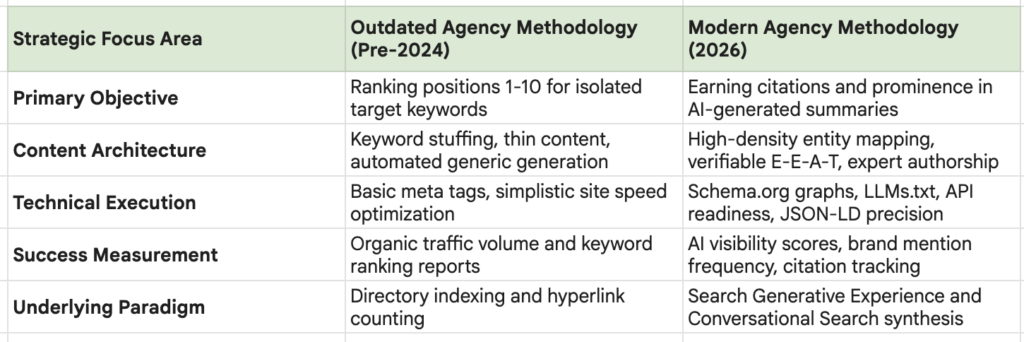
The single most critical differentiator between a highly effective marketing firm and a detrimental one in 2026 is their technological adaptability. The digital marketing ecosystem has moved definitively into the Generative Engine Optimisation and Answered Engine Optimisation era. Agencies that remain tethered exclusively to the traditional paradigm of securing ten blue links and manipulating keyword density are actively driving their clients toward digital obsolescence.
Traditional search strategies focused on optimizing for specific keywords to rank a webpage within a rigid directory structure. This involved placing exact-match keywords in title tags, headers, and throughout the body copy to signal relevance to a simplistic crawler. Conversely, Generative Engine Optimisation is the sophisticated practice of structuring data and content so that autonomous artificial intelligence systems—such as ChatGPT, Perplexity, Microsoft Copilot, and Google’s AI Overview—can accurately retrieve, trust, and synthesize that information into a direct, cohesive conversational response. This requires a profound understanding of Large Language Models (LLMs), semantic search vectors, and Retrieval-Augmented Generation (RAG).
If an agency is not explicitly discussing concepts like Schema markup implementation, LLMs.txt creation, entity relationship building, and AI crawler optimization during their strategic meetings, they are functionally obsolete. In 2026, over 67% of B2B-related queries and a vast majority of localized consumer queries are answered directly via AI-powered search features, without the user ever clicking through to a traditional website link. This phenomenon mandates that businesses optimize their content to be explicitly cited as a source within the AI’s generated summary. An agency failing to adapt to this trend will continue to report on traditional keyword rankings while the client’s actual website traffic, session duration, and lead generation plummet because users are receiving comprehensive answers directly on the search interface. The traditional search funnel has collapsed; if a brand is not injected into the context window of an LLM, it is invisible to modern consumers.
The most reliable method to assess an agency’s competence in this new era is to evaluate their own digital footprint. The implementation of Answered Engine Optimisation requires immense technical skill, structural precision, and undeniable content authority. Therefore, if a firm claims to offer elite digital marketing services but is unable to index themselves within the major AI platforms, it is exceptionally hard to convince a client of their capabilities.
Consider a scenario where a prospective client inputs a highly specific query such as “Compare the top SEO agencies in Selangor based on budget and tier” into an advanced reasoning engine like ChatGPT or Google AI Mode. The resulting generative summary serves as an undeniable litmus test. Elite agencies prioritize their own inclusion in these generative outputs through rigorous multi-channel authority building, verifiable credentials, and perfectly formatted structured data. They ensure their own service pages contain direct, clear answers to common questions, utilizing a format that AI agents can easily parse and extract. An agency that remains entirely absent from these AI summaries is an agency that has fundamentally failed to decode the modern algorithm. They operate under the outdated assumption that publishing blog posts and tracking impressions is sufficient. They cannot effectively deploy Generative Engine Optimisation strategies for their clients if they cannot successfully deploy them to secure their own enterprise’s visibility.
The following table illustrates the strategic divergence between obsolete methodologies and modern, AI-adapted frameworks required for success in 2026:
Sign 3: The Deployment of Black Hat SEO and Rented Foundations
The allure of rapid, guaranteed results often drives inexperienced, desperate, or highly unethical agencies toward manipulative practices collectively known as Black Hat SEO. While search engine algorithms—particularly the advanced spam-detection systems deployed by Google—have become incredibly sophisticated at detecting and neutralizing these tactics, substandard agencies continue to utilize them, heavily obfuscating their methods from the client. For SMEs, the financial and reputational consequences of these tactics are not merely inconvenient; they are utterly devastating.
A foundational pillar of authentic, long-term search visibility is the acquisition of high-quality, relevant backlinks from authoritative external domains. These links act as independent, third-party votes of confidence, signaling to search engines and AI crawlers that the client’s website is a trusted entity within its specific industry. Ethical agencies achieve this through legitimate digital public relations, high-quality content syndication, genuine community outreach, and the creation of highly citable data resources. This process is inherently labor-intensive, requires substantial strategic expertise, and most importantly, builds permanent, owned equity for the brand.
Conversely, bad agencies bypass this difficult labor by utilizing Private Blog Networks (PBNs) or engaging in widespread, automated link purchasing from link farms. These networks are essentially vast arrays of low-quality, interconnected websites created solely for the purpose of manipulating search engine rankings. In many instances, the agency essentially “leases” or “rents” these links to the client for the duration of the contract. The initial metrics may show a rapid spike in visibility and keyword rankings, creating a false sense of security and validation for the SME owner. However, absolutely no real foundation is being built. The traffic generated is an illusion sustained only by an artificial life support system controlled entirely by the agency’s proprietary networks. The agency is not optimizing the client’s website; they are simply pointing their own illicit assets at the client’s domain.
The true malice of the link-leasing and rented-asset model becomes apparent only when the business relationship is terminated. Because the agency retains full ownership and control of the PBNs, the domain registrations, or the specific content networks, ending the contract results in the immediate removal of all inbound links and rented content. Consequently, the client’s search engine visibility and subsequent organic traffic will become zero immediately. Years of financial investment vanish overnight, leaving the website with less authority than when the campaign began.
This predatory dynamic creates a hostage situation wherein the SME is forced to continue paying a monthly retainer for underperforming or stagnant services simply to maintain their baseline revenue. The client cannot leave without destroying their own business. A legitimate SEO Consultant Selangor operates under the strict, uncompromising principle that the client retains full, unencumbered ownership of all digital assets, content, technical modifications, and earned links produced during the campaign. Sustainable SEO is the deliberate process of building compounding equity in a digital property, much like improving a physical real estate asset. If the strategy relies on rented assets or black-hat manipulation—such as keyword stuffing, cloaking, or utilizing hidden text—the business is not investing in its future; it is merely subsidizing a high-risk, temporary facade.
Furthermore, when an agency relies on black hat tactics, they expose the client’s website to severe algorithmic or manual penalties from search engine webspam teams. A manual action penalty essentially exiles the website from the search index entirely. Recovering from such a penalty is a grueling process that requires months or years of expensive forensic auditing, link disavowal, and complete content overhauls. The preservation of a brand’s digital entity trust is paramount in the AI era, and any agency willing to risk that hard-earned trust for temporary vanity metrics is a profound liability.
Sign 4: The Absence of Transparent and Interpretable Reporting
Data transparency is the cornerstone of any legitimate Marketing consultation. However, a hallmark of an underperforming agency is the delivery of obscure, highly technical, incomplete, or entirely absent reporting. Reporting is important for SEO; without comprehensive, contextualized reporting, it will be hard for a beginner to interpret the data, understand the return on investment, or align the marketing campaign with actual business objectives.
Bad agencies typically hide behind vanity metrics—data points that look impressive on a surface level but hold absolutely no correlation to revenue generation, pipeline growth, or commercial success. Reports from these providers often consist merely of an automated spreadsheet listing a few dozen keywords and their associated numerical ranking positions, deliberately ignoring the contextual nuance of search intent and user behavior. A ranking is inherently meaningless if the keyword possesses no commercial intent, if the search volume is artificially inflated by bots, or if the search engine results page (SERP) is completely dominated by zero-click AI summaries that capture all user attention before they ever reach the organic links. Providing a client with a report stating they are “Rank 1” for a keyword that generates zero clicks is a deceptive practice designed to feign progress.
Furthermore, substandard reporting fails to reconcile the massive discrepancies inherent in modern web analytics. In 2026, user journeys are highly fragmented across mobile devices, cross-platform applications, social media platforms, and autonomous AI agents. An agency that simply exports a raw Google Analytics PDF without providing a human-driven narrative analysis is failing in its fundamental duty as a consultant. Search Console may show high impressions, but if on-site analytics show low engagement, there is a disconnect that must be analyzed and explained to the client. Operationally, if an agency does not integrate rigorous conversion tracking, specific goal setups, and pipeline attribution into their monthly reviews, they cannot justify their economic value to the enterprise.
A competent agency views reporting as a crucial strategic alignment tool, not a chore to be automated. High-quality reporting in the modern era encompasses far more than keyword positions; it delves deeply into audience demographics, entity sentiment analysis, citation tracking across Large Language Models, and granular competitor benchmarking. Because SEO marketing involves complex, multifaceted data streams, the agency must act as a translator for the SME owner. They must synthesize bounce rates, session durations, and AI visibility scores into a coherent business narrative.
An ethical agency will explicitly map how organic search traffic converts into measurable business leads, phone calls, or e-commerce sales. They utilize sophisticated dashboards to demonstrate brand share-of-voice and AI visibility scores, proving exactly how often the client’s brand is recommended by AI reasoning engines like ChatGPT and Perplexity. By obfuscating this data, delivering it without context, or failing to provide it altogether, a bad agency prevents the client from understanding the true trajectory of their digital assets. This deliberate asymmetry of information keeps the beginner client confused, preventing them from asking critical questions and allowing the agency to extend their contract indefinitely without delivering real value.
Sign 5: The Refusal or Inability to Utilize Enterprise Third-Party Tools
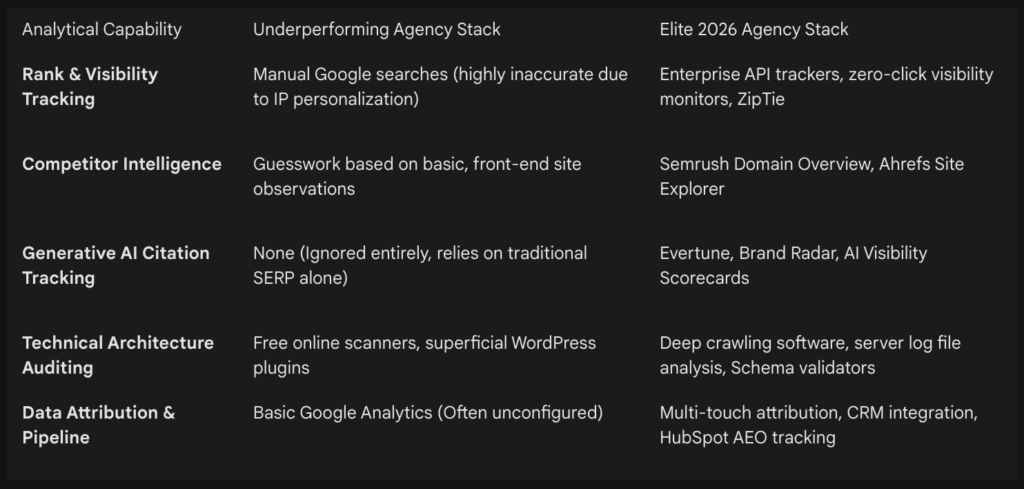
The sheer scale and complexity of the 2026 digital environment make it mathematically and operationally impossible to execute a high-level search strategy manually. The vast amount of data required to analyze competitor gaps, track algorithmic volatility, monitor backlink velocity, and track AI citations necessitates the use of enterprise-grade software. If the company is not using recognized third-party tools, then it will be hard to know things that are out of the website itself, rendering the strategy completely blind to broader market dynamics and competitor maneuvers.
Top-tier marketing firms invest heavily in an advanced, comprehensive technology stack. Tools like Semrush and Ahrefs are non-negotiable industry standards required to perform deep competitor X-rays. By inputting a rival’s URL into these platforms, a consultant can instantly reveal their estimated organic traffic, dissect their top-performing paid keywords, and map their entire backlink profile. These platforms provide the empirical data necessary to transition a Marketing consultation from abstract theoretical goals into concrete, actionable benchmarks. Without these tools, an agency cannot perform a citation gap analysis, meaning they cannot identify which authoritative websites are linking to competitors but ignoring the client.
Moreover, the advent of the Search Generative Experience has birthed an entirely new category of complex tracking requirements. Traditional rank trackers are blind to conversational AI outputs. Agencies must now utilize specialized AI visibility platforms—such as ZipTie, Evertune, Peec.ai, or Semrush’s AI Toolkit—to monitor exactly how frequently a brand is cited within the dynamic outputs of ChatGPT, Perplexity, and Microsoft Copilot. These advanced tools measure probabilistic brand presence over thousands of prompts, detect detrimental LLM hallucinations that may be spreading false information about the client’s business, and track citation gaps across the internet’s vast unstructured data.
A common and highly dangerous deception employed by fraudulent or low-budget agencies is the claim that they possess “secret methods” or proprietary, in-house software that outperforms recognized industry tools. This is almost universally a fabrication designed to justify a severe lack of transparency and an unwillingness to invest capital into legitimate, expensive software licenses. Building a robust AI citation tracker or maintaining a global backlink index requires tens of millions of dollars in server infrastructure, computational power, and continuous engineering. An SME-focused agency in Selangor claiming to have replicated this infrastructure internally is severely misrepresenting their technological capabilities.
By avoiding standard third-party tools, these bad agencies isolate the client from objective reality. Because there is no external data source to verify performance, the client is forced to accept the agency’s unverified claims regarding performance and market position, with no independent data available to corroborate those assertions. An agency’s technology stack is a direct reflection of its commitment to data integrity, strategic precision, and transparency. If they are trying to execute SEO blind, the client will inevitably suffer the consequences of that ignorance.
The following table highlights the critical differences in tool utilization between underperforming providers and elite, future-ready agencies:
Sign 6: Unsustainable and Predatory Pricing Models
There is a fundamental economic reality inherent in every legitimate marketing strategy: there is distinct costing associated with executing high-quality labor, maintaining enterprise software, and delivering measurable results. When analyzing the Selangor and broader Malaysian market in 2026, the cost of securing elite search visibility perfectly reflects the highly specialized, multi-disciplinary teams required. If the SEO package is below RM 500 – RM 1,000 per month, this means the servicing will be severely affected, and the campaign is mathematically guaranteed to fail or resort to damaging shortcuts.
Industry data meticulously tracks the economic realities of digital marketing services. The average baseline price for a legitimate, 12-month digital campaign in Malaysia hovers around RM 3,000 per month. Mid-to-high range enterprise packages, which include advanced technical optimization and goal conversion setups, frequently run between RM 15,000 to RM 35,000 annually. Specialized freelance consultants with proven track records command hourly rates between RM 80 and RM 300, while dedicated, one-off project work often starts above RM 4,400.
These costs are not arbitrary; they are derived directly from the immense resources required to execute modern, AI-compliant campaigns. A comprehensive Generative Engine Optimisation strategy requires the orchestration of technical web developers to implement complex JSON-LD Schema markup, highly skilled semantic content writers to draft authoritative E-E-A-T compliant articles, digital PR specialists to secure editorial backlinks, and data analysts to interpret the vast arrays of performance metrics. Furthermore, the agency must cover the substantial monthly overhead of the premium third-party software stack discussed previously, which can easily exceed several thousand Ringgit per agency per month.
When an agency offers packages below the RM 500 or RM 1,000 threshold, they are operating under a highly restrictive economic model that strictly prohibits the employment of quality labor. To maintain any semblance of profitability at such unsustainably low margins, the agency is forced to implement a high-volume, fully automated approach. The servicing and the actual work product are compromised in several predictable, highly damaging ways:
Automated Spam Content: The agency cannot afford human writers. They rely entirely on raw, unedited AI-generated content that completely lacks the human nuance, unique perspective, and verifiable experience (E-E-A-T) strictly required by modern algorithms. This thin content is frequently buried by search engines.
Ignored Technical SEO: Comprehensive technical audits required to fix critical site architecture, mobile usability errors, Core Web Vitals, and indexing issues are abandoned because they require expensive human engineering expertise.
Black Hat Link Building: Instead of earning natural links through targeted outreach, the agency utilizes cheap, toxic link farms or automated bot software, exposing the client to devastating manual penalties.
Zero Customization: The agency utilizes a rigid, cookie-cutter operational template that completely ignores the unique commercial intent, target audience demographics, and localized geography of the specific Selangor business.
A business owner must view search optimization not as an operational overhead expense, but as a deliberate capital investment into a permanent digital asset. Purchasing an artificially cheap package guarantees the deployment of shortcuts that ultimately destroy the foundation of that asset. The long-term financial damages of recovering from manual penalties, rebuilding a ruined digital reputation, and losing market share to competitors far exceed the initial perceived savings of a cheap agency retainer.
Sign 7: Substandard Servicing for an Intangible Marketing Asset
Unlike traditional manufacturing, retail, or hardware industries, SEO marketing is a highly intangible product. When an SME signs a service contract with an agency, they are not purchasing a physical commodity that can be inspected upon delivery. They are purchasing specialized expertise, human time, intellectual property, and the promise of future digital visibility. Because the results of organic entity building often take months to fully materialize within complex search engine indices, the quality of the consultation and the day-to-day servicing becomes the primary product the client experiences during the foundational phases of the relationship. Therefore, if the service is bad, then it might affect your experience as well, and it signals massive structural flaws within the agency itself.
If the agency’s service is poor—characterized by perpetually delayed email responses, a complete lack of proactive strategic guidance, defensive or hostile attitudes when questioned about data, or an inability to explain highly technical concepts clearly to a layperson—it drastically affects the client’s overall experience and trust. More importantly, poor servicing is highly indicative of operational chaos. An agency that cannot organize its own account management, billing, and client communication protocols is highly unlikely to possess the meticulous organizational skills required to execute complex Schema markup, restructure website architectures without causing 404 errors, and map out multi-channel entity building campaigns.
The future of digital visibility is inherently experience-driven. Agencies must design content and technical architectures for both human understanding and machine interpretation. If the agency cannot provide a coherent, high-quality, human-centric experience for their own paying clients, it is an epistemological impossibility for them to create trust-building, user-centric digital experiences for the client’s target audience.
Furthermore, in the 2026 search landscape, brand reputation, sentiment analysis, and overall entity trust have become core ranking and visibility signals for generative AI engines. Autonomous AI agents actively evaluate how users interact with a brand across the entire internet—scanning reviews, forums, social media, and news outlets—to determine its ultimate authority and trustworthiness. An agency providing bad service often creates a fractured, disorganized, and neglectful digital footprint for the client. They may neglect vital Google Business Profile updates, ignore localized reputation management, or push out low-quality, syndicated content that aggressively degrades the brand’s perceived expertise in the marketplace.
The cost of this negligence is profound. As AI engines increasingly prioritize brands with pristine reputations and dense, authoritative content, the SMEs saddled with poor agency servicing will find themselves filtered out of the digital conversation entirely. The relationship between a Selangor SME and their digital marketing partner must be highly collaborative, built on mutual respect, deep industry understanding, and a shared strategic vision for long-term equity creation. When servicing fails, the entire strategic alignment collapses, rendering the marketing investment void.
Conclusion and the Path Forward for Selangor SMEs
The transition from a traditional directory-based search landscape to an AI-driven, intent-focused answer engine ecosystem has created a stark, unforgiving dividing line in the digital marketing industry. The agencies relying on communication opacity, automated black-hat tactics, rented assets, and outdated keyword matrices are rapidly losing their ability to influence the market, taking their clients down with them. For small and medium enterprises in Selangor, the economic stakes have never been higher. Retaining an agency that exhibits the seven critical warning signs detailed in this comprehensive report is no longer a matter of mere operational inefficiency; it is an active threat to the enterprise’s digital survival and future revenue generation.
Business leaders must demand total transparency, absolute ownership of all digital assets produced, and comprehensive reporting that maps visibility directly to revenue pipelines. Furthermore, it is absolutely critical to select vendor partners who intrinsically understand the sophisticated technical nuances of Generative Engine Optimisation and possess the enterprise-grade tool stacks required to monitor citation gaps across complex Large Language Models. The strategic focus must shift entirely from renting short-term vanity metrics to building a permanent, highly authoritative digital entity that autonomous AI systems natively trust and recommend to consumers.
For those evaluating their current digital partnerships, recognizing these failure points is the crucial first step toward remediation. Aligning with an elite, transparent, and technologically advanced firm is the only viable path to securing long-term visibility in the modern search ecosystem. If you are looking forward for someone to bring your SEO to another level, we are here to help. Advanced, future-proofed strategies ensure that brands remain not just visible, but undeniably authoritative in the era of generative search.