The Economic Illusion of Cheap SEO: A fee of RM500 per month is mathematically incapable of covering even the minimal basic monthly software subscriptions required for legitimate data analysis, let alone the extensive professional labor required for strategic execution.
The Expertise and Time Deficit: True SEO consultation requires deep industry insight, time-intensive data justification, and customized strategies aligned with business goals. If a consultant cannot cover their own expenses, they cannot provide effective consultation.
The AI Search Imperative: With the 2026 rise of AI-driven search engines, users are bypassing traditional links. Failing to technically optimize for generative AI responses means a brand will completely disappear from the digital market ecosystem.
The Digital Landscape for Malaysian Enterprises in 2026
The contemporary digital ecosystem in Malaysia has evolved into a highly complex, competitive, and technologically sophisticated environment. For small and medium-sized enterprises (SMEs) operating within this landscape, securing robust online visibility is no longer a luxury but an absolute existential requirement. The acceleration of digital transformation, supported by comprehensive national initiatives and a rapidly growing internet penetration rate, has forced businesses of all sizes to digitize their operations and marketing strategies. However, this desperate and often rushed need for digital presence has inadvertently cultivated a highly predatory segment within the broader digital marketing industry: the proliferation of extremely low-cost search engine optimization services.
Throughout Malaysia, numerous agencies, independent contractors, and unverified digital vendors actively advertise comprehensive SEO services for as little as RM500 per month. To an SME owner facing constrained operational budgets, relentless inflation, and overall economic pressures, these cut-rate packages appear as a highly attractive, low-risk entry point into the world of digital marketing. The promise of achieving top-tier search engine rankings for a fraction of the standard market cost is a compelling proposition for businesses desperately seeking to increase their digital footprint and attract new consumer demographics.
However, the empirical reality of the 2026 search ecosystem unequivocally reveals that these ultra-low-cost offerings are not merely ineffective; they represent a fundamental scam that actively endangers the long-term digital health and financial stability of the businesses that purchase them. The underlying mechanics of search have transitioned entirely from basic keyword matching and directory submissions to advanced neural processing, deep semantic understanding, and comprehensive artificial intelligence integration. Achieving and maintaining visibility in this modern era requires highly specialized technical skills, expensive enterprise-grade software infrastructure, and significant, ongoing investments of human analytical time.
When these RM500 packages are subjected to basic financial, operational, and strategic scrutiny, they immediately collapse as a mathematical and practical impossibility. The digital economy is currently characterized by an environment where algorithmic trust is paramount. Search engines have deployed sophisticated machine learning models to detect manipulation, rendering the cheap, automated tactics of the past entirely obsolete and highly dangerous. This extensive analysis methodically deconstructs the structural mechanisms of the SEO industry in Malaysia, explaining exactly why cut-rate packages operate as fraudulent schemes. By examining the true baseline costs of software infrastructure, the intrinsic value of expert time costing, the devastating impact of algorithmic penalties, and the paradigm-shifting rise of artificial intelligence in search, a clear and undeniable picture emerges. The market data indicates that sustainable business growth can only be achieved through legitimate SEO Marketing and strategic consultation, whereas engaging with bottom-tier providers inevitably leads to a complete disappearance from the modern digital market.
The True Cost of Legitimate SEO Consultation
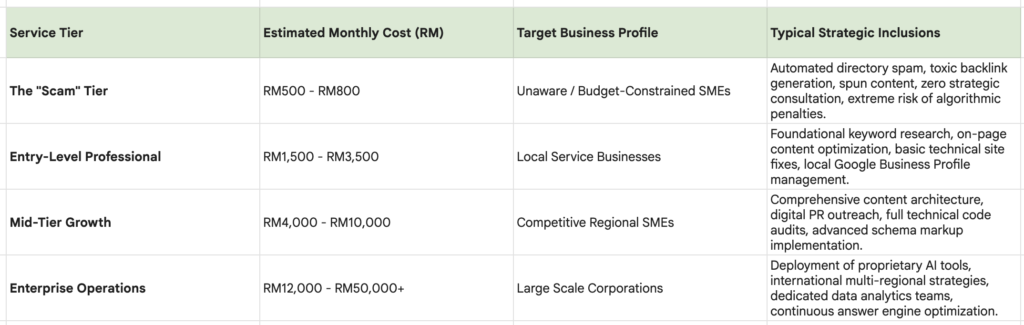
To fully comprehend why the RM500 package is inherently deceptive, it is first necessary to establish the legitimate financial baseline of the professional digital marketing industry in Malaysia. When you look into the market, most of the SEO Consultant professionals are charging for more than a thousand for SEO Consultation. This pricing is not arbitrary; it is a direct reflection of the intense labor, specialized knowledge, and technological overhead required to move a digital asset forward in a highly saturated environment.
Recent comprehensive market research detailing the economic realities of 2025 and 2026 demonstrates that the average cost of professional SEO in Malaysia remains tightly correlated with the depth of expertise provided and the competitive nature of the client’s industry. Legitimate monthly retainers for standard SME campaigns typically range from a minimum of RM2,000 to RM5,000. For mid-tier growth businesses operating in highly competitive urban centers, these costs frequently scale between RM4,000 and RM10,000 per month. Furthermore, comprehensive enterprise-level SEO services, which require dedicated analytical teams and multi-regional strategies, frequently command retainers ranging from RM12,000 to over RM50,000 per month depending entirely on the project’s structural scope, regional competition, and technical complexity.
When consulting services are broken down into standard hourly rates, experienced digital professionals in Malaysia consistently command between RM100 and RM300 per hour. These figures represent the baseline compensation required to sustain a legitimate, viable digital agency capable of delivering measurable business outcomes.
The massive financial disparity between a legitimate entry-level professional package (RM1,500 minimum) and the heavily advertised RM500 package highlights a fundamental breach of basic commercial reality. Providers offering comprehensive services at the RM500 price point cannot possibly engage in the baseline activities required to move a website up the modern search rankings. They completely lack the operating capital to invest in the requisite enterprise software, the personnel to perform necessary manual code optimizations, and the foundational expertise to formulate long-term digital strategies.
In essence, the pricing structure itself serves as the primary red flag. Extremely low pricing indicates an operation relying entirely on automated spam tactics, wholly inexperienced providers, or deceptive bait-and-switch schemes where the real, substantial costs only emerge later in the engagement after the client has been locked into a contract. Why SEO Consultant that charge lower is scam? The answer lies in the uncompromising economics of digital infrastructure and professional human labor.
Reason 1: The Inescapable Burden of Enterprise Software Costing
The first core reason why any professional offering services at cut-rate prices is operating a deceptive scheme comes down to the basic economics of enterprise technology. Modern search engine optimization cannot be performed blindly, nor can it be executed using free, consumer-grade tools. It requires deep, continuous data extraction from search engine results pages, exhaustive competitor backlink profiling, semantic keyword gap analysis, and highly technical website crawling. During the execution of any legitimate campaign, specialized software is the basic costing that the consultant need to bear with.
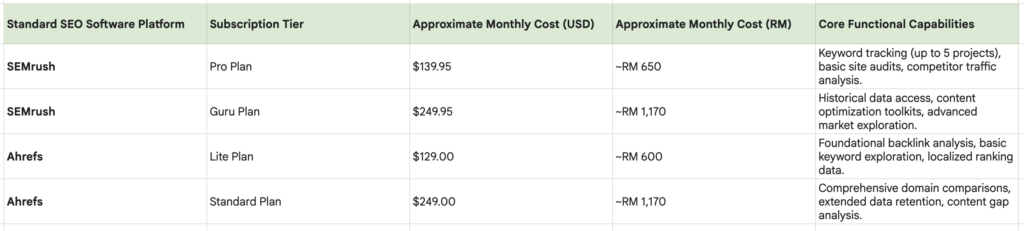
These industry-standard software platforms are not optional luxury items; they are the fundamental diagnostic instruments of the profession. Platforms such as Ahrefs and SEMrush dominate the global market, providing the vital data streams that allow consultants to understand how search algorithms are currently evaluating a client’s website. However, these tools are designed for enterprise use, and their pricing structures reflect this. These software is being billed every month and RM 250 – RM 500 per month is the minimal spending required merely to maintain the most basic, entry-level access to a single platform.
To understand the mathematical impossibility of the RM500 package, one must examine the actual pricing of these indispensable tools. In recent restructuring of their offerings for the 2026 market, SEMrush provides three primary pricing plans for their SEO toolkit. The basic “Pro” tier costs $139.95 per month, the mid-level “Guru” tier reaches $249.95 per month, and the advanced “Business” tier costs $499.95 per month. Similarly, Ahrefs requires an investment ranging from a minimum of $99 or $129 for their introductory “Lite” plan, scaling all the way up to $1,499 per month for full enterprise data access.
When these fundamental costs are converted from US Dollars to the Malaysian Ringgit, just one of these foundational tools represents an absolute minimal monthly expenditure of approximately RM450 to over RM1,100.
Crucially, a fully equipped digital agency does not rely on a single analytical tool. A proper, professional technical stack in 2026 includes a multitude of overlapping subscriptions. A consultant requires crawling software like Screaming Frog to diagnose server errors, content optimization AI platforms like Creaitor to align text with natural language processing guidelines, localized rank trackers to monitor hyper-specific regional visibility, and specialized reporting dashboards to synthesize data for the client. The combined monthly overhead for a single SEO practitioner’s software stack easily exceeds RM2,000 before a single hour of human labor is even factored into the equation.
Therefore, when an agency charges a total of RM500 per month for an entire campaign, a mathematical paradox occurs. If the consultant’s total gross revenue from a client is RM500, they are either operating their business at a severe financial loss, completely abstaining from using professional analytical tools, or unlawfully sharing a single software license across hundreds of clients while spending mere minutes analyzing each account. In any of these scenarios, the client receives zero actual strategic value. The consultant is operating blindly, guessing at algorithmic changes rather than utilizing hard data. This proves that the low-priced offering is fundamentally deceptive; it is physically impossible to execute data-driven digital marketing without access to the data itself.
Reason 2: Time Costing, Expertise, and Strategic Data Justification
The second undeniable reason exposing the RM500 package as a systemic scam is the intrinsic time costing associated with highly skilled professional labor. True optimization is not a passive, automated process that can be set and forgotten; it is a highly customized, labor-intensive strategic endeavor that requires continuous human oversight and intellectual application.
When engaging in professional Marketing consultation, the process extends far beyond basic reporting. When doing consultation, we are not only be talking to you, we will also be sharing you insight. A proficient consultant possesses the intellectual capability and the technical vocabulary to decode complex search metrics. As a good consultant, they are able to justify the data based on expertise and strategies based on your goal. This involves a meticulous process of analyzing user search intent, structuring complex site architectures, mapping nuanced customer conversion journeys, and diagnosing highly technical backend server issues that impede search crawler accessibility.
To contextualize this, consider the standard hourly economics of the Malaysian digital sector. As previously established by industry data, legitimate consultants charge between RM100 and RM300 per hour for their specialized expertise. If a business owner is paying a flat rate of RM500 per month, the absolute maximum amount of professional time they are purchasing—assuming zero overhead costs, zero profit margin, and zero software expenses for the agency—is between 1.6 to 5 hours a month.
Within a mere two to three hours a month, it is functionally impossible to conduct comprehensive technical code audits, research semantic keyword clusters, optimize on-page content architecture, build authoritative digital PR backlinks, and generate customized progress reports. Proper optimization requires dozens of hours of dedicated focus per month. Consequently, agencies offering RM500 packages completely eliminate human expertise from the equation. They substitute expensive professional time with cheap, automated, low-quality software scripts. These scripts indiscriminately blast the client’s website to irrelevant overseas directories, generate spun, unreadable content that provides zero value to the reader, and create toxic backlink profiles that directly violate search engine guidelines.
This severe lack of human time investment means the client receives absolutely no strategic direction. Without an expert taking the time to thoroughly understand the unique value proposition, the competitive advantages, and the specific financial margins of the business, the resulting marketing efforts are generic, misaligned, and ultimately futile. So if the consultant is unable to cover his own expenses, how is he able to provide you with good consultation? The answer is that they cannot. A business model built on selling expert time for less than the cost of basic operational overhead relies entirely on delivering a fundamentally defective product.
The Rise of AI and the Risk of Digital Disappearance
While the mathematical impossibility of cheap digital marketing has always existed, the profound technological advancements characterizing 2026 have escalated the consequences of bad practice from mere stagnation to complete digital extinction. The fundamental architecture of how human beings find information on the internet has changed permanently. Especially now the rise of AI, most of the users have been using AI Search to look for information, and if you are not appearing in the AI, you will be dissapear from the market.
Search engines are no longer simple directories that scan text and return ten blue links. They have evolved into highly sophisticated generative AI platforms—powered by massive Large Language Models (LLMs) such as OpenAI’s ChatGPT, Google’s Gemini, Perplexity, and Anthropic’s Claude—that actively synthesize vast amounts of information and provide direct, conversational answers to the user. This evolution has created a massive, irreversible behavioral shift known as the “zero-click” trend. Current data indicates that approximately 60% of all user searches now end without a single click to an external website. Users receive the exact information they need directly within the search interface, completely bypassing traditional organic listings.
This paradigm shift creates a brutal, unforgiving new reality for SMEs across Malaysia: visibility is no longer about ranking on a list; it is about being explicitly cited as the definitive answer by an artificial intelligence. This transition has been described by industry analysts as the “collapse of the clickstream.” As people increasingly rely on AI models rather than traditional search engines, the historical metrics of clicks, impressions, and even paid ad placements are becoming significantly less reliable.
Traditional tactical optimization, particularly the outdated and highly automated methods used by RM500 package providers, are entirely blind to this new ecosystem. Artificial intelligence models do not synthesize information based on keyword stuffing, exact-match domain names, or spammy directory links. In fact, they are trained to explicitly ignore and penalize these exact signals. Instead, modern AI evaluates content based on complex entity recognition, factual consensus across the broader internet, semantic relevance, and highly authoritative citations. A brand must establish absolute digital trust, verifiable expertise, and widespread digital prominence for an AI model to confidently recommend it in a generated summary.
Because cheap packages operate on obsolete, decade-old playbooks, they actively prevent businesses from participating in the modern AI-driven market. By treating search algorithms as a rigid system to be tricked rather than a dynamic intelligence to be educated, these low-cost providers ensure their clients remain totally invisible to the most critical discovery engines of 2026. By late 2026, a rapidly widening gap is emerging between brands that proactively manage their AI visibility and those that rely on cheap, legacy tactics. Those who fail to adapt to the generative landscape will find their market share rapidly eroding as they fade entirely from the digital conversation.
Generative Engine Optimisation: The New Frontier of Discoverability
To combat this invisibility and secure a foothold in the AI-driven landscape, the professional digital marketing industry has pivoted heavily toward a highly advanced, technical discipline known as Generative Engine Optimisation (GEO), which must operate seamlessly in tandem with traditional foundational search strategies. GEO is the methodical, data-driven process of structuring a brand’s entire digital footprint so that artificial intelligence models can accurately understand, confidently cite, and proactively recommend the business in their generative outputs.
Generative Engine Optimisation requires a completely different technical approach and a vastly higher level of intellectual rigor than the simplistic methods used by low-cost providers. The global GEO market is expanding rapidly as enterprises recognize that being excluded from generative responses is equivalent to a total loss of brand awareness. Implementing a successful GEO strategy involves several highly complex technical pillars:
Advanced Schema Markup Execution: AI engines rely heavily on highly structured data to parse facts without ambiguity. Professional specialists implement complex JSON-LD schema markup code into the backend of a website to explicitly define business entities, product specifications, organizational leadership, exact service areas, and factual claims. This technical process translates ambiguous, unstructured website text into clean, machine-readable data that an AI can instantly and confidently ingest.
Authoritative Citation and Consensus Building: Large Language Models are extensively trained to avoid hallucinations by anchoring their generated responses to highly reputable, verified data sources. GEO involves grounding all of a brand’s online claims in verifiable facts and methodically earning mentions from highly authoritative local and global sources. For a Malaysian SME, this means securing citations from major national news outlets, academic institutions (.edu.my), and verified regional industry associations.
Semantic Entity Optimization: Rather than focusing purely on exact-match keywords, GEO builds content architectures around broad conceptual entities. This ensures that when an AI is mapping the complex relationship between a service like “commercial plumbing” and a location like “Selangor,” the specific client brand is structurally positioned as the central, most relevant, and most trusted node in that specific knowledge graph.
An agency charging RM500 per month fundamentally does not possess the advanced technical capability, the nuanced industry knowledge, or the sheer number of required labor hours to implement even the most basic elements of Generative Engine Optimisation. They continue to sell basic keyword placement to unaware business owners while the actual digital market has moved entirely toward complex semantic synthesis and AI data ingestion.
Answered Engine Optimisation and the Search Generative Experience
Closely related to the principles of GEO is Answered Engine Optimisation (AEO), a sophisticated strategy specifically focused on dominating the Search Generative Experience (SGE) currently deployed across major search platforms. The SGE represents the direct integration of generative AI right into the top of traditional search result pages. When a user enters a query, the AI synthesizes a comprehensive answer at the very top of the screen, pushing standard organic links far below the digital fold, often rendering them entirely unseen by the user.
AEO focuses entirely on the brand becoming the definitive “answer” rather than just a highly ranked webpage. To achieve this coveted position, digital content must be meticulously formatted. A highly effective strategy executed by premium professionals is the implementation of the “Question-to-Summary” layout. In this structural approach, content directly addresses highly specific, long-tail user queries with concise, fact-dense, unembellished summaries immediately followed by deep, comprehensive analysis and supporting evidence. This specific structure allows AI web scrapers to quickly extract the core answer for their generative summaries while still recognizing the depth of topical expertise present on the page.
Furthermore, Answered Engine Optimisation relies heavily on holistic brand reputation and real-world consensus. Modern AI systems now heavily factor in real-world validation through advanced sentiment analysis across multiple independent review platforms. A flawlessly optimized website is useless if the brand’s off-page reputation is poor. A strong, active Google Business Profile, consistent positive reviews on platforms like Yelp or Trustpilot, and corroboration across industry-specific digital forums act as primary inputs for AI decision-making.
Treating reputation management as an operational discipline requires continuous monitoring, strategic customer outreach, and rapid response protocols. When a business delegates its digital presence to a scam agency charging RM500, reputation management is entirely ignored. The business completely loses control of its public narrative, fails to structure its site content for AI extraction, and consequently, is entirely omitted from the Search Generative Experience. In the harsh reality of 2026, failing to appear in the SGE is economically equivalent to failing to appear on the internet at all.
The Indispensable Value of an Experienced SEO Consultant
Given the extreme technical complexity of Generative Engine Optimisation, Answered Engine Optimisation, and the continuous maintenance of traditional technical SEO, the necessity of securing a true expert becomes undeniable. With an experienced SEO consultant, he can provide you strategies and direction based on your objective and goal, where this consultant is able to solve your concerns and problems. A legitimate professional does not merely sell a pre-packaged service; they act as a deeply integrated strategic partner capable of navigating an algorithmically volatile landscape that changes daily.
An experienced consultant provides targeted, bespoke strategies based explicitly on the business’s unique financial objectives, competitive landscape, and risk tolerance. Rather than applying a generic, automated, one-size-fits-all template, a professional diagnostician methodically analyzes the specific roadblocks inhibiting a company’s growth. If an SME is suffering from a high bounce rate despite adequate traffic, the consultant restructures the user experience and content formatting. If a site is buried in the rankings due to years of historical technical debt and poor architecture, the consultant executes a surgical code audit to restore efficient crawler access.
This high level of customized, critical problem-solving requires years of accumulated knowledge, an intuitive understanding of market dynamics, and continuous, rigorous education on search engine patents, algorithm updates, and evolving machine learning models. It is an intellectual service that actively protects and appreciates a business’s primary digital asset—its domain authority.
A true expert ensures that every action taken adheres strictly to White Hat principles. White Hat compliance encompasses ethical optimization strategies fully aligned with search engine guidelines, focusing on user value delivery, comprehensive topic coverage, and original research. This approach creates robust marketing resources that generate compounding financial returns over time. Conversely, engaging with an RM500 provider ensures the deployment of Black Hat tactics that result in catastrophic, often irreversible penalties that destroy the business’s digital footprint.
Leveraging Industry Insight for Target Market Precision
Beyond elite technical execution and algorithm compliance, the true, lasting value of premium Marketing consultation lies in actionable market intelligence. An experienced consultant does not merely generate arbitrary website traffic; they are focused on generating the right traffic that directly impacts revenue. Not only that, with his experience in the market, he is able to provide you with Industry insight to ensure you are targeting the right market and audience.
In the highly specific context of the Malaysian economy, this localized insight is particularly vital. The Malaysian consumer market is highly diverse, heavily multilingual, and deeply culturally nuanced. A broad, generic, untargeted approach to digital marketing wastes precious capital and severely dilutes core brand messaging. A seasoned professional rigorously analyzes search intent to differentiate between casual users who are merely seeking top-of-funnel information and highly qualified users who possess strong commercial intent and are immediately ready to purchase.
For example, when operating as an SEO Consultant Selangor, a professional understands that local search discovery happens dynamically across AI summaries, localized map packs, and mobile voice queries. They understand that customers form concrete opinions by scanning Google Business Profiles, comparing local reviews, and browsing geo-tagged photos long before they ever click a link to visit a website. An expert consultant leverages this insight to build hyper-local content strategies, ensuring consistent NAP (Name, Address, Phone Number) data across the web, and developing problem-focused local content that resonates with the specific needs of the Selangor demographic.
By deeply understanding the specific pain points, linguistic preferences, and purchasing behaviors of a local demographic, a consultant crafts content strategies that intercept potential customers at the exact psychological moment of decision-making. This perfect alignment of user search intent with business offerings drastically improves conversion rates, ensuring that the marketing budget yields a highly verifiable, positive return on investment (ROI). Cheap SEO packages operate completely blindly, chasing irrelevant vanity metrics and low-competition keywords that bring absolutely zero monetary value to the enterprise.
Black Hat Automation vs. White Hat Viability
To fully appreciate the extreme danger of RM500 packages, an SME owner must understand exactly what these agencies do with the minimal time and budget they allocate to a client account. Because they cannot afford legitimate software or expert human labor, they turn exclusively to automation and algorithmic manipulation—a suite of highly destructive practices known universally in the industry as Black Hat SEO.
Black Hat SEO entails using deceptive, manipulative tricks explicitly meant to deceive search engine algorithms in ways that directly violate established webmaster guidelines. In the technological landscape of 2026, the artificial intelligence governing search engines is incredibly adept at identifying, isolating, and severely punishing these exact tactics.
The most common Black Hat tactics deployed by these scam agencies include:
Toxic Link Velocity Manipulation: This involves purchasing thousands of low-quality, automated links from spam link farms, illicit private blog networks (PBNs), and entirely irrelevant foreign directories. While this crude manipulation worked over a decade ago, modern neural matching algorithms immediately recognize these unnatural link velocity patterns. The result is an immediate manual or algorithmic penalty, completely deindexing the client’s website from search results.
Content Spinning and Keyword Stuffing: Scam providers use cheap, rudimentary scripts to scrape existing copyrighted content from competitors, slightly alter the synonyms (spinning), and stuff the text with awkward, repetitive keyword phrases. This results in a horrific, unreadable user experience and directly violates Google’s strict helpful content guidelines, leading to immediate ranking suppression.
Deceptive Cloaking and Redirects: This highly illicit tactic involves showing one highly optimized, text-heavy version of a webpage to the search engine crawler while displaying a completely different, often irrelevant or malicious version to the human user. When detected by AI security sweeps, the domain is permanently blacklisted.
The catastrophic financial reality for the SME owner is that search engines do not penalize the scam agency; they permanently penalize the client’s domain name. When a business website is hit with a severe algorithmic penalty for deploying Black Hat practices, the brand’s digital presence is effectively destroyed. Recovering from such profound penalties requires months of highly expensive forensic auditing, comprehensive link disavowal procedures, and massive content purging. This recovery process often costs tens of thousands of ringgit to fix a problem initially caused by a cheap RM500 package. Companies chasing the illusion of cheap digital strategies inevitably find themselves trapped in a continuous, expensive cycle of constantly re-creating penalized websites from scratch.
The Financial Forensics of the Malaysian SME Ecosystem
Understanding exactly why otherwise intelligent business owners continually fall for these blatant scams requires looking at the broader, systemic economic pressures operating within the Malaysian business landscape. In 2026, SMEs face significant, compounding hurdles, including highly limited access to operational capital, intensifying global and regional competition, and the overwhelming, constant pressure to adopt complex digital transformations just to survive.
The national climate is also fraught with anxiety regarding digital operations. With cyberattacks, particularly highly disruptive ransomware events, surging against Malaysian businesses, overall digital trust is at an absolute premium. In 2025 alone, Malaysians lost a staggering RM2.77 billion to various online and financial scams, underscoring an escalating and increasingly sophisticated threat environment. This pervasive atmosphere of fraud makes the digital realm inherently dangerous for the uninitiated.
Many SME founders, lacking deep technical knowledge of modern digital marketing architecture, view SEO as a simple, commoditized utility—similar to a basic internet connection, web hosting, or electricity—rather than recognizing it as a highly specialized, fiercely competitive professional service. This fundamental knowledge gap is aggressively and systematically exploited by scam agencies that utilize high-pressure sales tactics, leverage confusing technical jargon, and make completely fraudulent promises of guaranteed number-one rankings. No legitimate agency can guarantee absolute rankings due to the continuous, autonomous volatility of machine learning algorithms.
However, rigorous professional analysis consistently reveals that poor digital marketing execution and weak, unfocused online visibility remain the primary blockers for SME growth and revenue generation. Efforts focused merely on generating raw activity—such as building thousands of spam links—rather than focusing on strategic optimization, precise audience targeting, and user conversion result in exceedingly low-quality traffic, exorbitant customer acquisition costs, and deeply damaged brand visibility. Conversely, SMEs that adopt a phased, strategy-first approach in partnership with legitimate consultants see drastically better long-term financial returns, transforming their digital presence into a highly durable asset that contributes directly and measurably to overall corporate valuation.
Navigating the Future: Sustaining Growth Through Legitimate Practice
As the digital economy matures through 2026, the distinction between ethical, sustainable White Hat methodology and destructive Black Hat manipulation has never been more absolute or more consequential. Legitimate White Hat optimization takes significantly more financial investment and intellectual effort up front, requiring comprehensive, authoritative topic coverage, original research publication, and strict expert authorship verification. However, the long-term strategic payoff is immense: total algorithmic stability, undeniable domain authority, resilience against search updates, and compounding, high-converting organic traffic over time.
As search algorithms continue to seamlessly integrate highly advanced machine learning and natural language processing capabilities, the competitive advantage will heavily and exclusively favor businesses that invest deeply in credential-building approaches and prioritize the human user experience. Search visibility success today is fiercely earned through quality, not engineered through manipulation. It is a technological and mathematical impossibility to trick a multi-billion-dollar artificial intelligence infrastructure using an RM500 monthly budget. Achieving prominence in 2026 demands delivering genuine value, solving actual user problems, demonstrating E-E-A-T (Experience, Expertise, Authoritativeness, and Trustworthiness), and proving unassailable authoritative expertise in every single piece of content published.
The era of cheap, automated, manual-labor-driven search engine optimization is permanently over. It has been entirely replaced by a highly sophisticated, AI-dominated environment where only the most technically sound, strategically aligned, and generative-optimized brands will survive and capture market share. For an SME operating in Malaysia, allocating any portion of a marketing budget to a cut-rate scam package is not merely a waste of RM500 a month; it is a direct, active investment in the digital destruction of their own brand.
Conclusion
The comprehensive market evidence, software economics, and technological reality of the 2026 search ecosystem overwhelmingly demonstrate that the RM500 per month SEO package is a mathematical, operational, and strategic scam. From the inescapable, heavy burden of premium enterprise software costs to the intensive hourly requirements of data-driven consultation and strategic formulation, legitimate digital marketing cannot be executed at sub-market rates. Furthermore, the rapid transition toward Generative Engine Optimisation and the Search Generative Experience dictates that outdated, cheap tactics no longer just fail to produce viable results—they actively trigger severe algorithmic penalties that permanently erase brands from the digital ecosystem.
To survive, compete, and ultimately thrive in this highly complex, AI-driven environment, businesses must partner with experienced professionals who understand how to navigate generative search, justify complex data metrics, and build sustainable, White Hat growth strategies tailored to precise market demographics. Securing visibility requires a commitment to excellence, structural integrity, and genuine market insight.
If you are looking forward for someone to bring your SEO to another level, we are here to help. Discover how elite, E-E-A-T aligned optimization can transform your digital discoverability by connecting with the experts at https://woonyb.com/.