The Paradigm Shift to AI Search: Traditional SEO ranking metrics and “ten blue links” are becoming obsolete in 2026. Businesses must pivot toward Answer Engine Optimisation (AEO) and Generative Engine Optimisation (GEO) to ensure their brand is cited by modern, autonomous AI search agents.
The Competency Gap in Consultancies: A major cause of campaign failure is a lack of specialised algorithmic experience. Many agencies act as generalists who focus on arbitrary vanity metrics (like basic keyword search volume) rather than technical foundations and actual revenue generation.
Strategic Misalignment for SMEs: Successful digital visibility cannot exist in a vacuum. SEO investments must be deeply tied to core business objectives and macroeconomic realities, ensuring that marketing efforts produce qualified commercial leads rather than just superficial web traffic.
The digital economy within Malaysia has reached a profound inflection point in 2026. Driven by rapid advancements in artificial intelligence, evolving consumer search behaviors, and shifting regional economic policies, the commercial landscape for Small and Medium Enterprises (SMEs) in Selangor is more volatile and competitive than ever before. As the state government accelerates its digital transformation initiatives—most notably through the Selangor Digital Future Action Plan (DxF) 2026-2030—businesses are under intense pressure to adopt modern digital frameworks to remain solvent and competitive. However, despite substantial investments in digital visibility, a chronic and pervasive issue continues to plague the SME sector: the systemic failure of traditional search optimization campaigns to generate tangible, qualified business leads.
Data indicates that approximately 87% of small businesses and startups that allocate financial capital toward search engine visibility initiatives fail to realize any meaningful return on investment. These enterprises spend considerable resources, review monthly reports detailing superficial traffic metrics, observe minor fluctuations in arbitrary keyword rankings, and ultimately conclude that search optimization is an ineffective acquisition channel for their specific market size.
This exhaustive research report investigates the root causes of these widespread commercial failures. It dissects the structural and operational inadequacies of conventional SEO services operating within Selangor, exploring why a lack of fundamental experience and risk aversion among consultants leads directly to campaign collapse. Furthermore, this document provides a comprehensive analysis of the metamorphosed 2026 search ecosystem. It details the obsolescence of traditional ranking mechanics in the wake of the Search Generative Experience, Generative Engine Optimisation, and Answered Engine Optimisation. By synthesizing current market data, algorithmic architectures, and regional economic realities, this report delivers a definitive framework for SMEs to evaluate technical consultancies, realign their digital marketing strategies, and secure measurable growth in an entirely AI-mediated commercial environment.
The Macroeconomic Realities and Pressures on Selangor SMEs in 2026
To understand why precision in digital marketing is so critical, one must first examine the intense macroeconomic pressures facing business owners in Selangor. The state remains the dominant economic hub of Malaysia, accounting for the majority share of the nation’s rapidly expanding e-commerce sector. The Malaysian e-commerce market itself is projected to surge from USD 103.0 billion in 2024 to an estimated USD 990.8 billion by 2033, expanding at an aggressive Compound Annual Growth Rate (CAGR) of 27.73%.
While these macroeconomic indicators suggest boundless opportunity, the microeconomic reality for individual SME founders is significantly more challenging. Founders face pressure from constant, aggressive competition, the rapid commoditization and copying of successful products, the dominance of massive digital platforms, and steadily shrinking profit margins. Furthermore, economic outlooks highlight rising operational costs, including pressures from minimum wage implementations, which disproportionately affect small-scale businesses that possess limited financial resources and liquidity.
In this high-friction environment, inefficiency is fatal. For nearly two decades, business analysts and mentors have observed a recurring pattern among founders: they endure shrinking margins even as gross sales grow, and they eventually admit to profound operational exhaustion. The foundational issue often lies in a misunderstanding of business fundamentals and the misallocation of critical capital. When an SME in Selangor allocates budget toward an external service provider for SEO Marketing, that investment must yield definitive financial returns. When it fails to do so—generating only vanity metrics instead of qualified commercial leads—it exacerbates the SME’s cash flow constraints and leaves the business vulnerable to more digitally sophisticated competitors.
The state’s DxF 2026-2030 roadmap explicitly focuses on 5G implementation and deep AI adoption for businesses, signaling that the government expects the private sector to modernize rapidly. However, technology adoption cannot occur in a vacuum. As industry experts note, digital transformations fail when leaders view them merely as isolated IT initiatives rather than holistic operational strategies designed to improve productivity, reduce costs, and enhance the customer experience. This exact dynamic mirrors the failure of outsourced search campaigns: businesses invest in the technology of visibility without bridging that technology to an underlying business strategy.
The SME Founder’s Dilemma: Core Strengths vs. Digital Complexities
A fundamental reality of business architecture is that everyone has their own specific strengths. The primary responsibility of an SME founder or managing director is to focus relentlessly on macro-level sales, operational efficiency, product development, and overall company growth. Founders possess deep, specialized knowledge of their specific industry vertical, whether that is manufacturing, logistics, professional services, or localized retail.
However, the mechanics of modern digital marketing represent an entirely different paradigm. The algorithmic environment that governs online visibility is highly volatile, intensely technical, and subject to constant, unannounced revisions by major technology conglomerates. For a business leader whose primary strength is enterprise growth, attempting to simultaneously master the intricacies of a marketing consultation, track algorithm updates, execute technical schema markups, and manage digital PR is not merely a challenge; it is a profound misallocation of executive time.
Consequently, engaging a specialized SEO Consultant Selangor becomes an operational necessity. The theoretical premise is sound: delegate a highly complex, technical function to a domain expert so that internal leadership can focus on closing leads and scaling operations. The breakdown occurs not in the decision to delegate, but in the qualitative realities of the consultation market in Selangor. When an SME owner outsources this critical function to an entity lacking genuine expertise, the resulting campaign actively damages the brand’s digital presence.
Dissecting the Pathology of Failed SEO Services in Selangor
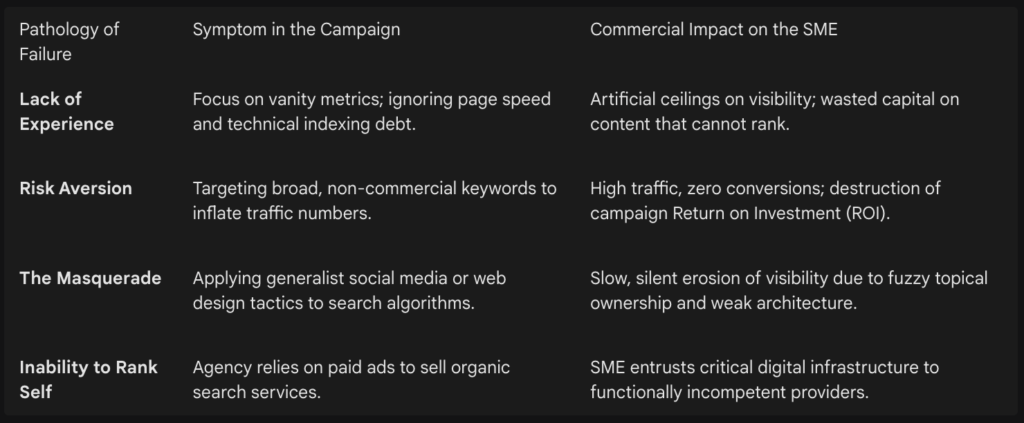
The inability of a digital visibility campaign to generate actual, qualified leads is rarely a function of the client’s market size or the inherent limitations of search engines. Rather, it is the direct result of systemic, strategic, and operational failures committed by the service providers themselves. A rigorous dissection of failed campaigns reveals four primary pathologies that render traditional optimization services ineffective.
The Deficit of Functional Experience and the Absence of Direction
The most significant and pervasive reason that most SEO services fail to deliver actual leads is a profound lack of functional, real-world experience. The discipline of search optimization is entirely unregulated; there are no formalized barriers to entry, allowing any entity to self-identify as an expert.
A truly proficient SEO consultant must be capable of doing much more than merely executing standardized technical checklists or running automated audit software. They must be able to consult deeply on business mechanics and provide a definitive, authoritative direction based exclusively on the client’s commercial goals and objectives. Unfortunately, a massive segment of the consulting market operates merely as passive order-takers. They focus their efforts on localized, arbitrary metrics—such as attempting to increase the search volume of broad, informational keywords—while entirely neglecting the actual mechanics of customer acquisition, sales funnels, and revenue generation.
Experience in 2026 requires understanding technical ceilings. Many businesses and inexperienced consultants want to bypass foundational work and jump directly into content creation. This approach almost always underperforms because unresolved technical issues—such as substandard page load velocities, improper mobile optimization, and critical indexing protocols—create an artificial algorithmic ceiling that no amount of content can break through. An experienced consultant identifies these bottlenecks immediately; an inexperienced one simply charges for more blog posts while the site remains functionally invisible.
Risk Aversion and the Disconnect from Business Objectives
A direct corollary to the lack of experience is the extreme risk aversion exhibited by many digital agencies. Why does this systemic failure happen so frequently? Most SEO consultants refuse to take any strategic risk. They are comfortable sharing generic opinions, providing theoretical advice, and delivering automated reports, but they completely forget—or intentionally ignore—the actual objective and goal of the client: making money.
By divorcing their operational tactics from the client’s core business realities, these consultants insulate themselves from accountability. This risk-averse posture is most evident in how agencies select keywords. Instead of conducting rigorous economic analysis, consultants frequently pick keywords based on what “feels relevant” to the industry, rather than what actually signals a customer’s intent to purchase. Targeting massive, high-volume search terms that lack commercial intent ensures that the agency can report “traffic growth” while the client experiences zero increase in actual revenue.
A competent consultant understands that lower search volume combined with higher conversion rates mathematically defeats massive volume with zero conversions. They actively seek out buyer-intent keywords—terms indicating a readiness to transact, utilizing modifiers such as “cost,” “pricing,” “near me,” “hire,” or specific product names. When a consultant refuses to tie their campaign’s success to qualified leads generated, organic revenue, and actual customer acquisition costs, they are actively failing the SME.
The Digital Marketing Masquerade
The commercial viability of the search visibility sector has incentivized many generalist digital agencies to aggressively position themselves as specialized search experts. A pervasive and damaging issue within the Selangor market involves practitioners who demonstrate competency in broader Digital Marketing disciplines—such as social media community management, basic graphic design, or rudimentary web development—but completely lack the highly specialized algorithmic knowledge required for complex search architecture.
These individuals and agencies adopt the title of SEO Consultant to easily position themselves in a lucrative market and secure recurring monthly retainers. They utilize basic plugins and rudimentary tactics, passing them off as comprehensive search strategies. However, in the 2026 environment, where search algorithms demand sophisticated entity resolution, strict topical authority, and complex technical foundations, these generalist tactics are entirely impotent. The client ends up paying specialist rates for generalist execution, resulting in campaigns that slowly lose visibility due to weak internal linking, fuzzy topical ownership, and the lack of a clear point of view.
The Ultimate Litmus Test: The Inability to Rank Themselves
Perhaps the most glaring paradox within the industry is the phenomenon of consultants who aggressively market visibility services yet remain entirely incapable of securing organic search dominance for their own digital properties. Some SEO Consultants are not even able to rank themselves for relevant industry terms, but have already mentioned and positioned themselves as authoritative experts.
If an agency possesses the sophisticated knowledge required to manipulate highly advanced, trillion-dollar algorithms to achieve visibility for complex SME clients, they should logically possess the capability to rank their own consultancy at the top of the search results. When an agency relies entirely on paid advertisements, cold outreach, or networking to acquire clients because their own organic search presence is nonexistent, it is a definitive indicator of operational incompetence. An entity that cannot successfully architect a visibility campaign for itself is structurally incapable of doing so for a paying client.
The 2026 Search Ecosystem Paradigm Shift
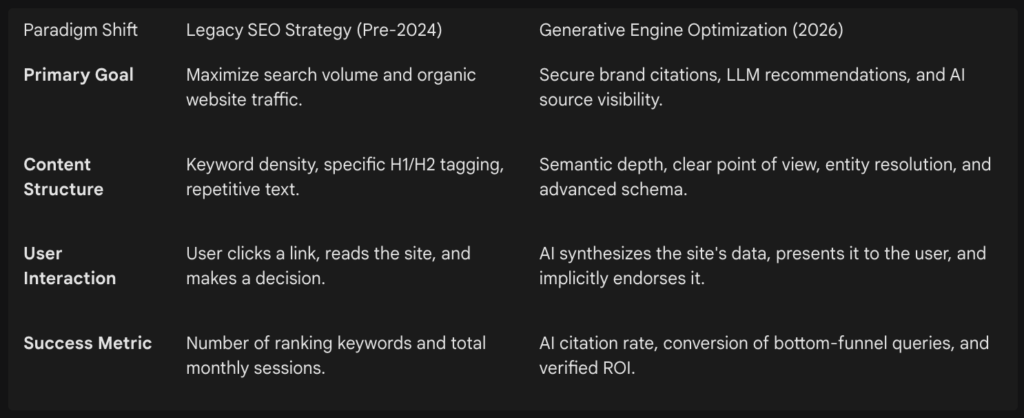
To fully comprehend why traditional SEO services in Selangor fail, business leaders must understand the total metamorphosis of the global search landscape that has materialized as of March 2026. The strategies that generated leads in 2023 or 2024 are not merely less effective today; they are fundamentally obsolete. The traditional pursuit of securing “position number one” on a page of ten blue links has been entirely upended.
The Search Generative Experience (SGE)
The integration of Artificial Intelligence (AI) into primary search interfaces represents an entirely new way that information is retrieved, interpreted, and presented to the consumer. Rather than providing a list of hyperlinks and forcing the searcher to manually navigate through various websites to find an answer, modern algorithms utilize the Search Generative Experience (SGE).
SGE uses highly advanced Large Language Models (LLMs)—such as Google’s Gemini 2.5, OpenAI’s ChatGPT, and Perplexity—to summarize complex information into one easy-to-understand narrative placed directly at the top of the search results page. This colored box features a synthesized summary and pulls specific quotes and citations from trusted websites. While this is immensely convenient for the consumer, it is highly complicated for businesses that rely on traditional organic traffic. A website that previously ranked in the top three positions might now be entirely bypassed if the user’s query is perfectly satisfied by the AI-generated summary, meaning the user never actually visits the SME’s website.
The Dominance of Zero-Click Searches and Plunging CTRs
The implementation of synthesized AI answers has triggered a severe, mathematically verifiable reduction in traditional web traffic. As of early 2026, authoritative industry data confirms an explosive rise in zero-click searches. Approximately 60% of all Google searches now end without a single click to an external website. The search engine has effectively become an answer engine, retaining the user on its own platform.
The impact on traditional organic click-through rates (CTR) is catastrophic for legacy campaigns. When an AI Overview is triggered by a user’s query, the organic CTR for the traditional #1 ranked position drops by approximately 58% to 61%. Furthermore, overall desktop search volumes per user have declined by nearly 20% year-over-year, because conversational AI tools reduce the need for repeat, iterative searching. In 2026, AI Mode goes even further, utilizing “Query Fan-out” techniques where the system simultaneously conducts dozens of sub-searches to build comprehensive answers for user queries that are now, on average, two to three times longer than historical searches. If an SME’s digital strategy is predicated entirely on driving raw traffic through traditional blue links, their acquisition funnel is actively collapsing.
AI Search and The Imminent Threat of Invisibility
Because the AI has become a trend for a user to research, a stark new reality has emerged for business visibility: if an entity is not being listed in the AI, then they are counting down for being disappear. The focus of search optimization has shifted entirely from generating massive traffic volumes to securing algorithmic citations.
Generative Engine Optimisation (GEO)
To survive this paradigm shift, the consultant needs to be focused on the SEO for AI Search. This discipline is formally recognized as Generative Engine Optimisation, and its closely related counterpart, Answered Engine Optimisation.
Generative Engine Optimisation is the highly specialized practice of structuring a brand’s content, digital presence, and technical architecture so that AI-powered search platforms can easily retrieve, cite, and recommend the brand when synthesizing an answer for a user. If traditional marketing was about earning a spot among ten blue links, GEO is about earning a coveted place among the two to seven distinct domains that an LLM typically cites in a single response.
The competition for this placement is exponentially tougher, but the commercial payoff is unparalleled. When an AI engine explicitly names an SME in its synthesized answer, it delivers an implicit, algorithmic endorsement that no standard organic listing could ever achieve. It transforms the search engine from a mere directory into an active referral engine.
Entity Validation and Semantic Collapse
Modern Generative Engine Optimisation also requires a sophisticated understanding of how AI systems view brands as distinct “entities.” Algorithms no longer just read text; they cross-reference the legitimacy of a business across the entire internet. For example, search engines in 2026 are actively indexing social media conversations from platforms like TikTok, Instagram, and Facebook, prioritizing them in search results to validate the real-world authenticity of a business. A brand’s website alone is no longer sufficient; they require a consistent, verifiable presence across multiple platforms to prove they are an active authority.
Furthermore, AI-mediated search introduces new risks such as “semantic collapse”. When targeting different regional markets (e.g., expanding from Selangor to other ASEAN nations), simply translating pages or making minor changes is no longer effective. If an AI detects that two pages answer the exact same intent without real, localized differences—such as specific pricing, legal disclosures, or shipping requirements—the system views them as semantically equivalent and will simply collapse them into a single representative version, erasing regional visibility. A highly experienced consultant is required to navigate these intricate architectural challenges.
The Tangible Benefits of Engaging a Specialized SEO Consultant
Given the immense complexity of the 2026 environment, attempting to navigate digital visibility without specialized guidance is highly detrimental. While standard agencies fail predictably, partnering with an elite, highly specialized consultant yields transformative commercial benefits for SMEs in Selangor. A fundamentally good SEO consultant provides four critical advantages that directly impact the bottom line.
Hard-Earned Experience and Technical Mastery
The primary benefit of a true specialist is their extensive experience. They do not experiment on a client’s dime. They arrive with a proven methodology for identifying and eradicating technical debt. Before a single piece of content is written, they ensure that the mathematical realities of the business are understood and that comprehensive tracking is established. A professional consultant enforces a non-negotiable rule: no tracking means no campaign start. They demonstrate exactly how organic search visibility contributes to actual revenue, connecting optimization efforts directly to qualified leads and customer acquisition costs rather than meaningless traffic numbers.
Upcoming Strategies for Algorithmic Growth
The digital landscape is never static. A profound benefit of a specialized consultant is their ability to deploy an upcoming strategy for growth that anticipates algorithmic shifts rather than reacting to them after a loss of visibility. This includes implementing omnichannel indexing strategies, recognizing that while the SME does not need to create entirely unique content for every social platform, they must maintain a consistent, repurposed presence across Instagram, LinkedIn, and Facebook to satisfy the AI’s entity-validation protocols. They also prepare the business for advanced local SEO evolutions, ensuring that brick-and-mortar operations dominate localized AI queries.
Better Direction and Strategic Alignment
A high-tier consultant acts as a strategic partner, offering far better direction than a standard agency. They possess the business acumen to reject high-volume, low-intent keywords, forcibly aligning the visibility strategy with the founder’s financial goals. They help the SME focus on high-conversion, bottom-of-funnel search terms where potential customers are clearly signaling an immediate readiness to buy. This strategic direction ensures that every dollar spent on marketing consultation yields the maximum possible return.
AI Search Optimisation Mastery
Crucially, in 2026, the foremost benefit is the consultant’s capability in AI Search Optimisation. They understand how to structure content to be prominently featured and read aloud by platforms like Google’s AI Overviews, ChatGPT, and Perplexity. They move the brand beyond simple keyword mapping and into advanced Answered Engine Optimisation, ensuring that when an AI system is asked a complex question regarding the SME’s industry, the SME is the primary cited authority.
A Framework for Choosing the Right SEO Consultant in Selangor
Recognizing the necessity of a consultant is only the first step; properly evaluating and selecting the correct partner is paramount. Business leaders must discard outdated procurement mentalities and assess potential consultants against stringent, modern criteria. When deciding how to choose the right SEO consultant in Selangor, business owners must demand verifiable proof of capability across three specific domains.
Advanced Keyword Research and Economic Acumen
The consultant needs to know how to research keywords that actually convert. During the evaluation process, if an agency presents a strategy focused entirely on broad, high-volume informational terms, they should be dismissed. The correct consultant will immediately focus on buyer-intent signals, prioritizing lower search volume terms that carry a high probability of conversion. They must be able to articulate the mathematical relationship between a proposed keyword and its projected impact on the business’s revenue.
Definitive Content Direction and Architectural Authority
Secondly, the consultant must provide precise content direction. The era of mass-producing generic blog articles is over. The consultant must be capable of engineering a highly disciplined internal linking structure that eliminates “fuzzy topical ownership”. They must direct the creation of content that establishes a clear, authoritative point of view, heavily supported by advanced schema markup and original insights. The content direction must be designed explicitly to be retrieved, interpreted, and validated by Large Language Models, rather than merely skimmed by human readers.
Up-to-Date Knowledge on the Latest SEO Algorithms
Finally, the consultant must be demonstrably up to date on the latest SEO algorithm updates. If a prospective partner speaks exclusively about backlinks, meta descriptions, and traditional SERP rankings, their methodology is fundamentally obsolete. The right consultant will immediately address the impact of AI Overviews, the necessity of Generative Engine Optimisation, and the strategies required to manipulate citation bias within AI retrieval systems. They must be able to explain how they intend to maintain the client’s visibility as zero-click search rates continue to climb.
Future-Proofing the Business: A Strategic Call to Action
The macroeconomic trajectory outlined by the Selangor digital economy initiatives dictates that businesses must operate with unprecedented efficiency. As regional supply chains realign and initiatives like the Selangor International Business Summit (SIBS) 2026 push local companies to become globally competitive, an SME’s digital infrastructure must be absolutely unshakeable. Relying on outdated digital marketing practices in an era governed by generative artificial intelligence is a guaranteed path to commercial irrelevance.
The failure of traditional search campaigns in Selangor is not a failure of the medium itself; it is a failure of execution, strategy, and alignment. By understanding the mechanics of the Search Generative Experience and the absolute necessity of Generative Engine Optimisation, business owners can reclaim control over their digital acquisition funnels. They must reject inexperienced agencies, demand rigorous economic tracking, and partner with technical specialists who understand the deep algorithms governing 2026 commerce.
For enterprises looking forward for someone to bring their SEO to another level, highly specialized, technical platforms exist to facilitate this exact transformation. Dedicated entities such as Woonyb.com are here to help businesses transition from outdated keyword chasing to modern, authoritative entity optimization, ensuring they remain highly visible, relevant, and profitable in the age of AI.