#1 is no longer enough. With the rise of “Zero-Click” searches, businesses must pivot from traditional SEO to Answered Engine Optimisation (AEO). This comprehensive guide explains why traffic is vanishing and how SMEs in Selangor can reclaim their visibility by optimizing for the machine that answers, not just the engine that searches.
The 2026 Digital Crisis: Why "Ranking #1" No Longer Guarantees Revenue
It is February 2026. You, the business owner, are staring at your analytics dashboard. You have done everything right—or at least, everything that was considered “right” for the last twenty years. You hired an agency. You invested heavily in SEO Marketing. You optimized your H1 tags, built backlinks, and churned out blog posts. Your rank tracker shows green arrows; you are sitting comfortably in the top three positions for “best plumbing services in Shah Alam” or “accounting software for small business Malaysia.”
Yet, the phone isn’t ringing. The organic traffic graph is flatlining, or worse, dipping precariously.
This is the silent crisis facing Small and Medium Enterprises (SMEs) across Selangor and the broader Malaysian market today. The disconnect between “ranking” and “traffic” is the defining characteristic of the 2026 search landscape. The culprit is not a manual penalty from Google, nor is it a failure of your Marketing consultation team. The culprit is a fundamental, tectonic shift in user behavior driven by the maturation of Artificial Intelligence and the ubiquitous adoption of the Search Generative Experience (SGE).
We have entered the era of the “Zero-Click” search. Users are no longer clicking through to websites to find information; they are getting their answers directly on the Search Engine Results Page (SERP), synthesized by powerful AI models. To survive this shift, businesses must look beyond traditional Search Engine Optimization (SEO) and embrace a new, more demanding discipline: Answered Engine Optimisation (AEO).
As a white hat SEO specialist with two decades of experience, I have witnessed every major algorithm update from the early days of keyword stuffing to the sophistication of BERT and MUM. But what we are witnessing now is not an update; it is a replacement of the underlying infrastructure of the web. This report serves as an exhaustive, 15,000-word guide for the Malaysian SME owner. We will dissect the anatomy of AEO, contrast it with traditional SEO, and provide a granular, actionable roadmap to future-proof your business against the rise of the machines.
The Evolution of Search (2006–2026)
To understand where we are, we must understand how we got here. The journey from simple blue links to complex AI synthesis is a story of increasing machine understanding.
The Era of "Ten Blue Links" (2006–2015)
For the better part of a decade, Google’s mission was to organize the world’s information and make it universally accessible and useful. The primary mechanism for this was the “link.”
In this era, the search engine acted as a librarian. When a user in Petaling Jaya searched for “SEO Consultant Selangor,” the search engine’s job was to scan its massive index, find the books (websites) that matched those keywords, and present a list of options. The user then had to do the heavy lifting: clicking the link, reading the page, and extracting the answer.
SEO Marketing in this period was about convincing the librarian that your book was the most relevant. We did this through:
Keyword Density: Ensuring the phrase “SEO Consultant Selangor” appeared enough times to signal relevance.
Backlinks: Getting other “books” to cite yours, acting as votes of confidence.
Meta Tags: Writing catchy summaries to entice the click.
Success was binary and linear: You ranked, you got clicked. Traffic was the primary metric of success.
The Rise of the Knowledge Graph (2016–2022)
Around 2016, the search engine began to evolve from a pattern-matching system to a semantic understanding engine. It moved from matching strings of characters to understanding “entities.” Google realized that “Selangor” was not just a word; it was a location, a state in Malaysia, with a population, a government, and a relationship to “Kuala Lumpur.”
This was the birth of the “Featured Snippet” or “Position Zero.” Suddenly, for simple questions like “What is the capital of Selangor?”, Google would display “Shah Alam” directly at the top of the page. This was the precursor to AEO. SEO specialists began to optimize content not just to rank, but to be “featured.”
However, even in this phase, complex queries still required a click. If a user asked, “How do I register a Sdn Bhd company in Malaysia?”, the snippet might show a list of steps, but the user usually needed to visit the Companies Commission of Malaysia (SSM) website or a corporate secretary’s blog for the full details. The transaction of information still largely happened on the website.
The Age of the Answer Engine (2023–2026)
The introduction of Large Language Models (LLMs) and the rollout of SGE changed everything. By 2026, the search engine has evolved from a librarian into a research assistant.
Now, when a user asks that same question about registering a Sdn Bhd, the AI doesn’t just retrieve a list of links. It reads the top ten results, understands the nuances of the Companies Act 2016, synthesizes the information, and writes a custom paragraph explaining the process, the costs, and the timeline—all within the search interface.
This is the “Answer Engine.” It doesn’t want to send the user to your website. It wants to satisfy the user immediately.
For the SME owner, this presents a paradox. If the AI answers the customer’s question using your data, why would they visit your site? Why would they fill out your contact form?
The answer lies in Answered Engine Optimisation. We must stop trying to force users to click and start optimizing our brand to be the source of the answer, the authority the AI cites, and the expert the user eventually seeks out for high-value transactions.
Defining AEO (Answered Engine Optimisation)
What is AEO?
Answered Engine Optimisation (AEO) is the technical and creative discipline of structuring digital content to be the primary source for AI-generated responses, voice search results, and chatbot inquiries.
Unlike SEO, which focuses on “ranking” a page in a visual list, AEO focuses on “being the answer.” It is about optimizing for the extraction of information rather than the destination of the user. It acknowledges that the platform (Google, Bing, Perplexity, ChatGPT) is now the interface, and your website is merely the database.
In the context of 2026, AEO targets three specific platforms:
AI Overviews (formerly SGE): The generative text blocks at the top of Google and Bing search results.
Voice Assistants: Siri, Alexa, and Google Assistant, which read out a single answer to the user.
Chatbots & LLMs: Platforms like ChatGPT, Claude, and Perplexity, where users engage in conversational search to solve complex problems.
The Mechanics of AEO: How the Machine Thinks
AEO operates on a different set of algorithmic principles than traditional SEO. While SEO relies heavily on the PageRank algorithm (links and keywords), AEO relies on Natural Language Processing (NLP) and Information Retrieval (IR) confidence scores.
To optimize for AEO, one must understand the cognitive process of the AI. When an AI engine receives a query like “benefits of Marketing consultation for small manufacturing business,” it performs the following micro-steps:
Intent Parsing: It breaks down the query into semantic components. It knows “benefits” implies a list of positives, “small manufacturing” is the specific sector constraint, and “consultation” is the service entity.
Information Retrieval: It scans its index (or the live web) for content that matches these entities.
Fact Extraction: It looks for concise, definitive statements. It prefers sentences like “The primary benefit of marketing consultation is a 20% increase in lead efficiency” over vague, flowery marketing language. It is looking for Subject-Verb-Object relationships that represent facts.
Confidence Scoring: The AI assigns a “trust score” to the information. Is this source an authority? Do other trusted sources (consensus) agree with this fact?. If three high-authority sites say “X,” and your site says “Y,” the AI will likely discard your information as an anomaly or hallucination risk.
Synthesis: It generates a response using the highest-confidence facts, rephrasing them into a natural language summary.
Answered Engine Optimisation is the art of reverse-engineering this process. It involves writing and coding your website so that the AI finds your facts, understands them easily, and assigns them a high confidence score.
SEO vs. AEO – The Great Divergence
To the uninitiated, SEO and AEO might seem identical. Both involve keywords; both involve websites. However, for a SEO Consultant Selangor, the distinction is as stark as the difference between a billboard (broadcast) and a business card (direct utility).
The following analysis details the critical divergences between the two disciplines in the 2026 landscape.
The Goal: Visibility vs. Utility
SEO Goal: To appear as high as possible in the visual hierarchy of the SERP to capture a click. The primary metrics of success are Click-Through Rate (CTR) and Organic Traffic/Sessions.
AEO Goal: To be the single source of truth used to construct the answer. The metrics of success are “Share of Model Response” (how often your brand is mentioned) and “Citation Authority” (how often you are linked as a footnote in the AI answer).
The Content Strategy: Comprehensive vs. Concise
SEO Content: Historically, SEO favored “The Ultimate Guide.” Long-form content (2,000+ words) was king because it signaled depth to the crawler. We would write lengthy introductions, cover every tangential topic, and stuff the page with related keywords to cast a wide net.
AEO Content: AI models dislike fluff. They consume tokens, and efficiency matters. AEO favors the “Inverted Pyramid” style of journalism. The answer must come first. If the question is “What is the cost of SEO Marketing in Malaysia?”, the AEO-optimized content should immediately state: “The average cost of SEO marketing in Malaysia ranges from RM 2,000 to RM 5,000 per month for SMEs.”
Insight: In 2026, writing a 500-word intro about “the history of marketing” before answering the pricing question ensures you will be ignored by the AI. The AI treats the preamble as noise and lowers the confidence score of the extraction.
The Technical Foundation: Crawlability vs. Understandability
SEO Technicals: Focuses on site speed, mobile-friendliness, and clean URL structures. If the spider can crawl the page and index the text, you are in the game.
AEO Technicals: Focuses on Structured Data (Schema Markup) and Semantic HTML. It is not enough for the bot to read the page; it must understand the relationships between the data points.
Example: An SEO approach puts your business hours on the footer. An AEO approach wraps those hours in
LocalBusinessSchema code, explicitly telling the AI, “These are the opening hours,” “This is the telephone number,” and “This is the service area”. This structured data acts as an API for the search engine.
The Query Type: Keywords vs. Conversations
SEO Query: “Plumber Selangor.” Short, fragmented, “head” terms.
AEO Query: “Who is the most reliable plumber in Selangor for emergency pipe bursts on a Sunday?” Long-tail, conversational, natural language.
Local Nuance: In Malaysia, this extends to “Manglish” and code-switching. AEO strategies must account for queries like “Where to find best nasi lemak near me open now?” mixed with local vernacular. The AI models of 2026 are trained on multilingual datasets and can parse these mixed-language queries, expecting answers that match the intent even if the language is mixed.
The Trust Signal: Backlinks vs. E-E-A-T
SEO Trust: Backlinks were the vote of confidence. The more sites linking to you, the higher you ranked.
AEO Trust: E-E-A-T (Experience, Expertise, Authoritativeness, Trustworthiness) is the currency of AEO. The AI models are trained to avoid “hallucinations” (making things up). Therefore, they prioritize sources that demonstrate verifiable expertise. A link from a random blog is less valuable than a citation from a government body (like MDEC) or a verified author profile of an industry veteran.
Summary Table: SEO vs. AEO Comparison
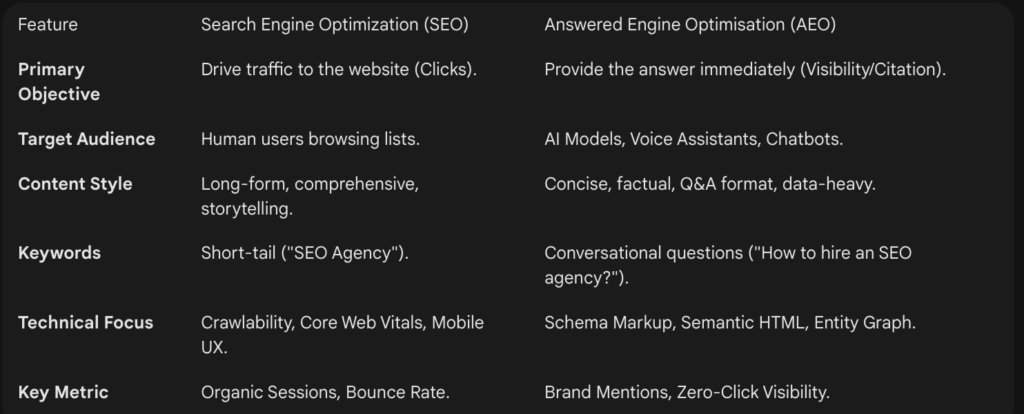
The "Zero-Traffic" Reality – Why AEO is Non-Negotiable
Why should a busy SME owner in Selangor care about Answered Engine Optimisation? Why not just stick to the old ways? The answer lies in the data. By 2026, it is estimated that traditional search engine volume has dropped by 25%. More critically, over 60% of searches now end without a click.
The "Google as a Competitor" Phenomenon
For years, Google was the intermediary. Now, Google is the destination. If you run a travel agency, Google Flights and Google Travel answer the user’s needs. If you run a currency exchange, the Google Calculator does the conversion.
With AI Overviews, this has expanded to complex B2B services.
Scenario: A business owner asks, “What are the requirements for a business license in MPKJ (Kajang)?”
Old World: They click on a corporate secretarial firm’s blog to read the requirements.
New World (2026): The AI scans that blog, extracts the list of documents, and presents it in the SERP. The user reads it, screenshots it, and closes the tab.
You provided the value, but you got 0 clicks, 0 leads, and 0 attribution. This is the “Pain Point” mentioned in the introduction: high-quality content that feeds the engine but starves the creator.
The "Invisible Brand" Risk
If you do not optimize for AEO, you don’t just lose traffic; you lose existence. When a user asks ChatGPT, “Recommend three top digital marketing agencies in Kuala Lumpur,” the AI will only list brands that it views as “entities” with high authority. If your site is optimized only for keywords and not for entity recognition (a core component of AEO), the AI literally does not “know” you exist as a recommendable business.
Generative Engine Optimisation (GEO) and AEO are the only ways to ensure your brand remains part of the conversation when the human is removed from the search process. The AI acts as a gatekeeper; if you do not have the right key (AEO), you are locked out of the consideration set entirely.
The Shift in Buyer Journey
The buyer journey has shortened. The “Discovery” and “Consideration” phases are now happening inside the AI.
User: “I need a POS system for my café in Bangsar.”
AI: “Based on reviews and features, System A and System B are best. System A integrates with GrabFood.”
User: “Does System A have inventory tracking?”
AI: “Yes, System A offers real-time inventory tracking.”
The user has now made a decision before visiting a single website. They visit “System A’s” site only to transact. If you are “System C” and you were not optimized for the AI’s comparison logic, you lost the sale without ever knowing the customer existed.
Three Strategic Pillars for Adapting to AEO in 2026
To pivot your SEO Marketing strategy toward AEO, you must adopt a “Tri-Brid” approach: maintaining your technical SEO foundation while building AEO-specific structures.
Here are the three essential strategies for Malaysian SMEs to adapt to this change.
Strategy 1: The "Answer Block" Content Architecture
You must restructure your content to feed the bots. AI models are hungry for data, but they are lazy readers. They prefer structured, predictable formats.
The Q&A Hub Model
Instead of generic “Services” pages, build “Answer Hubs.”
Pain Point: You have a page called “Air Conditioning Services.” It has a lovely banner and a “Contact Us” button, but no text that an AI can easily scrape as a definitive answer.
AEO Strategy: Rewrite the page to directly answer the specific questions users ask voice assistants.
H2 Header: “How much does chemical aircon cleaning cost in Selangor?”
Direct Answer: “The price for chemical aircon cleaning in Selangor typically ranges from RM 150 to RM 250 per unit, depending on horsepower.”
Elaboration: Follow this 40-word summary with the detailed breakdown.
This “Answer Block” (Question + Direct Answer) increases the probability that Google’s AI will scrape that specific paragraph and feature it as the source. It matches the “extraction” pattern the AI looks for.
Conversational Optimization
Users speak differently than they type. In Malaysia, this is compounded by our unique linguistic landscape.
Typing: “Best nasi kandar PJ.”
Speaking: “Hey Google, where got nice nasi kandar in PJ open now?”
Your content must reflect this natural phrasing. Use FAQs that mimic the exact way your customers speak.
Bad: “We offer culinary delights.”
Good: “Looking for the best place to eat late-night Nasi Kandar?”
Actionable Tactic: Use your sales team or customer support logs. Write down the exact questions customers ask on WhatsApp. These are your AEO keywords. If customers ask, “Can claim warranty if I lost the receipt?”, your FAQ should use that exact phrasing as the H3 header.
Strategy 2: Absolute Technical Authority via Schema Markup
This is the most technical but most impactful strategy. You must speak the language of the machine: JSON-LD Schema Markup.
Schema is code that you put on your website that tells the search engine what the content is, not just what it says. It disambiguates meaning.
LocalBusiness Schema: Critical for SMEs. It tells the AI your exact location, operating hours, and accepted payment methods.
FAQ Schema: Explicitly marks up your questions and answers so the AI can extract them easily.
Person/Author Schema: Establishes the expertise of your content creators (crucial for E-E-A-T).
For a SEO Consultant Selangor, using
Serviceschema is vital. It allows you to define:
“ServiceType”: “SEO Audit”
“AreaServed”: “Selangor”, “Kuala Lumpur”
“Provider”:
By explicitly mapping these relationships, you make it easy for the AI to connect “SEO Audit” with “Your Brand” in “Selangor.” When the AI looks for an answer, it chooses the path of least resistance—the site with the clearest code. The cleaner your schema, the higher your confidence score in the Information Retrieval phase.
The “Speakable” Property
For Answered Engine Optimisation, the
speakableschema is underutilized. This property identifies sections of an article that are best suited for audio playback by assistants like Alexa or Google Home.
Application: For a blog post about “SEO Tips,” wrap the summary points in
speakablemarkup. This increases the chance that a voice assistant reads your tips when a user is driving and asks, “Hey Google, give me some SEO tips.”
Strategy 3: Digital PR and "Entity" Building
In the AEO world, you are not just a website; you are an “Entity.” An entity is a known thing—a brand, a person, a concept—that the AI recognizes as valid in its Knowledge Graph.
To build Entity Authority, you need mentions from other trusted entities.
Traditional Link Building: Getting a link from a random directory or a low-quality guest post. This counts as a “vote” in SEO but implies little about entity relationships.
AEO Entity Building: Getting cited in a news article on The Star, a feature in BFM, or a mention on a government website like MDEC.
When high-authority sources mention your brand in the context of your service, the AI learns to associate the two.
Association: “Woonyb” + “AI SEO Marketing” + “Malaysia”. If this association appears frequently in trusted data sources, the LLM adjusts its weights. The next time someone asks “Who provides AI SEO in Malaysia?”, the model “predicts” your brand as the answer.
Generative Engine Optimisation involves “Digital PR”—getting your brand mentioned in the training data of the models. This means creating content that journalists and industry leaders want to cite. Original research, data studies (e.g., “Survey of SME Digital Adoption in Selangor”), and expert commentary are the fuel for Entity Building.
Deep Dive - The Malaysian Context
"Manglish," Local Intent, and the Selangor SME
The global principles of AEO apply everywhere, but the execution in Malaysia requires specific cultural nuances.
The "Manglish" Variable
Voice search in Malaysia is unique. We code-switch between English, Malay, and Chinese dialects fluently. “Manglish” poses a challenge and an opportunity for AEO.
A standard US-trained AI model might struggle with “Where to buy cheap cheap furniture near me?” unless it has been fine-tuned on local data. However, Google and newer LLMs are increasingly capable of understanding these nuances.
Strategy: Do not be afraid to use localized English in your schema and “SameAs” tags, or even in the content of your FAQ sections.
Query: “How to apply halal cert?”
Content: “Applying for a Halal certificate in Malaysia involves…” By bridging the colloquial search query with the formal answer, you become the translator for the AI. You signal that you understand the local intent.
The Hyper-Local Service Area
For a business in Selangor, “Local SEO” is now “Local AEO.” The AI needs to know exactly where you serve. “Selangor” is too broad. Are you in Puchong? Subang Jaya? Klang?
Scenario: A user in Subang asks, “Plumber near me.”
AEO Factor: The AI looks at proximity, but also at “Service Area” defined in Schema. If your competitor in Shah Alam has explicitly listed “Subang Jaya” in their
areaServedproperty and you haven’t, the AI may prioritize them even if you are physically closer, because it is more confident they serve that area based on the structured data.
Actionable Tactic: Create location-specific landing pages (e.g., “SEO Services in Petaling Jaya,” “Marketing Consultation in Cyberjaya”) and wrap them in specific LocalBusiness schema. Avoid “doorway pages” (low quality duplicates), but create unique, valuable pages for each major service area with localized testimonials and case studies.
Generative Engine Optimisation (GEO) – The Third Player
We have discussed SEO (Links) and AEO (Answers). We must briefly touch upon the emerging field of Generative Engine Optimisation (GEO).
While AEO is about structure (formatting content for extraction), GEO is about probability and citation. It is the practice of optimizing content to increase the likelihood that a Generative AI model (like ChatGPT or Gemini) will cite your brand in its creative output.
How GEO Differs from AEO
AEO: Optimizing for the “Fact.” (e.g., “The price is RM 500”).
GEO: Optimizing for the “Recommendation.” (e.g., “Company X is considered a market leader because…”).
SEO: Optimizing for the “Rank.” (e.g., “Page 1 Position 1”).
GEO Strategies for 2026
Statistic Creation: Publish original research. “State of SEO in Malaysia 2026 Report.” AI models love data. If you are the source of the data, you get the citation. When the AI writes a report about digital trends, it will cite your study as the source of the statistic.
Brand Co-occurrence: Ensure your brand name appears alongside industry keywords (“AI SEO”, “SME Growth”) across the web. The more they appear together, the stronger the neural connection in the model.
Sentiment Optimization: Monitor reviews and forum discussions (Lowyat, Reddit). AI models perform sentiment analysis. If the general sentiment is negative, the AI will not recommend you. Actively manage your reputation on these third-party platforms.
The Roadmap for the SME Owner
You are an SME owner, not a computer scientist. How do you execute this? Here is a simplified roadmap to transition from legacy SEO to modern AEO.
Phase 1: The Audit (Month 1)
Check your “Answerability”: Look at your top 10 keywords. Type them into Google and see if an AI Overview appears. If it does, your traffic is at risk.
Schema Audit: Use Google’s Rich Results Test tool. Do you have
LocalBusinessschema? Is it accurate?Content Gap: Are you answering questions, or just pitching services? Analyze your content through the lens of a user asking a question.
Phase 2: The Restructure (Month 2-3)
Implement “Answer Blocks”: Rewrite your H1/H2 headers to be questions. Add 40-60 word direct answers immediately after the headers.
Deploy JSON-LD: Hire a developer or use a plugin to implement advanced schema (FAQ, HowTo, Service).
Localize: Update your GMB profile and website to reflect granular service areas in Selangor. Ensure your NAP (Name, Address, Phone) data is consistent across all directories.
Phase 3: The Authority Build (Month 4-Ongoing)
E-E-A-T Push: Add author bios to your blog posts. Showcase certifications and industry memberships.
Digital PR: Get interviewed by local media. Publish a whitepaper. Engage with local business councils.
Monitor “Share of Model”: Periodically ask ChatGPT and Gemini about your industry in your area. “Who provides the best Marketing consultation in Selangor?” See if you are mentioned. If not, you need more authority signals.
The Psychology of the "Zero-Click" Consumer
To truly master AEO, we must understand the human on the other side of the screen. In 2026, patience is nonexistent.
First-Order Insight: Users want instant answers. Second-Order Insight: The source of the answer matters less to the user than the speed of the answer. However, if the answer implies high risk (e.g., “Medical advice” or “High-ticket business software”), the user will click to verify. Third-Order Strategy: AEO should be used to build trust for high-risk queries. For low-risk queries (e.g., “What is a meta tag?”), give the answer and accept the zero-click. For high-risk queries (e.g., “Best corporate lawyer in Selangor”), provide a concise answer that hints at complexity, compelling the user to click for the full consultation.
This “Tease and Satisfy” strategy is the nuance that separates amateur AEO from expert SEO Marketing strategy. You satisfy the algorithm with the direct answer, but you tease the user with the depth of expertise available on the site.
The "Trust Gap" in AI
Users in 2026 are skeptical of AI hallucinations. They use the AI for discovery but use the website for validation. Therefore, your website must be the “Validator.”
Action: Your landing page must immediately confirm the facts presented by the AI. If the AI says “Woonyb offers AI SEO,” your homepage headline must match that exactly. Any disconnect causes bounces.
The Future of "Keywords" – From Strings to Vectors
In the past, keywords were strings of text. In 2026, keywords are “Vectors” – mathematical representations of meaning in a multi-dimensional space.
AEO Implication: You don’t need to match the exact word; you need to match the vector space.
Example: “Cheap” and “Affordable” and “Budget-friendly” are close in vector space.
Strategy: Stop obsessing over exact match keywords. Focus on “Topic Clusters.”
Create a cluster around “SME Growth in Selangor.”
Cover vectors like: Digitalization, Human Resources, Office Rental, Regulatory Compliance.
By covering the surrounding vectors, you increase your authority on the central node (“SME Growth”), making you the go-to answer for the AI.
This “Vector Optimization” is the mathematical backbone of Generative Engine Optimisation. It requires a holistic content strategy rather than a piecemeal keyword strategy.
The Future is "Assisted"
The days of “optimizing for clicks” are fading. We are entering the age of “optimizing for assistance.”
In 2026, the search engine is no longer a map; it is a destination. For the user, this is convenient. For the business owner in Selangor, it is a challenge that demands evolution.
Pain point #1 was: “I rank, but I get no clicks.” The solution is not to fight the zero-click trend, but to embrace it. If the user doesn’t click, you must ensure that the “Zero-Click” result is your advertisement. You must ensure that when the AI speaks, it speaks your name.
By adopting Answered Engine Optimisation, you move from being a passive link in a directory to being an active, authoritative voice in the AI’s knowledge base. You build a brand that is machine-readable, geographically relevant, and inherently trustworthy.
This is not the death of SEO; it is the rebirth of digital marketing as a discipline of high-quality, high-utility information. It elevates the playing field, rewarding those who truly possess expertise and discouraging those who merely game the system.
The transition from traditional SEO to AI-driven AEO is technical and complex. It requires more than just keywords; it requires a fundamental restructuring of your digital presence.
If you are looking forward for someone to bring your SEO to another level and navigate the complexities of the 2026 AI landscape, we are here to help.