The era of “ten blue links” is fading as Google evolves into an Answer Engine. This guide explores the 2026 landscape of Generative Search, explaining why the “lazy” user now demands answers over lists. Learn how the shift to Answered Engine Optimisation (AEO) and Generative Engine Optimisation (GEO) is redefining visibility for businesses.
The Tectonic Shift of 2026
For nearly two decades, the implicit contract between a business owner and the internet was remarkably simple, almost elegant in its transactional nature. You, the business owner, created content—a blog post, a service page, a product listing—and optimized it with specific keywords. In return, Google acting as the world’s librarian, indexed that content and presented it as a blue link on a Search Engine Results Page (SERP). If you performed your duties well, or had the foresight to engage a competent SEO Consultant Selangor, you earned a click. That click was the fundamental currency of the digital economy, the singular unit of attention upon which empires were built and small businesses thrived.
In 2026, that contract has been torn up, rewritten, and digitized into a neural network. The landscape we navigate today bears little resemblance to the static lists of the early 2020s. The query that brings many Small and Medium Enterprise (SME) owners to this report—”Will generative search replace Google results pages?”—is, in many ways, a question that arrives too late. For a vast and growing majority of users, it already has. But “replace” is a dangerous, binary word. It implies a total erasure of the past, a clean slate where the old rules no longer apply. The reality, as we analyze the data from the current 2026 landscape, is far more nuanced, layered, and perhaps more treacherous for the unprepared than a simple replacement would suggest.
Google has not disappeared. It has not closed its doors. But it has evolved into something unrecognizable to the marketer of 2023. We have transitioned from the era of “Search”—where engines hunted for documents based on keyword matching—to the era of “Answers”—where engines synthesize intelligence to solve problems. This shift is not merely cosmetic; it is a fundamental alteration of the product that search engines sell. They are no longer selling access to the web; they are selling the synthesis of the web.
This comprehensive report serves as a survival manual for the modern business owner. It is not a brief overview; it is an exhaustive analysis of the Search Generative Experience (SGE), the psychology of the “lazy” user that demands Answered Engine Optimisation (AEO), and the inevitable, sophisticated encroachment of advertising into AI via Generative Engine Optimisation (GEO). If you are an SME owner asking, “Do I still need a website?” or “Is SEO dead?”, the answer is a resounding no—but the SEO you knew is gone. Welcome to the age of the Answer Engine.
The Evolution of the Machine – From Retrieval to Synthesis
To truly comprehend the magnitude of the shift we are witnessing in 2026, we must first deconstruct the functional evolution of the search engine itself. It is a journey from the passive retrieval of information to the active generation of knowledge.
The Legacy Model: The Librarian Paradigm
For the first twenty-five years of the commercial internet, search engines operated on a “Librarian Paradigm.” When a user typed a query, the search engine’s job was to look through its massive index—essentially a card catalog of the web—and retrieve a list of documents that contained the matching words. The burden of research, synthesis, and judgment was placed entirely on the user.
If a user searched for “best enterprise resource planning software for manufacturing in Selangor,” the engine would provide ten links to ten different software providers or review sites. The user then had to:
Click the first link.
Read the content.
Click the back button.
Click the second link.
Compare the features mentally or on a spreadsheet.
Synthesize the disparate information to make a decision.
This process was friction-heavy. It required the user to do the work. The search engine was merely a signpost, pointing the way but never accompanying the traveler.
The 2026 Model: The Concierge Paradigm
Today, in 2026, Google—along with its fierce competitors like OpenAI’s ChatGPT, Perplexity, and others—has adopted the “Concierge Paradigm.” The AI does not just point to the books; it reads them for you. It synthesizes the information, filters out the noise, correlates data points from multiple sources, and presents a finalized, coherent answer directly on the interface.
Yes, the normal Google search is being replaced. But it is being replaced by a more evolved, advanced version of itself. The traditional list of links—the “ten blue links”—has been pushed below the fold, often suffocated by the “AI Overview”—a dynamic, generative panel that answers queries before a click ever happens.
This transition is powered by Retrieval-Augmented Generation (RAG). When a query is entered in 2026, the engine executes a complex workflow:
Retrieves: It pulls data from the top 10-20 authoritative sources, checking for E-E-A-T signals (Experience, Expertise, Authoritativeness, Trustworthiness).
Reads & Comprehends: It analyzes the content semantically. It understands that “RM 500” is a price, that “Selangor” is a location, and that “poor customer service” is a negative sentiment found in reviews.
Generates: It writes a unique, natural-language response. It might say, “For manufacturing SMEs in Selangor, System A is the most cost-effective, but System B offers better local support. Here is a comparison table…”
This capability to “do the sorting and filtering” means the AI has usurped the role of the comparison website, the review blog, and the directory. For SEO Marketing professionals, this means the goalpost has moved drastically. We are no longer fighting for a position on a list; we are fighting to be the source material for the machine’s answer. If the AI doesn’t read you, the user doesn’t see you.
The Mechanics of Replacement: Why Now?
Why did this happen? The technology for text generation existed for years, but the convergence of computing power, Large Language Model (LLM) sophistication, and user demand created the perfect storm for 2026.
The “replacement” is not a destruction of the underlying web; the AI still needs websites to learn from. However, the interface of replacement means that the user’s journey ends on the search page 60% of the time. This “Zero-Click” reality forces businesses to rethink the value of traffic versus the value of visibility. In the past, traffic was the proxy for visibility. Now, visibility exists without traffic.
The following table illustrates the stark contrast between the search landscape of the past and the reality of 2026.
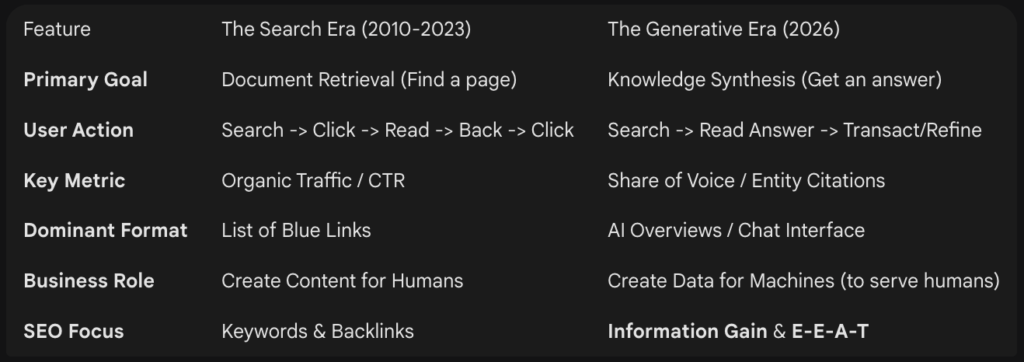
This shift mandates a new approach to Marketing consultation. Consultants who are still selling “Page 1 Rankings” are selling a commodity that is rapidly depreciating. The new currency is “Answer Inclusion.”
The Psychology of the "Lazy" Searcher
To understand why the technological shift has been so successful, we must look at the biological driver: the human brain. The primary driver of the Generative Search revolution is not just the capability of the supply (AI), but the overwhelming demand of the user for cognitive ease.
The Principle of Least Effort
In 2026, user searching behavior has fundamentally atrophied in terms of effort, while expanding in terms of expectation. The modern user is becoming increasingly “lazy” regarding research. This is not a derogatory assessment; it is a recognition of the “Principle of Least Effort.” Humans will naturally gravitate toward the method of solving a problem that requires the least amount of caloric and cognitive expenditure.
The cognitive load required to open three different tabs, compare prices, read “About Us” pages, and decipher industry jargon is now viewed as unnecessary friction. In an era where answers can be instant, the act of “research” feels like labor.
Statistics from late 2025 indicate a massive surge in Zero-Click Searches—queries where the user’s intent is satisfied without ever leaving the search results page.
Mobile Dominance: On mobile devices, where screen real estate is at a premium and internet connection speeds can vary, users almost exclusively engage with the AI summary. The friction of loading a heavy, ad-laden third-party website is simply too high when the answer is presented clearly by the search engine.
The “Good Enough” Threshold: Users are increasingly accepting the AI’s answer as “good enough.” They are trusting the algorithm’s filtering capabilities over their own ability to vet sources. If Google’s AI says “Company A is the best SEO Consultant Selangor,” the user is statistically likely to accept that as fact rather than verify it across five other forums.
The "Do It For Me" (DIFM) Economy
We have moved from a “Do It Yourself” (DIY) search economy to a “Do It For Me” (DIFM) answer economy. This psychological shift changes the intent behind the search.
Old Behavior (DIY): “Find me a list of marketing agencies.” The user is saying, “Give me the raw materials, and I will build the solution.”
New Behavior (DIFM): “Who is the best agency for a small plumbing business?” The user is saying, “Give me the finished product. Make the decision for me.”
This behavior is particularly prevalent in B2B contexts. An SME owner, time-poor and resource-constrained, does not want to read ten blog posts about “How to choose a consultant.” They want the answer. They want to know, immediately, who can solve their problem within their budget.
This “lazy” behavior drives the necessity for Answered Engine Optimisation (AEO). AEO is the discipline of structuring your content so that it can be easily digested and regurgitated by the AI to satisfy this laziness. If your content requires deep reading to understand the value proposition, you have already lost the user. Your value must be explicit, surface-level, and machine-readable.
The Erosion of Critical Analysis?
There is a darker side to this “laziness.” Studies suggest that reliance on AI summaries erodes the user’s impulse to critically analyze sources. Users are less likely to question the source of the data if the presentation is authoritative.
For businesses, this means that “appearing” authoritative to the AI is just as important as “being” authoritative. The AI is the proxy for the user’s trust. If you can convince the AI (through consistent signals, schema markup, and high-quality citations), you effectively convince the user. The user has outsourced their trust to the algorithm.
This psychological landscape defines the battlefield for 2026. You are not competing for attention; you are competing for “trust by proxy.” You need to be the path of least resistance.
The AI as the Ultimate Gatekeeper – Sorting, Filtering, and Judgment
The evolution of AI in 2026 has surpassed simple text generation. The AI has become an advanced analyst capable of sorting and filtering with a nuance that rivals, and often exceeds, human experts. This makes the AI the ultimate gatekeeper of digital visibility.
Advanced Filtering Capabilities: The End of "Average"
Early versions of AI search (circa 2023-2024) often hallucinated or provided generic, vanilla advice. The 2026 iterations utilize what engineers call “Reasoning Engines.” When a user queries a complex B2B topic, the AI performs a multi-step audit of the available content.
Filtering by Authority: The AI instantly discards content from sites lacking robust E-E-A-T. It looks for corroboration. If your website says you are an expert, but no other authoritative site links to you or mentions your brand, the AI treats your claim as noise.
Sorting by Sentiment: The AI scans thousands of reviews across Google Maps, Facebook, Glassdoor, and niche forums to determine the actual reputation of a business. It doesn’t just count stars; it reads the text. It knows if your 5-star reviews are fake or if your 3-star reviews are due to a specific, fixable issue like “parking” versus a systemic issue like “fraud”.
Contextualizing Data: It can look at a pricing page and calculate whether the service is “expensive” or “affordable” relative to the local market average in Malaysia. It understands purchasing power parity and local economic context.
The Gatekeeper Effect: You Cannot Trick the Machine
This advanced sorting capability makes the AI a ruthless gatekeeper. In the past, “Black Hat” SEO tactics—keyword stuffing, link farms, hidden text—could sometimes trick the simple algorithms of the past. In 2026, you cannot trick an LLM that reads for context, logic, and coherence.
If your website claims you are the “Best Marketing consultation firm in Selangor,” but your third-party reviews are average, your content is generic AI-generated fluff, and your domain authority is low, the AI will simply filter you out of the generative response. It sorts for proof, not just promises.
This is why Generative Engine Optimisation (GEO) has become a critical service. GEO is the art of convincing the AI that your business is the logical, factual answer to the user’s problem. It involves “Grounding” your content in verifiable facts and data that the AI can cross-reference.
The Information Gain Metric
One of the most critical new metrics in 2026 is “Information Gain”.
Google’s patents and AI papers have increasingly pointed to this concept. “Information Gain” measures how much new information a document provides compared to the set of documents the AI has already analyzed.
Low Information Gain: A blog post that repeats the same “Top 5 Tips for SEO” that exists on 10,000 other sites. The AI has no reason to cite this. It adds nothing to the knowledge graph.
High Information Gain: A report with original survey data from 500 Malaysian SMEs about their digital ad spend. Or a case study detailing a unique failure and recovery.
The AI craves novelty and data. To pass the gatekeeper, you must feed it something it hasn’t eaten before. This shifts the content strategy from “Volume” (posting every day) to “Value” (posting unique insights).
E-E-A-T in 2026: The Human Advantage
Ironically, in an age of AI, the most valuable signal is humanity. The “Experience” in E-E-A-T has become the primary differentiator.
AI models are trained on the past. They know everything that has happened, but they cannot experience what is happening. They haven’t run a business. They haven’t dealt with the specific frustration of a client in Petaling Jaya who can’t get their payment gateway to work.
Content that demonstrates visceral, first-hand human experience—using “I” statements, sharing personal anecdotes, showing photos of real team members working—is weighted heavily by the filtering algorithms. It acts as a “Proof of Humanity” signal that allows the content to bypass the spam filters designed to catch AI-generated slop.
The Upcoming Direction – Ads, Ads, and More Ads
A common myth circulating among business owners is that AI search will kill advertising. “If the AI gives the answer, where do the ads go? If no one clicks, how does Google make money?”
The reality of 2026 is the opposite. The “Death of Ads” is a fantasy. Monetization is inevitable, and it is arriving with the same sophistication as the search technology itself.
ChatGPT Ads and the New Real Estate
ChatGPT and other major LLM platforms have officially announced and implemented advertising frameworks. The economic reality is undeniable: the infrastructure of the AI internet costs billions to run. Electricity, water for cooling data centers, and high-end GPU compute are not free. The “Free” tier of these services must be subsidized by revenue, and advertising remains the most efficient model.
Generative Ads: We are seeing the rise of “Sponsored Citations.” When an AI answers a query about “Top CRM software,” the first recommendation may be a sponsored placement. However, unlike the banner ads of the past, these are integrated naturally into the conversational flow. They are labeled as sponsored, but they read like advice.
Contextual Injection: Ads in 2026 are not screaming for attention; they are whispering suggestions. “You asked for a marketing strategy. Here is a recommended SEO Marketing firm that specializes in your sector.” The ad appears exactly at the moment of highest intent.
Google's Survival Depends on Ads
Google is, at its core, an advertising company. Over 80% of its revenue has historically come from ads. It relies on this revenue to survive and to fund its AI research. The idea that they would allow Generative Search to cannibalize their primary revenue stream is economic fiction.
Google has adapted by evolving the SERP into a hybrid model:
The Sandwich Model: The “Generative Answer” (AI Overview) is often sandwiched between high-value Shopping Ads (top) and Local Service Ads (bottom).
Interactive Sponsored Elements: Within the AI snapshot itself, users can now see interactive toggles or product carousels that are paid placements.
Pay-to-Surround: Brands will increasingly pay not just to be clicked, but to surround the answer. Even if the AI gives a neutral answer, the visual space around that answer will be populated by the highest bidder.
The Future of Ad Formats: Conversational and Interactive
The future of advertising in this space is “Conversational.”
Ad-as-a-Chatbot: Instead of clicking an ad to go to a landing page, clicking an ad might open a specialized chatbot trained by the advertiser. “Hi, I see you’re looking for an SEO Consultant Selangor. I’m the WoonYB bot. ask me about our pricing.”
Intent-Matching: The targeting is no longer based just on keywords (“buy shoes”) but on complex intent (“I need shoes for a wedding in a garden that won’t sink into the grass”). The AI matches the ad that solves the specific problem, not just the keyword.
For the SME, this means Digital Ads management is becoming more complex. It is no longer just about bidding on keywords; it is about buying “Share of Voice” within the AI’s dialogue. The strategy requires a blend of organic authority (to get the AI to trust you) and paid amplification (to ensure you are seen).
Defining the New SEO – GEO, AEO, and SGE
To navigate this landscape, business owners must discard their old dictionary. The term “SEO” is now an umbrella for three distinct, albeit overlapping, disciplines. Understanding the difference is key to survival.
Search Generative Experience (SGE)
Definition: SGE is the specific interface Google uses to present AI-generated answers. It is the “box” at the top of the results page.
Impact: It physically pushes organic results down. It steals clicks. It satisfies intent instantly.
Strategy: Your goal is to appear inside the SGE snapshot, not just below it. This requires high “Information Gain”—providing unique data or perspectives that the AI finds valuable enough to cite.
Tactic: Structuring content with clear headers that answer “Who, What, Where, When, Why” allows the SGE to easily extract snippets.
Generative Engine Optimisation (GEO)
Definition: GEO is the broad process of optimizing content specifically for Large Language Models (LLMs) like ChatGPT, Gemini, and Claude. Focus: GEO focuses on Entity Salience and Brand Authority. It ensures that the AI understands who you are, what you do, and why you are authoritative. It is about influencing the “training data” or the “retrieval set” of the AI. Technique:
Citations: Getting mentioned in authoritative “seed” sources (news sites, Wikipedia, industry journals, government directories).
Co-occurrence: Ensuring your brand name appears alongside keywords like “Best,” “Trusted,” and “Expert” in third-party text.
Sentiment Management: Actively managing reviews and social chatter to ensure the “sentiment analysis” of your entity is positive.
Answered Engine Optimisation (AEO)
Definition: Optimizing content to provide the single, direct answer to a user’s question. This is crucial for voice search and “Zero-Click” queries. Focus: Reducing friction. The “lazy” user wants the answer now. Technique: AEO requires a specific formatting style:
The Q&A Format: If you are a SEO Consultant Selangor, your site should explicitly ask, “What is the cost of SEO in Selangor?” and immediately follow it with a concise, factual paragraph (40-60 words). This is the “answer block” the AI looks for.
Schema Markup: Using
FAQPageandSpeakableschema to explicitly tell the search engine “This is the answer.”Conversational Language: Optimizing for natural language queries. In Malaysia, this might involve “Manglish” nuances or local phrasing (e.g., “cheap and good marketing consultant near me”) to capture the specific voice intent of the local user.
The following table summarizes the strategic pivot required for each discipline:

Strategic Roadmap for SMEs – Adapt or Disappear
So, will Generative Search replace Google results? Yes, in function, if not in name. The “Ten Blue Links” are dead as a primary traffic driver for many queries. You can no longer rely on being #4 on page 1 to sustain your business.
The path forward for the SME in 2026 requires a radical pivot. Here is the strategic roadmap.
The "Winner Takes All" Dynamic
In the SGE era, there is less room for mediocrity. The AI usually presents one to three sources. Being #4 is now equivalent to being invisible. The distribution of traffic is becoming Pareto-optimal: the top 1% of sources get 99% of the visibility.
Action: You must strive to be the definitive authority in a specific niche. A generalist “Digital Marketing Agency” will struggle against AI. A specialized “SEO Consultant for Manufacturing SMEs in Selangor” has a much higher chance of being selected by the AI as the correct answer for that specific, high-intent query. Niche down to scale up.
The Importance of E-E-A-T and Personal Branding
Google’s E-E-A-T guidelines are the bible of 2026.
Experience: The AI knows facts, but it doesn’t have experience. Content that demonstrates human experience is the only content that differentiates you from AI.
Trust: If your site lacks contact details, clear pricing transparency, or author bios, the AI will classify it as “low trust” and filter it out.
Content Velocity vs. Content Depth
The days of churning out 500-word blog posts to “feed the beast” are over. The AI can generate 500 words in a second. It doesn’t need your generic content.
New Strategy: Focus on “Deep Content.” Produce comprehensive guides (like this one), original research, and data studies. Be the source of new information (Information Gain) that the AI hasn’t seen before. If you feed the AI new facts, it will cite you.
Local Context: For Malaysian SMEs, this means creating content that references local laws, local culture, and local economic realities—data points the global AI models might miss if you don’t provide them.
Technical Infrastructure
AEO requires a fast, technically sound vessel.
Page Speed: If your site loads slowly, the AI crawler (which has a limited “crawl budget”) might abandon it before indexing your answer.
Structure: Use clear H2 and H3 tags. Use lists. Use tables. Make it easy for the robot to read.
The Human Element in an AI World
The future of search is here, and it is generative. The user has become “lazy,” the machine has become smart, and the platform has become monetized. The transition from “Search” to “Answer” is not a threat; it is an opportunity to stop chasing clicks and start capturing intent.
However, machines cannot replicate human connection. They cannot replace the strategic insight of a seasoned professional who understands the unique nuances of your business. While AI can answer questions, it cannot build a vision. It cannot look you in the eye and promise to steward your growth.
In 2026, the businesses that win will be those that master the technical requirements of Generative Engine Optimisation and Answered Engine Optimisation, while maintaining the human soul of their brand. You need to be machine-readable, but human-relatable.
The landscape of 2026 is complex, volatile, and unforgiving to those who cling to the strategies of the past. Navigating the shift from traditional SEO to GEO and AEO requires more than just tools; it requires expert guidance, foresight, and a partner who understands both the algorithm and the market.
If you are looking forward for someone to bring your SEO to another level, we are here to help.