The question “Where can I find SEO audit services near me?” is no longer a logistical query; it is a strategic inflection point. We explore why the “barrier to entry” for trust has skyrocketed and how to decide between the “factory” model of agencies and the “specialist” approach of consultants.
From Search Engines to Answer Engines
The digital marketing landscape has undergone a metamorphosis so profound that the terminology of the past two decades is rapidly becoming insufficient to describe the current reality. For twenty years, the discipline of Search Engine Optimization (SEO) was predicated on a singular, clearer contract: businesses produced content, and search engines—primarily Google—indexed that content and served it to users via “blue links” in exchange for traffic. This symbiotic relationship, which fueled the growth of the open web, has fundamentally fractured as we approach the latter half of the 2020s. We have transitioned from an era of information retrieval to an era of information synthesis, a shift that demands a complete strategic overhaul for Small and Medium Enterprises (SMEs) in Selangor and across Malaysia.
The Mechanics of the Generative Shift
The defining characteristic of the 2026 search landscape is the ascendancy of the “Generative Experience” (GXO). Traditional search engines operated as sophisticated librarians; they cataloged the web’s vast repository of pages and, upon receiving a user query, presented a list of locations where the answer might be found. The burden of synthesis—of reading three or four different sources to form a conclusion—lay entirely with the user.
Today, Large Language Models (LLMs) and generative AI have transformed these platforms into “Answer Engines.” Platforms such as Google’s Search Generative Experience (SGE), OpenAI’s ChatGPT, Perplexity, and Anthropic’s Claude do not merely index content; they consume, understand, and reconstruct it. When a user asks a complex question, the Answer Engine acts as a research assistant, processing the query’s intent and generating a direct, comprehensive response. This phenomenon is termed Answer Engine Optimization (AEO) or Generative Engine Optimization (GEO).
The implications for traffic are stark. Gartner’s prediction that traditional search engine volume would drop by 25% to 50% by 2026 is materializing as the “zero-click” trend accelerates. In a zero-click scenario, the user’s intent is satisfied entirely within the search results page (SERP) or the chat interface. For informational queries—which constitute a significant portion of top-of-funnel traffic—users no longer need to click through to a business’s website. This decoupling of “ranking” from “traffic” challenges the core ROI model of traditional SEO, where the primary goal was simply to be visible in the top three positions to guarantee a click-through rate (CTR) of 30% or higher.
The Economic Impact on Malaysian SMEs
For Malaysian SMEs, particularly those in the economic powerhouse of Selangor, this technological disruption coincides with a critical period of economic recovery and transformation. SMEs contribute approximately 37% to Malaysia’s GDP and constitute 96% of registered businesses, yet they face a widening “digital divide”. While the pandemic accelerated e-commerce adoption, with the sector growing by over 30%, a significant portion of SMEs—roughly 77%—remain at a basic stage of digitization.
The “Missing Middle” phenomenon describes businesses that are too large to benefit from micro-financing and basic digitization grants but too small to afford enterprise-grade consultancy or withstand significant market volatility. These businesses are uniquely vulnerable to the AI shift. If their primary digital strategy relies on generic, low-quality content designed to capture informational searches, they risk being rendered invisible by AI overviews that answer those questions instantly and more accurately.
However, this shift also presents an opportunity. The “barrier to entry” for content volume has collapsed due to AI tools, but the “barrier to entry” for trust has skyrocketed. In 2026, visibility is reserved for brands that demonstrate high E-E-A-T (Experience, Expertise, Authoritativeness, and Trustworthiness). The AI algorithms prioritize content that offers unique value, proprietary data, or verified human experience—elements that cannot be statistically predicted by a language model. For a local business in Selangor, such as a specialized manufacturing firm in Shah Alam or a boutique consultancy in Petaling Jaya, the path to victory lies not in out-publishing the AI, but in becoming the source of truth that the AI cites.
Defining the New Optimization Disciplines
To navigate this environment, business owners must distinguish between three overlapping but distinct disciplines that will define the 2026 audit and strategy landscape.
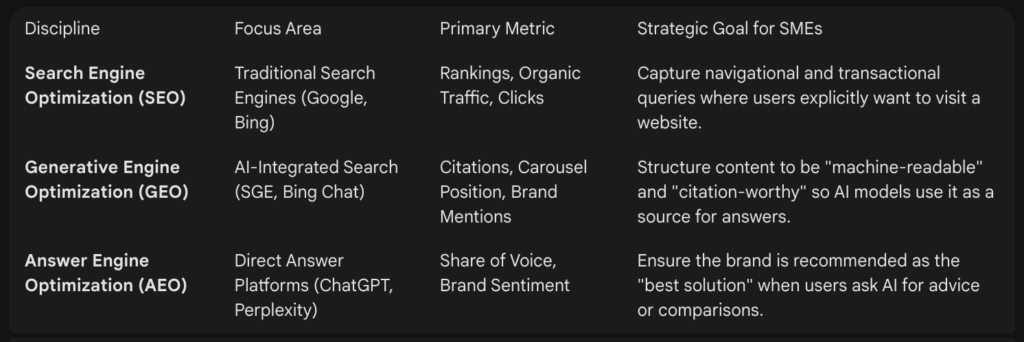
The convergence of these disciplines means that when a business owner asks, “Where can I find SEO audit services near me?”, they are implicitly asking for a partner capable of optimizing for this entire spectrum. A provider focusing solely on “keywords” and “backlinks” is operating on a deprecated playbook that may yield diminishing returns in an AI-first world.
The Service Provider Ecosystem: Agencies vs. Consultants
One of the most consequential decisions an SME owner will make is selecting the type of partner to guide their digital strategy. In Malaysia, and specifically within the competitive Selangor market, the choice typically lies between a full-service SEO Agency and an independent SEO Consultant. While both aim to improve visibility, their operational models, cost structures, and strategic incentives differ radically. Understanding these structural differences is essential to avoiding the “post-agency trauma” that plagues many businesses.
The SEO Agency Model: The "Factory" Approach
Agencies are structured to scale. They operate on a model that aggregates diverse talent—writers, developers, strategists, and link builders—under a single operational umbrella. This structure allows them to handle high-volume execution, such as producing 50 blog posts a month or managing complex technical migrations for large e-commerce sites.
Operational Mechanics
The agency model relies on hierarchy. A typical engagement involves a Sales Director who closes the deal, an Account Manager who serves as the primary point of contact, and a team of execution specialists (often junior staff) who perform the actual work. This “chain of command” ensures continuity; if one team member leaves, the account remains stable because the agency’s processes are standardized.
However, this structure creates significant overhead. Agencies must cover the costs of office space, HR departments, software subscriptions, and multiple layers of management. Consequently, a significant portion of the client’s monthly retainer—often 30% to 50%—goes toward administrative costs rather than direct strategic work.
The “Chain Restaurant” Analogy
Industry critics often compare agencies to “chain restaurants”. You receive a consistent, standardized menu of services (the “playbook”) executed by staff following a strict recipe. This is efficient for standard problems but can be disastrous for businesses requiring nuanced, non-standard strategies. If a business’s needs do not fit the agency’s pre-defined packages, the agency may struggle to adapt, leading to a misalignment between activity and results.
Pros of the Agency Model:
Scalability: Agencies can ramp up production quickly during peak seasons or growth phases.
Breadth of Talent: Immediate access to cross-functional skills (design, code, copy) without needing to hire separate freelancers.
Resilience: The project is not dependent on a single individual’s health or availability.
Cons of the Agency Model:
Communication Layers: The “Account Manager Firewall” often prevents clients from speaking directly to the technical experts, leading to diluted information and slower response times.
Junior Execution: Senior strategists pitch the business, but junior associates often execute the work, following a checklist rather than critical thinking.
Rigidity: High internal friction makes it difficult to pivot strategies quickly in response to algorithmic changes.
The SEO Consultant Model: The "Specialist" Approach
Consultants typically operate as senior-level independent experts. Many are former agency directors or “Head of SEO” figures who have chosen to exit the corporate structure to work directly with a smaller portfolio of clients. In the Malaysian context, top-tier consultants often charge comparable rates to mid-sized agencies but deliver a fundamentally different service product.
Operational Mechanics
The consultant model is built on depth and direct access. There are no account managers; the client communicates directly with the expert. This eliminates the “telephone game” and allows for rapid, high-level strategic discussions. Because consultants have lower overheads (no office, no staff), a larger percentage of the fee pays for high-level expertise rather than administration.
Consultants thrive on solving complex, specific problems. They are often brought in to fix failed migrations, recover from penalties, or design high-level content strategies that require deep industry knowledge. Their value proposition is “brains over brawn”—they may not write the content themselves, but they will provide the exact architectural blueprints for what needs to be written.
The “Architect” Analogy
If an agency is a construction crew, a consultant is the architect. The architect designs the blueprint, ensures structural integrity, and oversees the project, but they may not pour the concrete themselves. Consultants often partner with the client’s internal team or recommend vetted freelancers for execution, maintaining the role of strategic guardian.
Pros of the Consultant Model:
Expert Access: Direct line to senior-level experience, ensuring that strategy is crafted by someone who truly understands the nuances of the 2026 landscape.
Agility: Decisions can be made and implemented instantly. Consultants can pivot a strategy in days, whereas agencies might take weeks to approve a change order.
Cost Efficiency: For the same budget, a client often gets significantly more senior attention compared to an agency where that budget might secure a junior account executive.
Customization: Strategies are bespoke, tailored specifically to the business’s unique market position and goals.
Cons of the Consultant Model:
Capacity Constraints: A single consultant has a hard limit on hours. They cannot execute high-volume tasks (like writing 50 articles) alone.
Dependency Risk: If the consultant becomes unavailable, the project may stall. There is no “backup” team member.
Execution Gaps: The client must often provide the “hands” (internal staff or freelancers) to execute the consultant’s strategy, which requires internal management bandwidth.
The Hybrid Solution: The "Fractional Head of SEO"
For many SMEs in Selangor facing the “Missing Middle” challenge, the optimal approach is a hybrid model. The business hires a high-level Consultant to act as a “Fractional Head of SEO.” This consultant conducts the audit, sets the strategy, and defines the roadmap. They then help the business select a low-cost execution partner—either a boutique content agency or a team of freelancers—to handle the volume work. The consultant remains on retainer to audit the output, ensuring quality control and strategic alignment. This model combines the strategic depth of a consultant with the scalable execution of an agency, often at a lower total cost than a large agency retainer.
The Anatomy of an SEO Audit: Diagnosis vs. Commodity
The request for an “SEO audit” is often the first step in a business’s attempt to fix declining traffic or prepare for growth. However, the term “audit” is used loosely in the industry, describing products ranging from free, automated PDF exports to expensive, multi-month forensic investigations. Distinguishing between these is critical for protecting the marketing budget.
The "Vanilla" Report: Automation Disguised as Insight
A pervasive issue in the SEO industry is the sale of “Vanilla Reports.” These are automated outputs generated by white-label software tools (such as SEMrush, Ahrefs, or Moz) that agencies rebrand with their logo and sell to clients for hundreds or thousands of Ringgit. While these tools are valuable for data collection, a raw export of their data does not constitute a strategy.
Characteristics of a Vanilla Audit:
Generic Metrics: The report flags “issues” that have zero impact on revenue, such as “missing meta keywords” (which Google has ignored for over a decade) or “low text-to-HTML ratio.”
False Urgency: Highlighting thousands of “errors” to create panic. For example, flagging 500 “missing alt tags” on decorative spacing images.
Lack of Context: The audit treats a local plumber in Klang exactly the same as an international e-commerce store. It ignores the business model, the customer profile, and the competitive landscape.
Focus on Activity, Not Outcomes: The report lists tasks to be done (e.g., “fix 404 errors”) without explaining why or how those fixes will lead to more customers.
Case studies from industry forums reveal horror stories where clients paid thousands for “audits” that were merely templates, resulting in months of wasted time and zero organic growth.
The Strategic SEO Audit: A Business-First Diagnostic
A true Strategic Audit is a manual, intellectual process. It starts not with a crawl of the website, but with a deep dive into the business itself. The auditor seeks to answer: “Is the digital presence aligned with the company’s revenue goals and the realities of the 2026 search market?”.
Search Market Fit Assessment
Before optimizing a single page, the strategic audit evaluates “Search Market Fit.” This involves analyzing whether the keywords the business wants to rank for are actually used by people who want to buy.
Intent Mismatch: A company selling enterprise software might rank for “what is project management,” but the traffic consists entirely of students. A strategic auditor identifies this “empty traffic” and pivots the strategy toward lower-volume, high-intent terms like “enterprise project management software comparison”.
Zero-Click Vulnerability: The audit assesses which keywords are likely to be swallowed by AI Overviews. If a business relies on simple definition queries (“How long does a roof last?”), the audit will flag this traffic as “at-risk” and recommend shifting to complex, experience-based content.
Technical Foundation for AI Agents
In 2026, technical SEO is no longer just about helping Googlebot crawl; it is about helping AI agents understand.
Renderability: Can Large Language Models (LLMs) render the JavaScript on the page to extract answers?
Entity Identity: Is the site’s Structured Data (Schema.org) robust enough to unambiguously identify the brand, its products, and its location to the Knowledge Graph? This is non-negotiable for Local SEO in Selangor.
Core Web Vitals: Site speed is analyzed not just for ranking, but for user retention. A slow site (over 3 seconds) is a “red flag” that signals poor technical health.
E-E-A-T and Brand Authority Analysis
The audit evaluates the signals of Experience, Expertise, Authoritativeness, and Trustworthiness.
Author Credibility: Who is writing the content? Are there bios linking to LinkedIn profiles or external publications?
Reputation Management: What is the sentiment of off-site reviews? A business with poor reviews will not be cited by AI as a “best” solution.
Content “Information Gain”: Does the content add new value, or is it a rehash of the top 10 results? The audit identifies “commodity content” that is vulnerable to replacement by AI.
Strategic vs. Technical: Choosing the Right Tool
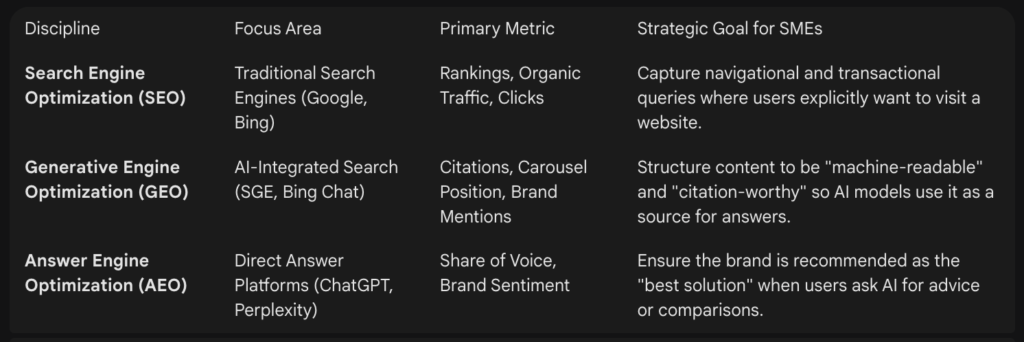
SMEs must diagnose their own situation to choose the right audit type.
Local Market Context: Navigating the Selangor Digital Landscape
For an SME in Selangor, “local context” is everything. The digital behavior of a consumer in Petaling Jaya differs from one in rural Sabak Bernam, and the broader Malaysian infrastructure presents unique challenges and opportunities.
The "Missing Middle" and Digital Adoption
The “Missing Middle” refers to the squeeze on mid-sized firms that are too big for micro-grants but too small for massive corporate resources. In Selangor, rising operational costs, ESG compliance requirements, and the impending implementation of e-invoicing are straining SME resources.
The Opportunity: While 77% of SMEs are at a basic digitization stage, the Selangor state government and federal agencies (MDEC) are aggressively pushing for digital transformation through initiatives like the Selangor Techsphere Summit and various digitalization grants.
The Challenge: Digital literacy remains a barrier. 83% of the workforce has minimal digital skills, and many SMEs struggle to implement the tools they purchase. This makes the role of an educational consultant—one who trains the team rather than just doing the work—highly valuable.
Local Search Behavior in Selangor
Selangor’s high population density (over 7 million) and mobile penetration (99.3%) create a unique search environment.
Hyper-Local Intent: Users search for “near me” services with high specificity (e.g., “SEO services Puchong” vs. “SEO Malaysia”).
Language Nuance: Search queries often mix English and Malay (Manglish). A generic global agency might miss keywords like “best wiringman KL” or “lorry sewa Selangor,” whereas a local specialist would capture this high-intent traffic.
Platform Diversity: While Google dominates, discovery also happens on social commerce platforms (Shopee, TikTok Shop). A modern SEO strategy in Malaysia must consider how Google indexes these “walled gardens”.
The 2026 Trend Landscape: Future-Proofing the Strategy
The year 2026 will not be “business as usual.” The trends shaping the industry demand a proactive shift in strategy.
From Keywords to Entities and Concepts
In the past, SEO was about repeating keywords. In the age of Semantic Search and AI, it is about “Entities.” An entity is a concept—a person, place, or thing—that the search engine understands as a distinct object with relationships to other objects.
Strategy: Instead of stuffing “SEO audit Selangor” 20 times, the strategy is to build the entity of the business. This involves robust “About Us” pages, clear service definitions using Schema markup, and consistent NAP (Name, Address, Phone) data across the web. The goal is to teach the AI who you are so it can recommend you.
The Era of "Zero-Click" and Brand Authority
With 60% of searches potentially ending without a click, the goal shifts from “traffic” to “influence.” If a user searches “best accounting software for Malaysian SME” and the AI summary lists your brand as a top option, you have won the “Share of Mind” even if the user doesn’t click immediately.
Optimization: This requires “On-SERP SEO.” Optimizing the snippets, the Google Business Profile, and the “Digital PR” footprint so that the brand appears in the AI’s summary text. The metric of success becomes “Brand Mentions” and “Share of Search” rather than just sessions.
Video and Multimodal Search
Search is no longer text-only. Users search with images (Google Lens) and consume answers via video.
Strategy: SMEs must treat video as a primary search asset. A video answering “How to fix X” can appear in the search results, the video tab, and within AI overviews. Transcripts of these videos provide text content for indexing, doubling the value.
The "Human" Premium
As AI content floods the web, “humanity” becomes a premium asset. Google’s E-E-A-T guidelines explicitly value “Experience.”
Strategy: Content must demonstrate first-hand experience. Use phrases like “In our experience dealing with X client…” or “When we tested this in our Shah Alam facility…” This authentic voice is harder for AI to mimic and is rewarded by ranking algorithms.
Conclusion and Strategic Roadmap
The question “Where can I find SEO audit services near me?” is not a logistical query; it is a strategic inflection point. For an SME in Selangor in 2026, the digital landscape offers immense potential but demands a sophisticated approach. The era of “easy SEO” is over. The era of “Strategic Authority” has begun.
Actionable Roadmap for Business Owners:
Audit Your Business Goals First: Define your “Search Market Fit” before hiring an auditor. Know who your customer is.
Choose Your Model: If you need hands-off volume, hire a reputable Agency. If you need high-level strategy and have an internal team, hire a Consultant. Consider the Hybrid Model for the best of both worlds.
Demand Strategy, Not Commodities: Reject “vanilla reports.” Insist on a strategic audit that speaks the language of revenue and brand authority.
Invest in “Human” Content: Focus on E-E-A-T. Share your unique local experience. Be the expert the AI wants to cite.
Think “Entity,” Not “Keyword”: Build a brand that exists as a verified entity in the Knowledge Graph.
By pivoting from a “traffic-chasing” mindset to a “brand-building” mindset, Selangor SMEs can navigate the AI transition, turning the disruption of 2026 into a sustainable competitive advantage.