The transition from a founder-led business to a scaling enterprise presents unique challenges for 2nd generation engineering business owners. Where the first generation often relied heavily on traditional marketing methods, personal relationships, and handshakes, modern growth demands systemization and scalable digital authority. To secure high-value, complex contracts and position a firm for corporate maturation—such as attracting investment or preparing for a potential public listing—a defensible digital strategy is essential.
This roadmap outlines an E-E-A-T aligned approach to AI ready Digital Marketing, focusing on building verifiable expertise and trust online.
Strategic Digital Growth Checklist
For the engineering SME owner seeking scalable, defensible growth, focus your digital transformation on the following core areas:
Establish a high-E-E-A-T (Experience, Expertise, Authoritativeness, Trustworthiness) website as the verified foundation of your brand.
Prioritize deep, long-form content optimized for Google SEO to capture qualified, technical long-tail keywords.
Implement Generative Engine Optimisation (GEO) now to gain first-mover advantage in AI-driven search results.
Treat LinkedIn as an organic thought leadership platform to attract both high-value clients and top-tier talent.
Reserve the use of Google ads and other paid media for tactical, targeted campaigns due to high industry keyword costs.
Understanding the Modern Engineering Buyer Persona and Intent
The foundation of any successful B2B strategy is recognizing that the audience the engineering purchaser is highly rigorous, technical, and risk-averse. Unlike consumer purchases, high-value engineering solutions require extensive due diligence, demanding that marketing materials provide technical validation and verifiable authority.
The Complex B2B Buying Committee
In the engineering sector, procurement is rarely the responsibility of a single person. It involves a buying committee, leading to high-value, long-cycle purchases that typically span three to six months. This committee includes multiple distinct stakeholders who must all be addressed by marketing materials:
Technical Engineers and Scientists: These are the ultimate influencers who care about specifications, interoperability, data, and technical performance under various conditions. They seek content that provides deep technical rigor.
Project Managers: Their concerns revolve around integration, timelines, staying within budget, and risk mitigation.
Procurement Officers: They analyze contractual terms, compliance, overall cost, and supply chain logistics.
C-Suite and Financial Decision-Makers: They assess strategic alignment, Return on Investment (ROI), and Total Cost of Ownership (TCO).
The successful marketing strategy must therefore be segmented and targeted to speak to these diverse personas individually, satisfying the analytical nature of the B2B research journey. Technical marketing messages must strive to simplify complex scientific processes without losing the necessary technical rigor, addressing a common language barrier between technical experts and decision-makers
Digital Research Dominance on Google and LinkedIn
B2B buyers are analytical and initiate their journey online, seeking solutions and technical validation. This necessitates a strategic focus on two primary platforms: Google and LinkedIn.
Google dominates the search-based intention phase. Buyers use specific, technical long-tail keywords to define problems, research methodologies, and identify potential providers. The search queries in this sector are typically longer and more specific than consumer queries, focusing on purchase-related signals such as “provider,” “comparison,” or “price” related to specific technical services.
LinkedIn is essential for the validation and trust-building phase. Decision-makers use this platform to validate organizational stability, assess leadership expertise, and understand the professional reputation of the firm, verifying the credentials that underpin complex, multi-year contracts. High-quality content shared on LinkedIn is used by 89% of B2B marketers for lead generation and is instrumental in building the crucial professional network necessary for trust.
Pillar 1: Establishing the E-E-A-T Digital Foundation (The Website)
For an engineering firm, the website must evolve past being a mere digital brochure. It must function as a comprehensive, high-authority resource center—a verified reference point that satisfies the rigor of the technical buyer and the demands of modern search engines. This transformation is the critical first step for gaining reliable online exposure.
The Authority Audit and Technical Integrity
The website must display E-E-A-T credentials immediately, ensuring clear, immediate value propositions because B2B buyers do not have time to decode what a company does.
Given the highly technical and regulated nature of engineering, the website functions similarly to a pre-qualification document. The presence of clear certifications, detailed team expertise, and verifiable data—all part of the E-E-A-T foundation—signals compliance and reduces perceived operational risk for procurement committees. If the website lacks immediate and verifiable organizational details, it can signal operational risk to highly risk-averse stakeholders. A high-E-E-A-T site accelerates the initial vendor vetting process.
A key component of establishing technical integrity is the implementation of structured data, or schema markup, which is non-negotiable for B2B engineering firms. This includes:
Organization Schema: Provides essential, verifiable business information.
Service Schema: Clearly defines and structures professional service offerings.
This technical optimization triggers rich snippets in search results, improving click-through rates and immediately signaling trustworthiness and clarity to both search engines and prospective clients.
Conversion Optimization for Sophisticated Buyers
The average conversion rate for manufacturing and engineering websites typically hovers around 2.5%, but strategic optimization can drive this toward 5–6%. For firms with high-ticket services, every percentage point increase in conversion rate means more qualified leads without additional traffic acquisition costs.
Generic Calls-to-Action (CTAs) like “Contact Us” often fail high-knowledge buyers who demand detailed information and technical validation. The website must offer actionable content, such as detailed case studies and technical guides, that validate performance and methodology.
When designing CTAs, refinement is critical. Conversion optimization studies show that action verbs suggesting problem-solving, such as “Get Started” or “Request a Strategic Consultation,” are significantly more effective than messaging associated with entering a sales cycle, like “Book a Demo”. Engineering firms should use interest-oriented, high-value CTAs that focus on the personalized benefit offered to the client, aligning the digital experience with consultative selling.
Pillar 2: The Long-Term Dominance of Google SEO
For the SME engineering business owner, committing to Google SEO is the primary sustainable strategy for digital dominance. While immediate returns are tempting, the volatile cost structure of Google ads in the B2B sector makes continuous reliance on paid media economically unfeasible for long-term growth.
The B2B Keyword Cost Crisis
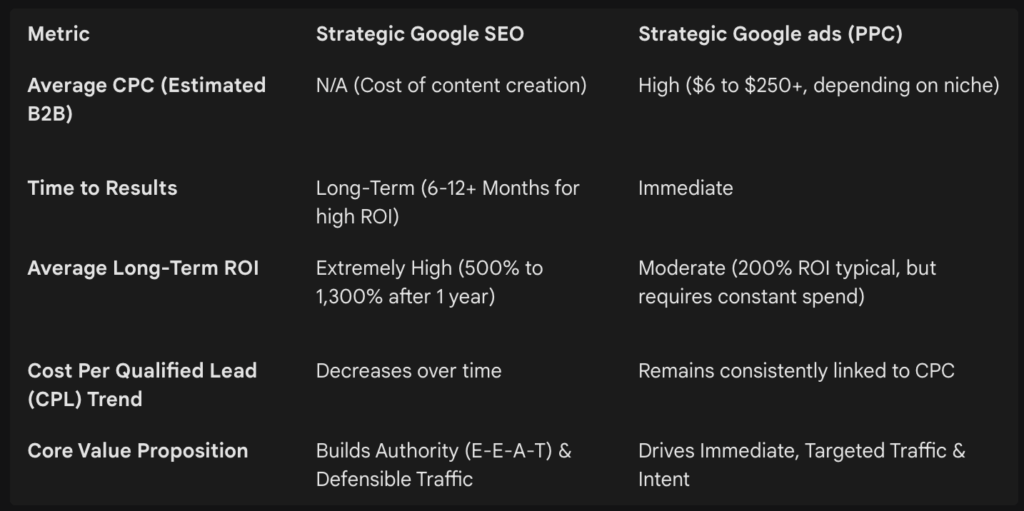
B2B marketing faces unique cost challenges. B2B keywords are structurally more expensive, averaging 67% higher in cost than B2C keywords. In the engineering and professional services space, competition for high-value contracts drives exceptionally high Cost Per Clicks (CPCs). Highly specialized B2B service keywords, such as “Offshore Software Engineer,” have been observed with CPCs exceeding $250. Even generalized B2B campaigns often start with CPCs around $6.40, resulting in high Cost Per Acquisition (CPA) for confirmed leads.
Given these high CPCs, sustained competitive advertising through PPC is a war of attrition favoring large, incumbent firms. This financial dynamic necessitates a pivot toward creating a “content moat” through organic search ranking.
The Power of Precision Google SEO
The competitive advantage for an SME lies in mastering long-tail SEO. While generic, high-volume terms are often unaffordable, specific technical long-tail keywords—which define the specialized problems the firm solves—achieve significantly higher conversion rates, up to 2.4 times higher than generic terms.
The effective SEO strategy involves intense focus on question-driven content that answers industry-specific challenges (e.g., “Risk mitigation strategies for structural integrity in seismic zones”) rather than chasing broad, costly keywords.
ROI and Sustainability
SEO starts slow, requiring six to twelve months to build momentum, but it delivers outstanding long-term returns. Strong SEO campaigns often report 500% to 1,300% ROI after a year or more. Crucially, once pages achieve stable ranking, the Cost Per Lead (CPL) decreases significantly over time. Conversely, in paid media, CPL remains consistently linked to fluctuating ad spend and ongoing competitive bidding. This sustained ROI from Google SEO provides a defensible traffic channel independent of fluctuating ad budgets.
Table 2 illustrates the strategic necessity of prioritizing organic methods for sustainable SME growth:
Table 2: SEO vs. Google ads: Strategic ROI Comparison for B2B Engineering
Pillar 3: Generative Engine Optimisation (GEO) and AI Readiness
The future of search is conversational and AI-driven. Generative Engine Optimisation (GEO) ensures your firm’s expertise is cited by AI assistants, guaranteeing visibility at the most critical stage of the buyer journey when prospects seek synthesized answers.
Defining Generative Engine Optimisation
GEO is an innovative approach that optimizes content for AI-driven search capabilities by leveraging semantic clarity and contextual richness, going beyond fixed keyword strategies. This defines true AI ready Digital Marketing. GEO amplifies existing SEO and demand generation efforts by increasing the likelihood that the firm becomes the authoritative voice cited when buyers ask complex technical questions.
Content Formatting for Citation Authority
AI agents favor content that is easy to ingest, comprehensive, and, most importantly, verifiable. The quality, format, and accessibility of your content determine whether your brand achieves high-authority citation.
Ungated, Long-Form Content: AI systems favor content that is rich in detail, structured for comprehension, and easily crawled without barriers. This means that long-form, ungated articles, comprehensive guides, and in-depth FAQs are AI’s “favorite” content because they provide sufficient contextual richness for accurate synthesis. The traditional B2B practice of gating all high-value content must be re-evaluated; foundational authority content should be ungated to gain GEO citation, capturing leads through high-value follow-up offers instead.
Semantic Clarity and Verification: Content must prioritize semantic clarity. Use clear, active, and conversational language, ensuring comprehensive coverage of technical topics. Given the precision required in engineering, every statistic or claim requires thorough verification against authoritative sources, regulatory guidelines, or internal subject matter experts. Since engineering deals with public safety (e.g., structural integrity), content must be demonstrably robust and validated. Engineering case studies, for instance, should be structured with robust validation and technical foundations to be accurately cited by AI. This commitment to demonstrable E-E-A-T elevates the content’s credibility for both human engineers and AI models.
First-Mover Advantage: Investing in GEO now allows an engineering brand to shape the conversation in its category before competitors adapt. This early investment ensures the firm’s expertise is front and center when buyers utilize AI to find crucial technical answers, securing a significant competitive advantage.
Optimizing LinkedIn for Authority and Talent Acquisition
While LinkedIn offers precise B2B targeting, the audience pool for niche engineering services is often small. To achieve scalable reach, a large budget is required, often making continuous LinkedIn Ads cost-ineffective for SMEs.
The superior strategy is organic social media management focused on demonstrating Expertise and Authority through consistent, engaging content.
Organic Thought Leadership as the Dual ROI Driver
The focus should be on consistent, expert-led content creation that humanizes the brand and showcases the intellectual capital of senior staff. By featuring internal experts, the firm builds trust and authenticity, which are far more influential than paid impressions in the B2B context. Content must focus on subject matter expertise, thought leadership, and team culture, always using compelling “hooks” to engage decision-makers quickly.
This strategy delivers a crucial dual return on investment:
Client Acquisition: Consistent high-quality content validates the firm’s competence and builds brand awareness, directly influencing complex contract decisions.
Talent Acquisition: For scaling engineering firms, attracting high-quality technical talent is critical for managing increased capacity and securing more contracts. Since LinkedIn is the key professional platform, content that validates the firm’s expertise and culture simultaneously attracts talent and validates competence to prospective clients. This compounding effect increases the efficiency of the organic content budget.
Furthermore, high-quality LinkedIn posts are now being indexed and leveraged by Google and AI engines as part of search results, fusing social authority with the overall SEO and GEO strategy.
The Role of Paid Media: Tactical Support, Not Strategic Reliance
While Google SEO forms the strategic core, paid media remains a necessary tool when used tactically and selectively to support broader goals, adhering to SME budget constraints.
Strategic Reservation of Ad Budget
The ad budget should be reserved for high-leverage scenarios where organic reach is too slow or insufficient.
High-Intent Niche Targeting: When using Google ads, the firm must avoid generic, high-cost terms. Instead, it must meticulously target long-tail, purchase-related keywords and technical solutions to improve lead quality and conversion rates.
Local and Time-Sensitive Campaigns: Paid ads are ideal for time-sensitive product launches, geographically targeted campaigns (as Local SEO remains important even for B2B firms ), and retargeting high-value website visitors who have already demonstrated interest.
LinkedIn Ads for Amplification: LinkedIn Ads are best utilized to amplify high-performing organic content or to deliver highly tailored messaging to a narrow list of priority accounts in an Account-Based Marketing framework, rather than continuous, broad-based lead generation.
Securing Contracts and Preparing for Public Listing: The Ultimate Digital Goal
Digital marketing, when executed with E-E-A-T and strategic foresight, directly supports the highest corporate ambitions of an engineering SME: securing stable, complex contracts and achieving corporate maturation, such as preparation for a public listing or acquisition.
Digital Authority Drives Contract Acquisition
The long, complex B2B sales cycle requires continuous trust-building and validation. SEO and GEO ensure that throughout the buyer’s research and validation phases, your firm is repeatedly encountered as the authoritative, cited source. When optimization embraces the iterative mindset—treating digital visibility as a dynamic process that must constantly adapt and improve—the firm reflects how it builds its own projects: resilient, dynamic, and forward-moving.
Branding for Public Market Readiness
A strong, visible, and trusted brand is a prerequisite for major corporate milestones like seeking public listing or acquisition. Investors scrutinize market visibility, reputation, and defensible growth strategies. Digital authority built through long-term Google SEO and proactive Generative Engine Optimisation signals operational stability and competitive advantage—essential features for a potential public offering.
Conclusion: The Mandate for the 2nd Generation Owner
The 2nd generation engineering business owner operates in a fundamentally digital marketplace. Success is no longer guaranteed by inherited relationships but by scalable, data-driven systems. The firms that will dominate the market are those that embed expertise and verifiable trust (E-E-A-T) into their digital DNA.
The strategic mandate is clear: build a high-authority website foundation, commit resources to long-term Google SEO for defensible traffic, secure early visibility advantages through Generative Engine Optimisation, and leverage LinkedIn to attract both high-value clients and necessary talent. By strategically reserving Google ads for tactical support, the SME engineering firm can achieve sustainable growth necessary to secure major contracts and pursue corporate maturity goals.