The transition to an AI-first digital ecosystem is not a gradual change but a fundamental, irreversible shift. For small and medium-sized enterprises (SMEs), traditional search engine optimization (SEO) tactics focused purely on traffic volume are obsolete. Google’s integration of large language models (LLMs) and the subsequent deployment of AI Overviews (AIOs) have permanently decoupled search volume from click volume, necessitating an urgent pivot toward machine trust, strategic visibility, and Generative Engine Optimization (GEO).
This report outlines the scale of the crisis, defines the new metrics for success, and provides a precise, white-hat optimization plan—covering content architecture, technical foundations (Schema), and paid media strategy—to ensure long-term digital viability in this new era.
The Generative Engine Crisis: Why the Old SEO Metrics Are Failing
Digital strategists must recognize that the search landscape is no longer driven by a simple link-and-rank mechanism; it is governed by AI systems designed to satisfy user intent without necessitating a click to an external website. This phenomenon, often termed “The Great Decoupling,” signifies that while search volume may be increasing overall (up 7-60% in daily Google searches), AI summaries are capturing approximately 60% of that volume as zero-click interactions.
The Great Decoupling: Defining the AI-First Reality
The most significant evidence of this paradigm shift is the dramatic collapse of click-through rates (CTRs). When AI Overviews (AIOs) appear, click-through rates plummet. Data analyzed across millions of impressions confirms that organic CTRs for informational queries featuring AIOs fell 61%, dropping from 1.76% to a mere 0.61%. Paid CTRs on those same queries suffered an even more catastrophic loss, plunging 68% (from 19.7% to 6.34%).
This immediate click suppression is severe, but the broader crisis lies in the subtle change in user behavior across the entire search ecosystem. Even on queries where AIOs were not visible, organic CTRs fell 41% year-over-year. This signifies that the user behavior change extends beyond Google’s SERP features; users are increasingly relying on external generative AI platforms like ChatGPT, or Google’s native AI Mode , to obtain complete, synthesized answers, bypassing traditional search results entirely. This lost traffic is not expected to return to the historical model.
For SMEs, this loss translates directly into reduced brand visibility and pipeline depletion. As AIOs now appear for over 13% of queries—a 102% increase from the previous baseline—the challenge is not how to compete for traffic, but how to compete for citation and share of voice.
The Collapse of Click-Through Rates (CTR) and the Strategic Pivot
The data dictates a mandatory redefinition of success metrics. In an environment where major digital publishers are reporting severe losses (e.g., HubSpot experiencing a 70–80% CTR decline), the focus must shift from pure organic traffic volume to strategic visibility and the brand’s presence in AI-generated summaries.
Success in the AI-first environment has become binary: sites that are cited win disproportionately. Research demonstrates that brands cited in AI Overviews gained significantly higher click rates, earning 35% more organic clicks and 91% more paid clicks than those not cited. This outcome highlights that the new strategic imperative is achieving citation eligibility through optimizing for machine understanding and trust.
While the zero-click trend dominates informational content, a crucial observation reveals a polarization in user behavior: for certain high-intent or complex queries where the AI cannot provide a complete answer, ranking excellence remains vital. For searches without AIOs, the #1 organic result has actually seen a slight CTR increase, climbing to 39.8%. This suggests that the remaining clicks on the traditional SERP are highly qualified and transactional. Therefore, the strategic mandate is dual:
Optimize high-value, transactional keywords for absolute ranking perfection.
Optimize all informational and educational content for Generative Engine Optimization (GEO).
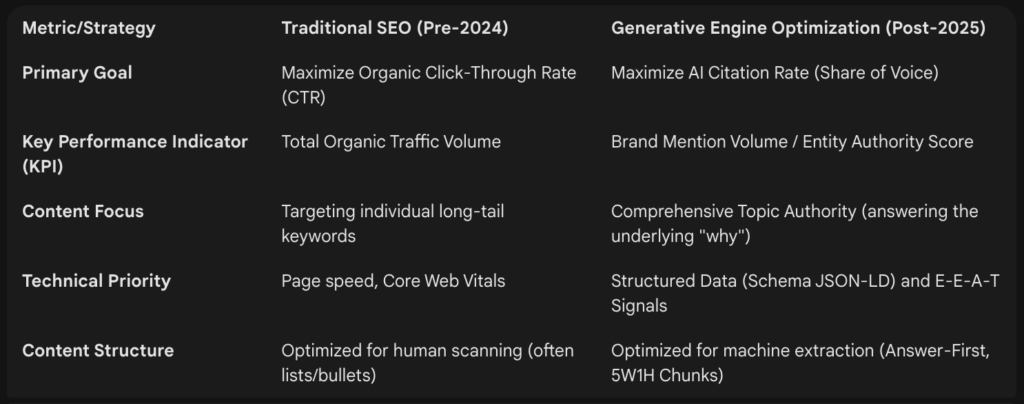
Generative Engine Optimization (GEO) is the formal, necessary practice introduced in 2023 for adapting all digital content and online presence management specifically to improve visibility in the results produced by generative artificial intelligence. This strategic pivot moves the business goal from maximizing organic CTR to maximizing AI Citation Rate.
The following table summarizes the mandatory shift in strategic focus for future-proofing digital presence:
Table 1: The Strategic Pivot: From Traditional SEO to Generative Engine Optimization (GEO)
E-E-A-T and Generative Content Strategy (The 5W1H Blueprint)
Generative AI, especially powerful models like Gemini now integrated into Google Search , relies on advanced reasoning and multimodal understanding. Due to the high visibility and implicit trust assigned to AI-generated answers, these systems must apply aggressive filtering mechanisms to ensure factual accuracy and protect against liability. This means the content used for citation must first pass the machine’s strict E-E-A-T (Experience, Expertise, Authoritativeness, Trustworthiness) standards.
Establishing E-E-A-T for Machine Trust
The E-E-A-T principles—Experience, Expertise, Authoritativeness, and Trustworthiness—are no longer soft content guidelines; they are the fundamental signals for achieving machine trust. Content that lacks clear E-E-A-T signals will be systematically excluded from AI Overviews and generative summaries, regardless of its traditional ranking.
To satisfy E-E-A-T in the AI era, SMEs must focus on proving, not just claiming, their expertise:
Experience: Show first-hand use or direct involvement with the subject matter. For an SME, this means incorporating original client case studies, proprietary research findings, or unique product reviews that demonstrate real-world application.
Expertise: Clearly demonstrate professional knowledge. This involves adding visible author bios with professional titles and credentials, and ensuring the content is factually accurate.
Authoritativeness: LLMs weigh external recognition heavily. Authority is built by earning mentions, securing strong backlink patterns from authoritative domains (.gov,.edu), and having content cited by reputable sources. Entity linking—connecting the author and the organization to the topic—is critical here.
Trustworthiness: This requires operationalizing transparency. Ensure the site uses HTTPS, has clear contact information (like Costco’s multiple support offers), and uses fair, balanced presentation of information, especially in reviews. Every factual claim must be backed up with verifiable statistics, research papers, or credible sources, often utilizing outbound links to strengthen trust signals.
The continuous maintenance of these signals—refreshing facts, examples, and statistics regularly—is essential, particularly in fast-evolving sectors like technology or finance, to ensure the content remains current and highly citable
Content Structure: The 5W1H Framework for AI Extraction
Generative AI extracts information in structured chunks. Therefore, content must be architected less for sequential human reading and more for precise machine parsing. The 5W1H (Who, What, Where, When, Why, How) framework provides the logical structure required for optimal AI extraction and citation
The Answer-First Principle
The top priority is providing the answer immediately. An explicit, concise summary (between 40 and 60 words) that directly answers the main query must be placed immediately after the main <h1> title. This block acts as the definitive source for featured snippets and AI Overviews, maximizing the chance of citation. This summary should use natural language and include the core entity and action associated with the content.
Logical Flow and Conciseness
AI systems use the HTML heading hierarchy (<h1>, <h2>, <h3>) to map the relationships between ideas. A robust structure ensures that the AI can understand how concepts connect.
Heading Structure: The content should be segmented using H2 tags that act as distinct, meaningful sections. H3 tags further divide complex topics.
Conversational Queries: To align with natural language processing and voice search, headers should be crafted as questions (e.g., “What is the cost?” or “How do I implement this strategy?”).
Paragraph Discipline: AI models struggle to parse sprawling, multi-concept paragraphs. SMEs must ensure that each paragraph focuses on a single, unified idea, typically consisting of 3 to 5 sentences. This precise length provides sufficient detail while maintaining the clarity necessary for effective AI synthesis and citation.
Structured Formats: Structured formats such as bullet points, numbered lists, tables, and FAQs are highly favored because they present data in discrete, easily extractable formats that facilitate multimodal synthesis and interpretation.
By implementing the 5W1H structure, SMEs ensure that when a user asks a nuanced follow-up question within Google’s AI Mode , the system can instantly isolate and cite the specific, relevant section of the content (e.g., the ‘Why’ section for a justification, or the ‘How’ section for a step-by-step process).
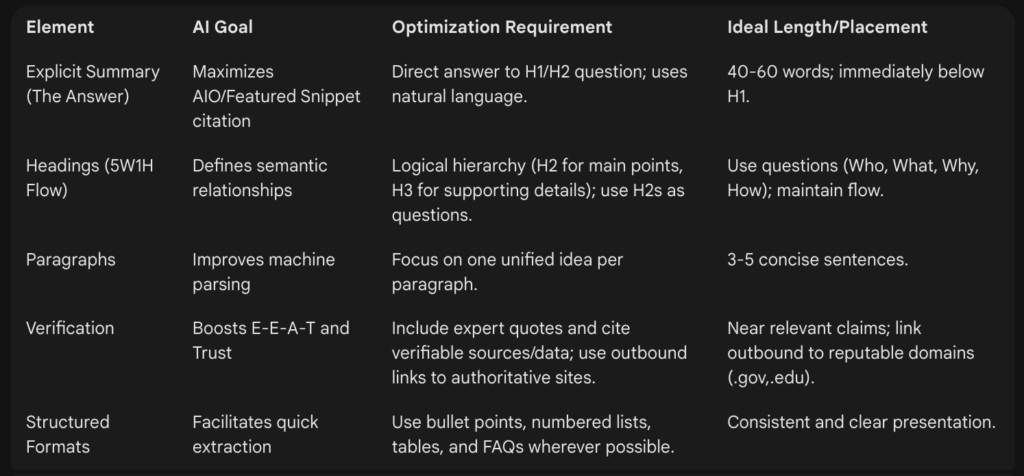
Table 2 details the content restructuring requirements for high citation potential:
Table 2: AI-Optimized Content Structure Checklist (The 5W1H Method)
Technical Readiness: Schema, Metadata, and Paid Media Defense
Achieving Generative Engine Optimization requires a robust technical foundation that speaks the language of LLMs. This technical language is structured data, and its deployment is now non-negotiable for digital visibility. Concurrently, the SME must overhaul its paid media strategy to defend against the AI-driven decline in ad visibility.
Schema Markup: The Foundation of Generative Engine Optimization (GEO)
Structured data (Schema Markup) acts as the essential connective tissue between content and the AI systems that interpret it. It explicitly labels content elements, telling search engines and LLMs what the content is, not just what it says. This semantic clarity is vital for citation.
The role of Schema in GEO is multifaceted: it increases citation potential, improves compatibility with AI summaries, and helps future-proof the content strategy against evolving AI algorithms. For example, by explicitly marking up hours of operation using the appropriate schema, an AI chatbot can instantly access the information, eliminating the need to scrape text or check third-party listings, thereby ensuring accuracy and improving the probability of the information being used.
Google strongly recommends JSON-LD as the preferred format for structured data due to its ease of implementation and reduced error rate at scale.
Essential Schemas for SME Entity Linking
The primary function of Schema in an AI environment is linking the business (the entity) to the Google Knowledge Graph. The following types are critical for SME preparedness:
OrganizationandLocalBusiness: These schemas establish the entity, ownership, and core contact details. PairingLocalBusinessschema with verified local directories (like Google Business Profile) is the definitive white-hat strategy for securing local search dominance. Given that 46% of all Google searches have local intent, comprehensive local keyword application alongside structured data is paramount.Article: Essential for informational content, this verifies E-E-A-T signals by linking the article to the author, publication date, and the parent organization.FAQPage: Crucial for feeding direct question-and-answer pairs to generative AI, making content highly extractable for quick summaries and conversational interfaces.ProductandReview: These types provide critical, structured data for commercial pages, which are increasingly important as AIOs move into high-volume commercial searches.
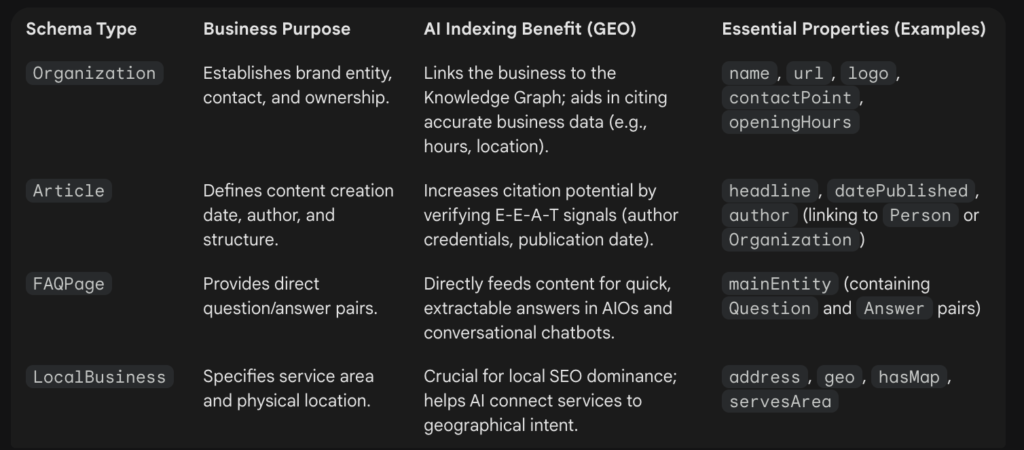
Table 3 provides a breakdown of the essential Schema types required for AI readiness:
Table 3: Essential Schema Markup for SME AI Readiness (JSON-LD Priority)
Adapting Paid Strategy for the AI SERP
The deployment of AI Overviews pushes both organic and paid listings lower on the SERP, reducing visibility and driving up the Cost-Per-Click (CPC) as advertisers fight for the remaining high-value real estate. The conventional wisdom of avoiding informational, upper-funnel queries because AIOs dominated them is now fundamentally challenged.
Strategic Interception and the Upper-Funnel Pivot
Paid search strategy must shift from a sole focus on transactional queries to strategic interception of users earlier in the research phase. Evidence suggests that in many industries (e.g., Automotive and Travel), ads perform significantly better on longer, more informational queries. For queries containing four or more words, the rate of winning an ad placement above the AIO jumps dramatically (in some cases, exceeding 74%).
By aggressively bidding on these mid-to-upper-funnel keywords, an SME can intercept the user’s journey before the AI provides a definitive, final answer, driving the lead to a proprietary landing page rather than losing them to the zero-click environment.
Ad Granularity and AI-Powered Optimization
To maximize effectiveness, ad campaigns must embrace Google’s AI-powered Search ads products, primarily Responsive Search Ads (RSAs). Improving RSA Ad Strength provides valuable feedback and is directly correlated with performance, potentially yielding 12% more conversions.
Campaigns must be structured with controlled granularity, focusing ad groups around specific user intents (e.g., problem identification, solution comparison, brand inquiry) to ensure ad titles, descriptions, and assets are ultra-precise and align perfectly with how users phrase conversational queries. Smart negative targeting is equally important to exclude out-of-scope queries and focus budget only on high-value buying signals.
The Next Frontier: Monetization on Independent AI Platforms (ChatGPT Ads)
Beyond Google, emerging AI platforms are preparing to enter the monetization space. Industry leaks indicate that OpenAI is laying the groundwork for ChatGPT Ads, intending to serve sponsored suggestions within the platform to monetize its vast free user base. These advertisements are expected to be voluntary and transactional, integrated into the conversation stream.
For SMEs, this signals the need for AI-ready data—data that is accurate, complete, secure, and structured—to be prepared for participation in conversational commerce. The ability of an LLM to recommend a product or service directly within a chat thread will depend entirely on the organization’s capacity to feed structured data (including voice, text, video, and screen interactions) to the platform in a format that the model can interpret and use effectively. Internal data hygiene is thus rapidly becoming a core marketing priority.
Action Plan and Conclusion: Moving from Traffic to Trust
The future-proof digital strategy for SMEs requires immediate, deliberate action. It is a transition from optimizing for volume to optimizing for structural trust and machine-readability. The following final recommendations distill the strategic and technical requirements into an actionable checklist.
AI Readiness Checklist for SME Business Owners
Strategic & Metric Shift: Immediately pivot all content and marketing KPIs away from reliance on organic traffic volume. Implement Share of Voice (SoV) tracking—measuring the frequency and quality of brand citations within generative AI results—as the primary success metric.
Technical Baseline: Conduct a mandatory technical audit focusing on Core Web Vitals and mobile-first design, which are foundational for AI-driven indexing. Deploy essential JSON-LD schema across all priority pages, focusing on
Organization,LocalBusiness, andArticletypes to establish entity authority and machine-readability. Validate all schema using Google’s Rich Results Test.Content Transformation: Audit existing high-value content for E-E-A-T compliance, ensuring clear authorship, credentials, and verifiable sourcing are visible. Mandate that all new content production follows the Answer-First principle and the 5W1H structure, using concise paragraphs (3–5 sentences) and conversational headers to maximize AI extraction potential.
Paid Media Defense: Restructure Google Ads campaigns. Increase budget allocation for mid-to-upper-funnel informational keywords where ad position above AIOs is favorable. Ensure maximum utilization of Responsive Search Ads (RSAs) to leverage AI-powered ad relevance and targeting.
Data Hygiene: Begin the process of standardizing and structuring all product, service, and customer interaction data to ensure it is “AI-ready” for future conversational commerce platforms like ChatGPT Ads.
Conclusion
The data confirms that the AI-first digital marketing landscape rewards structure, authority, and machine trust above all else. Organic visibility, in the traditional sense, is collapsing for general informational queries, replaced by a binary outcome: either being cited as the authoritative source or being effectively invisible.
The long-term viability of an SME’s digital presence hinges on embracing Generative Engine Optimization (GEO). By shifting from traffic acquisition to citation eligibility, leveraging the structural clarity of the 5W1H framework, and solidifying the technical foundation with structured data, businesses can ensure their expertise remains visible, trustworthy, and scalable across all emerging generative platforms. The future of digital marketing demands a focus on being the most reliable source for the machine, thus guaranteeing long-term share of voice and sustainable business growth.