The digital marketing landscape offers two primary avenues for visibility: search engine optimization (Google SEO) and paid advertising (Google ads). For small and medium-sized enterprise (SME) owners, particularly those operating with sensitive cash flow, the choice between these two channels is not merely operational; it is a fundamental strategic decision regarding capital allocation. This choice must balance the immediate need for liquidity against the imperative for building long-term asset value.
The Critical Cash Flow Dilemma for SME Owners
Marketing expenditure must be strategically classified to accurately reflect its financial impact. Paid advertising, specifically Google ads, functions financially as an operational expenditure (OpEx). It requires an immediate, variable outflow of cash to secure short-term leads necessary for immediate survival and sales targets. Conversely, strategic Google SEO is best viewed as a capital expenditure (CapEx). It represents a long-term investment that builds a sustained, high-value digital asset—the website’s organic visibility and authority.
The core strategic distinction relies entirely on the business’s current time horizon and liquidity position. If the urgent requirement is immediate cash flow, the appropriate allocation dictates a focus on Paid Ads. However, if the business possesses the runway to invest in sustained valuation growth and long-term stability, the commitment must shift significantly toward SEO. Volatility inherent in SME financial cycles demands a marketing strategy that offers quick adaptability. While Paid Ads provide the necessary flexibility to scale up or down instantaneously , an over-reliance on this channel prevents the accumulation of the high-ROI organic asset. Such businesses risk trapping themselves in a cycle of perpetual spending. Consequently, a sustainable, expert-level marketing plan must incorporate mechanisms to address both immediate financial needs and long-term economic stability.
Defining the Channels: Short-Term Spend vs. Long-Term Asset
Google SEO (The Organic Asset): Search engine optimization is the methodical practice of refining a website’s content, technical structure, and external authority to achieve and maintain higher rankings in organic search results. This process requires a significant upfront time commitment but, once successful, generates continuous, high-quality traffic at virtually no marginal cost per click.
Paid Ads (Google ads / PPC Spend): Paid-Per-Click (PPC) advertising, such as Google ads, involves setting budgets and bidding for premium placement adjacent to search results. This mechanism delivers instant visibility to targeted audiences but possesses a critical financial limitation: the traffic stops the moment the advertising budget is exhausted.
Deep Dive: Paid Ads (Google Ads) for Immediate Liquidity Needs
Paid Ads function as a powerful instrument for immediate cash flow injection and rapid market validation, making them indispensable during critical business phases.
The Advantage of Velocity: Speed and Control
The foremost advantage of Paid Ads is the velocity of results. They offer the “48-Hour Advantage,” providing near-instant visibility and lead generation capability. This immediate influx of traffic and conversions is crucial for new businesses testing market viability, seasonal businesses with short time windows, or established operations needing quick lead generation to cover immediate expenses.
Crucially for cash-flow management, Google ads offer profound budget flexibility. Businesses can scale spending up or down instantly, perfectly balancing immediate traffic needs against current cash flow availability. This ability to implement an instant ‘off switch’ or pause campaigns provides a vital mechanism for managing unexpected cash crunches or pivoting quickly away from underperforming campaigns. The ideal utilization focuses on bottom-of-funnel conversion campaigns, such as seasonal promotions, product launches, or highly targeted offers.
The Cost Reality: Variable Expense and Squeezed ROI
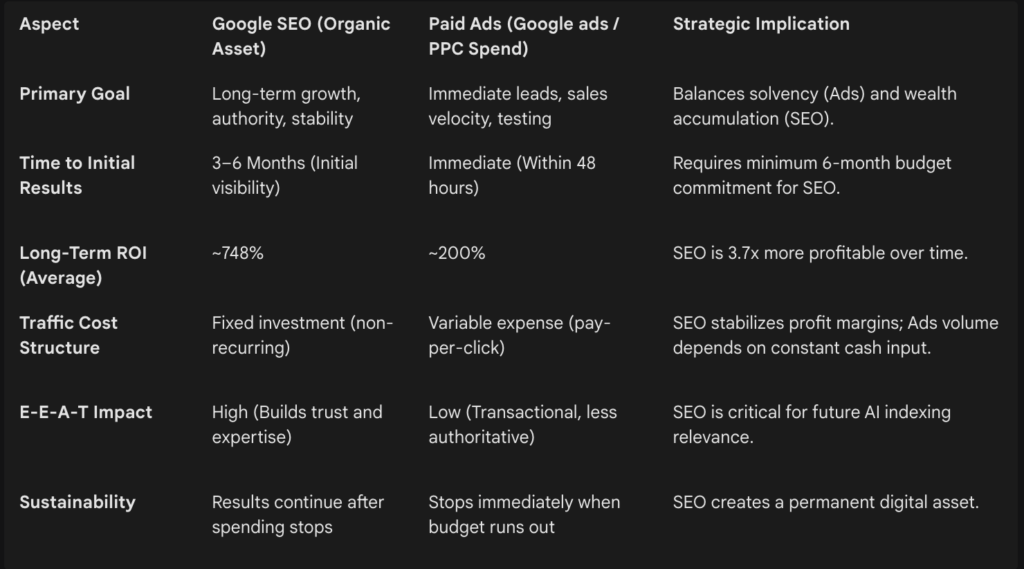
While offering immediate returns, Paid Ads operate under a constraint: their long-term efficiency is limited. Industry data suggests that Paid Ads generally yield a positive, though modest, ROI of approximately $2 for every $1 spent, translating to a 200% return. This positive return, however, is significantly overshadowed by the long-term profitability demonstrated by successful SEO efforts.
The principal cash flow risk associated with PPC is the highly variable cost structure. The Cost-Per-Click (CPC) is determined by competitive bidding, meaning that highly competitive terms—especially in lucrative or high-demand sectors like Legal, Medical, or certain B2B services—can demand exorbitant CPCs.
This variability creates a financial pressure point for local SMEs, particularly in robust Southeast Asian economies like Malaysia. The country’s aggressive pace of foreign investment, especially in high-growth areas such as Information & Communications (which attracted RM59.6 billion in investments) and Real Estate (RM38.6 billion) , drives up competitive bidding. As larger regional and global entities enter these markets, they engage in aggressive bidding wars in Google ads. SMEs relying purely on paid advertising in or around these high-value industry verticals risk having their entire marketing budget severely compressed by larger players, leading to a substantial reduction in their net profit margin per conversion. If the cost of acquiring a lead through competitive bidding inflates rapidly, the SME’s effective ROI drops, necessitating a shift toward alternatives to mitigate this financial pressure and avoid budget burnout.
Deep Dive: Google SEO for Long-Term Profitability and E-E-A-T
Google SEO is not an expense but an investment in a durable digital asset, providing financial and strategic superiority for long-term growth and stability.
The Investment Timeline Reality: Securing the Runway
SEO is fundamentally a long-term strategy, requiring patience and sustained effort. While the indexing process—where Googlebot discovers and adds a page to the search index—can occur within hours for authoritative sites or take several weeks for new content , the journey to ranking visibility is protracted. Initial keyword movement typically takes shape within 30 to 90 days. Ranking stability, where measurable traffic results become consistent, requires roughly four to six months. However, achieving full competitive impact and robust results, particularly for a brand-new domain, demands a sustained commitment spanning 6 to 12 months.
SMEs must adopt realistic budget expectations for this process. It is considered a massive financial error to invest in the early stages of SEO and then prematurely cease efforts after only a few months. Quitting before the six-month mark essentially means discarding the entire budget, as the investment clock stops before the asset can begin to yield returns. The delay in performance is due to Google’s stringent evaluation process: after indexing, the system must assess on-page signals, content quality, backlinks, and overall site trust (the components of E-E-A-T) before committing to a definitive ranking position.
The Definitive ROI Case: Asset Accumulation
The financial argument for SEO rests on its dramatically superior long-term return. Data indicates that Google SEO delivers an average return of 748% ($7.48 per $1 spent). This return rate positions SEO as 3.7 times more profitable than the average Paid Ads campaign for sustainable growth.
This high return is powered by sustainability. Once a web page achieves a high organic ranking, the resulting traffic flows continuously without the requirement of paying per click. The visibility and lead generation results persist long after the initial financial investment stops, creating significant cost savings and accumulating genuine long-term asset value. This sustained traffic reduces the Customer Acquisition Cost (CAC) to near zero over time, which dramatically improves profit margins. This stable stream of non-paid traffic provides crucial market stability, acting as a competitive shield against rivals who must continuously pay for every single click. The scalable, non-recurring cost structure of SEO is the financial mechanism that transforms marketing spend into a sustainable growth engine, fundamentally different from the volatile, linear spending required by Paid Ads.
Building Trust and Authority (E-E-A-T Alignment)
Successful Google SEO inherently requires the creation of high-quality content that is clear, helpful, and descriptive, directly aligning with Google’s core E-E-A-T standard (Experience, Expertise, Authoritativeness, and Trustworthiness). This strategic focus on quality content allows a company to build demonstrable industry leadership and secure sustained customer trust over time.
In the current environment of digital transformation and the emergence of generative AI indexing platforms, the content that achieves high organic rankings by satisfying the E-E-A-T standard offers the highest form of defense against disruptive algorithmic changes. High-quality, authoritative content is recognized as the single most effective strategy for maintaining discoverability, particularly as AI models prioritize content from trusted, expert sources. Investing in SEO, therefore, is not just about rankings; it is about mitigating future risk by establishing foundational authority that transactional marketing, such as Paid Ads, cannot replicate.
Strategic Focus: Local SEO and Southeast Asian Market Dynamics
The choice between SEO and Paid Ads is heavily influenced by the competitive dynamics and investment climate of the specific local market, such as the environment in Selangor, Malaysia.
Dominating the Local Search Landscape (SEO Selangor)
For local, service-based SMEs operating in Selangor, Local SEO is arguably the most critical component of their digital strategy. Local SEO focuses marketing efforts on making the business the top choice for customers in its specific city or state. The primary technical goal is optimizing the Google Business Profile (GBP) to secure dominance within the local Map Pack.
Local SEO offers a high-leverage opportunity that traditional national SEO campaigns often miss. Local competition is typically less intense than the broader keyword competition. Mastering SEO Selangor enables the SME to accelerate the time-to-value for their organic investment by driving highly qualified, geo-specific customers to their physical or digital doors faster and more cost-effectively than attempting to compete for broad, high-volume keywords.
The Competitive Trap: High CPCs in SEA
The broader Malaysian economy provides critical context for marketing budget decisions. Key economic hubs like Johor, Penang, and Kedah, and high-value sectors such as Information and Communications (RM59.6 billion) and Real Estate (RM38.6 billion), continue to attract substantial foreign investment. Singapore remains the dominant foreign investor, committing RM52.7 billion in the first nine months of 2025.
This significant influx of capital, particularly into high-value sectors, ensures that keywords related to these industries will see aggressively inflated bidding in the Google ads environment. Cash-flow sensitive SMEs in Selangor that operate in, or adjacent to, these high-value niches will find PPC increasingly financially prohibitive. When a business is confronted with an unwinnable bidding war against regional or multinational corporations with virtually unlimited marketing budgets, the only financially sound strategy is a decisive shift toward the organic channel. Securing a long-term, non-paid presence through Google SEO becomes essential for competitive resilience and long-term solvency, ensuring the business is not priced out of its own local market by transient competitive pressure. The investment in SEO Selangor thus functions as a strategic hedge against regional market volatility.
The Cash Flow Decision Framework: Choosing Your Path
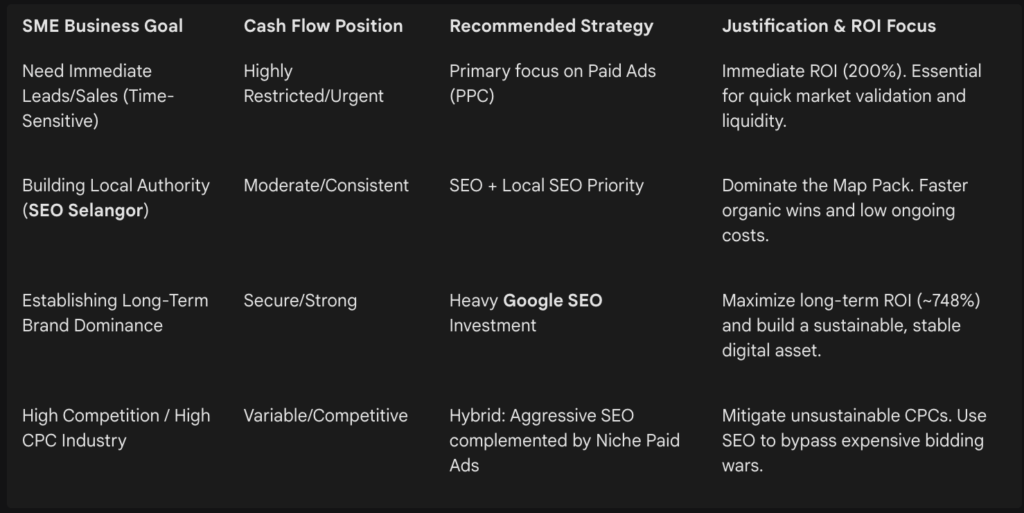
The following framework provides SME owners with a clear matrix for budgeting and strategic allocation based on their immediate financial reality, synthesizing time horizons, cost metrics, and ROI considerations.
Phase 1: Immediate Revenue Needs (Cash Flow Negative/Urgent)
Strategy: High-Velocity Revenue Generation (70-80% Paid Ads)
When the business requires immediate market validation or lead generation to maintain essential operations, the focus must be on velocity. This strategy involves the immediate launch of highly targeted Google ads campaigns focused strictly on proven, high-converting services. This secures necessary liquidity and sales validation. While the budget allocation is heavily weighted towards Paid Ads, a minimal budget must be maintained for continuous site health checks and foundational organic optimization (Google SEO) to ensure the long-term investment clock continues to tick.
Phase 2: Growth and Stability (Moderate/Consistent Cash Flow)
Strategy: Hybrid Synergy Model (50% Google SEO, 50% Paid Ads)
Once the business achieves moderate, consistent cash flow, the strategy must pivot to building sustainable growth without sacrificing immediate lead generation. This hybrid approach uses Paid Ads to maintain a reliable, controlled stream of leads while dedicating significant capital to high-quality content production and authority building (SEO). This allows the SME to begin the long process of capitalizing on the 748% long-term ROI. This phase is also characterized by implementing the data-sharing strategy, leveraging Ads data to accelerate SEO progress (detailed in the next section).
Phase 3: Market Dominance (Secure Cash Flow/Scaling)
Strategy: Asset-First Dominance (80-90% Google SEO Investment)
When the business is financially secure and focused on scaling for long-term market dominance, the marketing investment shifts decisively toward the organic channel. The majority of spending moves away from expensive general Google ads campaigns toward sustained content expansion and technical optimization. This maximizes long-term profitability and minimizes exposure to competitive pricing risk. A minimal Paid Ads budget is maintained primarily for defensive campaigns (protecting brand terms) and highly specific niche targeting.
The allocation framework is summarized in the following decision matrix:
The SME Cash Flow Decision Matrix: Strategy Based on Urgency
The Synergistic Hybrid Strategy: Maximizing Results with Existing Spend
The most sophisticated and successful SMEs view Paid Ads not only as a revenue stream but as a high-speed, data-rich research tool designed to accelerate the slower, yet higher-ROI, efforts of Google SEO.
Using Ads Data to Accelerate Google SEO Strategy
One of the most effective ways to maximize marketing spend is to eliminate guesswork from organic content creation. The Google Ads Search Terms Report provides immediate, real-world data showing the exact queries that trigger ads, and critically, which queries drive genuine conversions.
This conversion data allows the SME to prioritize the creation of high-converting SEO content. By focusing organic content efforts exclusively on the keywords already proven to generate revenue via Ads, the likelihood of that organic content contributing significantly to long-term business growth is dramatically boosted. Furthermore, if specific search terms are generating successful results in the Paid channel, it indicates a customer need that the organic content may not yet satisfy. The SME must prioritize creating comprehensive content clusters optimized for those specific organic queries, ensuring the content covers the full spectrum of customer interest and enhances site relevance.
Optimizing Organic Snippets with Paid Ads Copy
The effectiveness of an organic ranking position is not determined solely by its location on the search results page (SERP); it also depends on how compelling the result appears to the user. High-performing ad headlines and descriptions that generate strong Click-Through Rates (CTRs) in Google ads provide instant, validated language. This persuasive language should be adapted and replicated for organic page titles and meta descriptions.
By treating organic meta descriptions as high-impact ad copy—concise, compelling, and oriented toward user benefit—the SME maximizes the value of its earned organic ranking position. This approach ensures that the highly-ranked SEO page attracts maximum clicks, effectively accelerating the time-to-value for the SEO asset. The rationale is that a perfectly ranked position is financially insufficient if the searcher scrolls past the snippet. Using language proven effective in Paid Ads ensures that the organic listing successfully combines the inherent trust of an organic ranking with the velocity and persuasiveness of paid advertising.
Refining Local SEO with Campaign Insights
The integration of Ads data is particularly vital for local businesses focusing on SEO Selangor. If Google ads campaigns are geographically restricted to specific towns or districts within Selangor, analyzing the resulting geographic performance data provides clear indicators of demand concentration.
This insight allows the SME to refine its Local SEO strategy. Efforts should be concentrated on optimizing local landing pages and Google Business Profile management for the specific regions or areas where the paid campaigns demonstrated the highest conversion rates. By strengthening organic presence where customer demand has already been proven through the Paid Ads budget, the business achieves superior local rankings and secures maximum customers from targeted regions.
Validation Section and Key Metrics Summary
The definitive strategic choice for an SME must rest upon comparative financial metrics that illustrate the economic trade-offs between speed and sustainability.
Future-Proofing Strategy: Navigating AI Indexing
The continuous evolution of search algorithms, including the increased reliance on AI for content synthesis and indexing, mandates that businesses focus on demonstrating superior expertise and relevance. The focus is shifting away from simple keyword stuffing toward evaluating deep content quality and authority. Investing in high-quality, genuinely helpful content, the hallmark of successful Google SEO, is recognized as the most robust defense against potential algorithmic disruptions. This dedication to creating valuable content helps maintain discoverability even when search results are influenced by advanced AI models that prioritize authoritative sources.
Furthermore, leveraging advanced digital tools, such as utilizing Google Search Console for comprehensive performance tracking and employing sophisticated analytics to benchmark against competitors, is essential for SMEs to maintain competitive alignment and reduce overall long-term marketing costs.
Conclusion and Actionable Next Steps
Final Strategic Synthesis
The analysis confirms that the decision between Google SEO and Paid Ads hinges entirely on the SME’s available cash flow and its desired time horizon. The expert recommendation mandates a dual-channel strategy: utilize Paid Ads to purchase immediate market visibility and crucial data, but commit to Google SEO to secure long-term financial freedom and profitability. The cost structure of Paid Ads makes them an unsustainable foundation for growth, particularly in high-competition, high-CPC regions like Selangor. Therefore, a business must never cease its SEO investment prematurely; the necessary six-month investment runway must be secured for the organic asset to fully accrue value.
Strategic allocation of marketing capital requires a precise assessment of your current financial phase—Phase 1 (Survival), Phase 2 (Growth), or Phase 3 (Dominance).
If optimizing your marketing spend to build a sustainable digital asset that yields 3.7 times the returns of traditional paid advertising, while simultaneously mitigating the competitive risks of high-CPC bidding in SEO Selangor, is your core objective, Request a Personalized Strategy Review Today. Understanding the ideal allocation mix between Google SEO and Google ads is the first step toward securing enduring digital profitability.