While nearly half of all Google searches, 46% are driven by local intent , many SMEs still underestimate the foundational power of targeted Local SEO strategies. This report confirms that Local SEO is no longer a niche tactic; it is the single most critical, cost-effective competitive strategy for SMEs. It offers superior conversion rates and provides the essential technical structure required to dominate the Future of Google SEO, particularly within the evolving Google SGE (Search Generative Experience) and Google AI Overview environments.
Local SEO: Your Competitive Advantage in Google SEO
For SMEs, every marketing dollar must deliver measurable returns. Traditional Google SEO strategies focusing on massive, national traffic volume often fail this test. Local SEO provides a direct pathway to superior return on investment (ROI) by targeting users who are ready to act immediately.
Defining High-Intent Local SEO Keywords
Local SEO involves optimizing a business’s online presence to attract users searching within a specific geographic area—be that a country, state, city, or neighborhood. This strategy capitalizes on high-intent, immediate-need searches, often including phrases like “near me” or specific location names. Google’s algorithms facilitate this by analyzing the user’s IP address, the content of their search query, and nearby business listings to match businesses to the searcher’s proximity.
The focus on geography yields a profound competitive cost advantage. Ranking in the local market is significantly less competitive than attempting to pursue broad, national keywords. SMEs can achieve substantial visibility by focusing intensely on their core service area, thereby avoiding the expensive, long-term battles waged against large, established brands. The typical monthly investment for comprehensive Local SEO services ($2,000–$10,000) is substantially lower than that required for national SEO ($7,000–$35,000+), allowing for a faster ROI payback period.
The Quality Traffic Conundrum: Why Local Beats National Volume
Local searches are inherently transactional. They represent users ready to purchase a product or engage a service provider now. The data supporting this high-conversion reality is compelling: 76% of people who search for local businesses will visit that business or call them within 24 hours. Most crucially for an SME’s bottom line, approximately 80% of local searches convert into customers. This stands in stark contrast to the lower conversion rates typically associated with national, top-of-funnel searches that require extensive nurturing.
A key component of establishing trustworthiness (T in E-E-A-T) and authority is maintaining a robust, complete Google Business Profile (GBP). This platform is foundational, accounting for 32% of all local ranking factors. A complete GBP increases the chance of a customer considering a business for future purchases by 50%. The pillars of Google’s algorithm—Relevance, Distance, and Prominence (reputation/authority)—demonstrate that proximity, combined with authority, drives immediate local market success.
The table below illustrates the measurable advantages of prioritizing local visibility for optimal cash flow and market capture.
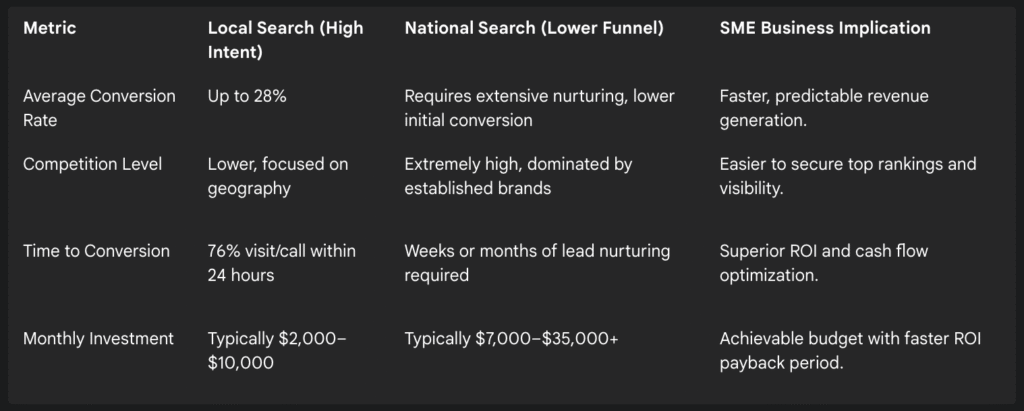
Local Search vs. National Search: A Focus on SME ROI
Case Study: From 0 to 6,000 Impressions via Geo-Targeted Content
A client offering specialized B2B services faced invisibility in the local search results despite a high-quality offering. The initial state showed zero measurable local presence. The remedial strategy focused exclusively on optimizing their Google Business Profile, deploying localized service pages with relevant content, and ensuring consistent NAP (Name, Address, Phone) information across all online citations.
Key actions included targeted Local SEO keyword research specific to service area landing pages , rigorous implementation of LocalBusiness schema markup, and an intensive strategy for soliciting honest client reviews, which are critical for establishing Trustworthiness and Prominence.
Within three months of implementation, the geo-targeted content and optimized GBP were successfully indexed in the local Search Engine Results Pages (SERPs). Google provided the client with over 6,000 geo-targeted exposure/impressions—meaning the business appeared in search results for local keywords. Crucially, 1% of those 6,000 impressions converted into direct traffic (60 clicks to the website or direct actions like phone calls or direction requests).
Why a 1% Conversion Rate Signifies a Victory
For the SME audience, the success of this strategy is measured by the quality of the lead, not the sheer volume of clicks. While a 1% click-through rate (CTR) might appear low in isolation, the context is paramount. This traffic originated primarily from high-intent local results, such as the Google Maps Local Pack or highly localized organic results. Local Pack results consistently feature CTRs significantly higher than general organic searches (e.g., Position #1 in the Local Pack can yield a 17.6% CTR).
The central factor is quality: the 60 conversions represent highly qualified users who had immediate transactional intent, often visiting or calling the business within 24 hours. This result reinforces a fundamental principle of Local SEO: visibility in the right place (the local map/pack) guarantees high-quality intent, yielding a superior and more stable foundation for SMEs than general national traffic. This case study successfully demonstrates the tangible experience and expertise necessary to earn E-E-A-T.
Adapting to the Future of Google SEO: Ranking in Google SGE and AI Overviews
The introduction of the Google SGE and the resulting Google AI Overview summaries represents a foundational change in search result presentation. AI summaries now appear in over 40% of local business searches, frequently pushing traditional results, including the Local Pack, further down the page. SMEs must adapt their content structure now to capture this evolving visibility
The AI Indexing Imperative: Why Content Authority Trumps Proximity
Google’s AI models analyze the search index, synthesizing data from diverse sources to create a concise summary for the user. Research indicates that the Google AI Overview, unlike the traditional local pack, places much greater emphasis on content relevance and authority than on simple physical proximity to the searcher, especially for certain query types.
The local search landscape is now bifurcated:
Short Commercial Queries (e.g., “plumbers near me”) are less likely (17.2%) to trigger an AI Overview and still rely heavily on Local Pack visibility.
Long-Tail Informational/Reason Queries (e.g., “Why is my roof leaking in this city?”) are much more likely (59.9%) to trigger an AI Overview.
To capture both high-intent local pack traffic and discovery-phase AI Overview traffic, SMEs must transition from simply having location keywords to becoming the definitive, trusted expert for those local queries. This necessitates that Local SEO content be structured specifically for AI consumption. The emphasis on high-quality content and authority, rather than just link quantity, is paramount for success in the Future of Google SEO.
Technical Optimization for AI Synthesis: Structured Data and Content Layout
To secure high-ranking placement in the generative results of Google SGE, SMEs must ensure their content is “AI-friendly”. Technical SEO now acts as a strategic gatekeeper for AI indexing.
Structured Data (Schema Markup)
Implementing structured data is non-negotiable for AI indexing because schema provides explicit signals Google’s AI models need to understand the business and verify its authority.
LocalBusiness Schema: This markup must be implemented on all location-specific pages (often achieved efficiently using WordPress plugins like Yoast Local SEO or SEOPress Pro ). This schema explicitly marks up the business name, address, hours, and service area. By providing this machine-readable data, the SME utilizes code to verify its real-world existence and operational parameters to Google’s indexing systems, significantly boosting foundational Trustworthiness and Authority (E-E-A-T).
FAQ Schema: Utilizing FAQ schema on pages that answer common local queries clearly helps the AI identify question-answer pairs. This is especially effective when content is well-organized and concise, drastically increasing the chance of inclusion in the Google AI Overview summary.
Content Structuring for AI
The physical layout and organization of the content on the page are strategic factors that enable AI to easily scan, understand, and summarize the information.
Direct Answers and Conciseness: Content should be designed to start with direct, synthesized answers to core user queries. This allows the AI model to easily extract the main takeaway, which is key for ranking in generative summaries.
Question-Based Headers (H2/H3): Utilizing clear, descriptive headings formulated as questions (e.g., “What are the core benefits of X service?” or “How do I choose the right provider?”) optimizes the content for the conversational format inherent to Google SGE and helps establish internal topical authority.
E-E-A-T Reinforcement: Beyond technical markup, clear author bios with verifiable credentials and relevant experience must be displayed to consistently showcase Expertise and Experience to the quality raters and, subsequently, the algorithms.
Secure Your Local Market Share Today
For SMEs, Local SEO keywords represent a strategy of stability, high conversion rates (80% intent), and a predictable path to ROI that national competition cannot match. The success demonstrated in the geo-indexing case study confirms that highly qualified traffic is an achievable objective.
However, ignoring the structural and technical requirements for Google SGE and Google AI Overview means forfeiting future visibility. The technical implementation of schema and content restructuring is urgent, serving as the necessary adaptation to ensure that competitors do not establish unassailable content authority in the local AI space. The Future of Google SEO emphatically favors those who adapt swiftly to these new indexing standards.
Don’t wait for your local competitors to capture the Google AI Overview results. We offer a specialized, data-driven Local SEO Audit focused on immediate E-E-A-T improvement and AI-readiness for your SME. Contact us today to secure your complimentary 15-minute consultation and map your path to hyper-local domination.